


MMTU details Kuki refugees' scam
Source: The Sangai Express
Imphal, October 07 2026:
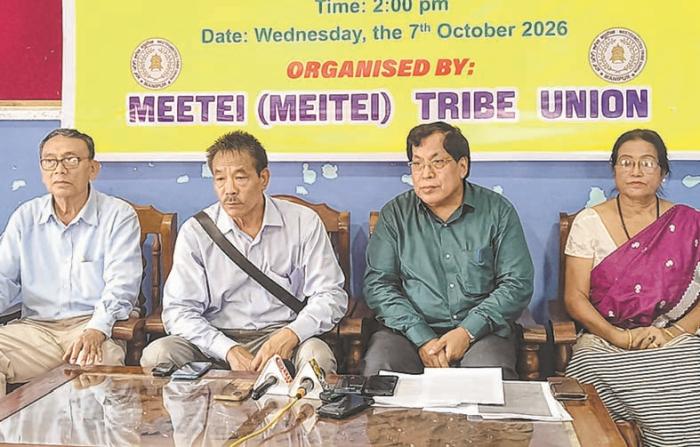
The Meetei (Meitei) Tribe Union (MMTU) has come out with a detailed report on the Kuki refugees scam of 1967 and how Kuki refugees manipulated, destroyed and misinterpreted official orders/documents.
Speaking to media persons at Manipur Press Club here today, MMTU Research and Development Cell chairman and former Acting VC, MU Prof K Jugindro said that Manipur was under President's Rule from October 25, 1967 to February 18, 1968 .
The Sangai Express had also published an article penned by the Professor detailing the manipulation of the orders/documents on October 6 .
Manipur was then a single-district Union Territory and Baleswar Prasad was the Chief Commissioner.
|
During the President's Rule, Kukis literally ruled the State at their fancy and whims.
Thangkhopao Kipgen was the Home Secretary and Paokai Haokip was the Member of Parliament (1967-77) .
Soon after PR was imposed in Manipur, around 300 Kuki chiefs created a ruckus at Imphal and all printed copies of the Manipur Hill Areas (Acquisition of Chiefs' Rights) Act 1967 which had been already published in Manipur Gazette on June 20, 1967 were burnt, Prof Jugindro said.
He said that the Act was primarily meant to abolish the hereditary chieftainship of Kukis and implementation of the MLR& LR Act 1960 in hill areas too.
A copy of the Manipur Hill Areas (Acquisition of Chiefs' Rights) Act 1967 was obtained from the National Archive recently.
The MMTU is currently working to see that the same Act is implemented, he said.
During the PR, a large number of Kukis belonging to 1500 families came to Manipur on the pretext that they were expelled by the Burmese Army.
After the Chief Commissioner informed about the Kuki refugees, the Home Minister sent a letter on March 20, 1968 instructing the Chief Commissioner to take necessary steps for permanent rehabilitation of 500 Kuki families.
The Home Ministry also sanctioned Rs 3,62,500 at the rate of Rs 735 per family for construction of houses and as assistance for agricultural works, Prof Jugindro said.
Subsequently, Deputy Commissioner SC Vaish rehabilitated all Kuki refugees in Churachandpur, Teng-noupal, Ukhrul and Sadar Hills (Kangpokpi), he said.
The Burma Kuki Refugee Association, Manipur wrote a letter to the Government of India on February 15, 1973 complaining that the amount sanctioned by the Home Ministry could not meet the requirements of the 1500 families.
State's Industry Minister Holkhomang Haokip and Member of Parliament Paokai Haokip went to Delhi and urged relevant Union Ministers to address the refugee association's complaint favourably, he said.
As a result of the efforts of the two Kuki politicians, a substantial amount was reflected in the Manipur budget for comprehensive rehabilitation of 1509 Kuki families.
Moreover, all Kuki immigrants from Burma were recognised as Scheduled Tribes.
They were also given land free of cost as well as agricultural loan, business loan and housing loan, Prof Jugindro said.
Further investigation revealed that the Kuki refugees came to Manipur in 1967 on the strength of a fake letter fabricated by some Kuki politicians in collusion with some staff of the Ministry of Rehabilitation.
The fake letter claimed that all people who came from Burma to Manipur through land routes will be taken as Burma repatriates, if they reported to the Police Department and each Burma repatriate family will be given business loans of Rs 5000 as well as Rs 2 lakh each every year as housing loan.
These claims were totally contradictory or inconsistent with what the Government of India notified.
The Government of India made it clear that all Burma repatriates should have come to India by air or sea routes after obtaining identification documents from the Indian Embassy based at Rangoon.
Moreover, as per the Government of India's rules, the maximum amount for housing loan entitled to Kuki refugees was Rs 2,250.Moreover, this loan was a one-time assistance, not a recurring one, Prof Jugindro said.
Using this fake letter, Kuki politicians lured a large number of Kukis from Burma to come to Manipur and settle here.
Some of the Kuki refugees who came to Manipur in 1967 wrote another letter to the Government of India in 1982 complaining that they did not get any assistance.
Then Manipur Forest Minister SL Paokhosei and MP Gouzagin (1980-84) went to New Delhi and exerted pressure upon the Government of India to address the Kuki refugees; complaint, Prof Jugindro said.
Later, the Rehabilitation Ministry made it clear that the 1967's letter was wrong and the Kuki refugees who came to Manipur in 1967 did not possess any document and as such they were not Burma repatriates.
The MMTU Research and Development Cell Chairman said that they have obtained proof of destruction of the fake letter purportedly issued in 1967 in 1974 .
He said that there are records of how much financial assistance were given to how many Kuki refugees till date.
All the Kukis who came to Manipur from Burma did not bring any identification document and as such they are not Burma repatriates, Prof Jugindro asserted.
Real Burma repatriates should be in possession of "Foreigner Registration Certificates" or "Emergency Certificates" issued by the Indian Embassy, Rangoon.
Without these documents, Burma repatriates could not be granted Indian citizenship.
Again, no ST certificate can be given to non-citizens, he asserted.
Granting Indian citizenship and giving ST certificates to the 1500 Kuki refugees who came to Manipur in 1967 was wrong from the legal perspective, Prof Jugindro said.
ST certificates given to the 1500 Kuki refugees and their descendents must be cancelled, Moreover, the Government must recover the lands and financial assistance given to them, he said.
He said that the Kukis who are now demanding a separate administration are those refugees who came to the State in 1967 .
He maintained that there will be peace and normalcy in Manipur if these refugees and their descendents are deported back.
Deportation of the refugees will also considerably minimise the obstacles to the path of updating the National Register of Citizens, he added.
 Comment

