
TODAY -


Scientific springshed management stressed
Source: The Sangai Express
Imphal, September 15 2026:
Even as the Directorate of Environment and Climate has mapped over 1,000 springs across Manipur, around 52 percent of it in the hills have either dried up or declining.
Drying up of springs threatens water security for local communities and reduces the perennial river or environmental flow (e-flow) .
Let alone Manipur (India), the Himalayan country of Bhutan, which is one of the few carbon negative countries, is also experiencing increasing pressure on its water sources.
A carbon negative country is one that absorbs more carbon-dioxide, a major greenhouse gas, than it releases.
|
Bhutan has a forest cover of 69.71%, yet the country's 25.1% (1,856) of water sources are drying up.
Springs account for 67.6 % (5,001) of the total water sources.
At 36.5%, climate change has been identified as the single largest cause drying up the water sources.
Like in Bhutan, springs are a major source of water for local communities in the hills in Manipur.
As in Bhutan, Manipur too is taking up measures and implementing springshed management initiatives to prevent its springs from drying up.
Both Bhutan and Manipur are implementing springshed management projects, yet a major difference is observed in the overall goals and objectives of the projects being implemented.
While the objective of the springshed management project in Bhutan is to conserve the springs as a source of water for direct use of the locals, the project being implemented in Manipur is to conserve the springs as a source of water for local use and also recharge streams and rivers as well.
Nandeibam Madhap (74), from Yumnam Patlou, Imphal East, said there were around nine springs in the hills, located behind the village, but all of them have dried up over the decades.
At least five of the nine springs in the area were abundant sources of water for irrigation and daily usage of the villages in the surrounding area.
Even during the dry season, the villagers were using the water from the springs to irrigate their fields with ease, Madhap said.
Now, the springs have dried up.
The villagers tried digging ponds in the mouths of the springs, but such efforts have been futile.
Felling of trees, declining rainfall-climate change in short-may have caused the springs to dry up, he added.
Manipur State Environment and Climate Change Department's Junior Research Officer, Yengkokpam Satyajit, said that the department in association with relevant departments and institutions and local communities have been implementing climate-resilient springshed management programmes since 2021 .
The goals of the climate-resilient springshed management project is to prevent springs from drying up, and recharge them to save rivers, he said.
The project has been implemented in several cluster villages of Ukhrul district, starting at Lunghar.
In 2025, the project was expanded and implemented at Hoomi village of the same district, he added.
Lunghar has four cluster villages, with one facing extreme shortage of water during dry seasons.
After the implementation of the climate-resilient springshed management project, the cluster is now getting water throughout the year, he said.
The same project is being implemented at Hoomi village, and is expected to bear positive results, he added.
About implementing the springshed management project, he said the first step is to make aware to the locals that springs are their source of water, their properties and responsibility.
The next step is identifying recharge zones and protecting them.
To protect the spring recharge zones, villages are encouraged to declare them as protected zones, and take it upon themselves to safeguard it from destruction, he said.
A crucial part of protecting the recharge zones is keeping them evergreen.
Afforestation of deep-rooted trees is done in such areas, and various structures including check dams, water harvesting structures, and staggered contour trenches are constructed to catch and retain surface/rainwater for recharging springs and underground aquifers, he said.
In Bhutan too a community-led springshed management project, adopting traditional and nature-based solutions, for water security is being implemented by the Tarayana Foundation, a civil society organisation.
The foundation launched a survey to identify springs in the country in 2021, and implemented the project in 2023 .
The springshed management project has so far benefited more than 350,000 people in 1,120 villages under 143 blocks.
According to a report published by Bhutan's Watershed Management Division, Department of Forests and Park Services, springs are the most prevalent type of water source accounting for 67.6% of the total sources.
The country has 5,001 identified springs.
Other sources of water in the country include 1,898 streams (25.7%), 200 marshes (2.7%), 168 ponds (2.3%), 81 rivers (1.1%), and 51 lakes (0.7%) .
Of the total 7,399 sources of water, 69 representing 0.9% have dried up, and as many as 1,856 (25.1%) are drying.
Degradation of forest and climate change have been identified as the largest factors responsible for the depleting water sources.
As per the report, some of the main factors responsible for the depleting water sources include climate change (36.5%), forest degradation and deforestation (28%), anthropogenic (7.3%), land use change (4.1%), overgrazing (3.4%) etc., and unknown cause (12%) .
Among the projects in Bhutan, the springshed management at the Barachhu spring site in Tsaluna village, located in Mewag Gewog, Thimphu, stands out.
At the Barachhu spring, the local community is very much involved in the springshed management.
A member of the local community said that the springs in the area were drying up before the Tarayana Foundation intervened and implemented efforts to revive and recharge the springs.
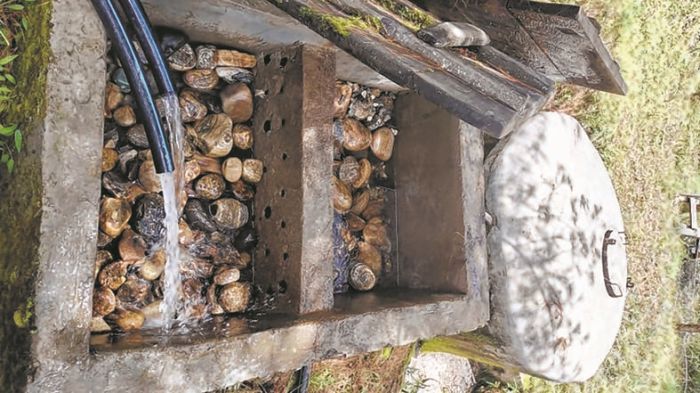
At the site, traditional methods are used to construct structures using bamboo, trees and gravel.
Trenches are dug at potential recharge areas to catch rainwater and allow it to seep underground easily and efficiently to recharge aquifers.
Gravel drainages are also constructed to collect and divert water to filtration systems, which use charcoal.
The filtered water is then channelled to storage tanks for use by the locals.
With the successful implementation of the springshed management with community involvement, the springs now have come to life.
Water is available throughout the year for daily usage and irrigation.
The revival of the springs has also saved and enhanced livelihoods of the villagers, said locals.
Even as springshed management projects have proven successful with active community participation, the challenges to the survival of springs as water source still remain large with climate change impacting rainfall, land-use patterns, and driving underground aquifers dry.
When springs dry up, the impact is not limited to villages.
It also affects wetlands, streams, rivers, forests, and the overall ecosystem .
According to NITI Aayog, nearly half of around 3 million springs in the Indian Himalayan Region have either dried up or become seasonal, raising concerns about long term water security for millions who depend on the water source.
Even as a widespread and intensified climate-resilient springshed management involving local community is highly needed, more innovative, traditional and scientific knowledge are still needed to address the challenges facing underground aquifers and springs.
 Comment
* Comments posted by users in this discussion thread and other parts of this site are opinions of the individuals posting them (whose user ID is displayed alongside) and not the views of e-pao.net. We strongly recommend that users exercise responsibility, sensitivity and caution over language while writing your opinions which will be seen and read by other users. Please read a complete Guideline on using comments on this website.


HEADLINES - 16, SEP 2026
SPORTS - 16, SEP 2026
LATEST IN E-PAO.NET
Jump Start
DBS Imphal SubSite |
Readers Mail |
Editorials |
Education Announcements |
Essay |
Exclusive Event |
Flash - Audio Visual |
Incidents |
LFS Imphal SubSite |
News Timeline |
Poetry |
Opinion |
Sports |
Rock Concert |
RSS |
Top Stories |
Wathi Jugai