


Swachh Survekshan: 'Most Promising Town' award for Jiri
Source: Chronicle News Service
Imphal, July 17 2025:
Jiribam Municipal Council has been conferred the "Most Promising Town" award in the Swachh Survekshan 2024-25, emerging as the top-ranked town among 21 small towns in the North Eastern Region and securing the 174th position nationally out of 2,035 towns in its category.
The award ceremony, hosted by the Ministry of Housing and Urban Affairs (MoHUA) at Vigyan Bhawan, New Delhi, was attended by President Droupadi Murmu and Union Housing & Urban Affairs minister Manohar Lal Khattar.
A total of 23 "Super Swachh League" cities were felicitated during the event, apart from Swachh Shehar (Clean City) with top honours in five population categories awarded to cities including Ahmedabad, Mira-Bhayandar, Dewas, Panaji and Bilha.
|
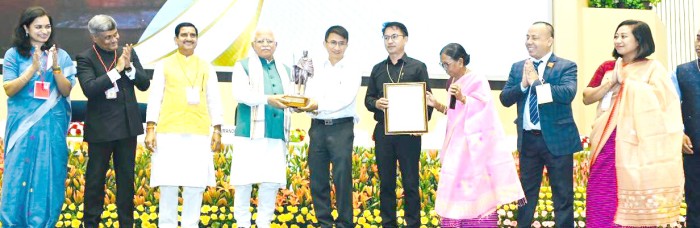
According to a statement issued by MAHUD Department, Jiribam Municipal Council has also achieved the 'Garbage Free City' (GFC) 3 Star certification and ODF++ status from the Ministry, marking a significant milestone in Manipur's efforts towards clean and sustainable urban living.
A state delegation comprising principal secretary (MAHUD) RK Dinesh Singh, director Ngangom Uttam Singh, Jiribam Municipal Council chairperson S Shanti Devi, and executive officer Moirangthem Surjit received the award on behalf of the state.
The team later took part in a high-level brainstorming session chaired by the Union minister to review centrally sponsored schemes.
The session focused on expediting implementation, ensuring outcome-based monitoring and encouraging innovation in sanitation and housing.
According to the statement, Jiribam's success underscores the commitment of the state government, municipal staff, and residents towards advancing cleanliness and public health.
In the Manipur-specific rankings, Jiribam (national rank 174) was followed by Moirang (1,063), Nambol (1,079), Imphal (617), and Mayang Imphal (1,186), among others.
The national ranking is based on their respective population category.
MAHUD extended congratulations to the people of Jiribam and reaffirmed its resolve to replicate such achievements across other ULBs in Manipur under the Swachh Bharat Mission (SBM) 2.0 framework.
The "City Report Card" under Swachh Survekshan 2024-2025 offers further insight into the com parative performance of urban local bodies.
For the state, Jiribam Municipal Council recorded 93 per cent in door-to-door waste collection, 75 per cent in source segregation, and 97 per cent in waste processing against generation.
While no progress was reported in dumpsite remediation, the Council achieved 100 per cent in cleanliness of residential areas, market areas, and water bodies, with 50 per cent cleanliness in public toilets.
In contrast, Imphal Municipal Corporation reported just 5 per cent door-to-door waste collection and 45 per cent source segregation.
Waste processing stood at 79 per cent of the total generated, with 0 per cent remediation of dumpsites.
Cleanliness indicators for residential and market areas both stood at 50 per cent, while water bodies scored 100 per cent and public toilets recorded a low 17 per cent cleanliness rating.
The 9th edition of the world's largest urban cleanliness survey - Swachh Survekshan 2024-25 - has been designed to be 'simpler, sharper, systematic and inclusive' .
The survey introduced a separate matrix of indicators for evaluating cities based on population, with simplified indicators grouped into 10 key sections.
New additions include the "Super Swachh League", fresh indicators for project grounding and CTU transformation, as well as focused assessments for tourist and high-footfall areas.
A school-level assessment component has also been introduced, and penalties are now in place for inaccurate data and false claims.
The 10 parameters used for evaluation include visible cleanliness; segregation collection and transportation of waste; solid waste management; access to sanitation used water management mechanisation of desludging services; advocacy for Swachhta; ecosystem strengthening and institutional parameters overall welfare of sanitation workers; and citizen feedback and grievance redressal.
The 2024-25 survey used 54 distinct indicators across the 10 parameters to assess overall performance.
 Comment

