
TODAY -


Declining salamander population in Ukhrul alarms environmentalists
Source: The Sangai Express / Mungchan Zimik
Ukhrul, September 15 2026:
The population of the "orange salamanders", known as Lengva in Tangkhul dialect, has declined sharply in Ukhrul raising serious concern among environmentalists.
The salamanders, Tylototriton verrucosus, are amphibians that resemble lizards.
Once found abundantly in villages in Ukhrul including Hunphun, the population of this amphibian is declining.
Although the exact cause of the decline in the salamander population is yet to be studied, environmentalists expressed that diminishing damp and marshy land due to rampant deforestation and erratic rainfall patterns may be driving the decline.
|
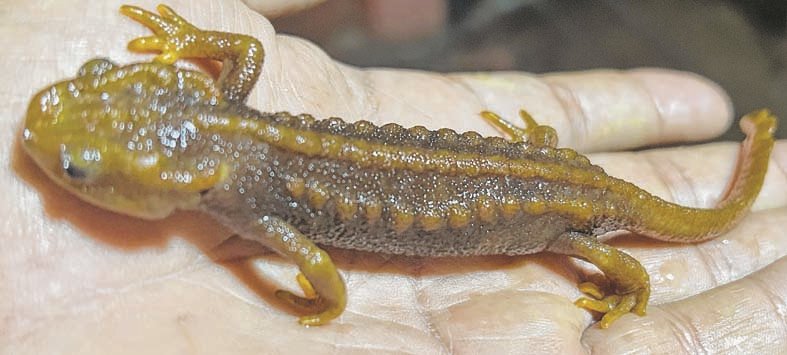
Salamanders (specifically Himalayan newts) thrive in cool, temperate climates with significant rainfall from May to October.
Its habitats include mountain forests, rocky ponds, and marshy land with vegetation.
Salamanders hibernate during the winter season and breed during the rainy season.
The breeding cycle starts with the monsoon's first rains triggering their movement to water for mating and egg-laying in May-June.
They usually lay eggs during May-June in rock ponds that have aquatic vegetation.
The low-pitched "matting call" of the salamanders "twak-twak-twak" during the monsoon is hardly heard now, said 75-year-old Zingthanla Zimik, a resident of Ukhrul village.
A couple of decades ago, the salamanders were abundantly found in Kazar, Muiyi, Pahei, Tuira areas of Ukhrul and in the peripheries of Halang, Shirui and Shimtang, she said, recalling that there were many marshy land with rich vegetation back then.
Increasing construction of roads, buildings and other structures may have destroyed their habitats, she added.
Ersi Jajo, Associate Professor at Pettigrew College, Ukhrul, observed that the rapid decline of the salamander population in Ukhrul may have been driven by increasing local temperature and human consumption for medical treatment such as cancer or palliative disease although such beliefs have not been proved medically or scientifically.
The colour of salamanders are different, depending on the environment and their habitat, Ersi said.
She said the salamander is a cold blooded animal.
Conserving the salamander requires scientific study of the species and its habitat.
While the salamander population is declining in Ukhrul, in a positive step, the Directorate of Environment and Climate Change is taking up efforts to conserve the endangered "Himalayan Newt" at Zaimeng lake, under Kangpokpi district.
Replicating the conservation project in Ukhrul may help heal the habitat and bring back the salamander.
(This article was written under a joint initiative of the Ukhrul District Working Journalists Association (UDWJA) and the Directorate of Environment and Climate Change Govt of Manipur) .
 Comment
* Comments posted by users in this discussion thread and other parts of this site are opinions of the individuals posting them (whose user ID is displayed alongside) and not the views of e-pao.net. We strongly recommend that users exercise responsibility, sensitivity and caution over language while writing your opinions which will be seen and read by other users. Please read a complete Guideline on using comments on this website.


HEADLINES - 16, SEP 2026
SPORTS - 16, SEP 2026
LATEST IN E-PAO.NET
Jump Start
DBS Imphal SubSite |
Readers Mail |
Editorials |
Education Announcements |
Essay |
Exclusive Event |
Flash - Audio Visual |
Incidents |
LFS Imphal SubSite |
News Timeline |
Poetry |
Opinion |
Sports |
Rock Concert |
RSS |
Top Stories |
Wathi Jugai