


Source: The Sangai Express
Imphal, June 25 2009:
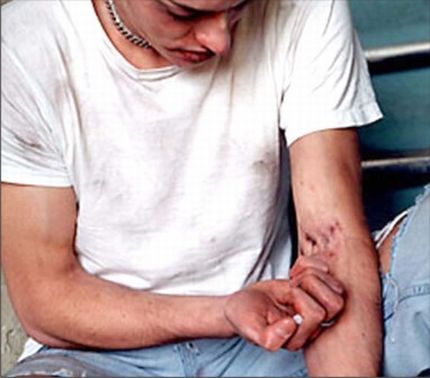
Although male injecting drug users (IDUs) in Northeastern India are more aware of HIV/AIDS and have better intervention coverage than their counterparts in northwestern part, they continue to share contaminated injecting equipments, thus exposing themselves to higher level of associated risks, according to a new study report.
A report of the study on 'HIV vulnerability among IDUs, their spouses and children' conducted by Society for Promotion of Youth and Masses (SPYM), New Delhi in partnership with NGOs in Chandigarh, Imphal, Jammu, Kohima and Patiala with technical support from National Drug Dependence Treatment Centre and All India Institute of Medical Sciences (AIIMS), New Delhi pointed out that IDUs are at risk of HIV transmission not only because of sharing injecting equipments but also on account of their sexually risky behaviour.
|
However, the risk of transmission of HIV from IDUs to their spouses through sexual route has been a relatively under-researched area in India and the impact of injecting drug use by the husband on the wife and their children has not been a subject of scientific enquiry in the country.
The study report which was released during a function at the conference hall of State Youth Centre at Khuman Lampak here on June 23 hence has been hailed as the first of its kind in identifying the risk factors and vulnerability of IDUs, their spouses and children to drug use related HIV/AIDS not only in Northeast but also in other parts of the country.
Presenting the report funded by Plan International, India with, Associate Professor Dr Atul Ambekar of AIIMS who is one of the key persons behind the report, observed that the contribution of sexual route of HIV transmission among and from the drug users has often been ignored despite that fact that many IDUs are also sexually active and have both kinds of partners, sex workers as well as their regular partners.
Thus, most of the groups regarded as high risk may be linked or even overlapped with each other and spread of HIV infection among IDUs eventually reach the general population of community, contributing to the generalisation of the epidemic.
According to the report risk of HIV transmission from IDUs to their wives is high in India as many IDUs tend to be married and stay with wives and women's economic dependence on men increases their vulnerability to the infection by constraining their ability to negotiate safer sexual practices.
Comparing the sexual behaviour of male IDUs in northeast and northwest, the report noted that although the age of sexual initiation was almost same in both regions, as was the prevalence of having had sex with multiple partners, there is a stark difference, however, in the type of sexual partners with a much higher proportion in the northwest reportedly having had sex with CSWs as well as men/hijra as compared to the northeast.
On condom usage pattern, the report said more IDUs from northeast reported condom use with their sex partners whether they be wife or CSW.
However, at both the region, rates of condom use with wives were much lower as compared to rate of condom use with CSWs.
Similarly, condom use on the last occasion of sex irrespective of the partner was also much higher in the northeast, indicating more awareness of safe practices.
MLA Ng Bijoy, Project Director of MACS Dr Pramodkumar and representative of Plan International, India Dr Gyanen also present at the occasion of releasing the report.
 Comment

