


Bringing the tale of indigenous game Yubi Lakpi
Small but significant steps taken to preserve game
Source: The Sangai Express
Imphal, July 09 2025:
A number of indigenous games and sports, deeply rooted in the Manipuri culture and heritage have vanished over the years.
Ignored for long, "Yubi Lakpi" too may soon meet its demise, creating a void that would obscure a piece of the State's rich culture and history.
"Yubi Lakpi" literally translates to "coconut snatching".
"Yubi" translates to "coconut" and "Lakpi" means "snatching" .
Closely related to "Sarit Sarak" - a form of Manipuri traditional martial arts, "Yubi Lakpi" is believed to have started during the 5th century.
Experts believe that this outdoor sport started during the reign of Ningthouja King Sameirang.
|
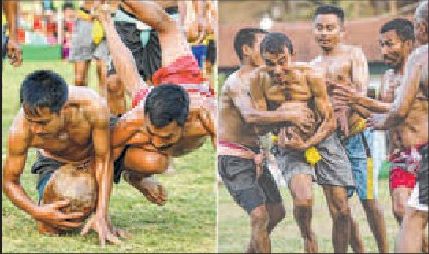
The sport was earlier called "Lu (Kok) Lakpa" or "Kangdrum Lakpa" .
Players used "Kangdrum"--a carved rounded root of bamboo or a round object.
After the introduction of coconut during the reign of Chandrakirti Maharaja (1831-1886), the sport came to be known as "Yubi Lakpi" .
The sport has no defined number of players.
The coconut to be used is soaked in oil to make it slippery and difficult to hold.
The players aren't allowed to wear shirts, and oil is also applied on their bodies from the neck down.
The play starts with the King throwing the coconut among the players on the field.
Each player attempts to hold the coconut and place it before the King or dignitary at one end of the field to win rewards.
When no individual player is able to win the coconut and place it before the King, then the coconut will be placed at a far end of the field and the individual players will compete in a race to touch it.
Whoever touches the coconut first is declared the winner and given rewards.
No player is allowed to directly push other players.
Players can only tackle the individual carrying the coconut, and these tackles often involve skills related to Mukna-a traditional wrestling sport.
Punching, kicking, passing the coconut and dangerous tackles are prohibited.
No player is allowed to have long nails, wear metal ornaments.
The sport is considered an intense physical, mental and wrestling skill test.
While the sport is hardly organised widely, it sometimes features as exhibition matches during the Sangai Festival.
To promote the sport, Chingdompok Ideal Top Youth (CITY) Club, Heirok organises Yubi Lakpi every year on "Sajibu Nongma Panba Cheiraoba".
Speaking to The Sangai Express, the club's secretary, Maibam Khendu Meitei said the elders started organising Yubi Lakpi on Cheiraoba in 1972 .
To promote the sport and carry on this legacy, the club included it in its calendar and hence has been holding the sport every year on Cheiraoba day, he said.
The club organises Yubi Lakpi every year with the objective of promoting the sport and preserve.
It also serves as a platform where younger generations could learn about the indigenous sport and participate in it, Khendu said.
"Our youths, mostly from the younger generations, have shown great interest in Yubi Lakpi.
The number of participants has grown over the years," Khendu said.
This year, Yubi Lakpi was organised at district level.
The club is planning to expand and hold the sport in a grander way in the future, he added.
"Besides Yubi Lakpi, there are other indigenous games and sports which have been ignored.
The indigenous games and sports like Yubi Lakpi are our cultural and historical treasure.
All indigenous games and sports must be preserved and promoted at all levels," Khendu said.
Khendu, however, asserted that the preservation and promotion of the indigenous games and sports "depend on us" .
"Preservation and promotion of the indigenous games and sports must start with us.
If not us, nobody will come and promote our games and sports.
We must be actively engage in the sports to promote them", Khendu said.
The Government too has an important role.
It must make policies and take steps to revive and promote the indigenous games and sports, he added.
Assistant Professor N Sanatomba, of Manipuri Department, Manipur University, said Yubi Lakpi as a sport has declined over the years.
Believed to have started as "Lu Lakpa" during the time of ancient Manipur ruler Sameirang, Yubi Lakpi is purely indigenous to Manipur, said the Professor.
The majority of the new generations now haven't seen Yubi Lakpi, and is a clear sign that this sport is declining, he said.
"Our indigenous games and sports like Yubi Lakpi are our treasure.
It is very unfortunate that these cultural treasures are fading away slowly due to our sheer negligence and lack of efforts to promote them," Sanatomba said.
The Government must intervene and take serious steps to preserve the indigenous games and sports, he said.
"Someday, in the near future, these indigenous sports may vanish and the future generations would hear only words about them.
The Government must formulate proper policies to preserve and promote the sports," Sanatomba said.
Saving Yubi Lakpi and other indigenous games and sports would help "save our culture and identity", he added.
 Comment

