
TODAY -


World's Indigenous Peoples Day observed fittingly
Need for Constitutional protection of Meiteis stressed
Source: The Sangai Express
Imphal, August 09 2026:
The International Day of the World's Indigenous Peoples was observed across Manipur on different themes and with a renewed push for Constitutional protection for indigenous communities.
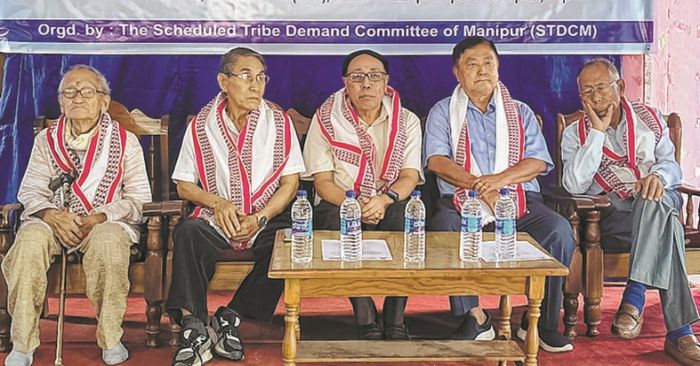
The Scheduled Tribe Demand Committee, Manipur (STDCM) observed the day under the theme 'The fate of Indigenous Meitei/Meetei Tribe of Manipur" at the Youth Hostel, Khuman Lampak Sports Complex.
Speaking on the occasion, STDCM general secretary K Bhogendrajit said the Meitei is the only indigenous community in Manipur which has not been given the ST status.
|
When other indigenous communities have been recognised as Scheduled Tribes, the Meiteis have not been given this Constitutional status and protection, he said.
Recognising the Meitei community as a Scheduled Tribe would grant it protection and help preserve and promote the indigenous identity, culture and tradition.
The demand for ST status is legitimate, and getting the status is crucial for the survival of the community, he added.
As the State is in the midst of violent conflicts, the committee is giving priority to efforts to restore normalcy and peace.
The STDCM's democratic demand for ST status has however not changed, he said.
Retired Professor Dr Thounaojam Ratankumar; RIMS' retired MS Dr Yanglem Mohen; STDCM chief patron Moirangthem Naodalenkhomba; STDCM advisor retired Professor Huidrom Jayantakumar; STDCM working president Lt Col Lokendra and MU Law Department's Assistant Professor Dr Sapam Dilip attended the observance.
On the theme "Honouring Indigenous Midwives: Safeguarding Life, Health and Our Environment", the "International Day of the World's Indigenous Peoples 2026" was also observed at DMC Arts Auditorium, Imphal.
The event was jointly organised by the Yelhoumee Phurup (YP), in collaboration with Manipur International Youth Centre (MIYC), People's Progressive Alliance Manipur (PPAM), United Zeliangrongpui Coordination Committee (UZCC), Rongmei Naga Council Manipur (RNCM), Zeliangrong Union (AMN), Kabui Mothers' Association Manipur (KAMA), and Research Club, Dhanamanjuri University.
The programme highlighted the indispensable role of indigenous midwives and traditional caregivers-including Mayok Maibi, Chabok Maibi, Chabokpi, and traditional caregivers among the Meiteis, the Nagas and other communities-as custodians of knowledge linking healthcare, culture, spirituality and the environment.
Their knowledge, transmitted across generations, represents a living system of care that has sustained mothers, children and communities even in remote areas where access to formal healthcare remains limited, reaffirmed the observance.
The gathering stressed that indigenous midwifery should not be treated as a relic of the past.
In many remote and difficult-to-access areas, traditional caregivers remain the first hands, first voices and first guardians of maternal and community health.
Their knowledge of traditional medicines, local healing practices, childbirth, postpartum care and reproductive health constitutes an important body of community knowledge deserving recognition, protection and responsible integration with modern healthcare.
The programme also drew attention to the wider socio-ecological crisis confronting Manipur--deforestation, biodiversity loss, water scarcity, degradation of forests and watersheds, expansion of poppy cultivation and weakening of traditional sustainable practices--which are placing increasing pressure on the land and on community well-being.
The gathering called for stronger protection of indigenous land and forest rights and for Free, Prior and Informed Consent (FPIC) of indigenous communities before major land-use conversions.
The organisers called for integration of indigenous midwives into formal healthcare systems through mutual recognition, sanitation support, emergency training and communication facilities.
They call for strengthening emergency maternal transport and peripheral healthcare so that geographical isolation does not endanger mothers and newborns.
The organisers also called for revival of safe traditional practices, including organic farming, natural food production and responsible community health traditions.
Indigenous knowledge must be documented and integrated into education and research so that endangered cultural practices are not lost, they said.
They also called for building a self-sustaining local economy based on organic production, natural resources, traditional skills, handloom, handicrafts and community-based industries.
Professor Ch Sheelaramani, former Dean, School of Humanities, Dhanamanjuri University and Principal DM College of Arts; Professor Th Rabikanta Singh, Dean of Students' Welfare, Dhanamanjuri University; and Dr L Phaomei, president, Yelhoumee Phurup attended the event.
 Comment
* Comments posted by users in this discussion thread and other parts of this site are opinions of the individuals posting them (whose user ID is displayed alongside) and not the views of e-pao.net. We strongly recommend that users exercise responsibility, sensitivity and caution over language while writing your opinions which will be seen and read by other users. Please read a complete Guideline on using comments on this website.


HEADLINES - 10, AUG 2026
SPORTS - 10, AUG 2026
LATEST IN E-PAO.NET
Jump Start
DBS Imphal SubSite |
Readers Mail |
Editorials |
Education Announcements |
Essay |
Exclusive Event |
Flash - Audio Visual |
Incidents |
LFS Imphal SubSite |
News Timeline |
Poetry |
Opinion |
Sports |
Rock Concert |
RSS |
Top Stories |
Wathi Jugai