
TODAY -


GSI report confirms rich mineral deposits in state
Source: Chronicle News Service
Imphal, July 13 2025:
Long known for its hydrocarbon reserves, the northeast region is rapidly becoming a focal point in the country's strategic shift toward critical minerals exploration, with at least three states showing major potentials for Rare Earth Elements (REE) and vanadium.
The Geological Survey of India (GSI), under its intensified survey and exploration programmes, has identified significant deposits of rare earth elements (REE), vanadium, nickel, cobalt, and chromium in the region, aimed at supporting India's clean energy transition, high-tech manufacturing, and mineral self-reliance.
|
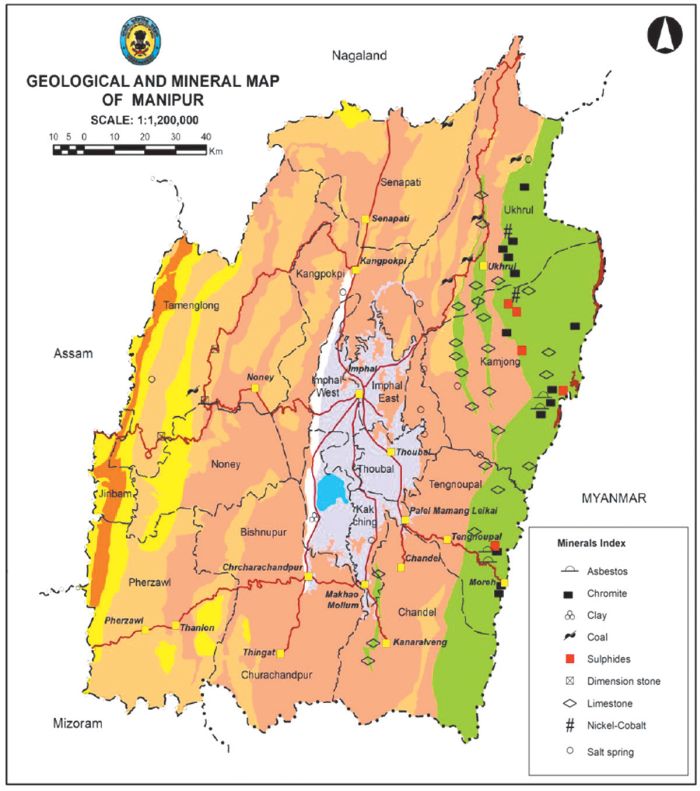
As per a report published by GSI in June this year, Manipur is showing potential with its unique geological setting nestled in the Indo-Myanmar Range.
Dominated by sedimentary sequences such as the Eocene-aged Disang Group and the Oligocene-aged Barail Group, the state presents vast potential for metallic and industrial mineral exploration.
These flysch-type formations - comprising splintery shales, greywacke, sandstones, and conglomerates - span much of central and western Manipur, indicating a prolonged sedimentary basin environment favourable for resource accumulation.
However, it is the eastern frontier that holds the most strategic interest for the state.
Here, Jurassic-Cretaceous Ophiolite Suites, which are remnants of ancient oceanic crust tectonically uplifted onto the continental margin, form the backbone of the state's critical mineral potential.
These ophiolitic belts, stretching across Ukhrul, Kamjong, Tengnoupal, and Chandel districts, have been identified by GSI as a "Chromium, Nickel-Cobalt, and Platinum Group Elements (Ni-Cr-PGE) Potential Belt".
The area is marked by clustered occurrences of podiform chromite and serpentinised peridotite that host significant deposits of chromium, nickel, and cobalt.
GSI reports indicate a reserve of 1360 million tonnes of refractory and metallurgical grade chromite in Manipur, positioning it as one of the most promising sites for chromium in the country.
These ultramafic rocks are also associated with platinum group elements (PGE), particularly in podiform chromitites.
Studies suggest that the PGE content in such subduction zone ophiolites can exceed primitive mantle concentrations due to post-melting fluid interactions, underscoring their strategic value.
To better understand these resources, GSI has launched detailed geochemical surveys and petrographic studies targeting nickel and cobalt enrichment in the state's ophiolite complexes.
These initiatives are part of the broader Critical Mineral Assessment Programme (CMAP), which is also evaluating Manipur's lateritic profiles for potential REE, nickel, and cobalt content.
Manipur's mineral portfolio extends beyond critical metals.
Cement-grade limestone reserves of over 69 million tonnes have been identified in Ukhrul, Chandel, and Tengnoupal districts, although these deposits are less extensive than in neighbouring Meghalaya.
A substantial 7,500 million tonnes of serpentinite, commercially marketed as "Green Marble", occurs throughout the eastern ophiolite belt, offering potential as a dimensional stone.
Other recorded resources include clay and lignite deposits in Kangvai valley, base metal and copper occurrences in tertiary sediments, and an isolated find of titanium-vanadium-magnetite (TVM) in the state's southern zone.
The potential for decorative stones in ophiolite-derived formations also presents future opportunities for mining and export.
In Nagaland, the adjoining ophiolite terrains share similar prospects, though the scale of exploration remains modest in comparison.
The state's geology is being surveyed for nickel and cobalt under NMET-funded projects, with reconnaissance and G3-stage exploration currently underway.
A Geological Memorandum block at Mollen-Washelo in Meluri has been identified for auction, signalling early-stage interest in systematic development of nickel, cobalt, and chromium resources.
Nagaland also possesses known reserves of coal and limestone, which continue to support the state's mineral economy.
Beyond the two states, the entire Northeast region is emerging as a hotspot for rare earth elements and vanadium, two minerals deemed critical for high-tech industries and clean energy.
Arunachal Pradesh has taken the lead with the discovery of India's first significant vanadium resource totalling 13.79 million tonnes.
In Papum Pare district, the Lodoso area has yielded a REE-bearing ferruginous phyllite deposit with a resource estimate of 2.15 million tonnes at 1.08 percent total REE, including high concentrations of neodymium exceeding 2,000 parts per million.
Assam's Karbi Anglong district is another promising area.
The Jashora and Samchampi alkaline complexes have demonstrated REE concentrations between 1,000 and 5,000 ppm from pedo-geochemical surveys.
The Jashora complex alone has a G3-level estimated resource of 28.64 million tonnes of REE, which is now being upgraded to G2-level in preparation for commercial auction.
Additional prospects have been identified within the Assam Meghalaya Gneissic Complex, including REE and rare metal potential in granite gneisses.
In Meghalaya, the Sung Valley ultramafic-alkaline-carbonatite complex has shown high REE concentrations in lateritic bauxite caps, with total REE values ranging from 3,646 to 5,100 ppm.
These figures align with economically viable thresholds used in other tropical countries for laterite-hosted REE extraction, suggesting Strong commercial potential.
Looking ahead, the GSI's exploration strategy under CMAP and the Regional Mineral Targeting initiative is shifting toward resource estimation and auction-readiness of critical mineral blocks.
A multi-year roadmap beginning in Field Season 2025-26 will prioritise REE-enriched alkaline and carbonatite complexes, pilot studies on laterite-hosted and placer-hosted critical minerals in Manipur, Nagaland, and Tripura, and integration of remote sensing and aero-geophysical data for underexplored terrains.
As part of this effort, the GSI plans to launch an Aero-Geophysical Mapping Programme covering inaccessible parts of Arunachal Pradesh, Nagaland, Mizoram, and Manipur.
The programme is expected to detect buried structures, lithological contacts, and magnetic anomalies to aid in subsurface mineral targeting.
Concurrently, geochemical and geophysical atlases are under preparation to support future exploration decisions and investment.
 Comment
* Comments posted by users in this discussion thread and other parts of this site are opinions of the individuals posting them (whose user ID is displayed alongside) and not the views of e-pao.net. We strongly recommend that users exercise responsibility, sensitivity and caution over language while writing your opinions which will be seen and read by other users. Please read a complete Guideline on using comments on this website.


HEADLINES - 14, JUL 2025
SPORTS - 14, JUL 2025
LATEST IN E-PAO.NET
Jump Start
DBS Imphal SubSite |
Readers Mail |
Editorials |
Education Announcements |
Essay |
Exclusive Event |
Flash - Audio Visual |
Incidents |
LFS Imphal SubSite |
News Timeline |
Poetry |
Opinion |
Sports |
Rock Concert |
RSS |
Top Stories |
Wathi Jugai