


Rising temperatures posing serious threat to reproductive health
Source: Chronicle News Service / Nongmaithem Debarani Devi
Imphal, July 13 2025:
As the sun beats down on the hills and valley of Manipur, women in the state are facing a deepening crisis that is seldom mentioned - the impacts of climate change on reproductive health.
Climate change is no longer limited to the melting glaciers or rising sea level but is now having physical effects on women including missed periods, high-risk pregnancies, and limited access to care services.
Manipur has over 30 lakhs people, with more than 75 per cent of the population living in villages and farmers accounting for almost 60 per cent of the population.
In Manipur, people's health and the economy are intimately tied to its ecology.
|
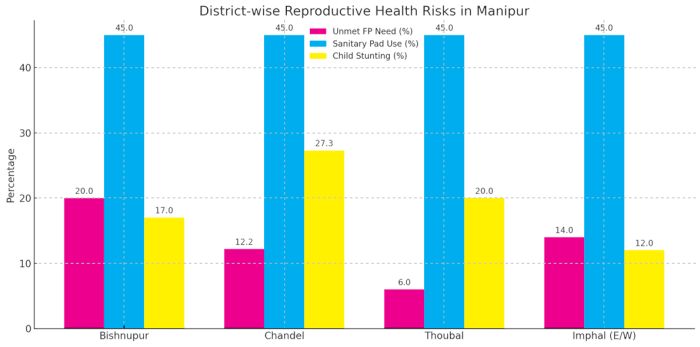
An increase in the temperature, erratic monsoons, flash floods and droughts have implications for agriculture production in the state, while also affecting women's health in various ways.
According to the Manipur State Action Plan on Climate Change (2022), summer temperatures increased by 0.4 degree Celsius and winter minimums by 0.75°C over the last 30 years in the state.
Rainfall patterns are also continuously changing.
The impact of the extreme weather events has led to seasonal flooding as well as water shortage in the lean sea sons.
Manipur has been affected by several major flooding events and landslides between 2010 and 2025.These events have affected health systems and services for women since 2023 .
The flooding in Bishnupur alone caused service delivery disruptions to over 40 sanitation facilities and 15 health sub-centres.
There were many pregnant women in that area who were cut off from reaching hospitals, and several women reportedly have had home births without a skilled midwifery present.
Health workers have also noted an increase in infections, anaemia, and postpartum complications.
Health reports following the drought-like situation in 2022, observed a 20 per cent increase in reproductive tract infections.
A 2021 NGO study found that only 45 per cent of rural women in Manipur use commercial sanitary pads National Family Health Survey, 2019-21 or NFHS-5), while others use cloth or other makeshift arrangements, and sometimes reuse them without washing, thereby increasing the risks of infection.
As such, in an effort to tackle menstruation with a policy response, the Chief Minister's Menstrual Hygiene Scheme (CMMHS) was launched in 2022, under which 323,292 sanitary pads were distributed and 38 sanitary vending machines purchased for installation at schools.
However, the stigma remains deep in the bones.
A 2020 report by UNICEF disclosed that all pre-pubescent and adolescent girls in Manipur had never received formal education around menstruation.
In most tribes, women are still barred from kitchens, temples, and public spaces while menstruating.
However, the health risks posed by climate change do not stop at menstruation.
The Indian Council of Medical Research (ICMR) indicated that high heat during pregnancy can exacerbate the chances of preterm, stillbirths, and low birth weight.
Nationally, in India, there was an average of six pregnancy heat-risk days, also known as days that the pregnant person may be at risk based on heat from 2020-2024.Of these heat-risk days, one-third specifically relates to situations associated with extreme weather events.
In Manipur, the Maternal Mortality Ratio (MMR) stood at 243 per 100,000 live births (more than double the national average of 97), which clearly presents a stated threat.
While skilled birth attendance is inconsistent, particularly in hilly areas where rains and damage hinder access to roads, access to hospitals can be impossible for days during floods or landslides.
Similarly, fertility is precarious.
Health experts have recognised that heat stress and pollution, exacerbated by extreme and unpredictable weather events, can cause infertility.
National rates suggest that 14-16 per cent of eligible couples are confronted with impaired access to conception.
While the Total Fertility Rate (TFR) in Manipur is 2.2, which is at replacement level with the national average, the climate and nutritional stress either side of TFR threshold have implications for individuals and family units in accessing fertility and obstetric care.
Programmes like Reproductive, Maternal, Newborn, Child & Adolescent Health (RMNCH+A) and initiatives by the state's Family Welfare Directorate are in place to bolster maternal outcomes.
The state continues to maintain a ratio of 960 girls born for every 1,000 boys (CRS 2022) .
However, these improvements may be at risk.
During disaster response, supply chains for sanitary pads and contraceptives are disrupted, post-disaster response in terms of relief camps lacks privacy, and healthcare workers struggle to mobilise to their work in impacted villages.
Experts have stated that the time to climate-proof the health system is of utmost urgency.
This involves strengthening primary health centres, sustaining water access, providing mobile clinics in disaster-hit or prone areas, and making sure menstrual health is considered to be part of disaster preparedness.
First responders including ASHAs and ANMs need to be trained, so that they are able to identify and respond to the reproductive health and birth risks induced by climate change.
Early warning systems must prioritise pregnant women and adolescent girls.
Access to clean energy can also help.
Many rural households still depend on biomass fuels, primarily for cooking fuels.
Inhalation of smoke from biomass fuels will have major implications for maternal and neonatal health.
Having access to liquefied petroleum gas (LPG) and clean cooking technology can significantly reduce maternal and neonatal health implications.
In addition, good menstrual waste management, using products that can be composted and good disposal practices can reduce health and environmental implications.
India has reduced the maternal mortality rate from 167 (2011-2013) to 97 (2018-2020).However, rural maternal health success is likely to be increasingly threatened by weather events, associated with climate change in a poorly supported geographical region like Manipur, The state is now at a crossroad, existing with ecological vulnerability as well as public health vulnerability.
The link between climate change and reproductive health is no longer theoretical but unravelling in real time, whether it is witnessed through water-scarce villages, in flood-ravaged hospitals, or in overworked health workers' reports.
Protecting women's health requires urgent, gender-sensitive, and localised responses.
Only then can Manipur and India build climate resilience that includes its women and girls.
(The report is filed under the 5th Media Fellowship Programme on Climate Change Reporting under the sponsorship of Directorate of Environment and Climate Change, Government of Manipur) .
 Comment

