


Drastic impact of climate change on Manipur
Temperature rise tied to spike in Dengue cases down the years
Source: The Sangai Express / Moirangthem Khagemba
Imphal, May 24 2026:
Climate change has emerged as one of the most serious environmental and public health challenges across the world.
Among its many impacts, rising temperatures have created favourable conditions for the spread of mosquito-borne diseases such as Dengue, Malaria, and Japanese Encephalitis.
Manipur is no exception, as the State has witnessed a rapid increase in Dengue cases in recent years, with 2025 reporting the highest number of cases at 5,519.For 2026 the datum is yet to be finalised.
According to data available from the Indian Meteorological Department (IMD), temperatures in Manipur reached as high as 38 degree C during June and July last year.
|
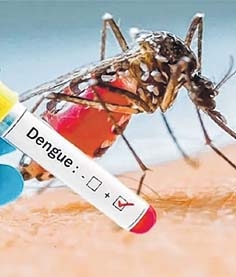
Experts pointed out that rising temperatures contribute to increased mosquito breeding.
Concerningly, this month (May 2026) has also witnessed high temperatures, with Noney recording 35.58 degree C during the period from 7 pm on May 21 to 6 pm on May 22, according to the Directorate of Environment and Climate Change.
During the same period, high temperatures were also recorded in several other districts, including Bishnupur (33.52 degree C), Churachandpur (33.71 degree C), Imphal East (35.03 degree C), Imphal West (32.75 degree C), Kakching (33.56 degree C), Kangpokpi (33.28 degree C), Senapati (30.51 degree C), Tamenglong (28.01 degree C), Tengnoupal (27.07 degree C), and Ukhrul (27.02 degree C) .
Chaotombi (50), a resident of Palace Compound, stated that a large number of people from the locality suffered from Dengue last year.
She said that in many families, all members tested positive for the vector borne disease, expressing concern that a similar situation might occur again this year.
Speaking to The Sangai Express, Dr Ngangom Surjalata, an entomologist at National Vector Borne Diseases Control Programme Manipur (NVBDCPM), said that rising temperatures contribute to increased mosquito breeding and spread of diseases such as Dengue, Malaria and Japanese Encephalitis.
To prevent these mosquito-borne diseases, she urged people to remove stagnant water from their households and surrounding areas.
She said that mosquitoes mostly breed in stagnant water collected in places such as unused tyres, open containers, trays at the back of refrigerators, and other objects that can store water but are often overlooked.
As per the report of the National Centre for Vector Borne Disease Control Programme, Manipur reported 203 Dengue cases in 2021, 504 cases and two deaths in 2022, 2,548 cases in 2023, 2,463 cases and five deaths in 2024, and 5,519 cases and one death in 2025 .
The figures show a disturbing upward trend in Dengue cases over the period.
|
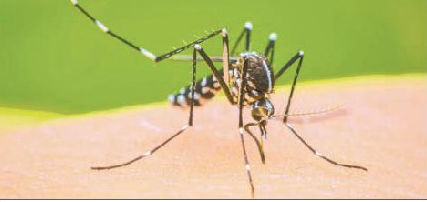
This year, the State has so far reported 34 cases viz 17 in Imphal East, 8 in Imphal West, 5 in Bishnupur, 2 in Kangpokpi and 1 each in Kakching and Ukhrul.
Dr Surjalata stated that Dengue used to be a seasonal disease, but with rising temperatures, cases are now being reported almost throughout the year.
She also said that higher temperatures increase mosquito breeding by accelerating the development cycle from eggs to larvae.
Saying that Dengue is spread primarily by infected female Aedes mosquitoes, she added that female mosquitoes become more active and seek more blood during the egg-laying stage.
If they are infected, the risk of transmitting vector-borne diseases increases, she explained.
Dr Surjalata stated that temperatures above 15 degree C are favourable for mosquitoes.
Given the impacts of climate change and rising temperatures, she urged the public to get rid of stagnant water from commonly overlooked items and to always keep water containers properly covered.
She also stated that water tanks installed in households should be checked and cleaned regularly.
She emphasized that the public has a major role to play in preventing the spread of mosquito-borne diseases.
Stating that fogging is not a complete solution as it also kills beneficial insects and may pose risks to public health, she appealed to people to keep their surroundings clean and prevent stagnant water from accumulating.
Senior scientist Dr Aarti Ningombam, an entomologist at the ICAR Research Complex for the NEH Region, Lamphel, also stated that rising temperatures have become a concern and it is time for collective action.
She added that erratic rainfall patterns contribute to an increase in disease-carrying insects.
The rise in minimum temperature is concerning, she said and expressed worry over the declining population of frogs and urengkonthou (white-breasted waterhen), which feed on mosquito eggs.
This report is written as part of the 7th State-Level Media Fellowship Programme on Climate Change, organised by the Directorate of Environment and Climate Change.
 Comment

