


Unseasoned blooms, bad air behind spike in allergy cases
Source: Chronicle News Service / Nongmaithem Debarani Devi
Imphal, July 12 2025:
Unseasonable flowering and burgeoning air pollution are blamed for severe health problems across Manipur, with doctors documenting a stark increase in allergy-related issues from persistent sneezing and rashes to potentially deadly asthma.
Due to climate change, the patterns are changing, while the environment is becoming worse and allergies - that used to be seasonal - are now an annual struggle, particularly in Manipur.
Manipur's bio-geographical and structural diversity, which were once considered a natural defence, are increasingly becoming uncertain in the face of climate change.
Winters are warmer, monsoons are more variable, and plant cycles are visibly perturbed.
|
In the Imphal Valley and nearby hill districts, trees, shrubs, and grasses flower earlier and for longer period, extending the pollen season.
Health professionals suggested that an increasing number of people are presenting with rhinitis, wheezing, and other sinonasal complaints outside of the familiar allergy windows.
The triggers are more persistent, and the cases are far greater than had been seen even five years ago.
The problem is not only about when things are blooming, but which things are flourishing uninhibited in the state.
A 2024 biodiversity assessment found 98 invasive species in Manipur many of which are known to produce allergenic pollen.
Some examples include Parthenium hysterophorus (Congress Grass), Lantana camara (Samballei), Mikania micrantha (Oori Hingchabi), and Ageratina adenophora (Japan Napi), which all favour a changing temperature and moisture regime.
Their invasive behaviour is not only replacing native species but also producing allergic reactions in both urban and rural population.
Apart from already known problems, the air quality is much worse.
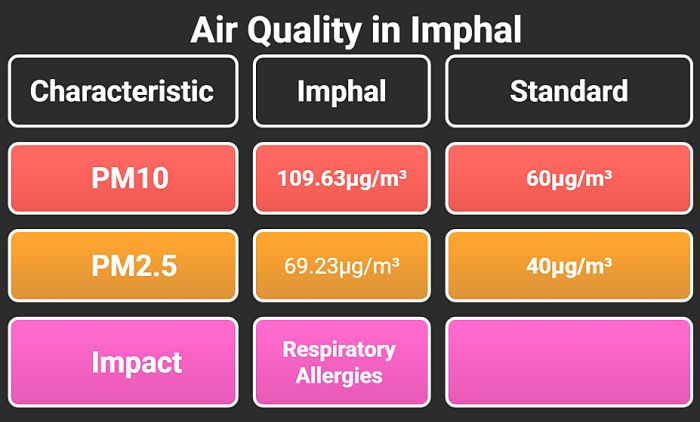
In 2023, Imphal measured PM10 at 109.63 μg/m3 and PM2.5 at 69.23 μg/m, well over the National Ambient Air Quality Standards of 60 and 40 μg/m3 respectively.
In addition, other pollutants like nitrogen dioxide and sulphur dioxide have caused allergic responses to vulnerable populations, especially children and the elderly.
According to Manipur Pollution Control Board (MPCB), the interaction of pollen and other explosive pollutants have made the respective areas a "sweet spot" for respiratory allergies.
They stated that as early as 2018, high PM levels correlated with increased childhood asthma incidence.
The health burden was intensified by the June-July 2025 floods, which produced some of the worst floodings seen in several years.
The floods had rivers like Nambul, Imphal, Iril, and Thoubal at spill-over levels, with data from state disaster response teams reporting over 50,000 people displaced and over 10,000 homes lost.
All the evacuees in those areas affected by the floods including Imphal East found themselves living far longer in damp and often poorly ventilated environment than initially anticipated.
As such, many health practitioners reported an increase in fungal infections, mold-related asthma and skin allergies.
Paediatricians also mentioned that after the floods, a spike in new paediatric cases for allergic bronchitis and eczema was witnessed.
The allergens existed are all around us including in schools, homes and in relief camps/shelters.
At the same time, rural and tribal communities have shown an increased exposure to allergenic weeds, and fungal spores that follow flooding episodes.
In these communities, medical care is limited and often times, the allergy symptoms go into a black hole of non-diagnosis, misdiagnosis, and mis-recorded as respiratory illness.
Public health researchers have noted that allergy-related conditions are poorly represented in statistics because there are no systems for monitoring the recording of allergy cases.
There are no local pollen counts, real-time air quality alert services, or useful perspective in when they could prepare for an epidemic of allergy.
So when the pollen counts are through the roof and the risk for allergy symptoms is high, they have no way to know to take precautionary measures or mitigate the risk.
While the state climate adaption plan for flooding and drought addressed the health problems caused by the severe weather extremes, it did not include allergy prevention and treatment.
The recent release of Rs 1,066.8 crores in central flood relief to the northeast including Manipur, however, can be seen as a great opportunity.
Public health experts have indicated that a portion, however small, would be appropriate to set aside for remediation of mold, improving ventilation of housing, and ordering and stocking allergy medications in government clinics.
Experts also suggested longer-term responses which involve introducing non-aller-genic trees and shrubs along the paths to schools and in public green spaces, instituting air pollution controls, and regulating biomass burning particularly in peri-urban settings which burn agricultural waste in open spaces.
Whether it is in schools and humanitarian shelters, clinics and planning departments, Manipur will require a cross-sectoral response in order to manage an allergy epidemic.
Awareness campaigns, education for primary care providers, and schoolbased interventions are the immediate priorities, considering that children are the most vulnerable group for allergic responses.
The "bad air" and unseasonal flowering might just feel like Mother Nature s whims.
But outside of these psychosocial disturbances, they represent a growing uncomfortable norm for the people of Manipur, wherein allergies are chronic, generalised, and intensifying.
Unchecked, the silent epidemic might just be the next aggregate health burden to the state.
(The report is filed under the 5th Media Fellowship Programme on Climate Change Reporting under the sponsorship of Directorate of Environment and Climate Change, Government of Manipur) .
 Comment

