


Foreign aggression at India's Frontier UDWJA fact-finding team exposes border security failure
Source: The Sangai Express / The Dawn Tantak
Ukhrul/Kamjong, May 11 2026:
In what may stand as one of the gravest instances of cross-border aggression in recent years along the Indo-Myanmar frontier, an independent fact-finding mission conducted by the Ukhrul District Working Journalists' Association (UDWJA) has uncovered chilling ground realities pointing toward a coordinated foreign militant assault, large-scale destruction of civilian property, and alarming lapses in border security response.
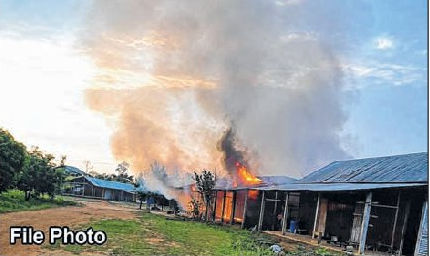
The UDWJA journalists' team visited the last Indo-Myanmar border villages under Kamjong district on May 8, a day after heavily armed foreign militants stormed and set ablaze three vulnerable frontier settlements - Namlee, Wanglee, and Z Choro - in the early hours of May 7 .
|
The visit was undertaken as an independent investigation to document firsthand testimonies, assess damages, and verify claims surrounding what locals have unequivocally described as an act of foreign aggression on Indian soil.
Dawn of Terror: A Coordinated Assault
According to survivors, the attack began around 4 am, when hundreds of armed militants allegedly crossed the Indo-Myanmar border and surrounded the villages in a "C-circle tactical formation", launching simultaneous assaults from multiple directions.
Gunfire echoed across the hills "like continuous rain," villagers recounted.
Explosions followed as bombs were reportedly deployed, forcing residents to flee into forests and nearby hills in desperate attempts to save their lives.
By sunrise, 22 houses and shops lay reduced to ashes across the three villages.
Vehicles were des- troyed, properties looted, and entire families displaced.
The journalist team met several traumatized villagers now taking shelter at Kamjong Headquarters, many still unable to comprehend the scale of violence unleashed upon them and their peaceful settlements.
Survivor's Testimony: "They said they came for revenge"
Among the most disturbing testimonies recorded was that of a woman who narrowly escaped death during the assault.
Visibly shaken and nursing an injury to her leg sustained while fleeing, she narrated that dozens of armed militants entered her home before firing began.
She and her husband were forcibly taken to a nearby Church.
"They asked us to pray," she said, struggling to hold back tears.
"After the prayer, they showed us photos of dead bodies and said they came to take revenge for their comrades" .
According to her statement, the attackers openly identified themselves as members of KNA-B, wearing uniforms bearing identifiable insignia and carrying sophisticated weapons.
When questioned in Manipuri by an interpreter, she told them she was merely a farmer who cultivates pineapple.
Moments later, the militants began torching houses indiscriminately.
"My house was burned in front of my eyes," she said.
"I could save only my Bible and the clothes I was wearing.
Everything else turned to ashes" .
She described how she and her husband escaped only when the militants' attention shifted toward heavy firing elsewhere.
"By God's miracle we survived.
It was unimaginable.
I thank God for saving our lives" .
Village Authorities Confirm Cross-Border Intrusion
Eno Phungreing Ansari, Mantri of Choro village, confirmed to the media team that villagers have strong evidence indicating the militants had infiltrated from the Myanmar side.
He alleged that two to three Kuki villages across the border, reportedly hosting armed elements of KNA-B alongside People's Defence Force (PDF) fighters, served as their staging points.
"The militants entered our villages in coordinated formation," he said.
"They fired from all sides simultaneously and even used bombs.
Over twenty houses across three villages were burned down" .
Looting, Arson, and Vehicle Hijacking
Volunteers from Namlee village further reported that the attackers were unmistakably KNA-B militants who advanced from southern Myanmar before launching synchronized attacks on Namlee, Wanglee, and Z Choro.
Besides arson and gunfire, widespread looting was reported:
Three Gypsy vehicles were seized after the militants broke into houses and shops.
Fuel was forcibly taken from local stores.
Laptops, mobile phones, power banks, jewelry, electronic items, and cash were looted.
Seven Kenbo motorcycles were taken across the border into Myanmar.
Villagers stated they personally witnessed the stolen vehicles being driven by militants toward Myanmar.
Several vehicles were destroyed during the assault, including one Mahindra Jeep, one DI pickup vehicle, one Alto car (burned completely), a Swift car and another Alto riddled with bullets.
The Unanswered Question: Where Were the Border Guards?
Perhaps the most disturbing finding of the UDWJA investigation concerns the absence of timely response from security forces stationed nearby.
Villagers emphasized that an Assam Rifles check post at Aloyo lies barely 5-8 minutes' drive from Choro village.
Despite gunfire continuing from 4 am until nearly 7 am, residents claim no security forces arrived during the attack.
Security personnel reportedly appeared only after villagers had already fled and the militants had withdrawn.
According to witnesses, security forces later instructed the village Pastor to announce through loudspeakers that residents should return home as the situation was "under control" .
One villager alleged that when a village guard emerged from hiding following the announcement, he was detained and questioned by security personnel, who later informed media outlets that they had "rescued one NSCN-IM member" .
The incident has severely eroded public trust.
"We have lost confidence in the security forces," one villager said anonymously.
"Earlier they came once a month.
Recently they began frequent movement, checking border pillars and even sending drones to monitor our villages a day before the attack.
The next morning, gunfire rained upon us" .
Police Confirmation and FIR Registered
Kamjong Police confirmed receiving information about the attack around 4.30 am on May 7, 2026 .
A suo motu case was registered under FIR No 05(05)2026/CSD-PS stating that 50-60 armed miscreants suspected to be KNA-B militants crossed the Indo-Myanmar border, carried out terrorist attacks using sophisticated firearms, explosives, and drones to drop bombs, resulting in the destruction of 22 houses and injuries to civilians.
Security Personnel Video Adds Weight to Claims
Adding further gravity to the allegations is a video reportedly recorded by a member of the security forces.
In the footage, the personnel is heard stating in Hindi that Choro village had been destroyed by KNA militants coming from Burma (Myanmar) .
The video has intensified demands for accountability and independent verification.
Political Response Raises National Security Concerns
MLA of 43-Phungyar Assembly Constituency, Leishiyo Keishing, also acknowledged that the attack originated from across the international border and publicly questioned the effectiveness of India's border protection mechanism.
"Who will guard the border if such attacks continue?" he reportedly asked.
A Pattern That Cannot Be Ignored
While authorities maintain that the precise involvement of KNA-B or any other militant organization must be established through formal investigation, the cumulative evidence gathered by the UDWJA team points overwhelmingly toward a coordinated cross-border operation.
The attackers:
Entered from Myanmar,
Conducted simultaneous assaults on villages
Used advanced weapons and explosives,
Looted civilian property,
Burned homes,
And retreated back across the border - all without interception.
For border residents, the message is painfully clear: India's frontier villages were left exposed.
Foreign Aggression and the Question of Accountability
The findings emerging from ground zero strongly suggest that what occurred on May 7 was not an isolated militant incident but a calculated act resembling foreign aggression against civilian populations inside Indian territory.
The tragedy of Namlee, Wanglee, and Z Choro raises urgent National questions:
How did hundreds of armed militants cross an international border unnoticed ?
Why was there no immediate response despite prolonged gunfire ?
Were warning signs ignored ?
And who bears responsibility for protecting India's most vulnerable frontier citizens ?
Justice, villagers insist, cannot be achieved merely through compensation or relief.
Accountability must follow.
Until the truth is fully uncovered through an independent and transparent investigation, the ashes of three border villages will remain a haunting reminder that India's distant frontiers cannot be defended by silence.
For the displaced families now sheltering in uncertainty, one reality stands undeniable: "Foreign Aggression" is written across every testimony, every burnt home, and every unanswered question left behind on the Indo-Myanmar border.
 Comment

