


Centre backs German Road proposal amid state denial
Source: Chronicle News Service
Imphal, August 09 2025:
The Ministry of Development of North Eastern Region (DoNER) has asked the state government to examine a proposal from Kuki Inpi Manipur for a dedicated road corridor linking the state's hill districts the German or Tiger Road, which has earned a controversy amid raising concern of encroachment on Naga areas and emergence of a major drug trade route.
The advisory came amid a heated dispute over unauthorised roads, narcotics trafficking, and recent blockades in ethnic fault-line areas.
In an official letter dated August 6, joint director Pausianmuang Tunglut forwarded to the Manipur chief secretary a copy of the August 1 memorandum Kuki Inpi Manipur addressed to the President of India.
|
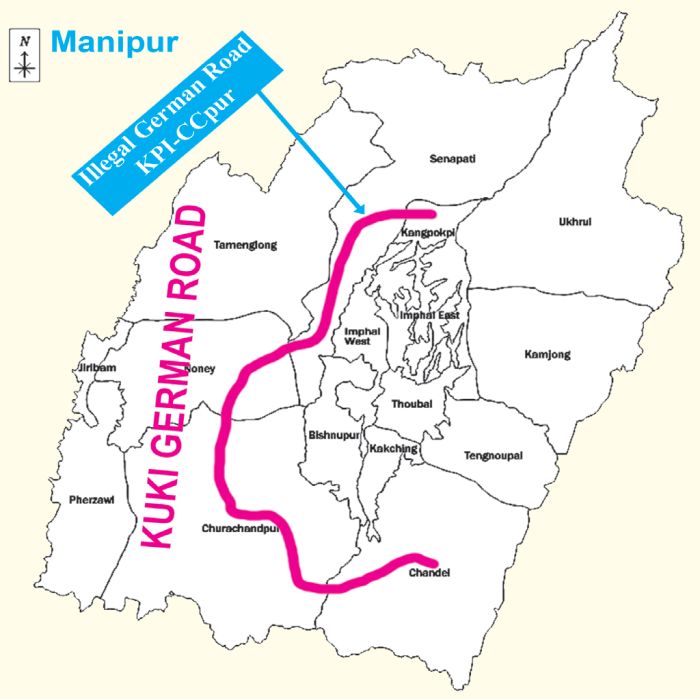
The memorandum urged urgent intervention to develop the corridor, citing a humanitarian crisis in the hills caused by ongoing ethnic violence, economic blockades, and restricted movement since May 2023 .
Kuki Inpi Manipur described the proposed corridor as the "lifeline of the Hill Areas", saying that connectivity between the hill districts and the rest of Manipur had been severely disrupted.
Civil society organisations representing Kuki and Zo communities argue that such routes are essential for patients, students, and migrant workers cut off from vital services.
In some cases, journeys that once took under four hours now stretch to three days via Nagaland, Assam, and Mizoram, at costs many cannot afford.
However, the demand comes against a backdrop of intensifying scrutiny and resistance from Naga groups and different sections of the society, who warn that such "humanitarian" roads have also become conduits for narcotics smuggling and militant activity.
The corridor, a network of roads, including the illegally built "German" and "Tiger" roads, that emerged after the 2023 violence made key highways such as the Moreh-Imphal route unsafe.
While Kuki leaders maintain they were built to restore mobility, investigations and seizures since last year indicate the routes have become preferred channels for heroin, opium, and other contraband entering from Myanmar.
According to records cited by security agencies, drug seizures in Kangpokpi and Senapati have spiked since 2023 .
Notable busts include the May 24 seizure in Churachandpur of 870 grams of brown sugar, 20 soap cases of heroin, and Rs 29.5 lakh in cash; the July 10 interception at Tupul Bridge of 2.19 kg of brown sugar worth Rs 18 crore; and the July 16 seizure by Assam Rifles of 50.5 kg of opium and foreign currency in Sajik Tampak.
There are reports that some Kuki militant factions, including the KNF, have taxed poppy cultivation and transport, using the proceeds to fund armed operations.
The issue escalated further recently when the Foothill Naga Coordination Committee (FNCC), citing rampant smuggling and territorial encroachment, enforced an indefinite blockade on Kuki movement through Naga-inhabited foothill areas.
An internal police alert from the ADGP (LO) had warned of possible counter-blockades and heightened tensions after Kuki CSOs imposed blockade on National Highways.
However, FNCC lifted its blockade on Friday evening after talks with the state government resulted in an agreement on several contentious issues.
The record note of the meeting showed the government assuring FNCC that it had not approved or sanctioned any unauthorised roads in the disputed areas and would take legal action after verification.
It said that no illegal construction or naming of roads would be permitted.
On concerns about the Suspension of Operation (SoO) agreement and designated camps, the government promised to seriously consider Naga interests in consultation with the Centre.
Both sides also acknowledged the problem of illegal poppy cultivation, with the state reiterating its "zero tolerance" policy under its War on Drugs campaigns and pledging joint action with central agencies.
The road dispute has brought into sharp focus the broader collapse of oversight in certain hill tracts.
Many of these unofficial corridors cut through reserved forests and contested territories without any registration or security checkpoints, creating a de facto no-man's land where armed groups operate with impunity.
Critics say that such conditions erode the gains made since the state's anti-drug campaign was launched in 2018, during which thousands of acres of illicit poppy were destroyed and drug seizures worth over Rs 70,000 crore were reported.
While the humanitarian needs in the hills remain pressing, the state government has consistently denied sanctioning any illegal road construction, warning that unauthorised corridors risk fuelling the state's narco-economy and insurgency.
Officials and security agencies have also voiced concern that these routes could entrench armed militant camps, raising the risk of renewed clashes between Naga and Kuki groups.
Meanwhile Kuki Inpi Manipur and other Kuki organisations, however, said that the stakes are existential.
They argue that the ongoing ethnic unrest and blockades have crippled daily life, and that without a dedicated, safe corridor, entire communities remain isolated from health care, education, and trade.
The DoNER ministry's intervention marks the first time the Centre has formally urged the state to consider such a proposal since the crisis began.
However, the proposal now sits at a volatile intersection of humanitarian relief, territorial politics, and national security.
Any decision will likely be tested by competing narratives: one framing the corridor as a vital lifeline for marginalised hill populations, the other as a dangerous breach that could perpetuate Manipur's drug trafficking and armed insurgency networks.
 Comment

