


Study flags health risks over toxic metals in monsoon clouds
Source: Chronicle News Service
Imphal, August 02 2025:
A new scientific study has revealed the presence of toxic metals including cadmium, chromium, copper and zinc in monsoon clouds over India's highlands, especially the Eastern Himalayas region, warning of potential health risks for local populations.
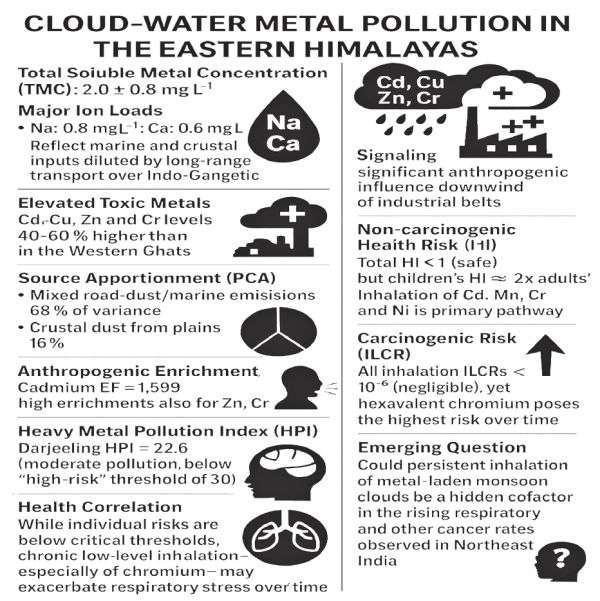
Researchers found that clouds passing over Darjeeling in the Eastern Himalayas carried particularly high levels of these harmful metals, largely attributed to industrial and urban pollution from the Indo-Gangetic Plain.
The pioneering study titled "Trace metals in non-precipitating, low-level monsoon clouds over India: Sources, pollution index and health risk assessment", published in the June 2025 issue of 'Environmental Advances' has revealed that monsoon clouds over India carry significant loads of soluble metals, some with potential health impacts.
|
The research, conducted by Md Abu Mushtaque, Shahina Raushan Saikh, Abhishek Biswas, Gopala Krishna Darbha and Sanat Kumar Das of the Bose Institute and the Indian Institute of Science Education & Research (USER), Kolkata, marks the first comparative analysis of trace metals in non-precipitating clouds over climatically distinct Indian highlands.
Using a custom-designed borosilicate spiral-tube condenser, the team sampled monsoon clouds during late May and early June 2022 from Mahabaleshwar in the Western Ghats and Darjeeling in the Eastern Himalayas.
These sites were selected to contrast Arabian-Sea-fed clouds exposed to desert dust with clouds funnelled through the heavily populated and industrial Indo-Gangetic Plain.
Laboratory analysis detected major ions including sodium, calcium and magnesium, along with trace metals such as iron, zinc, copper, nickel, cadmium and chromium.
Concentrations were higher at Mahabaleshwar, averaging 4.1 milligrams per litre compared to 2.0 mg/L in Darjeeling.
However, toxic metals including cadmium, copper, zinc and chromium were 40 to 60 percent more abundant in Darjeeling's clouds, highlighting a greater anthropogenic burden downwind of industrial and urban corridors.
Statistical source apportionment linked Mahabaleshwar's clouds to road dust, biomass burning, marine spray and desert dust, while Darjeeling's were dominated by mixed road-dust and marine signatures along with local fossil-fuel combustion.
Cadmium showed extremely high enrichment factors at both sites, underscoring a strong human influence.
The atmospheric research team assessed health risks from toxic metals in monsoon clouds through inhalation, ingestion and skin contact, using statistical models to trace their sources.
Health risk assessments following US Environmental Protection Agency guidelines found non-carcinogenic hazards below safe limits, but children were nearly twice as vulnerable as adults, particularly to inhaled cadmium, manganese, chromium and nickel.
Inhalation of polluted clouds over the Eastern Himalayas is identified as the main pathway for non-carcinogenic diseases.
The study also found that carcinogenic risks have risen due to inhalation of dissolved chromium present in clouds.
Hexavalent chromium showed the highest potential concern due to its solubility and mobility.
Researchers linked elevated levels of cadmium, chromium, copper and zinc in the region's clouds to vehicular and industrial emissions from the foothills.
They warned that clouds act as transport mediums for heavy metals, which can enter the body through breathing, skin exposure and consumption of rainwater in high-altitude areas.
Pollution levels, measured through the Heavy Metal Pollution Index, suggested moderate contamination, with Darjeeling scoring higher than Mahabaleshwar though both remained below India's high-risk benchmark.
The findings carry particular weight for Northeast India, where communities in hill regions spanning Sikkim, Arunachal Pradesh, Assam and Manipur often harvest cloud water for irrigation or consumption.
Researchers caution that prolonged exposure to cloud-borne metals could accumulate in soils, crops and human bodies, raising long-term risks for respiratory and developmental health.
While the study does not specifically mention anything about the Northeast region, as samples were collected from only two sites, rising respiratory diseases and cancers in parts of the Northeast may not be fully explained by industrial pollution and tobacco use alone, suggesting that chronic inhalation of metal-laden clouds could be an overlooked co factor.
The authors recommend expanded cloud monitoring and region-specific epidemiological studies to better understand this atmospheric pathway of exposure.
The southwest monsoon that drenches Manipur each year originates over the Bay of Bengal, where moist winds sweep north along India's eastern coast as a low-level jet.
Funnelled into the Eastern Himalaya corridor, the currents rise sharply over the Meghalaya, Patkai and Naga Hills, triggering condensation and heavy rainfall.
After this orographic lift, rain-laden winds spill eastward through mountain passes into the Manipur Valley, making the state one of the key recipients of intense June-September monsoon downpours.
 Comment

