


Not fact finding, but endorsement of separatism: COCOMI tears apart PUCL report
Source: The Sangai Express
Imphal, August 26 2025:
The Independent People's Tribunal (IPT) report of the People's Union for Civil Liberties (PUCL) on Manipur crisis is not fact-finding but a political endorsement disguised as a report that seeks to legitimise separatist agenda, the Coordinating Committee on Manipur Integrity (COCOMI) has said, categorically rejecting the controversial report in its entirety.
Released on August 20, the PUCL report is nothing but a biased, misleading, and politically engineered narrative that seeks to vilify the Meitei community while legitimizing the separatist aspirations of Chin-Kuki narco-terrorist groups, the COCOMI said in a statement, debunking the report page by page.
|
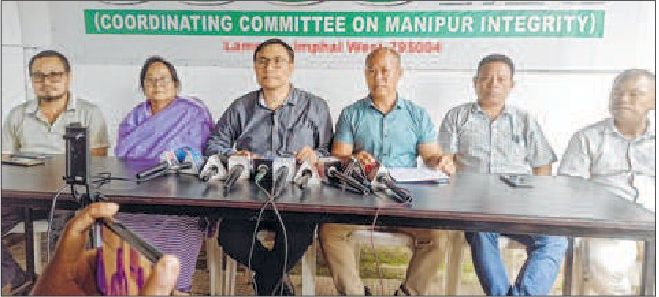
"The contents [of the report] reflect bias, selective omission, and fabrication, demonising an entire community while shielding the role of narco-terrorist groups.
We categorically reject the report and demand accountability," COCOMI said.
The COCOMI debunking the "engineered report" has been reproduced below as it was released with some minor changes for clarity.
Misrepresentation on Meitei ST status (on Page 19 of the PUCL report)
The report claims that the Manipur High Court directed the State Government to recommend ST status for the Meiteis to the Centre.
This is patently false.
The former Chief Justice himself has clarified multiple times that the High Court has no authority to direct the State in this matter.
The Tribunal's framing is clearly designed to misinform.
False narrative on outbreak of violence (Page 20)
The report states: "Mobs rampaged through Kuki settlements in Imphal...
retaliatory violence emerged against Meitei homes and properties in Churachandpur and Kangpokpi".
This is the complete opposite of verified facts.
Photo and video records in the public domain confirm that the first incident of arson and mob violence occurred in Torbung-Kangvai, Churachandpur, where Meitei homes were torched in broad daylight by mobs emerging from the rally gathering.
Retaliation in Imphal occurred only later in the evening, after the violence in Kangvai had gone viral for several hours.
The Vice President of India was in Imphal until noon on May 3, 2023 and no violence was reported until after his departure.
One-sided depiction of victimhood (Page 22)
The report says: "Kuki-Zo communities were driven out of the valley.
Meitei communities left the hill areas".
This framing is consciously engineered to depict Kukis as sole victims.
In reality, Meiteis were the first to be driven out and attacked in Kangvai, forcing retaliation later.
By omitting this, the Tribunal shows clear bias.
Deliberate endorsement of separatist agenda (Page 22)
The section titled "The Outcome was de facto ethnic partition" echoes separatist narratives and seeks to legitimise the demand for Separate Administration.
This is not fact-finding but a political endorsement disguised as a report.
Poppy cultivation-justifying illegality
The Tribunal generalises poppy cultivation, portraying it as poverty-driven, while deliberately overlooking the major players in narco-terrorism.
This is nothing short of justifying an illicit business.
Omission of armed Kuki groups' role
The report makes no mention of Kuki-Chin armed groups involved in the violence - despite their own spokespersons admitting responsibility.
Seilen Haokip himself confessed on NE Live (interview with Wazbir Hussain) that SoO groups were involved.
Yet the Tribunal repeatedly mentions Arambai Tengol and Meitei Leepun while ignoring ITLF, COTU, Kuki Inpi, Kuki Students' Organization, Kuki Women's Association, and Kuki Zo Council - all of whom control and direct militant activities in the hills.
Even in incidents like the Jiribam Jakuradhop massacre, where 10 armed Kuki militants were killed while kidnapping six women and children, and in the forced disappearance of Linthoingambi, Hemanjit, and Kamal Babu (the latter from inside an Army garrison), the Tribunal deliberately avoided naming the Kuki groups responsible.
Wrongful conclusion of "Unbridgeable Differences" (Page 56)
The report ends by declaring that differences are "unbridgeable." This is false.
Imphal remains open, and many innocent civilians from Chin-Kuki-Mizo-Paite-Hmar-Thadou communities are already returning, except those being threatened by separatist groups not to resettle until their objective of separation is achieved, COCOMI said.
False historical claims and demonisation (Page 58)
The most glaring example of bias is here:
"The relationship between Meitei and the Indian State has always been contentious, very different from that of the Kuki-Zo...
The latter were active in the independence movement, by being members of the INA and Congress".
This is fabricated and misleading.
While the Meiteis have consistently produced the highest number of Indian Army officers (proportionally, in the entire country), martyrs, and achievers in National and international platforms (Sports, Arts, Culture, Science, Technology) - the Tribunal demonises them as anti-State.
The PUCL and its members cannot justify such falsehoods under the pretext of human rights.
They must be held legally accountable for every baseless statement.
Misleading on ST consultation process (Page 103)
The Tribunal suggests that the State Government should consult stakeholders on granting ST status to communities.
This is Constitutionally incorrect.
ST status is granted by the Parliament based on the recommendations of the Registrar General of India and the National Commission for Scheduled Tribes - not through local consultations.
Distortion of Tribal histories (Page 287)
The report falsely claims: "The hill tribes are held to be alien...
tribals dispute this narrative".
By using the blanket word "tribals," the Tribunal deceptively includes Nagas - who have never subscribed to the Kuki-Zo narrative of historical migration and occupation.
This is an intentional distortion meant to project legitimacy on behalf of Kuki-Zo separatist claims.
As a future course of action, COCOMI said it will organise a public review of the PUCL-IPT Report, where each misrepresentation, falsehood, and omission will be systematically exposed to the people of Manipur and the wider Indian public.
"Every unfounded and defamatory statement against the Meitei community, every attempt to legitimise separatist aspirations, and every distortion of fact will be met with necessary legal action.
PUCL and the so-called tribunal members will be held accountable under the law," COCOMI said.
COCOMI will continue to mobilise civil society, intellectuals, and legal experts to ensure that Manipur's integrity and unity are not undermined by fabricated reports designed for international consumption and separatist propaganda, it added.
The PUCL-IPT report has no legitimacy and no credibility.
It is rejected in its entirety by the people of Manipur, represented through COCOMI.
This report does not serve the cause of peace, justice, or reconciliation.
Instead, it emboldens narco-terrorist groups and weakens National security, it added.
"The PUCL must recognise that it is the Chin-Kuki narco-terrorist groups who have been repeatedly confronting other communities over land encroachment and communal issues across the region.
There has never been any single group that has engaged in conflict with almost every community, in every area, except them.
If PUCL still chooses to side with these forces out of vested interests or to appease Left-liberal establishments, it will stand to lose its remaining legitimacy and credibility.
Manipur does not need propaganda masquerading as human rights.
What it needs is truth, fairness, and collective resolve to restore peace, integrity, and unity," COCOMI said.
 Comment

