


India's delay is creating more problems, not solving them: Atem
Deputy Ato Kilonser speaks out on stalled peace process
Source: The Sangai Express / Addie Chiphang
Ukhrul, November 01 2025:
The Naga peace process-one of the longest-running political negotiations in South and Southeast Asia-remains unresolved even after decades of dialogue.
Despite numerous rounds of talks, ceasefire agreements, and promises of a "final solution," the question of Naga sovereignty and identity continues to hang in limbo.
In an exclusive and indepth conversation, VS Atem, Retired General and Deputy Ato Kilonser (Deputy Prime Minister) of the National Socialist Council of Nagalim/Govt of the People's Republic of Naga-lim (NSCN/GPRN) spoke on a myriad of issues including the Meitei-Kuki clash and the demand for a Separate Administration with the caveat that Kangpokpi and Tengnoupal are ancestral lands of the Nagas and do not belong to the Kukis.
|
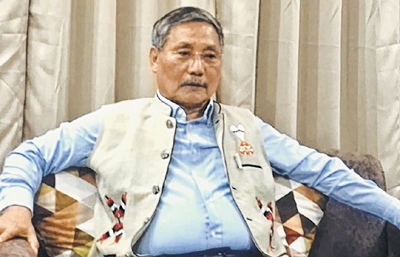
"We extend our hand of friendship to every community - Kukis, Meiteis, all," Atem said and added that they want peace with everyone.
"We want good relationships.
But truth must be acknowledged," he added.
Recalling the 2010 Mao Gate clash, he claimed that they could have taken over the Government of Manipur at that time but restrained themselves because they respect that Manipur is under India's governance.
"We wanted peace, not chaos", he added.
On refugees and illegal immigration, Atem said that facts must be faced honestly and referred to the statements of KNO president PS Haokip in his book Zalengam.
"Mr Haokip himself wrote that in the 1960s, Burma's General Ne Win expelled over 30,000 Kukis.
They didn't go to Thailand or Bangladesh - they came to Manipur and Nagaland," Atem pointed out.
"Again in the 1980s, another 30,000 came when the Burmese junta cracked down on democracy movements," he said.
He stressed that while Meiteis and Nagas provided humanitarian shelter, the demographic shifts must now be acknowledged.
Saying that those who came as refugees have been well-treated, he added that identification, however, must be done honestly by the Kukis themselves to bring about a lasting peace and understanding.
He also spoke candidly about the state of the Naga peace process, the reasons behind the deadlock, and the dangers of political manipulation by New Delhi.
"We are straightforward people; It is India that keeps changing the goalposts", Atem began with a quiet but firm conviction.
He said that the Nagas are very simple and straightforward people and whatever they have agreed upon they have stood by it.
Saying that the Government of India (GoI), however, keeps changing its stance, he added that the peace accord has been stalled for so long due to the lack of commitment by the GoI.
Atem recalled that the NSCN leadership entered the peace talks with sincerity and a clear mandate from the Naga people.
"We never came to negotiate for power or position," he asserted.
Stating that they came with one purpose to resolve the Indo-Naga political issue based on mutual respect and recognition of Naga sovereignty, Atem accused New Delhi of "playing for time" while creating new complications.
"Instead of trying to solve the problem, they are creating more problems.
This is just a diversionary tactic to weaken the Naga spirit and unity.
But the Nagas will not accept it.
We will do whatever is within our reach to defend our identity and our rights," he warned.
On border fencing and Free Movement Regime, Atem said that among the most serious issues troubling the NSCN leadership today is the GoI's plan to fence the Indo-Myanmar border and to end the Free Movement Regime (FMR) - a long-standing arrangement allowing ethnic Naga communities to cross freely for social, cultural, and familial ties.
Atem called this move a direct assault on the historical and emotional unity of the Naga people.
"For generations, Nagas have lived on both sides of the border-in India and Myamnar - as one people," he said and added that the artificial line drawn by colonial powers never divided" our hearts.
The GoI's decision to fence the border will not only separate families but also provoke unrest, it is a recipe for conflict, not peace, he added.
"Instead of addressing the political roots of the Indo-Naga issue, Delhi is deliberately shifting the focus to border management, military operations, and new administrative arrangements.
These are distractions, not solutions," the NSCN/GPRN leader added.
On the Manipur crisis, Atem said that it exposed India's failure, not the Naga weakness.
The Deputy Ato Kilonser dismissed the idea that the ongoing ethnic conflict in Manipur has weakened the Naga cause.
On the contrary, Atem argued that the violence in Manipur has exposed the GoI's total failure in handling complex issues in the North East.
"It also shows that the Indian system cannot manage diversity with fairness,"he continued.
Maintaining that the Naga issue is not about violence or secession but about a political right, he added that conflicts like in Manipur are inevitable when the State fails to treat its people equally.
According to him, while the violence has temporarily distracted attention from the peace talks, it has also strengthened the Nagas' conviction that only a negotiated and honourable settlement, not military or administrative imposition can bring lasting peace.
When asked whether Indian elections have affected the Naga political movement, Atem replied with historical perspective and frankness that the elections do not impact the Naga cause in essence.
"Yes, they distract temporarily, but the Indian Government knows very well that such distractions will occur," Atem said.
He recalled how in earlier decades, Nagas resisted Indian elections often at great cost.
"In the 1960s and 1980s, many Naga villages boycotted elections.
Heavy fines were imposed - my own village was fined Rs 25,000, and when we refused, it was doubled to Rs 50,000.Security forces even confiscated livestock to make up the amount," he recounted solemnly.
Claiming that the entire villages were burned down and people were hunted like wild animals just for boycotting elections, Atem alleged that the first elections in Kohima were conducted under the barrel of a gun.
Soldiers went house to house checking who had not voted.
People eventually realized it was senseless to resist such a mindless show of force.
They cast their votes quietly to survive not because they accepted India's authority, but because it was a policy of survival, he stressed.
He also said that participating in Indian elections today does not mean Nagas have surrendered their political aspirations.
"We have not abandoned our rights.
We are merely navigating a system imposed upon us by a more powerful State without losing sight of who we are" .
On drone strikes and targeting of Naga groups, Atem said that they are not surprised.
The recent drone strikes reported in the Nagaland-Myanmar border area, allegedly targeting Naga groups, have raised alarms, Atem said and added that such incidents are not new.
Claiming that the Government has always used military force to intimidate the Nagas, he remarked that they did it to them before, and now they are doing it again to Naga brothers in the Yongyen area and it shows their intention to suppress, not to resolve.
As the interview draws to a close, Atem's tone grew resolute.
He said that for decades, they have exercised patience and restraint.
"We have honoured the ceasefire, attended countless rounds of dialogue, and upheld every commitment we made," he said and maintained that the GoI, however, continues to evade the core issue - the political recognition of Naga sovereignty.
He warned that the patience of the Naga people should not be mistaken for weakness.
"The world must understand - Nagas are not asking for charity.
We are asserting our inherent political right.
If India continues to delay and deceive, it will only create more resentment and unrest", Atem asserted.
Continuing that they are not enemies of peace but its true advocates he added that peace, however, must be based on truth and justice, not manipulation.
The Nagas will continue their struggle - peacefully, resolutely, and unflinchingly until 'our political destiny is rightfully acknowledged,' he concluded.
 Comment

