
TODAY -

DNA (Deoxyribonucleic acid) Vaccine Technology in Aquaculture/ Fisheries

By:- Bijayalaxmi Nongmaithem / Ajit Kumar Ngangbam *


INTRODUCTION

Aquaculture involves the farming of any aquatic organisms which includes fish, molluscs, crustaceans and other aquatic plants. It is the production of aquatic animals and aquatic plants under controlled conditions. This type of farming implies some scientific intervention in the rearing process to enhance production for example maintaining regular stocking, proper feeding and protection from predators.

Aquaculture is the fastest growing animal food-producing sector with per capita supply increasing from 0.7 kg in 1970 to 7.8 kg in 2006 with an average annual growth rate of 6.9 percent. The production level shows a huge change from 1 million tonnes per year in the early 1950s, to 51.7 million tonnes production in 2006 with a value of US$78.8 billion.

World aquaculture is dominated by the AsiaPacific region, which accounts for 89 percent of production in terms of quantity and 77 percent in terms of value. China remains the largest producer in the world, with reported fisheries production of 51.5 million tonnes in 2006.

The share of China is 69.6 per cent in production and 51.2 per cent in value. India has emerged as the world's second largest producer of farmed fish but its total production is merely one-twentieths that of China and the share of India, on the other hand, is 7 per cent only in total global production.

The fishery sector needs to increase its global production and efficiency to meet the increasing consumer needs for fish and other related products. Infectious diseases have been a major hindrance to the development and profitability of fisheries sector. From this point of view, vaccines offer the most efficient way to control infectious pathogens as with compared to other treatment and the current vaccine products have only been successful against only some fish pathogens.

These are mostly bacterial, and there are still several important diseases, mainly of viral and parasitic origin, for which no prophylactic treatment exists. DNA-based vaccination could overcome various problems which are normally associated with traditional methods of immunization.

DNA vaccines as when compared to traditional vaccines have several practical and immunological advantages that make them very attractive for the fishery sectors. Immune responses to DNA vaccines have only been poorly characterized in fish because of the limited knowledge of the fish immune system and the less number of researches on DNA vaccine.

Other than optimizing the efficiency of DNA vaccines, many other important issues, such as safety and production cost will be determinants for the potential application of this DNA vaccines technology in fish farms.

DNA VACCINES TECHNOLOGY IN FISHERIES

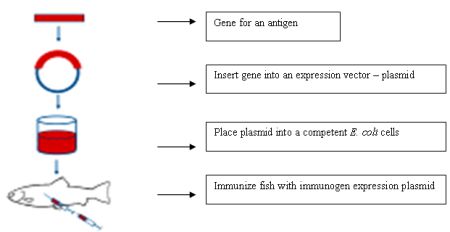
DNA vaccines can also be considered as the advanced or the third generation vaccines which are made up of a small, circular piece of DNA that is genetically engineered to produce one or two specific proteins from a micro-organism. The vaccine DNA is injected into the cells of the body, where the host cells reads the DNA and converts it into pathogenic proteins.

Since these proteins are recognized as foreign, when they are processed by the host cells and displayed on their surface, the immune system is alerted, which then triggers a range of immune responses. The concept of DNA vaccines was developed from failed gene therapy experiments.

The first demonstration of a plasmid-induced immune response was when mice inoculated with a plasmid expressing human growth hormone elicited antibodies instead of altering growth. DNA vaccination is the method of administrating the gene encoding the vaccine antigen rather than the antigen itself.

The Subsequent expression of the antigen by cells in the vaccinated hosts triggers the host immune system and illicit both the cell mediated and humoral mediated immune response. The primary function of DNA vaccines, a bacterial plasmid DNA containing a construct for a given protective antigen, is to establish the specific and long-lasting protective immunity against diseases where conventional vaccines fail to induce protection.

Although development of DNA vaccines has been attempted for various pathogens in a number of different fish species, the DNA vaccines against the infectious haematopoietic necrosis virus (IHNV) and viral haemorrhagic septicaemia virus (VHSV) remain the most efficient and also the most extensively analysed to date.

The vaccines against rhabdovirus diseases in fish have given some of the most promising results. The development of DNA vaccines against some fish pathogens like Aeromonas sp. is in progress. DNA vaccines against other types of fish pathogens have so far had limited success.

The most efficient delivery route at present is Intramuscular injection, and suitable delivery strategies for mass vaccination of small fish still need to be developed. In terms of safety, no adverse effects in the vaccinated fish have been observed till date.

As DNA vaccination is a relatively new technology, various theoretical and long-term safety issues related to the environment and the consumer remain to be fully addressed, although the risks should not be any greater than with the commercial fish vaccines that are currently used.

The present classification systems lack clarity in distinguishing DNA-vaccinated animals from genetically modified organisms (GMOs), which could raise issues in terms of licensing and public acceptance of the technology.

SAFETY OF THE DNA VACCINE

From the safety point of view, three important aspects must be considered; this includes the environment, the consumer and the vaccinated animals. In almost all of the experimental and clinical DNA vaccination experiments conducted so far no serious side effects on the host individual have been reported.

DNA vaccines is based on purified plasmid DNA carrying only a single gene from the pathogen are found to be non-infectious and are unable to replicate within the vaccinated host so there is no risk of transferring the actual disease with the vaccine. DNA vaccines are very much safer than conventional vaccines, i.e. inactivated whole virus, with or without oil adjuvant, or attenuated live virus.

Other factors that make DNA vaccines preferable are that inactivated whole virus vaccines may contain unknown impurities and trace amounts of inactivating agents, while live attenuated vaccines pose a risk of infection by mutants or may revert to virulence. Investigations to date suggest that the injected plasmid DNA does not integrate into the genome of the host cells.

The chance of integration into the germ line is in all probability an even rarer event. Till now no DNA vaccines have been licensed yet, the major challenge remaining is to develop an appropriate set of regulatory requirements for this DNA vaccine.

The Food and Drug Administration in the United States of America and the European Agency for Evaluation of Medical Products have prepared some guidelines concerning DNA vaccines in general and veterinary DNA vaccines in particular. Several relevant issues, such as requirements on composition and safety testing, are covered, but no specific restrictions in terms of application of DNA vaccines are given.

CONSTRUCTION OF DNA VACCINE


CONCLUSION

DNA vaccines offer an inexpensive alternative to antibiotics in aquaculture or fish farms. As such there is no problem of accumulation of chemicals, development of drug resistant strains and contamination of the aquatic environment with the DNA vaccines.

The potential benefits of DNA vaccines for farmed fish include improved animal welfare, reduced environmental impacts of aquaculture activities, increased food quality and quantity.

The application of DNA vaccine technology provides an important tool for maintaining sustainable production of farmed fish. DNA vaccines for fish are shown to be promising and felt necessary for the researchers to examine the requirements for a DNA vaccine technology in aquaculture.


* Bijayalaxmi Nongmaithem (College of Fisheries, Tripura) and Ajit Kumar Ngangbam (PhD scholar, Department of Microbiology, UNESCO Centre for Marine Biotechnology, College of Fisheries, Mangalore) regularly contributes to e-pao.net . Ajit Kumar Ngangbam can be contacted at ajit_b2007(at)yahoo(dot)co(dot)in
This article was webcasted at e-pao.net on 09th July 2009.


* Comments posted by users in this discussion thread and other parts of this site are opinions of the individuals posting them (whose user ID is displayed alongside) and not the views of e-pao.net. We strongly recommend that users exercise responsibility, sensitivity and caution over language while writing your opinions which will be seen and read by other users. Please read a complete Guideline on using comments on this website.


LATEST IN E-PAO.NET
  • Candle Light- Chongtham Vikram : Gallery
  • Violence in Manipur 2023-2026 : Timeline
  • Manipuri Pony Heritage Talk to Students
  • Souls with no sacred flame :: Poem
  • International Primate Day 2026
  • Misuse of Tapentadol: A grave danger
  • North East Creator Circuit 2026
  • Memorial Service for Nimananda Das
  • Clean chit on Sept 3, suspended on Sept 8 !
  • Presenting the reality to Delhi
  • Colonial records: Hill Areas, 1891-1947
  • Joint Resolution: Abrogation of SoO
  • NRC in Manipur : Time for 'walk the talk'
  • Elimination of Racial Discrimination
  • Manipur after conflict: Shared hope
  • Condemn Arson at Lhungjang Primary School
  • International Literacy Day 2026
  • Demands Abrogation of SoO
  • Decision to stay away from Assembly
  • Justice for 6 Liangmai Nagas #1 : Gallery
  • Manipur Can Simply Be Manipur
  • PhD Admission at Assam University
  • What delimitation could mean for Manipur
  • The puppet :: Poem
  • International Peace Poster Contest
  • Electoral Rolls of Senapati published
  • Bringing eco activity to a halt
  • Exploring The Vanishing Self #9
  • Teachers' Day Celebration : Gallery
  • Census 2027 for Manipur deferred
  • Somehow, We Continue :: Poem
  • Limping towards normalcy : Manipur Today
  • MoUs with 14 Institutions signed
  • Read Meitei Mayek news in romanized English
  • Tracing the evolution of territorial boundaries
  • Natural Farming through Rice-Water mimosa
  • Demands Justice in May 13 Massacre
  • Monsoon handcare tips for this rainy season
  • 'Dipholu' to release in theatres in Oct
  • Importance of road connectivity
  • NEROCA Vs Navy : Durand Cup : Gallery
  • Why Manipur's NRC cannot be delayed
  • A teacher by chance, a mentor by choice
  • Study & Career Pathways in South Korea
  • Is it real peace or not ? :: Poem
  • 'Bokshi' trailer spotlights Sikkim's myths
  • When the last-resort antibiotic fails
  • Expectations from the Government
  • 24-hour Gen Strike (Sep 1) : Gallery
  • JNIMS Paper IV : A roadmap for reform
  • An uncle calloused hand carried Manipur boxer
  • Natural Farming: A New Business Frontier
  • What ails the SoO arrangement
  • LGBI Airport Enhances Landing Safety
  • Taking NRC case to Delhi
  • Panthoibi Anoi Khuthek #1 : Gallery
  • Book on the History of Manipur released
  • Insights of Natural Farming in Day Today Life
  • Training on Mushroom Cultivation
  • Brutality of wars and conflicts
  • 'Govt Accountable for N Teikhang Killings'
  • 20th Charter Nite Celebrated
  • From Naga MLAs to Amit Shah
  • 48-hour General Strike by JFD #3 : Gallery
  • Wungshungmi, Kaduangaipouu : Eming
  • Culturals from Manipur at Delhi Fashion Week
  • Leaders versus politicians
  • The Mask !! :: Poem
  • Indonesian - community-led HIV responses
  • Stand to put census on hold
  • The flame of Haipou Jadonang
  • Kang Khichri Chaba #2 : Gallery
  • Manipur's Peace Begin With Refusal to Hate
  • The Highway of Hope & the Road of Blood
  • Bleeding Mother :: Poem
  • NEET-UG 2026 Pangal Students of Tripura
  • Meghalaya shines: Delhi Fashion Week 2026
  • 'Tell your folks to be human'
  • Exploring The Vanishing Self #8
  • September Calendar for Year 2026 : Tools
  • One Table, Many Tongues
  • Use of Rice Husk on Controlling Insect Pest
  • The First Bus :: Poem
  • Census deferred & NRC begins
  • Flood-Affected Communities in Upper Assam
  • Relevance of NRC, 1951 for immigrants
  • Natural Farming in Ancient Manipur
  • JNIMS Paper III : A case in point
  • National Sports Day 2026 Inaugurated
  • Condemns Killing of 5 Naga Civilians
  • 'Meetei Needs ST protection'
  • Need to go beyond issuing warnings
  • 61st Hunger Marchers' Day #1 : Gallery
  • Featured Front Page Photo 2026 #4: Gallery
  • Plain Flowerpecker sighted in Kasom Khullen
  • A mother's hope :: Poem
  • Condemns Killing of Naga Civilians
  • 1st day of Northeast India Space Workshop
  • Ticket to Hornbill 2026 Announced
  • Guns, guns everywhere in the hills
  • The King Who Caught a Bird : Konthoupa
  • JNIMS Paper II : The anatomy of a disconnect
  • GI-Tagged Natural Farming Could Turn NE
  • Condoles Passing of Huirem Ongbi Ibeni
  • Tree Plantation Drive 1.7 - Koirengei
  • NE Bands at Soundscapes of India
  • Make the JMG Report Public
  • Growing call to update NRC
  • Meira Rally 'No NRC, No Census' : Gallery
  • Day Dreaming of a Vision for a True Change
  • ChipCraft: RTL, IP Integration Course
  • Before the Census, Count the Future :: Poem
  • Khelo India Samvaad in Senapati
  • Induction Programme for Group-A & B Officers
  • Chumoukedima Councillors joined NPF
  • Questions people should raise
  • FC Reangdai Vs TRAU : Durand Cup : Gallery
  • Fast-Growing Tree Species: Link in Farming
  • Manipuri Sahitya Parishad Awards 2026
  • MTU Disaster Risk Reduction Club
  • Meeting with IDPs
  • Imphal-Guwahati Route continue on 3rd Day
  • Ambedkar Medical Aid Scheme Extended
  • 48-hour General Strike by JFD #2 : Gallery
  • Ghosts of Khadawmi: Numbers, Nationhood
  • Why Healthcare must be governed differently
  • Tree Plantation, "Loushangkhong Ningol Van"
  • Shobha Shukla "Justice unbound" : Book Rvw
  • Makeup meltdown during Monsoon
  • Science for Viksit Bharat at IBSD
  • Unresolved questions continue to hang
  • Exploring The Vanishing Self #7
  • Gen Z Rising: Pandora's Box Is Open ?
  • Northeast India Space Workshop 2026
  • Wanglembam Gobin: National Teachers Award
  • Broken heart :: Poem
  • Khemchand's bus & laity
  • Mumbai-Ghy as "Bhupen Hazarika Express"
  • Manipur Expeditionary Force, World War I
  • Waqf Amendment Act: An Analysis
  • 80th Independence Day @ Senapati : Gallery
  • Lanchenba : National record at 52nd Aquatics
  • The petition in Parliamentary democracy
  • Support for Children with Special Needs
  • Cracking down on protesters
  • 135th Patriots' Day @ Thangal Tomb : Gallery
  • India-Myanmar territorial exchange
  • The quiet alienation of living in Manipur
  • Babina wins AHPI Leadership Awards 2026
  • Brazil's favelas are reimagining HIV prevention
  • Foreign funds & responsible civil society
  • Dipholu release postponed
  • Taking the NRC demand to Delhi
  • 48-hour General Strike by JFD #1 : Gallery
  • Most neglected root causes of Manipur crisis
  • If the State moves on Agarwood now
  • The genesis of wars and conflicts :: Poem
  • Support to "No NRC, No Census"
  • The gem of transparent public procurement
  • Understanding the angst of the people
  • 35th Manipuri Language Day, 20 August
  • 'Beating of the Retreat' #2 : Gallery
  • Citizens of Manipur can reverse the downslide
  • Condolence Message : Niketu Iralu
  • Delhi Fashion Week 2026 launched
  • Community-based model transforming HIV
  • Eco-Sustainable 'Pine Home' Project
  • Assembly resolution of 2022: Update NRC
  • 77th Indian Republic Day #5 : Gallery
  • Engagement: SCGJWD Logistics & Transworld
  • 'Toy Gun' Featured in at BISFF 2026
  • India shrinking relationship with neighbours
  • A generation that undervalue experiences
  • Visit to displaced Naga families at Makhan
  • 8th Foundation Day of World Meetei Council
  • Rising call for NRC first, census later
  • 80th Independence Day @ 1st MR : Gallery
  • Durand Cup : Touching the hearts
  • 2nd "Fields of Hope" at Bengaluru
  • The torchbearers of Independent Bharat
  • Abok Ki Singju: A Student Film
  • 80th Independence Day at 1st MR Ground
  • 80th Independence Day at Senapati
  • Peace begins with us :: Poem
  • Delhi Fashion Week 2026 Auditions
  • Reliance Foundation's Scholarships open
  • Remembering the martyrs of 1891
  • NEROCA Vs TRAU: Durand Cup #2 : Gallery
  • Manipur: The best place on earth If we change
  • Why Manipur Needs Special Economic Zone
  • 7-Week Free Cancer Screening
  • Safe Release of 3 Thadou Individuals
  • Cambodia's HIV success
  • Normalcy still a far cry away
  • 135th Patriots' Day @ Hicham : Gallery
  • In Search of Peace in Manipur
  • Manipur: NRC before it will accept Census
  • India-Myanmar border dispute & land swap
  • 135th Patriots' Day at Arunachal
  • What is ABHA ?
  • How to eliminate the smell from home
  • Call to surrender all illegal arms
  • A Brief History of DM College
  • 2026 MaolKeki Memorial Scholarships
  • MU's intervention in Manipur's crisis
  • Hiroshima and Nagasaki revisited
  • Harshit Dhingaun: "Best Bollywood Host"
  • Organ Donation : The gift of life
  • LGBI Airport Advances Water Sustainability
  • Power supply : The rising need
  • Ibudhou Thangjing Haraoba #2 : Gallery
  • MKF Robert Memorial Internship Award
  • Indigenous Peoples Day @Chingmeirong
  • A bodybuilding saga from Ukhrul
  • World Elephant Day 2026
  • Endorsed Rio's letter to Home Minister
  • YAS Employee Association suspends Strike
  • Call to enlist Meiteis in ST category
  • Raengdai Vs TRAU - Durand Cup : Gallery
  • Youth Advocacy, Civil Society, & Peacebuilding
  • Panthung (The Last Spring Of Love)
  • The Price of Your Vote :: Poem
  • Wakol Laoba : A Philosophical Analysis
  • Moirang Phi: Living fabric of Manipuri Culture
  • Lifetime Achievement Award for 4 Scientists
  • 13th CM Kang Tournament : Gallery
  • N Tomchou : Gold @ Asian Weightlifting
  • 77th Indian Republic Day #4 : Gallery
  • The chappals we leave behind
  • Takhellambam Rani: National Handloom Award
  • Col M Ranjit's book: Long journey west
  • Mandengbam Jadumani @ Airport : Gallery
  • Naophangpa & the Boy Who Saved Kangla
  • Tingkuradin : Sacred text of Tingkao Ragwang
  • Raengdai Vs Navy Durand Cup : Gallery
  • Colonial Knowledge Production in NE India #24
  • Naga Peace Process: Indo-Naga Talk: Timeline
  • Search 25 years of e-pao.net
  • Remembering the Forgotten Army
  • YengjaKhige : Story on friendship released
  • Candle Light Vigil @Kangla : Gallery
  • Zomi Leaders meet CM @Imphal : Gallery
  • Honoring 3 Global Achievers from Manipur
  • NE Book Fair Imphal @Lamphel #1 : Gallery
  • Leinana Yomlibi - A Dynamic Musical Offering
  • Thailand's community-led HIV revolution
  • Mirabai Chanu won a gold medal
  • North East India Fest @ London : Gallery
  • Kang Khichri Chaba #1 : Gallery
  • Colonial Knowledge Production in NE India #23
  • 135th Durand Cup: Manipur's football empire
  • 17th Anniv of Rabina & Sanjit: Gallery
  • Kang Chingba @Kakwa, Singjamei : Gallery
  • Posts @ Life Sciences, Manipur Univ
  • A rainy day @ Ima Keithel : Gallery
  • Ahingee Laan @ JNMDA #3 : Gallery
  • Early History of Manipuri Sahitya Parishad #3
  • The Forgotten Kings : A Hearthside Story
  • Kang Chingba @Thangal Keithel : Gallery
  • Kang Chingba @Govindajee Temple : Gallery
  • 63rd Mr Manipur @ MU #5 : Gallery
  • Seasonal Fishes @Ima Keithel #3: Gallery
  • Solo Dance: Wahengbam Debina #2: Gallery
  • Yumjao Lairembi Haraoba #2 : Gallery
  • Sillam Sintha Jagoi @ATINGA : Gallery
  • 360° panoramic view of spots in Manipur
  • ANSAM Rally demanding justice : Gallery
  • 25th The Great June Uprising #2 : Gallery
  • Candle Light Vigil @ New Checkon : Gallery
  • Massacres perpetrated by Kukis during British
  • Remains of 6 Naga hostages @JNIMS: Gallery
  • Tronglaobi: 2 children laid to rest : Gallery
  • Final Merit List : Manipur Civil Services 2022
  • PUCL Tribunal report: A shadow of partiality #3
  • PUCL Tribunal report: A shadow of partiality #2
  • PUCL Tribunal report: A shadow of partiality #1