


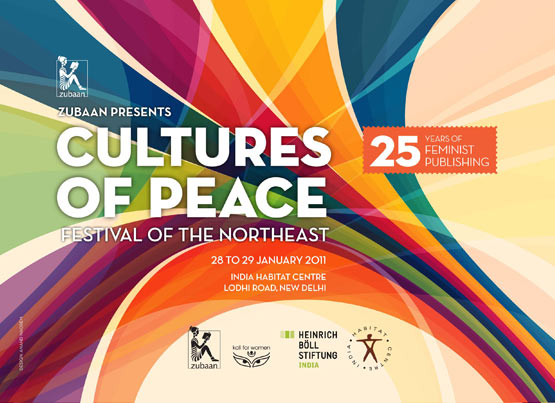
CULTURES OF PEACE: FESTIVAL OF THE NORTHEAST
Venue: India Habitat Centre, Lodi Road, New Delhi
Gulmohar Hall & Amphitheatre
Dates: 28 and 29 January 2011
Organized by: Zubaan - Heinrich Boll Foundation - India Habitat Centre
The Concept:
To say that the northeastern states are different from the rest of India in almost every way is to state the obvious, but it is important in that it requires us to recognize that these “differences” have created rifts, giving rise to local insurgencies, demands for secession from the Indian State and to years of internal conflict and simmering discontent. It is also important to recognize that this region is different from the rest of the country in a way that is inevitable in border areas taking one back to arguments made by scholars and academics, writers and activists alike - that locating a region by placing oneself at a point central to oneself is an arrogant and potentially dangerous stance which is what New Delhi has often been accused of doing. To the people of the Northeast their world is central to themselves, to “mainland India” it is a borderland but nevertheless the pattern of political violence in Northeast India cannot be seen as temporary or aberrant.
It is apparent that more and more creative writing is coming from the region and in many ways the conflicts and the impact of these informs the writings of poets, novelists, prose writers, storytellers from these states. Underlying all this is a desire for normalcy, whatever that may mean, and this finds expression in the richness and complexity of the writing as well as the beauty and poignancy of the art and music from the region. A notable feature of writing from the Northeast is that while the writers are of all ages and genders (and here is an instance where women do not follow but form the vanguard) there are many young writers and there is a vibrant dialogue between generations through well established sahitya sabhas and literary organizations, writers groups etc. It is these groups that have kept the lines of dialogue open in the Northeast by channeling and giving space to creativity and works of the imagination. So we have a unique situation: a conflict torn region, creative cultural expression that takes this conflict as its base, is enriched by many genres of creative writing and driven by a deep concern and desire for peace and a love of the land. By sheer force this vibrant writing and cultural tradition has made its way beyond the Northeast and a key feature that has helped make it so accessible is the fact that much of it is written in English. A festival of peace would allow for the showcasing of this writing and also at the same time look at the whole question of whether or not culture can play a proactive role in bringing about peace, or at the very least, preparing the ground for it, and how this works. It will also allow for people, both from the Northeast and from outside to talk across borders and to learn from the experience of others, and will, we hope, open up a dialogue among people within the Northeast.
Zubaan has long been involved in publishing writers from the Northeast. The publication of their work fits in well with Zubaan’s own commitment to and concern for peace (Zubaan’s list includes books from other violence torn regions like Kashmir, Bangladesh, Pakistan and so on). A festival of peace would allow for the showcasing of this writing and also at the same time look at the whole question of whether or not culture can play a proactive role in bringing about peace, or at the very least, preparing the ground for it, and how this works. It will also allow for people, both from the Northeast and from outside to talk across borders and to learn from the experience of others. Zubaan has also been involved in solidarity activities with people in the Northeast: our most recent publication is a collection of poems by Irom Sharmila, to mark the 10th anniversary of her fast.
The festival is envisaged as a series of workshops/seminars around the themes of Peace and how writing and culture contribute to creating an atmosphere that is conducive to peace. The role of the writer and the creative person in mitigating violence and conflict - something that has besieged the region for decades. It is envisaged as a platform where we can also initiate centre-periphery dialogues around peace and how culture can be central to this. There have been many discussions on the Northeast but none that has attempted to bring people from the different states in the Northeast, virtually none that has focused on literature as a vehicle for peace, and none that has combined academic work with creative writing as this one plans to do. In addition we will also have a music concert with musicians from the Northeast showcasing their talent and also a photo exhibition on young women from the Northeast who come away from their violence torn states to urban centres like Delhi and how the city treats them. This is called Seven Sisters and the City by Uzma Mohsin.
The Programme
28 January
Venue: Gulmohar Hall, India Habitat Centre, New Delhi
Session One: WRITING PEACE, WRITING VIOLENCE
9.30 am to 11.30 am
Speakers:
Subir Bhaumik, journalist, Tripura
Temsula Ao, retired professor, Nagaland
Arupa Kalita, writer, Assam
Ananya Guha, senior academic, Meghalaya
Aruni Kashyap, writer, translator, Assam
Pradip Phanjoubam, journalist, Manipur
Indrani Raimedhi, journalist, columnist, writer, Assam
Moderator: Nilanjana Roy
For the last six decades and more parts of the Northeast have been caught in a spiral of political violence. Without exception, writers and cultural activists have responded to the violence around with an extraordinary flowering of creativity. In this session writers, poets, journalists from the different northeastern states respond to the questions: Do situations of ongoing conflict motivate writers to write for peace? Can literature and culture play a proactive role in bringing about peace? Can they act as political tools to mitigate violence? What role, if any, do writers themselves play? How do writers deal with the difficult issue of writing and representing violence without falling into the trap of creating a pornography of violence? How do they counter popular stereotypes presented in the media of the Northeast to the mainland and of the ‘outsiders’ to the Northeast?
Exhibition Opening: SEVEN SISTERS AND THE CITY, by Uzma Mohsin
11.30 am
Venue: Convention Hall Foyer, India Habitat Centre
Exhibition Inaugurated by (tbc)
Note from Uzma Mohsin
Over the last decade, women from the North-East have been increasingly making their way to Delhi either to study, work or live. The city gives them opportunities absent back home where political conflict and violence underpins everyday functioning. Seeking refuge they arrive in the Capital only to be faced by another kind of violence. A violence of a personal kind.
A big city usually provides possibilities of integration into modern society free of social structures and prejudices. The anonymity it offers not only empowers but also enables the evolution of one’s identity and dreams. But this is not true for the majority of the women from the North-East.
To come and live in the city is an ordeal that they say robs them of their ‘dignity’. Where belongingness to a metropolis is stolen by their distinct looks, always caught up in labels - ‘exotic’, ‘chinky’ or ‘available’. They live in constant fear of being targeted as the ‘other’. Lack of knowledge about their culture further compounds matters.
The following diptychs, “Seven Sisters and the City” tries to encapsulate the experiences of the city that the women you see here have shared with me. The photographs provide a glimpse into the spaces where they feel safe, free to be themselves and other spaces, where they feel threatened and trapped by their distinct looks.
11.30 am: Tea/coffee break
Session Two: THE WORDS TO SAY IT
12.00 pm
Speakers:
Mamang Dai, writer, journalist, Arunachal Pradesh
Mitra Phukan, writer, Assam
Bijoya Sawian, writer, translator, Meghalaya
Rita Chowdhury, writer, Assam
Mona Zote, poet, Mizoram
Omar Sharif, poet, blogger, Assam
Moderator: Preeti Gill
The different northeastern states have rich and multiple linguistic and cultural histories. They also have high levels of literacy, and, in many places, a familiarity with English as a language. This session asks how writers choose their various literary and cultural forms of expression - oral narratives, poetry, theatre, music. Do they serve similar or different purposes? How and why has the English language become the dominant medium of expression? Do the local/indigenous languages still have a role to play? Is the younger generation experimenting with new form and content? What sorts of themes are younger writers and poets looking at? Is the old writing style relevant in the current context? Is there are a movement away from oral narratives? How are younger writers using, or are they using, the rich inheritance of myths and legends and folktales?
1.30 pm: Lunch
Session Three: CROSSING BORDERS
2.00 pm
Speakers:
Monalisa Changkija, journalist, Nagaland
Uddipana Goswami, poet, researcher, media consultant, Assam
Aruni Kashyap, writer, translator, Assam
Triveni Mathur, writer, translator, educator, Assam
Rajesh Dev, political scientist, Meghalaya
Rupa Chinai, journalist, Mumbai
Dhiren Sadokpam, journalist, Manipur
Moderator: Uma Chakravarti
For many years, with the Northeast, as with Kashmir, the media in what in the Northeast is called ‘mainland’ India, have paid scant attention to the region, seeing it somehow as belonging to the periphery. Equally, northeastern writers have not figured much – until recently – in the literary world (more specifically the English literary world) of ‘mainland’ India. In recent years, this has begun to change. How successful has the effort to create space in ‘mainland’ India been for writing from the Northeast? Equally importantly, is this literature crossing state borders within the region itself? What has been the experience if this has already been done? How far can translations, literary fests and conferences contribute to this?
Another interesting question in this context might be: If the Northeast has been ‘relegated’ to the ‘periphery’ and the person from the Northeast faces a sort of stereotyping (something that we read about in media reports, in conversations etc.) is there also a stereotyping of the ‘outsider’ in the literature of the region? How does the Northeast perceive the immigrant outsider who has settled in the states of the Northeast?
4.00 pm: Tea break
Session Four: STORIES FROM A WAR ZONE
4.15 pm
Speakers:
Subir Bhaumik, journalist, Tripura
Sanjoy Hazarika, journalist, writer, Assam
Meenakshi Ganguly, researcher, activist, New Delhi
Deepti Priya Mehrotra, independent scholar, activist, New Delhi
Utpal Borpujari, journalist, film-maker, Assam
Pradip Phanjoubam, journalist, Manipur
Moderator: Urvashi Butalia
For several years, parts of the Northeast have been under the infamous and draconian Armed Forces Special Powers Act (AFSPA). The presence of the army is ubiquitous, and security forces are everywhere. Yet it is important to ask: What is security? Does the presence of weapons create a sense of safety? What purpose does the Armed Forces (Special Powers) Act serve? What would repealing it mean? How does one work towards mitigating violence, both state-driven and due to factionalism? What does the prolonged presence of armed forces mean for the ordinary citizen? Does security get identified with what would normally be its opposite – the weapon, the soldier? In this session, writers present their views on this by speaking on the issue or reading from their works.
6.00 pm: End Day One
29 January
Venue: Amphitheatre, India Habitat Centre, New Delhi
Session One: CONFRONTING THE PAST, IMAGINING THE FUTURE
3.00 pm
Speakers:
Sanjoy Hazarika, journalist, writer, Assam
Laxmi Murthy, journalist, writer, feminist activist, Bangalore
This session focuses on the difficult question of looking at the past, and imagining the future. For the Northeast, a region with enormous linguistic, ethnic and political diversity, and yet with many commonalities of geographies, of resources, of marginalization, what does, or what can, the future hold? Is it at all possible to imagine the region as a federation of states, given the geographical contiguity and the physical ‘separateness’ of the region? Or are the differences too wide and too deep? If one question is how the northeastern states may imagine themselves as a region, another is how the Northeast sees its future vis-à-vis the ‘mainland’, i.e. India. Does the past have any lessons to offer in this respect?
Session Two: EXPRESSING THE NORTHEAST, Readings and Performances
4.00 pm
Readings from Irom Sharmila’s Fragrance of Peace by Haripriya Soibam
Performance by Rojio Usham based on Irom Sharmila’s poetry
Readings by creative writers and poets from the Northeast:
Mitra Phukan, Mona Zote, Aruni Kashyap, Monalisa Changkija, Uddipana Goswami, Nitoo Das, Omar Sharif, Ananya Guha, Rita Chowdhury, Sabah al Ahmed, Haripriya Soibam, Nazneen Hussain
Music by Imphal Talkies led by Akhu
5.30 High Tea
GRAND CLOSING: MUSIC CONCERT by SOULMATE from Shillong
6.30 pm
Soulmate needs no introduction. SOULMATE is “The Band That Re-Ignited The Blues In India”. Inspired by the roots and groove sounds of the Blues, Blues-rock, Soul, Rock ‘n Roll, Funk and R&B,SOULMATE came together in Shillong, in February 2003 playing their first concert at the ‘Roots Festival’ at the Water Sports Complex in Umiam. Soulmate have played numerous gigs all over India as well as in Kathmandu, France, USA, Singapore, Bhutan and Indonesia. They will be representing India at the Massive India Festival, to be held at the Kennedy Center, in Washington DC on the 4th of March, 2011.
We request the media to support this festival by widely covering the festival. The Festival is open to ALL and there are no entry passes or invitations required for the events.
For more information please contact:
Preeti Gill, Editor, Zubaan
Landline: +91 11 26494617/ 18 Mobile: +91 9810536512
Email: [email protected]
Facebook page: CULTURE FOR PEACE-A FESTIVAL OF THE NORTHEAST
* This announcement was sent to us by [email protected].
This announcement was posted on Jan 26, 2011.
* Comments posted by users in this discussion thread and other parts of this site are opinions of the individuals posting them (whose user ID is displayed alongside) and not the views of e-pao.net. We strongly recommend that users exercise responsibility, sensitivity and caution over language while writing your opinions which will be seen and read by other users. Please read a complete Guideline on using comments on this website.


