


Saluting Indian Navy through Stamps
- 4th December – Indian Navy Day -
S Balakrishnan *
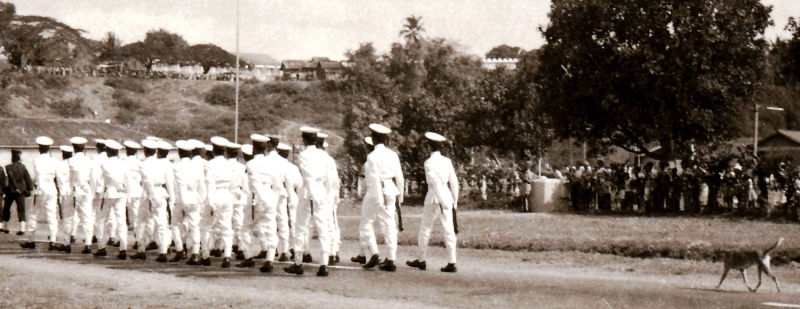
1979 R'Day Naval contingent
Indian Navy Day is celebrated on 4th December every year to commemorate Indian Navy's achievements and its pivotal role in the 1971 India-Pakistan War. This day marks the attack on Pakistan’s Karachi port in 1971, a defining moment in India's naval history.
Navy Day is observed with various events such as parades, exhibitions, and activities showcasing the Navy's strength and capabilities, while also honouring the sacrifices and contributions of naval personnel.
After India's partition in 1947 when we gained independence, the Royal Indian Navy was divided into the Indian Navy and the Pakistan Navy, with India retaining two-thirds of the assets. On 22 April 1958, Vice Admiral R.D. Katari became the first Indian Chief of Naval Staff. Following India's Republic status on 26 January 1950, the Navy dropped the "Royal" prefix and was renamed the Indian Navy.
The Lion Capital of Ashoka, the Indian State Emblem, replaced the royal crown on its emblem, and the Navy adopted the Vedic invocation to Lord Varuna with the motto "Sam no Varunah," meaning "Be auspicious unto us, Oh Varunah." The inscription "Satyameva Jayate" was also added below the State Emblem.
The Indian Navy is a well-balanced, future-proof, credible and cohesive three-dimensional force with the capability of operating above, on, and under the surface of the oceans, efficiently safeguarding our national interests.
The Chief of the Naval Staff (CNS) exercises operational and administrative control of the Indian Navy from the Naval Headquarters (NHQ) in New Delhi. He is assisted by the Vice Chief of the Naval Staff (VCNS) and three other Principal Staff Officers, namely Deputy Chief of the Naval Staff (DCNS), Chief of Personnel (COP) and Chief of Material (COM).
The Navy has the following three Commands, each under the control of a Flag Officer Commanding-in-Chief: The Western Naval Command (with Headquarters at Mumbai), the Eastern Naval Command (HQ at Visakhapatnam), and the Southern Naval Command (HQ at Kochi).
While the Western and the Eastern Naval Commands are 'Operational Commands' that exercise control over operations in the Arabian Sea and the Bay of Bengal respectively, the Southern Naval Command is the Training Command of Indian Navy.
The cutting edge of the Indian Navy is its two Fleets, namely the Western Fleet, based at Mumbai, and the Eastern Fleet, based at Visakhapatnam (Vizag) in Andhra Pradesh. Besides the Fleets, there is a Flotilla each in Mumbai, Vizag and Port Blair (A & N Islands) that provide Local Naval Defence in their respective regions.
Naval ships are also based at other ports along the East and the West coasts of India and the two island territories, thus ensuring continued naval presence in the areas of national interest. Further, there are various Naval Officer-in-Charges (NOICs) under each Command responsible for the Local Naval Defence of ports under their respective jurisdictions.
During the 1971 India-Pakistan War, our Navy played a crucial role that ultimately led to the creation of Bangladesh. The Navy's primary task was to blockade Pakistan's eastern and western coasts, disrupting supply lines and weakening Pakistan's maritime capabilities.
Indian Navy's Eastern Fleet, under the command of Rear Admiral Krishnan, launched a series of strikes on Pakistan's ports, including a successful attack on the naval base at Karachi, severely damaging Pakistan's naval assets. The Indian Navy's contribution extended beyond the blockade by providing support to the Indian Army and Air Force through naval gunfire, intelligence, and logistical support.
The Indian Navy also played a key role in facilitating the movement of troops during the conflict and in evacuating refugees. The operation was highly successful, contributing significantly to India's victory in the war and proving the maritime prowess of Indian Navy.
Well, as an ordinary citizen of India with Aadhaar Card, Voter ID, PAN card, Ration Card, Driving Licence Card and also the inevitable debit & credit cards, I can only pay my tributes to our Indian Navy through
the humble philatelic collection of mine. I would have joined Indian Navy but for my fear of deep waters “thalassophobia” and sea-sickness! Besides, an astrologer had also warned that I had danger in water.
Hence I avoid even bath tubs (so as not to face a tragic death like actress Sridevi). The 1968-issued 20 Paisa stamp commemorates the launch of INS Nilgiri, Indian Navy’s first indigenously designed and built major warship. INS Nilgiri was the lead ship of the British Leander-class frigates. (Don’t ask what is Leander-class; but frigate is a small fast ship in the navy that travels with other ships in order to protect them.)
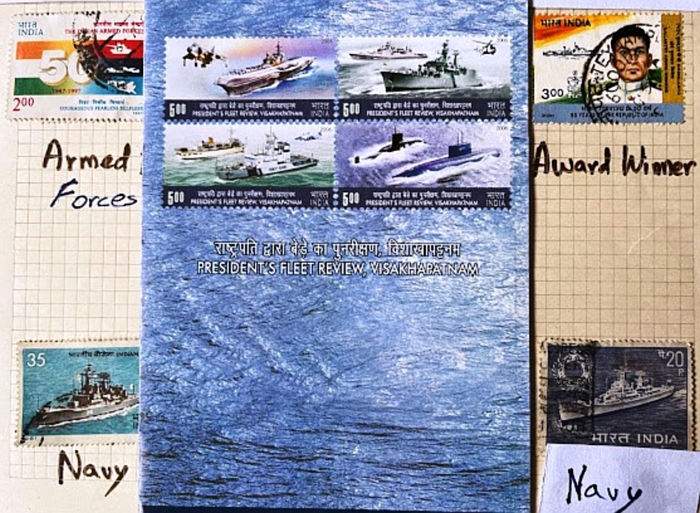
Philatelic material on Navy
Built at Mazagaon Docks Limited, Bombay, in collaboration with Yarrow Shipbuilders, Glasgow, UK, it was launched by the then Prime Minister, Mrs. Indira Gandhi, on Oct. 23 1968. After extensive trials lasting for four years, it was finally commissioned on 3rd June 1972. It was equipped with sophisticated anti-submarine and anti-aircraft weapon systems.
But this stamp was issued some two months later on 15 Dec. 1968 by the (undivided) Indian Posts & Telegraphs Department, along with a first day cover depicting Navy’s ships. INS Nilgiri was decommissioned in 1996 and was sunk in 1997 by a test firing of a Sea Eagle anti-ship missile fired from aircraft carrier INS Viraat. What a sad end to the first of its kind! It is time I discovered it, a la Titanic operation.
The 2 rupee stamp honours the Courageous, Fearless & Selfless Indian Armed Forces, the Tri Services of Army, Navy & Air Force; this multi-colour stamp was issued in 1997 on the occasion of celebration of 50th Anniversary of Indian Independence.
The 35 paise stamp, on the other hand, features INS Taragiri (Frigate 41), the final ship in the Nilgiri-class frigate. This commemorative stamp was issued on Dec. 4 1981, on Navy Day. INS Taragiri was launched on 25 October 1976 and commissioned on 16 May 1980. It is named after a hill range in Uttarkhand’s Garhwal Himalayas and had a speed of 28 knots (52km/hour; 32miles/hour).
After serving for 33 years, it was decommissioned on 23 June 2013. Hope this final frigate in that category did not meet a sad end like the first-of-its-kind INS Nilgiri, forcing me to undertake another scary underwater exploration.
The 3 rupee postal stamp was issued on January 28 2000 as part of a series honouring Gallantry Award Winners, to suit the occasion of 50 years of the Republic of India. The commemorative stamp honours Captain Mahendra Nath Mulla, MVC (Maha Vir Chakra awardee, posthumously), the commanding officer of INS Khukri. He chose to go down with his ship when it was sunk by a torpedo during the Indo-Pak 1971 war, on 9th December 1971.
He was just 45 years. The ship is named ‘Khukri’ after the traditional weapon of the Gorkhas (Nepalis). INS Khukri sank off the coast of Diu, adjoining Gujarat, within two minutes because the oil tankers had exploded in the torpedo attack. It was the first warship sunk in action by a submarine since World War II. INS Khukri is shown in the stamp’s background.
Reports suggest that Khukri was a bit obsolete Blackwood-class frigate against Pakistan’s modern Daphne-class submarine. (Again, do not ask me ‘Out of Syllabus’ questions about Blackwood-class and Daphne-class frigates.) It is notable that INS Khukri is the only Indian ship lost in combat since India’s independence, though a few more (perhaps 2?) were lost in accidents during peace time.
The Brochure was issued on 12th February 2006 on the occasion of President’s Fleet Review. The President is the Supreme Commander of Indian Armed Forces, namely, Army, Navy and Air Force. The then President, Dr. APJ Abdul Kalam, reviewed the fleet anchored in Bay of Bengal, off Visakhapatnam harbour (Andhra Pradesh).
The Postal Department ‘India Post’ issued a se-tenant set of four stamps on the occasion of this 9th Presidential Fleet Review. All the four stamps are valued at 5 rupees each and the print copy was 8 lakh numbers each. This was the first Fleet Review to be held on the Indian East Coast, with all the earlier Reviews being held off Mumbai on our West Coast.
Though I have the Brochure I do not have even one of these four stamps, nor the First Day Cover with special cancellation! The Brochure costs 2 rupees but it was a complimentary copy to my office (PIB) for publicity purpose which I snitched. Maybe I have some First Day /Special Covers on Navy but right now I have no patience to search for them. I reserve them for next year’s Navy Day article; be prepared.
It was in 1979 that I first watched a Republic Day parade in Port Blair, my first place of posting. The sparkling all-white uniform of the Navy contingent impressed me much. Perhaps also impressed, a dog faithfully followed the Navy contingent to the amusement of the public.
Now that I have honoured Indian Navy with my tribute-paying article, two more are pending on our Army and Air Force. On completion of all the three I hope to be inducted as an honorary Major-General in … ha, our Air Force so that I can fly high in Tejas and because I have so for travelled only in Tejas trains. Hope I am not packed off on a BrahMos missile, instead.
[Background material on Navy sourced from Indian Navy website]
* S Balakrishnan wrote this article for e-pao.net
The writer is from Chennai and can be reached at krishnanbala2004(AT)yahoo(DOT)co(DOT)in
This article was webcasted on December 02 2025.
* Comments posted by users in this discussion thread and other parts of this site are opinions of the individuals posting them (whose user ID is displayed alongside) and not the views of e-pao.net. We strongly recommend that users exercise responsibility, sensitivity and caution over language while writing your opinions which will be seen and read by other users. Please read a complete Guideline on using comments on this website.


