


‘Krishna Temple’ of Patan, Nepal
- 16th August - Krishna Jayanthi -
S Balakrishnan *
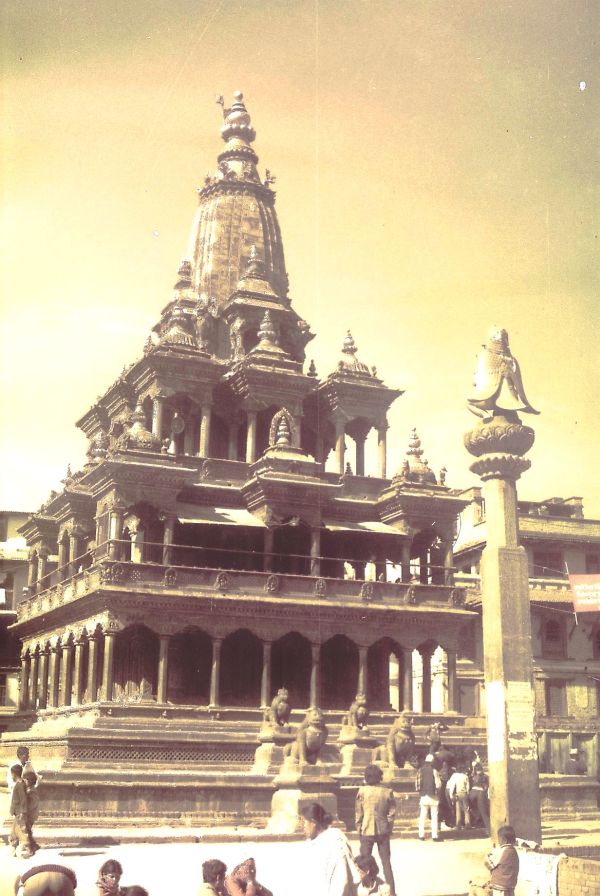
Krishna Mandir, Patan, 1986
On Janmashtami festival day, the Krishna Mandir in the town of Patan, near Kathmandu, becomes the centre of worship in Nepal. Built 388 years ago, this three-tiered stone temple is not only a centre of devotion but also a major cultural icon. Patan, also known as Lalitpur, is 5 km south-east of Kathmandu, Nepal’s capital.
The three Durbar (Palace) Squares of Patan, Hanuman Dhoka (Kathmandu), and Bhaktapur (all in the Kathmandu Valley) have been inscribed as World Heritage Sites by UNESCO in 1979. These Durbar Squares usually have palaces, temples and public spaces and are a fusion of Hindu and Buddhist culture which lends its own magic and charm.
Lalitpur / Patan still thrives as a centre of arts & crafts, especially of the Newar people, reaching its peak during the reign of Malla kings. The palace buildings, courtyards and the pagoda temples are a testimony to their craftsmanship. The Krishna Mandir within Patan’s Durbar Square is an exemplary example of their workmanship in stone!
Built entirely of stone, the Krishna Temple is said to be the first specimen of Shikhara-style architecture in Nepal. Unlike the many temples of Nepal that were predominantly built of bricks or wood, stone was used for the entire construction.
Not typically based on North Indian temple style, its two-bay colonnaded ambulatories make this temple unique. Though it is actually a heavy three-tiered stone shikara structure, yet it looks lighter and airy because of the ingenious arcades (chhatris) with screened parapets.
The Patan Krishna Mandir was raised between 1631 and 1637 by the Malla King Siddhi Narsimha Malla (ruled 1620-61) and consecrated on 23rd February 1637. Legends associated with this mandir say that the King dreamt that Lord Krishna with His consort Radha was standing in front of the palace. Therefore, the King ordered that a temple be built on the very location.
A decade later, the king won a battle with a neighbouring kingdom after praying to Krishna to defeat the enemy king. As a thanksgiving, the King is said to have built a replica of this temple inside the Sundari Chauk courtyard.
The Lalitpur Krishna Mandir is one of the oldest stone temples in Nepal (388 years ancient). The Nepal earthquake of April 2015 heavily damaged this temple as well, like many other structures in Nepal. An icon of 17th century architecture, it was painstakingly restored between 2015 and 2018. The temple met with a lot of structural damages, mainly in the top two floors that housed Shiva and Buddha.
It is to be noted that while in the past, many pagoda style temples had been reduced to rubble, this Krishna Mandir was damaged only during the 7.8 magnitude 2015 Nepal Earthquake. More than 900 heritage structures were damaged during this tremor which also caused over 8,000 deaths in the Kathmandu Valley.
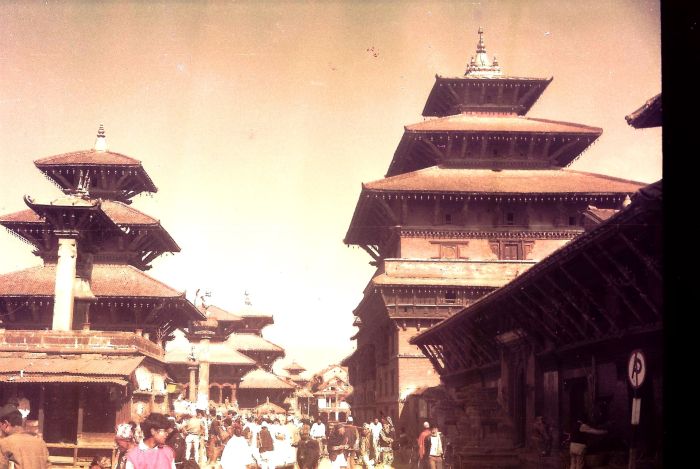
Durbar Sq.,Patan, 1986
The damage of this temple was so heavy that many suggested complete demolition and building a new temple, but the KVPT (Kathmandu Valley Preservation Trust), instead, decided to undertake restoration work. KVPT is an American and Nepalese charity that has worked since 1991 to preserve and restore the Valley’s extraordinary architectural heritage.
The Trust continues to improve the seismic strength of threatened structures, making the greatest possible use of traditional techniques in combination with unobtrusive new measures to help increase future safety and durability.
It was observed during examination by KVPT that the soft cornerstones had given up during the 7.8 magnitude earthquake. “The one on the north-west corner was in such a bad state it didn’t even exist.” The floor above the Krishna shrine was the worst hit by the earthquake. The pillars were damaged significantly along with the cornerstones which were supporting the floors above.
Restoration cost 5.7 million Nepali rupees (55,000 USD) and the temple reopened to pilgrims and tourists in 2018. The main funding for the temple came from the Gerda Henkel Foundation and the Japanese Embassy. Each cornerstone took two-three weeks to settle, as they had already been weakened by the 1934 earthquake; hence the major structural damage in 2015.
To avoid a repeat of such incidents, slow and steady progress was made this time. Expertise of local artisans of Patan and Bhaktapur was used in repair & renovation efforts. After 18 months of patient work, the temple was finally restored to its originality using traditional craftsmanship.
The first floor enshrines Krishna, the second Shiva (in the form of a Shiv Linga), and the third Lokeshwar (Buddha). The intricate & complex stone carvings along the beam above the first and second-floor pillar are most notable as they depict scenes from the epics the Mahabharata and the Ramayana. Depictions of the ten avatars of Vishnu can be seen at the ground-level gallery.
The Garudasthamba in front of the Mandir was erected by King Siddhi Narasingh Malla some ten years after completion of the temple. The Shikhara style buildings have stone clips on the corners, similar to the locks in the wooden temples. The first and second floors have eight chhatris each, with four more set on the tower’s four faces, totalling twenty. With the spire (kalash) atop the tower, there are 21 gilded spires on the temple.
On Krishna Jayanthi day, devotees throng the temple even beyond the midnight hour, singing the praise of Lord Krishna, as He was born at midnight on the eighth day of the dark moon of August which is known as ashtami. The temple surroundings glitter with the thousands of oil lamps lit by the devotees. The Krishna Mandir is managed by local Brahmins, and entrance is forbidden to non-Hindus.
I had the fortune to visit Patan Krishna Mandir in January 1986 (40 years ago) during a week-long trip to Kathmandu Valley; Nepal then was a Kingdom. I was then working in Gangtok, Sikkim. It was indeed a giddying experience to visit these Durbar Squares of Kathmandu, Patan/Lalitpur and Bakthapur. No doubt they are inscribed as UNESCO World Heritage Sites.
* S Balakrishnan wrote this article for e-pao.net
The writer is from Chennai and can be reached at krishnanbala2004(AT)yahoo(DOT)co(DOT)in
This article was webcasted on August 11 2025.
* Comments posted by users in this discussion thread and other parts of this site are opinions of the individuals posting them (whose user ID is displayed alongside) and not the views of e-pao.net. We strongly recommend that users exercise responsibility, sensitivity and caution over language while writing your opinions which will be seen and read by other users. Please read a complete Guideline on using comments on this website.


