


The Real Subject of Priyakanta Laishram's I AM SPECIAL Is Society
Daniel Sagolsem *
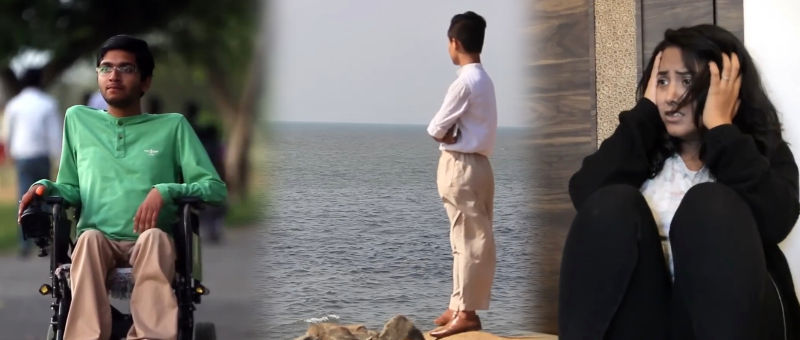
Priyakanta Laishram's I AM SPECIAL
Disability documentaries often begin with a straightforward objective: to help audiences understand the experiences of disabled people. Priyakanta Laishram's I AM SPECIAL (2017) certainly does that, but its most revealing observations lie elsewhere.
The film is less concerned with disability itself than with the ways society reacts to it. Again and again, it turns the camera away from medical conditions and toward the behaviours, assumptions, and responses that surround them.
Written, edited, and directed by Priyakanta Laishram, and produced by Harendra Laishram under the banner of Priyakanta Productions, the 47-minute English-language docufiction brings together documentary footage and fictional narratives involving individuals living with different disabilities. What connects these stories is not a shared diagnosis or a common struggle, but a recurring examination of how people respond when confronted with difference.
This perspective emerges most powerfully in the film's opening segment centred on the filmmaker's mother, Jibanlata Laishram, who lived with Amyotrophic Lateral Sclerosis (ALS). While the progression of the disease forms the backdrop of these scenes, the emotional force of the material comes from something less visible.
As her condition worsens, the audience gradually becomes aware of a shrinking social world. Friends and acquaintances who were once present begin to disappear. Relationships become quieter. Visits become fewer.
The film never dramatises this process through confrontation or accusation. Instead, it presents abandonment as an uncomfortable social reality that often accompanies long-term illness. People withdraw not necessarily out of cruelty, but because they do not know how to remain present in situations that cannot be easily resolved.
The result is one of the film's most perceptive observations: disability often reveals the limits of other people's comfort rather than the limits of the individual experiencing it.
The personal nature of the project makes its achievements particularly noteworthy. Laishram was only eighteen when he wrote, directed, and edited I AM SPECIAL, drawing inspiration from the experience of witnessing his mother's battle with ALS. Rather than processing that loss privately, he transformed it into a work that attempts to engage with broader questions surrounding disability and social attitudes.
Equally significant is the inclusion of Girish Asotra, whom Laishram befriended while studying in Chandigarh during his senior secondary years. By incorporating Girish's story alongside his own family's experiences, the filmmaker expands the documentary beyond autobiography, connecting personal grief with a wider exploration of disability across different lives and circumstances.
This attention to social behaviour continues throughout the documentary.

Priyakanta Laishram's I AM SPECIAL
The story of Girish Asotra, a young boy living with Duchenne Muscular Dystrophy, is particularly effective because it quietly exposes the expectations people attach to disability. His aspiration to join the Indian Administrative Service is presented without fanfare, yet it immediately raises a larger question.
Why should such an ambition seem surprising in the first place? The film does not provide an answer. Instead, it allows the audience to confront the assumptions that make certain futures appear more imaginable than others.
The fictional segments operate in a similar manner. A deaf and mute dancer, an autistic archer, a visually impaired singer, and a woman living with bipolar disorder are not presented as lessons or symbols. Rather than focusing exclusively on their conditions, the film places them within everyday situations where they must navigate the expectations, misconceptions, and reactions of those around them.
What distinguishes I AM SPECIAL is its refusal to construct simple moral divisions. The people who underestimate, misunderstand, or distance themselves from others are not depicted as villains. The film recognises that exclusion is often produced through ordinary actions rather than overt hostility.
A lowered expectation, an awkward silence, a patronising assumption, or an absence at a critical moment can be just as consequential as explicit discrimination.
This approach gives the documentary a degree of maturity that many issue-based films lack. Rather than searching for obvious antagonists, it examines the subtle ways society participates in exclusion while continuing to view itself as compassionate and inclusive. The result is a film that encourages self-examination rather than self-congratulation.
At the same time, the film's broad scope occasionally limits its ability to fully explore every story it introduces. The opening ALS segment benefits from a level of intimacy and sustained observation that naturally develops emotional complexity.
As the documentary expands to incorporate additional voices and experiences, some narratives are necessarily afforded less room to breathe. Several subjects leave a strong impression, but viewers may find themselves wishing for a deeper engagement with their lives and relationships.
This is ultimately a consequence of the film's ambition. Within a relatively concise runtime, I AM SPECIAL attempts to engage with multiple disabilities, personal histories, and social realities. While not every thread receives the same depth of exploration, the film's willingness to embrace that complexity remains one of its strengths.
The film also concludes on a thoughtful musical note with the end-credit song This Is Who I Am. Soulful without becoming overly sentimental, the song acts as a fitting companion to the documentary's central concerns.
Its lyrics speak of rejecting identities imposed by others and embracing self-definition, reinforcing many of the questions the film raises about perception, expectation, and individuality. Arriving after a series of stories shaped by misunderstanding and assumption, the song feels less like an attempt to inspire and more like a quiet affirmation of personal dignity.
What lingers after the film ends is not a particular statistic, diagnosis, or message. It is the recognition that disability is never experienced in isolation. Every story in I AM SPECIAL is shaped by families, friends, strangers, institutions, and communities. The film understands that the challenges disabled individuals face are often inseparable from the attitudes of the society around them.
Many documentaries ask audiences to learn about disability. I AM SPECIAL asks audiences to consider how they themselves respond to it. That shift in focus is what makes the film distinctive, and what continues to make it relevant years after its release.
* Daniel Sagolsem wrote this article for e-pao.net
The writer can be contacted at danielsagolsemwrites(AT)gmail(DOT)com
This article was webcasted on June 16 2026 .
* Comments posted by users in this discussion thread and other parts of this site are opinions of the individuals posting them (whose user ID is displayed alongside) and not the views of e-pao.net. We strongly recommend that users exercise responsibility, sensitivity and caution over language while writing your opinions which will be seen and read by other users. Please read a complete Guideline on using comments on this website.


