


A tribute to Ruskin Bond
Kongbrailatpam Rajeshwar Sharma *
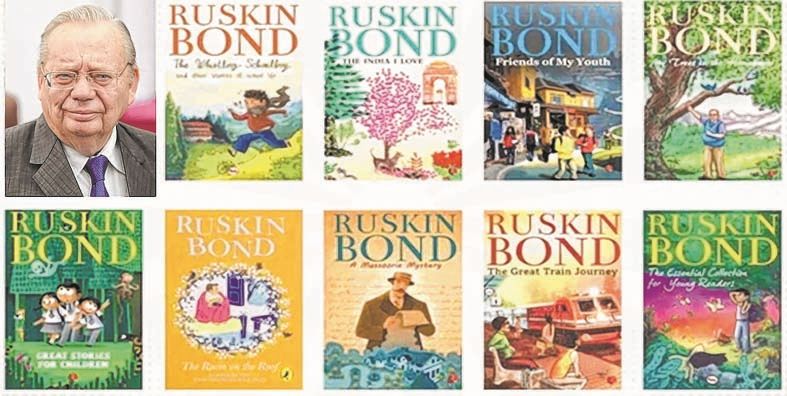
A tribute to Ruskin Bond :: Pix - TSE/ Kongbrailatpam Rajeshwar
As a young man in the late seventies of the last century, I used to be a movie buff who would hang around the movie theatres at Imphal to see if there were any new releases, particularly around Imphal Talkies one of the oldest movie theatres in the town, where western movies or rather Hollywood movies were shown.
James Bond movies based on Ian Fleming’s novels were favorites of mine. But one day I came across a short story in the JS (Junior Statesman) a popular magazine for the youths in the seventies, which was published from Calcutta now Kolkata.
It was my first encounter with a new genre of literature. As far as my memory can recall, the story took me on a train ride to the Terai region where the Gangetic plains of India touch the feet of the Himalayas as if to seek blessings from the majestic mountains.
Although I cannot remember either the title of the story nor its author, its imagery with sight, sound and smell still linger in my mind like the sweet scent of a Champak flower that keeps you revisiting your memory to be with your beloved as it is in Leo Sayer’s song – When I Need You.
Ruskin Bond’s short stories were not only my favorites but also my first taste of the ever tempting flavors of literature like the first love in one’s life. His short stories were to me the stepping stones to the world of literature where I can see and feel the beauty of Helen of Troy and the arduous journey of the Okies to California in Steinbeck’s novel, The Grapes of Wrath.
In the beautiful, captivating lines of Christopher Marlowe in Dr Faustus, Helen’s beauty is compared as
“O, thou art fairer than the evening air/
Clad in the beauty of a thousand stars; /
Brighter art thou than flaming Jupiter.../
More lovely than the monarch of the sky.”
Not only is Ruskin Bond the writer who makes the lives of ordinary people in the misty mountains of the Himalayas come alive with all the beauty of Mussoorie and its surrounding forests in his novels and short stories, but he is also a master storyteller. He is the only living legend who weaves story after story out of ordinary people and incidents that happen every day.
His stories enthrall the hearts of every story-lover young and old. They are a tapestry of love, romance, fairies, ghosts and children. As one reads his short stories, one can see and feel the lives of ordinary people that we take for granted, and more often do we forget them.
Take, for instance, the basket girl in The Night Train at Deoli who sells baskets not only catches the attention of the author but she enthralls the heart of the protagonist too. The momentary meeting between two former lovers - Sushila and Rusty in Love and Cricket - is a rare romantic incident that we sometime wish it happened to us. Similar moments of delight and longing are also captured in the other stories of Ruskin Bond.
Ruskin Bond is an Anglo-Indian writer who was born on 19th May 1934 at Kasauli in Himachal Pradesh. His biological parents were Edith Clerke and Aubrey Bond. When he was four years old, his parents got separated. Soon after their separation, Aubrey Bond married Mr Hari, a Punjabi Hindu businessman leaving young Ruskin Bond to his father.
He spent his early childhood at Jamnagar where his father worked with the Royal Air Force. At the age of ten, he went to live with his grandmother at Dehradun after his father died of malaria in 1944. He did his schooling at Bishop Cotton School in Simla from where he graduated in 1952. At the school writing competitions, Ruskin Bond won prizes such as Irwin Divinity Prize and Hailey Literature Prize.
In 1957 his first novel, The Room on the Roof won the John Llewellyn Rhys Memorial Prize, which was awarded to a British Commonwealth writer less than thirty years of age. In addition to these prizes, the Sahitya Academi Award was given to him in 1992 for his Our Trees Still Grow in Dehra. In recognition of his contribution to children’s literature, Ruskin Bond was awarded the Padma Shri in 1999.
Most of his stories are centered in and around Dehradun and Musoorie where he lives and grew up. There are autobiographical elements in his short stories and particularly in his novel, The Room on the Roof, where the protagonist, Rusty, an orphan, is nothing less than the author himself.
In the introduction to his novel, Ruskin Bond writes, “Dear old room on the roof, I can’t say I miss it (it was horribly hot at times), but I feel a certain nostalgia for that little barsati where I spent an important year of my life.” The novel is about “adolescence by an adolescent” It was written when the author was 19 years old and when he was “naïve, trustful, eager for love and friendship.”
The love between Mrs. Meena and Rusty is born out of their ardent desire for love and friendship. In Rusty, she can find love that she does not get from her drunkard husband, Mr Kapoor. And Rusty too gets from her what he desires. “Yes, it was written out of the loneliness of a young person longing for love and family” writes Ruskin Bond.
In The Woman on Platform No. 8 too, the longing of the author for parental love and care is reflected in the stranger woman’s love and care shown to Arun, the twelve-year old school boy who waits alone for the train in the middle of the night at the Ambala station.
The woman in white sari, on the other hand, is the personification of the author’s longing for a mother whose love and care that Ruskin Bond missed in his childhood. It is like Charles Lamb’s Dream Children: A Reverie where Charles Lamb imagines having his own children – John and Alice, and tells them stories about their great grandmother, Mrs. Field. Like most men and women who seek solace and happiness in day-dreams, Ruskin Bond tells us stories which are woven out of his imaginations filled with real characters and spices of life – love, laughter, romance and sorrow, to fulfill what he missed in his childhood.
Ruskin Bond loves humanity. This is evident in his stories which are filled with characters drawn from the lives of ordinary people – beggars, villagers, thieves, vendors and basket-girls who sell baskets at train stations.
He writes about the poor, middle-class men and women, and describes their lives. Ruskin Bond is also a humorist. He pokes fun at human follies as humor is part and parcel of human lives. Not only does Ruskin Bond describe the lackluster lives of ordinary people, but he also studies their attitude, behavior and relationships with others.
Moreover his stories try to explore human relationships characterized by human feelings such as love, sorrow and anger. Besides studying human relationships, Ruskin Bond observes nature and its relationship with people, which can be seen amply in his stories.
In The Last Tonga Ride, he even tries to make friendship with an old bunyan tree. His short stories and novels reveal not only his childhood, but they also tell us that he is a master craftsman who weaves stories out of his childhood.
* Kongbrailatpam Rajeshwar Sharma wrote this article for The Sangai Express
This article was webcasted on August 06 2026.
* Comments posted by users in this discussion thread and other parts of this site are opinions of the individuals posting them (whose user ID is displayed alongside) and not the views of e-pao.net. We strongly recommend that users exercise responsibility, sensitivity and caution over language while writing your opinions which will be seen and read by other users. Please read a complete Guideline on using comments on this website.


