


Development and poverty among tribal people in India
ZK Pahrü Pou *
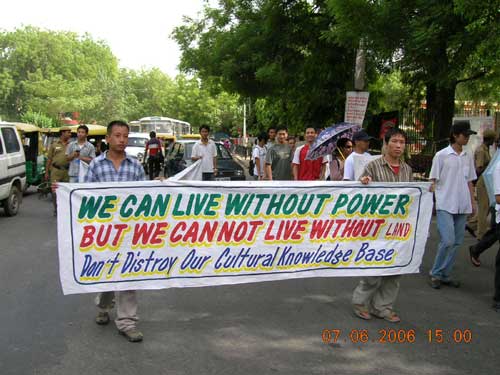
Silent Rally Against The Tipaimuk Dam In New Delhi in 2006 :: Pix - Thangja Lun
Tribal people are often considered as a 'blockage' towards development and progress. Development, like growth, corresponds to different meanings. However, the ideology of 'development' is generally used and rightly understood as 'dominant development paradigm' that brings only negative effect on the tribals. Although it is considered as an essential part of enhancing economic growth through which social justice can be brought in, its experience of today is of anti-poor and pro-rich.
According to a noted Indian economist C.T. Kurien, poverty does not continue to exist in spite of "development" but because of it. The state has consistently using development concept to solve poverty problem in India especially in the tribal areas. Because of development there has millions of tribals are displaced. Development which boasts of as 'progress' and 'modernity', on the one hand deprives the tribal people of the right and access to resources and the same time destroys the non-renewable natural resource base rapidly.
In India many development projects such as construction of roads, airport extension, uranium mining for industries, dam construction etc., have forcefully dislocated/displaced millions of people. The World Commission on Dams, estimates that 40 million to 80 million people have been physically displaced by dams worldwide, a disproportionate number of them being indigenous peoples. Indeed, this 'development cleansing' may be well constitute ethnic cleansing in disguise, as the people dislocated so often were from minority ethnic communities. In India, 40 per cent to 50 per cent of those displaced by development projects – a total estimated at more than 33 million since 1947- are tribal people.
In the case of Sardar Sarovar project- the number of displaced tribal stood at 57.6 per cent. North East India which has large concentration of tribal population is facing the heat of development today. Arunachal Pradesh government has signed hundreds of MOUs for dam constructions with companies. Such dams would have destructive effect on the people, its livelihoods and ecological balance. Timothy Z Zote wrote about the Tipaimukh dam in Manipur thus: "The Government's final decision for the construction of the Timaimukh Dam is really a knell to the affected people of Tipaimukh Sub Division. Economically or politically, the Hmars, inhabitants of Tipaimukh Sub-Division will certainly be exploited by the outsiders who are more advanced. Half of the population will leave the place for some economic and political reasons, almost half of the land, orchards, gardens and public jhum land will either be submerged by water or will be acquired for township, colonies or other types of construction."
The Barak River on which the Tipaimukh dam is contructed is the life line and their mother who gives them all domestic needs in season and out of season. For the Hmars and Nagas tribes living on the bank , the river has been the carrier of uncountable source of income and wealth to the people, and in return this river carries away poverty. The people sell their agricultural products in Silchar and carry their domestic needs through this river; their economic activity entirely depends on this river. Therefore, the construction of Tipaimukh Dam means the destruction of the economy of its inhabitants.
Another example of a development project that affect the tribal people in Manipur is Khuga Dam (multi-purpose project). In the construction of the Dam, many villages and households had been affected and displaced. The people especially the meiteis, who had been allotted land under the provision of the MLR & LR Act 1960, are made genuine land owners. Such people only got land compensation. The tribals who had been living there even before the framing of the land laws and owned the land on the basis of the traditional and customary laws are made encroachers in their own land. The extension of the Act had deprived the people of ownership of land based on traditional and customary practices.
Government of North eastern states have allowed Special Economic Zones (SEZ) to be set up in their states as part of economic development. The Indian government in collaboration World Bank is constructing new roads almost every part in NE India. With its Look East Policy (LEP), the Indian government is planning for transnational highways which would cross through Arunachal Pradesh to China, Nagaland to Myanmar and Manipur to Thailand and Malaysia.
The poor tribal will be wipe out from their own land as is happening in many parts of mainland India (as in Narmada valley and Chhattisgarh, Orissa etc). An intensive research needs to be done about these projects to educate the rather ignorant tribal people about the benefits and ill-effects of such development in the region. Certain quarters and concerned individuals have already started to raise voice about the dangers of such development works in the region. Many villages will be wiped out by developmental projects. Traditional livelihoods will be destroyed. Social system will be broken.
Such development will intensify commercialization of natural resources that has been already threatened by money-oriented economy in the region. Only few will people (both local elites and outsiders) will become richer at the expense of poor masses. India state has been ruthlessly efficient in the way it has appropriated its resources –its land, its water, its forests, its air – and redistributed it to a favoured few (in return, no doubt, for a few favours). While the government is keen to alleviate mass poverty through development, tribals fear that this could lead to gain control over their lands.
Today, India's poorest people are subsidising the lifestyle of her richest. Most tribal people have no formal title to their land and therefore cannot claim compensation anyway. They were forced to migrate to cities and end up in slums. The price of the mega development projects has been paid by the rural poor, particularly the tribal, the Scheduled Castes and the other landless category of people. They have paid the price in terms of their dislocation and consequent dispossession in the event of meager compensation by the State for their losses.
Arundhati Roy said that contrary to what we were often told in public speech that India lives in her villages, in fact, India doesn't live in her villages. India dies in her villages. India gets kicked around in her villages. India lives in her cities. India's villages live only to serve her cities. Her villagers are her citizens' vassals, and for that reason must be controlled and kept alive, but only just. If India wanted to remove mass poverty among the tribal people, reviving, protecting and enhancing village economy is a must. Without this, various welfare schemes of the state (mostly given through cash) alone will not be able to solve the problem.
Under the patronage of government, the corporates are taking over everything –water, electricity, minerals, agriculture, land, telecommunications, education, health –no matter what the consequences. Almost everywhere in India, the tribal people are struggling with one problem or the other as their very survival is threatened. The Dongria Kondh tribe in Niyamgiri region was fighting against the giant company Vedanta from mining bauxite. The government allows "market forces" to mine resources "quickly and efficiently" in most of the mineral rich regions of tribals.
The tribal lands are forcefully acquired and turn it over to private mining corporations which is illegal and under unconstitutional under the Panchayat (Extension to Scheduled Areas) Act or PESA. Passed in 1996, PESA is an amendment that attempts to right some of the wrongs done to tribal people by the Indian Constitution when it was adopted by Parliament in 1950. It is a law that acknowledges the deepening marginalization of tribal communities and is meant to radically recast the balance of power.
As a piece of legislation, it endowed the community -the collective- a legal entity and it confers on tribal societies who live in scheduled areas the right to self-governance. Certain powers were conferred to gram sabha such as management of community resources, resolution of disputes, approval of plans and programmes and mandatory consultation before the acquisition of the land. The gram sabha is also entitled to ownership of minor forest produce, enforcement of prohibition, restoration of unlawfully alienated lands, control over money lending and marketing., etc under PESA. Under PESA, "compulsory acquisition" of tribal land whether it is for reserved forests, mining, or for any other developmental projects cannot be justified on any count.
In spite of this provision, tribal people continue to suffer in the name of development. The adivasis and the tribals' lands are being grabbed and distributed to the rich for Special Economic Zones (SEZs). In places like Lalgarh, the tribals held a stiff opposition to land grabbing by the rich companies who works in connivance with the state government. People who dreamt of equality and justice and who demanded land to the tiller are often branded as 'Maoist' or 'insurgents" and are booked under criminal laws.
The armed forces, the state controlled media, the state and the companies all work together to grab the resources of the poor tribal and at the same justify this act in the name of development. Economic growth based on heavy industry, mega dams, steel industry, transnational highways, etc, has ecological concern on which the lives and livelihoods of the tribals depend. Destroying ecological health is tantamount to destroying tribals' lives and livelihoods as they have symbiotic relationship with forests, land and rivers.
So often our government interprets poverty as lack of cash to buy food. This belief has destroyed forests, rivers and land for growing cash crops. By growing cash crop, it is believed that more money will be earned, income will increase, and living standard will be raised. But it turn out to be opposite for the majority poor.
Seeing poverty simply as a lack of cash is dangerous. This is abolishing food security. Cash incentive is given to the people and they were told to buy food. Land resources and other productive are privatized and commoditized to make more money. People have to search job in order to earn. This is unreasonable. If public investment in agriculture sector is neglected, agricultural land and forest diverted for other commercial purposes, poverty and high rate of unemployment will be the fate of poor masses.
The deficiency of understanding poverty in terms of cash poverty is that it directed all economic policies and activities are turn towards earning money. Growth in that condition will not be able solves mass poverty. It will benefit few at the expense of the majority poor. Cash crops have been intensively encouraged to earn money and buy more from the market. This will uproot them from their subsistence economy. Giving money directly to tribal people is likely to destroy their food security rather than solving poverty problem.
The plan of government to give cash in lieu of subsidised food and kerosene directly to the poor is not going to help the poor tribal. Even the money that comes through NREGA has been used unmindfully like buying mobile phones, eating and drinking and gambling and so on. This makes them lazy too. In spite of its defects, such welfares schemes are necessary, but it should not be taken as a sure way to solve poverty problem in the country. Proper education and awareness about various schemes and its importance towards enhancing their living standard needs to be given to the tribal people. This calls for the involvement of civil societies, NGOs and leaders from the grass-root level.
Lack of money to buy minimum needs cannot be the only yardstick to measure poverty in the tribal area. It is imperative to look poverty from food security perspective especially when it relates to tribal people. This calls for investment in agriculture and its allied activities which will be of great help towards solving mass poverty if such is taken up in accordance with the tribal knowledge and ecological viability.
The government negligent attitude towards agriculture and its allied activities is a cause of great concern. This will leave millions of workers unemployed and hungry. Protection of the commons (land or forests or rivers) from privatization and restriction of mega developmental projects is a must in protecting and promotion of tribal people. In many parts of North East India, where forests and other resources are completely at the control of local people, deforestation takes place partly due to poverty on one hand and commercial interest on the other hand. There is a need to makes them realize about the importance of conservation of forests as they have been doing since long. Proper education will lead them to preserve and nurture forests. This would lead to sustainable living.
Perhaps it is time to revisit Gandhi's vision of Gram Swaraj which has ecological relevance, empowerment of local masses through decentralisation of planning according to local needs. But one must not neglect the problem of internal class, caste and patriarchal divisions of traditional society on an organisational level. Decentralised local initiatives, flexibly determined by local needs, resources and opportunities may be better way of dealing with poverty. To alleviate poverty therefore is not an individual enterprise. We all need to put our heads together and fight against global capitalist force from grass root level.
Arundhati Roy, a writer activist, aptly put it this way: "Most important of all, India has a surviving adivasis [Tribals] population of almost 100 million. They are the ones who still know the secrets of sustainable living. If they disappear, they will take those secrets with them....If there is any hope for the world at all, it does not live in climate change conference rooms or in cities with tall buildings, it lives low down on the ground, with its arms around the people who go to battle everyday to protect forests, their mountains and their rivers because they know that the forests, the mountains and the rivers protect them."
* ZK Pahrü Pou wrote this article for The Sangai Express
This article was posted on April 15, 2013
* Comments posted by users in this discussion thread and other parts of this site are opinions of the individuals posting them (whose user ID is displayed alongside) and not the views of e-pao.net. We strongly recommend that users exercise responsibility, sensitivity and caution over language while writing your opinions which will be seen and read by other users. Please read a complete Guideline on using comments on this website.


