


Lai Haraoba : Moirang Haraoba
Moirang and Ebuthou Thangjing :: Part 13
Hemamcha Shobha *
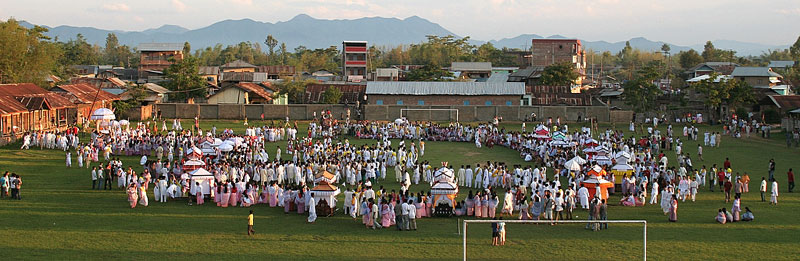
Ibudhou Thangjing Haraoba @ Moirang, Manipur in April 2007 :: Pix - Recky Maibram
LAI HARAOBA
Manipur is a land of varied and bountiful festivals. Some of them are of Hindu origin and are painted as mosaic of national festivals. But the traditional form of Lai Haraoba in Manipur along the original and ancestral lineage is an established institution in Manipuri society and it can not be easily separated from the Manipuri folks or people.
Every year, mostly during summer season the hill and the plain people worship their gods and goddesses in celebrity since early period. Traces to the originality and institutionalization of Lai Haraoba in Manipur are being carried out and undertaken by the scholars and Maichous and from them it may be concluded that it is a peculiar kind of worship which is more socio-cultural in character and less religious.
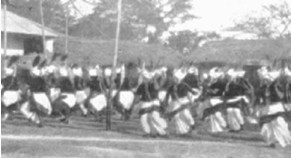
Phamnaiba Dancing in 1933 before Thangjing God. Courtesy: J. Shakespear
Lai Haraoba festivals in modern times have departed from their traditional character and scientific philosophy behind these festivals as was before is being diluted with the negative additives of more festive human pleasing moods and programmes implicating Laiyingthou and Lairembi as cheap God and Goddess, more materialistic than philosophical and less divine in the eye of ordinary viewers. Those people to whom institution of Lai Haraoba in Manipuri society is new will hold out of their witness of the festival that it is not a festival of God, rather, a festival of people.
Such an opinion would expose the core value and inner meaning of Lai Haraoba festival into the wilderness of misinterpretation. Indeed, it is a not a festival for the human folks to please themselves, but to please their worshipping God or Goddess. In this respect, it may be pertinent to refer to the opinion of an eminent scholar, Moirangthem Narendra of Khokman. He interpreted Lai Haraoba as 'the revival of ancient culture' and propounded two reasons behind the performance of Lai Haraoba festival-first, through it the worshippers/people get salvation; secondly, it speaks into the tracing of origin of a common social group.
As such, Lai Haraoba is the kind of practice and performance by the common social group imitating the past deeds and way of the life of the Creator in Whom they believe. In a sense, it is the demonstration of the way of life in the form of replay-like-display of the activities of Laiyingthou and Lairembi performed by the common social group in festive mood to please Him/Her recollecting His/Her remote past.
It is a natural, scientific and common sense that a soul is pleased when there is prayer and offering to it. It is still in obscurity to establish or identity the exact date which could watermark the first performance of Lai Haraoba where Amaiba, Amaibi, Aseiba and other participants performed their respective roles to please the worshiping Gods or Goddesses.
What it can be concluded is that it has become a precedent in which they were the only performers before the respective Gods or Goddess to exercise a prophetic or narrative role of linkage with Gods or Goddess, a holy messenger from Them to the worshippers, a pious interpreter of Their word, oracles or divine pronouncements before and during the festival, sometimes dispelling the mode of special offerings or prayer, even mitigating remedies or waivering grievances endowed to selective worshippers or community at large by the spirit of evil or omen and showering blessings and benedictions to the worshippers for prosperity and welfare of the worshippers or social group.
In most cases, evolution of human kingdom on earth is linked up with, or related to the festival of Lai Haraoba often associated with the creation of Leibak (Earth), Nongthou (Heaven) and other prerequisites for living creatures including human beings. It is, more or less analogous with the theory or concept of Five Essentials of Hindu Philosophy. Here lies the core value and significance of the festival of Lai Haraoba with religious and philosophical foundations amenable to the advocacy of a scientific theory in modern times regarding origin and evolution of mankind or the universe.
In another scholarly work of Moirangthem Narendra on Lai Haraoba published in a souvenir "Tengbanbagi Yaon" (Cosmic Evolution) in 1980 he wrote three kinds of Lai Haraoba prevalent in Manipur today. They are - Kanglei Haraoba, Chakpa Haraoba and Moirang Haraoba. He viewed that the three kinds of Lai Haraoba have some common character and more or less similar inner ideas but vary in the mode of performing their respective festivals, praying (hymning) and offerings in accordance with the social and cultural set up, customs and traditions in vogue in their respective kingdoms. Neverthless the three kinds of Lai Haraoba have been in vogue in Manipur and are interwoven into the socio-culture fibres of Manipuri society only to contribute to the rich cultural heritage of its people.
Moirang Haraoba
Genesis of Thangjing Culture
Ever since Thangjing Koirel Ningthouba established a strong and powerful Kingdom of Moirang several godly kings or divine human beings became kings and were thought to be the rulers over an unaccounted period but many centuries together in the ancient history of Moirang. Due to lack of written records in detail about the social, political and administrative affairs of the Moirangs during the unaccounted period before and after the reign of Iwang Puriklai Ngangningshing or prior to the coronation of Iwang Puriklai Phang Phang might be in the process of rebirth and regrowth, sometimes continual and sometimes uninterrupted in character.
As such, it could be treated and included in the Pre-historic Periods of the Moirangs. However, there are some specific descriptions and writings about Eputhou Haraoba and His ritualistic ceremonies and prayers and these outsources are available in a few Puyas. Accordingly, Haraoba of Thangjing Koirel Lai is found celebrating through the ages in different names and styles. Locally it is known as Lai Haraoba or Kalen Haraoba. To different sections of people living in Manipur and outside it is commonly known as Moirang Thangjing Haraoba or Moirang Haraoba.
Moirang Haraoba has its own unique features. The main origin is "all about the creation of Earth, Mankind, Living Beings and other forms/things related to cosmic evolution by the divine power of Eputhou Thangjing" as opined and found in the writings of late Amaiba Hanba, Maibram Sekho of Thangjing Amaiba Loishang of Moirang.
The Moirangs worship Thangjing Koirel Lai as their Great Grand Father and creator of Moirang as well. As mentioned earlier, it is one of the three kinds of Lai Haraoba of Manipur. In a real sense, it is a festival to celebrate His traditions, customs, culture and others associated with Him during the creation of human kind.
Late P. Ibohal Singh, founder editor of the journal, The Yageirel supplemented and held that Thangjing Haraoba is mainly "based on social, cultural and traditional offerings and prayers related to the creation of mankind, learning the art of cultivation, manner of drink and eating, introduction and use of clothes etc. which would, in the succeeding generations culminate into the heritage of Thangjing culture".
It is noticeable in the course of festival of Thangjing Haraoba that religious and ritualistic items, prayers and offerings are performed and presented before Eputhou and Ebenthou and other Laibungthou and Lai Nura attending the festival. It implicates two aspects--on one hand, it is a festival dedicated to their pleasure and on the other, it is a festival for beseeching blessings from them for peace and prosperity of the cosmic mankind.
Against this philosophical backdrop it is not wrong to say that Moirang Haraoba or Thangjing Haraoba is the genesis of Thangjing culture which was set into institutionalization since the period ruled by divine personalities and followed by the ancient kings of Moirang and nonthless, in modern ages by the people, devotees, and concerned authorities.
However, it will be interesting and even exalting to go deeper into the account from the Puyas which have thrown light on the origin and uniqueness of Eputhou Haraoba. It was started celebrating the festival for the first time by three divine rulers of ancient Moirang namely, Thonglen Haying Khoicha, Kayaba and Yangkhongjamba.
In this connection, it was written in the old texts that functions, duties and charge were distributed among those functionaries or personalities for performing the Haraoba Festival. In the pre-historic time, a well-organized system on democratic norms was found to have been practiced in the kingdom of Moirang which was believed to have been established by Thangjing Koirel Lai. Different duties and functions were allotted to so-called Hanbas who would be in charge of specific allocations and those Hanbas discharged their duties accordingly in the form of division of labour as found in modern society.
With the head of each department named as 'Hanba', a suffix meaning 'leader' or 'eldest' different Loishasngs (Departments) did their duties well. For the purpose of Eputhou Haraoba there were three Loishangs namely Amaiba Loishang, Asheiba Loishang and Yoirenba Loishang and were headed by officers respectively as Amaibahanba, Aseihanba and Yoirenhanba.
Allotting the duties in such a way among themselves Thonglen Haying Khoicha took the charge of Amaibahanba, Kayaba was in charge of Aseihanba while Yangkhongjamba took the charge of Yoirenhanba. All priestly works of the festival were done by Amaiba Hanba and Yurenhanba; Aseihanba performed Yakeiba. Establishing or combining the three departments or Loishangs may aptly be termed as the origin of Thangjing Cultural Institution so that modern historians or scholars could conveniently undertake their investigations deeper and further into the origin, character and institutionalization processes of the festival of Moirang Haraoba.
By speculation and pragmatism there stands to prove that Moirang Haraoba might have been performed through a long unaccounted period in the pre-historic time of the Moirangs. It was only during the reign of Iwang Puriklai Phang Phang Ponglenhanba, the 8th king of Moirang who was coronated on the throne of the kingdom of Moirang in 52 BC that Eputhou Haraoba was started to have been performed for the first time by human worshippers.
Maibram Sekho in his account said that Thangjing Koirel Lai wished to have a permanent abode and Haraopung or festival site in Moirang. His wish was heralded in a dream to Khuyol Mori Phaobicha, the first human priest that Chingoo Yaikol (means Abode/Temple cum Festival complex) be founded in a soil to the south of Keke Khori Keithel. The soil is the site which is, at present known as Eputhou Thangjing Laikon.
It is also known as "Amaiba Chamma Pongbei-Sang. Aseiba Chamma yaka-Sang". It means a temple to be thronged by hundreds of priests and to be attended by hundreds of singers. The Maibahanba opined further that the singers included drummers, flutterers and Pena Sakpas. In this account he mentioned that in the early Hayichak Moirang Haraoba started from the first Sunday of Sajubu, the first month of Meitei Calendar but later in Konchak it was changed to be celebrated in a summer month-Kalen, the second month of the calendar.
Though different in the timings of celebrating Haraoba festival philosophy, tradition and mode of worship etc. do not deviate from the established 'cultural institution'. It is believed that some changes might occur in the matter of appointment of the posts/functionaries of different Loishang, management of affairs and properties of Eputhou Thangjing during the periods when the Ningthouja dominated and subdued the Moirangs. However, system, tradition and mode of celebration of the festival have not undergone any sharp changes owing to the will and wishes of Eputhou Thangjing.
to be continued ....
About the Book:
Source Author: Hemamcha Shobha (b.1941), President of Moirang Thangjing Yageirel Marup [Register No: 1025/1972] and Chief Editor of 'Yageirol'.
Reproduced from Chapter - 3 of his book 'Moirang and Ebuthou Thangjing'
for public reading by: Shanjoy Mairembam, London (UK), shanjoym (at) gmail (dot) com
* Shanjoy Mairembam , resident of UK, regularly contributes to e-pao.net. He is sharing this book for public consumption and can be contacted at shanjoym (at) gmail (dot) com
This article was webcasted on July 18 2012.
* Comments posted by users in this discussion thread and other parts of this site are opinions of the individuals posting them (whose user ID is displayed alongside) and not the views of e-pao.net. We strongly recommend that users exercise responsibility, sensitivity and caution over language while writing your opinions which will be seen and read by other users. Please read a complete Guideline on using comments on this website.


