


D.M. College : It's history and legacy
- Founded on August 6, 1946 -
Dr Syed Ahmed *

Statue of Maharani Dhanamanjuri at DM College in Imphal city on February 19 2015 :: Shankar Khangembam
D.M. College was founded 79 years ago on August 6, 1946. The college was established by the efforts of a handful of modern-educated Manipuris. The college soon became one of the most prominent institutions of higher education in NE India. And it became the hub of academic, political and cultural activities in the State.
The college has, over the decades, produced numerous graduates in various disciplines, who shaped the history of modern Manipur. The college has the distinction of producing several politicians, including legislators, Ministers and even Chief Ministers, bureaucrats, engineers, academicians in different disciplines, artists, sportspersons, social activists, etc.
Establishment of D.M. College
In the 1920s and early years of 1930s, a handful of western-educated Manipuris felt the urgent need of establishing an institute of higher education in Manipur. During those days, after completion of high school education, one had to go outside Manipur for higher education. Therefore, modern education was a privilege only for the students who belonged to well-to-do families.
In 1932, a Foundation Governing Body was constituted, which included:
1. Capt. C.W.L. Harvey, M.C., I.A., President of Manipur State Durbar (1930-1933)
2. Sougaijam Somorendra Singh, Durbar Member, as Member
3. Lairenmayum Ibungohal Singh, Durbar Member, as Member
4. Sanjenbam Nodiachand Singh, Durbar Member, as Member
5. Jamini Sundar Guha, Head Master of Johnstone High School, as Member
6. Hidangmayum Dwijamani Dev Sharma, a Sanskrit scholar, as the Member Secretary
Initially, Capt. C.W. Harvey allotted a plot of land for the college at Kwakeithel, now in Imphal West District, by the side of the Tiddim Road, while the elder brother of Maharaja Churachand (1892-1941), Raja Dumbra Singh, assured to built a library for the college. Later, Capt. M.K. Priyobrata, member of the Manipur State Durbar (in-charge of Education), and the second son of the then maharaja, approached the then Political Agent, G. Grimson, Esq. ICS (1933-1946), and requested the land northward of the western Kangla to be de-notified for the construction of the college.
The request was granted. The college campus was officially founded (as an Arts College) on August 6, 1946. However, the building of the college could not be constructed due to shortage of fund. The Government approached Maharani Dhanamanjuri Devi (1886-1975), the spouse of Maharaja Churachand, for fund. She donated a sum of Rs. 10,000. The construction of the building commenced. The college was thus named after the queen.
In 1945-46, few more members were inducted in the Foundation Governing Body, which included:
1. E.F. Lydall, Esq. M.A. ICS. President
2. M.K. Priyabrata Singh as Maharani’s Nominee
3. Waikhom Chaoba Singh as Member
4. Mayengbam Radhamohon Singh as Member
5. Athiko Daiho as Member
6. Qazi Md. Walliullah as Member
In the early days, the classes of the college were held at a hall of Johnstone High School (established in 1885 by Political Agent, Sir James Johnstone) with 68 students. Calcutta University gave the affiliation in 1945, later transferred to Guwahati University in 1949. The construction of the main building, which is now a part of D.M. College of Science (now the conference hall), was designed by a German architect (name could not be traced).
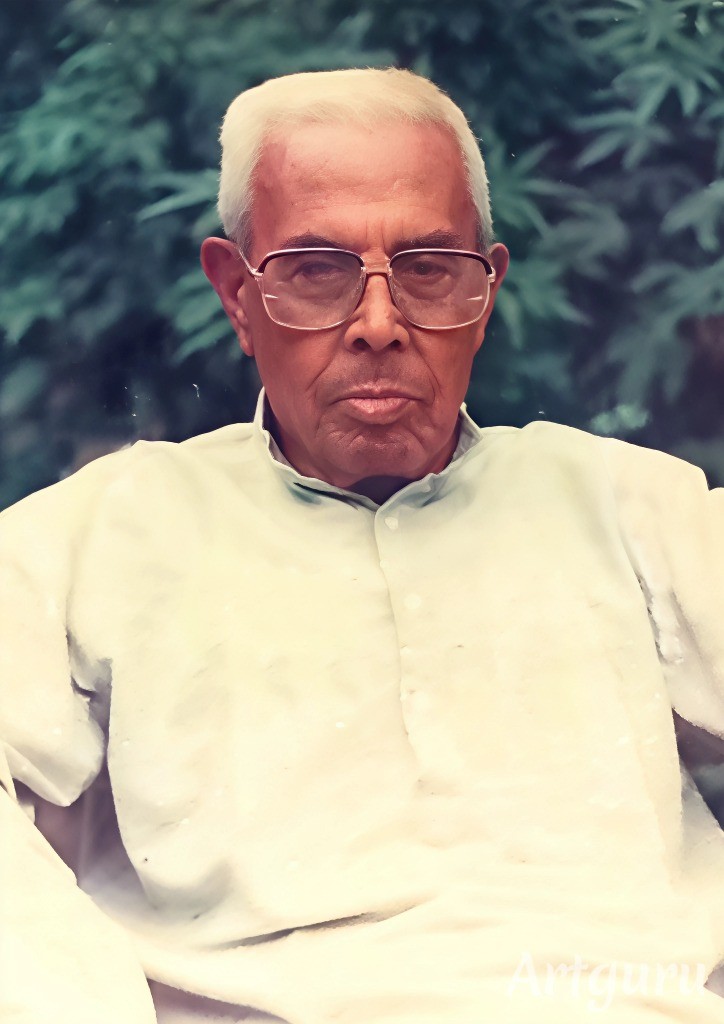
H. Dwijamani Dev Sharma
Dwijamani Dev Sharma had recorded the early history of the setting up of the college. Sadly, this piece of history has remained unnoticed to many for long. His valuable memoir, My Reminiscences (translated from Manipuri into English by Ch. Manihar Singh, 1986), accounts the early history and the difficulties faced in the establishment of D.M. College.
As per the account, D.M. College, the first college in the State, was established as a private college, named Manipur College. It came into being with public funding. However, there was acute shortage of fund. The founder members approached Maharani Dhanamanjuri, who offered the amount of Rs. 10,000 for the college. On July 1, 1948, the State Government took over the college, against the wishes of Dwijamani Sharma and other members of the Governing Body. An excerpt from his memoir is reproduced below:
A college for imparting higher education to those coming out of the high schools was the need of the hour. And it would verily be two strings to one bow as referred to above. I first broached the matter with Sri Sougaijam Somorendro Singh and Sri Lairenmayum Ibungohal Singh, and they were soon convinced of the urgency of the matter. Encouraged by them I sought the view of Capt. C. Harvey the President of Manipur State Durbar. He was a decent person with a broad outlook for social development.
Having talked with him I could realise that he was closely following the views and comments on social and political problems regularly brought out in the Yakairol. He was also one not to fall in with the unjust policy of the authorities. After listening to me he happily welcomed the proposal for establishing a college in Manipur and readily accepted my request to chair the governing body of the college. On the advice of himself and the two gentlemen mentioned above the Foundation Governing Body was constituted in 1932 with the following members:
Capt. C.W. Harvey – President
Sougaijam Somorendra Singh – Member
Lairenmayum Ibungohal Singh – Member
Sanjenbam Nodiachand Singh – Member
Jamini Sundar Guha – Member
Dwijamani Dev Sharma – Member – Secretary
Correspondences and papers relating to the proposed college were lost during the chaos of the Second World War. However, except for a few minor details, I am sure of my ability to present a true picture of the succeeding events from my memory. In between the first formation of the Foundation Governing Body and the actual establishment of the college there were change now and then in the members according to convenience and the demand of circumstances.
Though unable to recollect all the names of those dedicated social workers at this hour I, on behalf of the Foundation Governing Body, express my deep gratitude to them. To mention a few: the late Panditraj Atombapu Sarma, Sri Hijam Irabot Singh, Sri Hijam Angouba Singh, Sri Khumanthem Mohendro Singh actively worked as members of the governing body. Maharaj Kumar Priyobrata Singh, Sri Mayengbam Radhamohon Singh and Maulvi Basiruddin were also associated with it.
It shall be in the fitness to say that Dhanamanjuri College, the premier institute of higher education in Manipur, and well known in Assam and other adjoining parts of north-eastern India, is the cherished fruit of a long and strenuous effort of the governing body. As it is now a government-run college the younger generation harbours the wrong notion of it being established by the Government of Manipur. Unfortunately, at present few seem to have a clear background of how the governing body suffered and crossed great obstacles in bringing about the establishment of the college. Even those existing persons who had a personal knowledge of all the selfless persons who worked for the college have gone the way of all flesh leaving me alone; I feel it obligatory on my part to reduce my recollections to writing.
Manipur College was its first name. When I approached the public for funds of the great cause it was greeted with overflowing response and unprecedented joy. Government servants, businessmen and the masses were one in their bid to contribute their mite. Thus within a brief span of time a few thousand rupees could be collected. The President of Manipur Durbar allotted a beautiful plot of land for the college complex at Kwakeithel near Gouro Singh Khongnangkhong by the side of the Tiddim Road.
Raja Dumbra Singh Senapati, the elder brother of the Maharaja and an earnest advocate of higher education, promised a befitting library for the college. This act was a source of encouragement to us and we set great store by it. A few generous persons with post-graduate degrees came forward to serve the college free till it can feel its leg. Though unstinted supports were extended by the President and members of the State Durbar, those belonging to the royal family and other respectable families, the Political Agent and the Maharaja were reticent. It was yet difficult to study their mind and judging by their earlier stand this caused much anxiety to the members of the governing body. However, undeterred they proceeded unflinching in their purpose.
… I had an audience with Maharani for the second time accompanied by Sri Sougaijam Somorendro Singh and Sri Lairenmayum Ibungohal Singh and soon a deal was struck. The Maharani would donate then thousand rupees and the college be named after her. It was placed before the governing body and was approved out-right. The next day it was made known to the public and everybody was rejoiced at it. They spoke highly of the Maharani’s generosity, the more so when she came out with a defiance of the suppression of higher education. Now who shall be more confident than us?
… On May 10, 1942, Imphal was bombed by the Japanese planes. Many innocent civilians were killed and wounded; houses were burnt and properties lost. Within hours of the raid people left their homesteads and took shelter in remote villages leaving the town to the hands of army men and the dacoits. The whole town wore a devastated and forsaken look. My office too was not spared; the numerous papers relating to the college were destroyed as a result of depredations by the army personnel. On the other hand the bank which had the college money in its custody was looted after it was hit by a bomb.
(After the war Dwijamani Sharma retired from service. Mr Lydall, the President of Manipur State Durbar, who began to show interest in the college, sought the former to meet him. Mr Lydall assured to help Dwijamani Sharma)
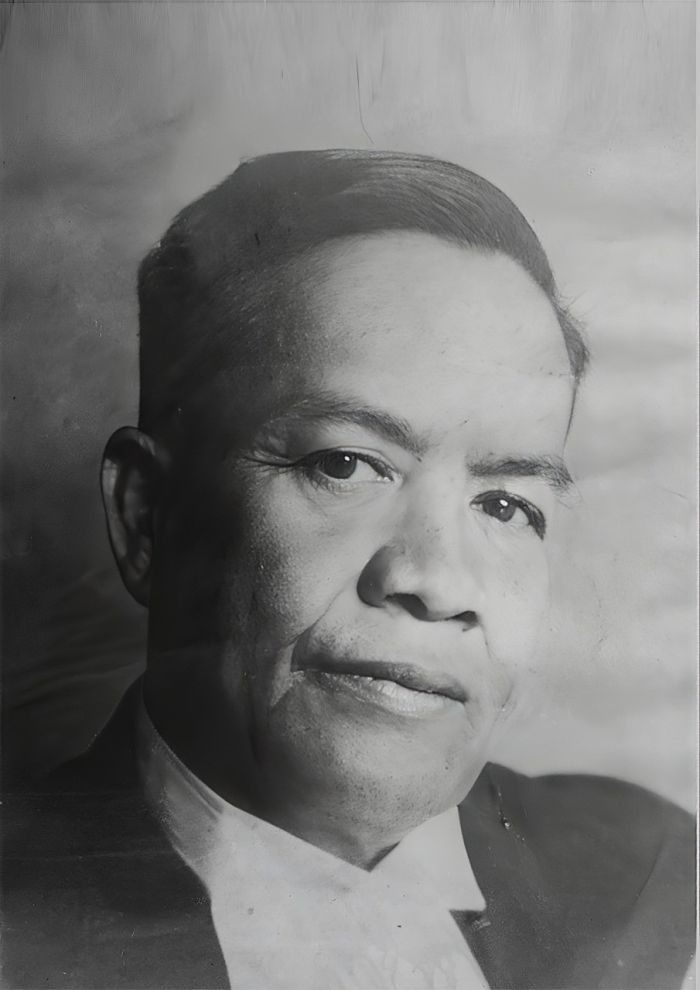
L. Iboongohal Singh
Mr Lydall, through his good offices, had retrieved the lost money even without production of the concerned official papers (as they were all lost) and the new site situated in a vacant locality was the generous offer of the Political Agent. This was directly under his jurisdiction and the State Government could not interfere at all.
The college is now poised to take final shape as all the hindrances have been cleared. The rest of the British officers seemed to outdo each other in their bid for services to the college… The classes of Dhanamanjuri College began in 1946 in the premises of Johnstone High School in the heart of the town. It started as an evening college as it had no building of its own and also for the convenience of the students comprising matriculates who could not afford further education outside the State and Government employees. Mr R.R. Thomas, the retired Principal of Cotton College, Gauhati became the first Principal of D.M. College and as desired by the governing body I also joined as a Professor of Sanskrit and as Vice-Principal of the college. Later I was made its Principal.
It commenced first as an intermediate college and we applied in 1947 to Calcutta University for opening degree classes. The university did not take long in granting permission.
Thus the college had a smooth beginning. But suddenly there was an eruption. The Government of Manipur unilaterally decided to take over the college in the middle of 1948… However, time was running out and after having discussions threadbare, we finally resolved, in the interest of the college, to entrust it to the State Government with effect from July 1, 1948.
It may be mentioned that K. Gouro was appointed as the first Officiating Principal of D.M. College (August 6, 1946 – December 8, 1946. He was succeeded by R.R. Thomas, a retired Principal of Cotton College, Guwahati (founded by Sir Henry Stedman Cotton, ICS in 1901, now a university). Thomas served as the Principal of the Cotton College in 1945-46. The list of the first generation Principals of the college included:
1. R.R. Thomas (9/12/1946 - 31/05/1947)
2. P.N. Mitra (7/07/1947 - 10/10/1947)
3. H. Dwijamani Dev Sharma (10/10/1947 - 13/08/1948)
4. N.B. Sinha (14/09/1948 - 22/11/1949)
5. S.N. Chatteerji (23/11/1949 - 30/01/1954)
6. N.B. Sinha (31/01/1954 - 22/05/1957)
7. S.N. Kaul (23/05/1957 - 22/08/1965)
8. N.B. Sinha (22/08/1965 - 19/10/1966)
9. N.C. Sen (20/10/1966 - 25/10/1969)
10. A. Brajamani Singh (25/10/1969 - 5/08/1975)
In its early days, the teachers were appointed through Union Public Service Commission (UPSC), New Delhi, and the best brains from different parts of the country came to teach here. The first batch of graduates of the college received their degrees in 1950. In the same year, D.M. College became a full-fledged college and classes were conducted at its own building. Till 1950, the college offered only Arts courses. From 1951, Science and Commerce courses were added. In 1965 the Girls’ College got separated, which later became G.P. Women’s College. In 1959, Teachers’ Training course was introduced.
In 1962, in addition to the Under-Graduate classes in Sciences, Arts and Commerce, D.M. College began to offer Post-Graduate classes in Mathematics, Economics and History. And the classes were held in the evening. It may be mentioned that in 1972, the Post-Graduate classes got merged with Jawaharlal Nehru University (JNU) Centre, Imphal, which was later shifted to Canchipur. The foundation of the JNU Centre was laid there on November 19, 1972 by the then Chief Minister, Md. Alimuddin. Several faculty members of D.M. College were engaged in the Centre. After closing the JNU Centre, the State Government established Manipur University on June 5, 1980 (under the Manipur University Act, 1980) as a teaching cum affiliating university. In 1981, D.M. College was affiliated to Manipur University.
From the early years of 1960s, D.M. College became the largest college in North-East India with more than 3000 students. The college was known not only for its academic excellence, but also for sports and cultural activities. From the early years of 1950s, few private colleges were established, modelled on D.M. College, by the educated elites of the State. Imphal College was established in 1952, Manipur College in 1958, Modern College and Thoubal College in 1963, Churachandpur College in 1964 (the first college in the hill districts).
In 1975, the State Government felt the need of bifurcating D.M. College into Science and Arts stream. That year, the college was split into D.M. College of Science and D.M. College of Arts and Commerce. D.M. College of Arts and Commerce got separated and shifted to their present campuses, while D.M. Science retained the old campus.
1996 is a historic year for the D.M. Colleges. D.M. College observed its 50th anniversary (Golden Jubilee). On August 2, 1996, D.M. College of Commerce got bifurcated from D.M. College of Arts. In the same year, D.M. College of Teachers Education too was also born. In 1972, the Department of Education of D.M. College became the centre for teachers’ education in the State, which existed as a separate institution under the name of Post-Graduate Training College. This college was re-named D.M. College of Teachers Education in 1996. In 2006, the D.M. Colleges observed Diamond Jubilee.
In 2018, Dhanamanjuri University was established under thr National Scheme of Rashtriya Uchchatar Shiksha Abhiyan (RUSA). However, the university officially came into existence under the Dhanamanjuri University Act 2017, which was passed by the Manipur State Assembly. The Act came into force on April 6, 2018. Under the scheme, five colleges, namely the D.M. College of Arts, D.M. College of Science, D.M. College of Commerce, along with G.P. Women's College and L.M.S. Law College were brought under the Dhanamanjuri University.
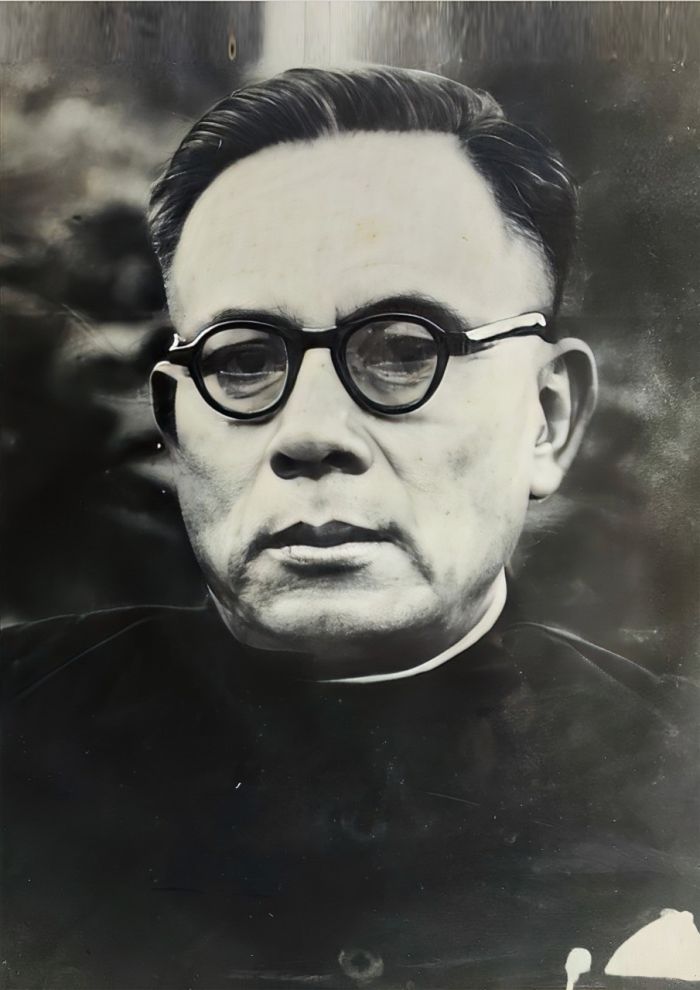
S. Somorendro
Notes
1. S. Somorendro was enrolled at Sylhet High School. Hijam Irabot joined him. He cleared BA from Dacca University in 1919. In 1929, he became the Private Secretary of Maharaja Churachand (1892-1941). He also became a Judge of the Chief Court of the State. In 1931, he became the Member of Manipur State Durbar for several years.
2. Dwijamani Dev (d. 2000) served as Principal of the college from September 10, 1947 to August 13, 1948. He was actively involved in the setting up of Manipur Institution, which was later renamed Churachand High School. He also played significant role in the setting up of G.P. Women’s College in 1965 (donated a sum of Rs. one lakh). He setup Sanskrit College in 1947 (now Dwijamani Dev Sharma Sanskrit Midyalaya).
3. Nodiachand was the Second Manipuri to graduate. In 1921, he passed BA from Cotton College, Gauhati. He was a Member of the Manipur State Durbar, and served as Minister in the Interim Council.
4. L. Iboongohal (d. 1966) studied Law at Earle Law College, Guwahati. He became the first Bachelor of Law in Manipur. Iboongohal joined Law Court in 1926. Next year, he served as ADC to Maharaja Churachand Singh. In 1931, he became a Member of Manipur State Durbar. He was commissioned as a Member of the Manipur State Deputation to His Highness the Viceroy and Governor General of India. He then became the first Forest Member of the State. From 1944 to 1950, he became the Judge of the Chief Court. He was also the founder Principal of Lairenmayum Sheibyasaschi (LMS) College, Imphal, till his death. The college was founded on 7th August 1958 initially as Manipur Law College, but it was later named after Iboongohal’s father. The foundation stone of the college was laid by the then Home Minister, Lal Bahadur Sastri, in 1963.
5. M.K. Priyobrata (@ PB, d. 2005) got his early education at the Rajkumar College in Raipur (now in Chattisgarh), and graduated from Allahabad University in 1934. He learned Fine Arts from Gopal Krishna Kanetkar, an alumnus of J.J. School of Arts, Bombay. He became the CM of Interim Council (1947-48). His Government bridged the divide between Hill and Plain, conducted the first State Assembly Election based on adult franchise. He founded Manipur Cultural Integration Conference, which worked to bring cultural integration.
6. A. Daiho was member of Constitution Making Body (representative of Mao). He was a leader of Naga National League (NNL), which worked to consolidate the Nagas of Manipur.
7. Qazi Waliullah (d. 1989) was the first Muslim graduate; completed B.A. in 1928 from Ripon College in Calcutta. He served as Member of Manipur State Durbar (1944-47), Constitution Making Committee, First Interim Council. He was also the first Head Master of Churachand High School. He founded Fatima High School, named after his wife.
* Dr. Syed Ahmed wrote this article for e-pao.net
The writer is an Associate Professor at
Department of History,
D.M. College of Arts, Imphal
and can be contacted at syed_ahmed4(AT)yahoo(DOT)com
This article was webcasted on August 15 2025.
* Comments posted by users in this discussion thread and other parts of this site are opinions of the individuals posting them (whose user ID is displayed alongside) and not the views of e-pao.net. We strongly recommend that users exercise responsibility, sensitivity and caution over language while writing your opinions which will be seen and read by other users. Please read a complete Guideline on using comments on this website.


