


Irabot's Unfinished Revolution
- Reimagining Equity, Identity, and Progress in the 21st Century -
Dr. Homem Thangjam *
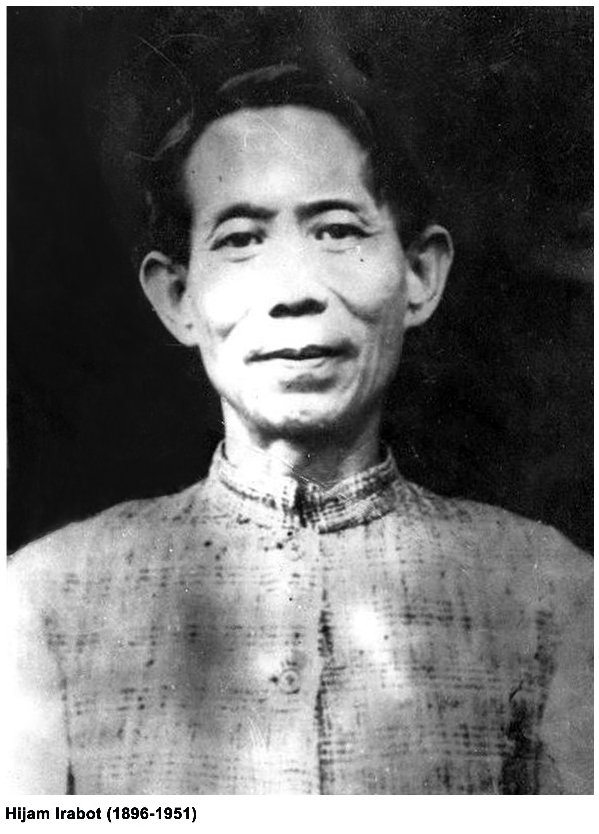
Hijam Irabot (1896-1951)
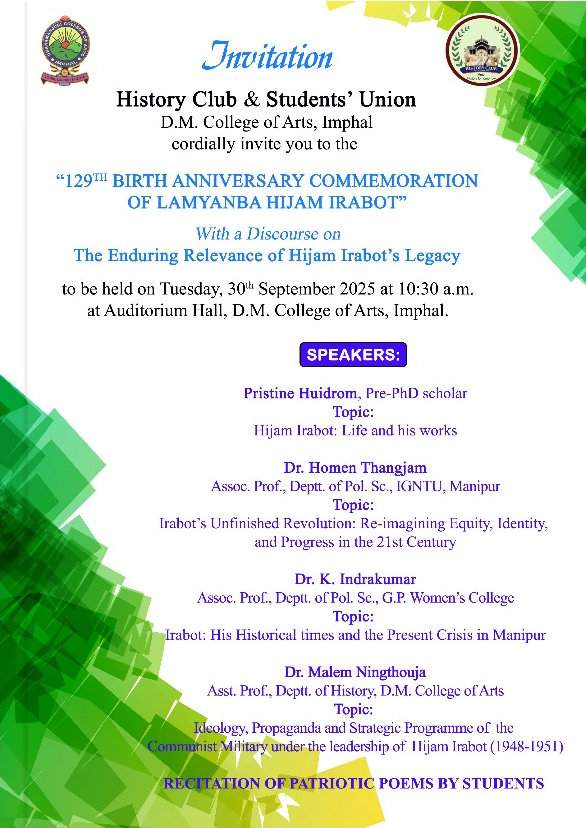
Lecture delivered by Dr. Homem Thangjam, Associate Professor, Department of Political Science & Human Rights, IGNTU, Manipur, on the occasion of the "129th Birth Anniversary Commemoration of Lamyanba Hijam Irabot," organised by the History Club & Students' Union, D.M. College of Arts, Imphal on 30th September 2025
It is a privilege to be with you today to discuss a figure whose shadow looms large over the history and politics of Manipur and the entire Northeastern region of India. A man who is a symbol, an icon, and yet whose complete vision remains, I would argue, a task unfinished. That man is Hijam Irabot.
Today, we will journey to understand "Irabot's Unfinished Revolution." We will define the core of his vision, travel back to the historical context that forged him, and most importantly, ask a pressing question: How do we reimagine Irabot's principles to address the 21st-century challenges of equity, identity, and progress?
Let us begin.
Part 1: Defining the Man and His Unfinished Revolution
Who was Irabot? To call him merely a politician is to miss the point. He was a kaleidoscope of roles: a poet, a journalist, a sportsperson, a social reformer, a political leader, and a revolutionary. His legacy is a complex enigma; we can understand his "unfinished revolution" through three core pillars.
First, the Pillar of Social Equity and Anti-Feudalism. Irabot's primary battle was against the Maichou system, the feudal aristocracy of the Manipuri monarchy. He saw how this structure exploited the peasantry, fishermen, weavers, and ordinary people. It was a cry for economic justice, land rights, and a socialist model where resources were distributed equitably. Scholar Karam Manimohan Singh notes that Irabot's politics were fundamentally rooted in the commoner's soil and sweat.
Second, the Pillar of Political Self-Determination and Identity. Irabot was a fierce advocate for the political rights of the Manipuri people. His journey saw him engage with the Indian National Congress, but he grew increasingly skeptical of designs from the centre. He championed a distinct political space for Manipur that would protect its unique identity and sovereignty in the face of a nascent Indian nation-state. As historian John Parratt argues, Irabot's stance on Manipur's merger into the India Union was one of profound criticism, viewing it as an undemocratic annexation.
Third, there is the Pillar of Cultural Renaissance and Inclusive Nationalism. Irabot was a master of symbolism. He understood that you must speak to their soul to mobilise a people. He used proscenium theatre, literature, and publications to revive and assert Manipuri culture. However, crucially, his cultural project was not narrow. He envisioned an inclusive identity that could bridge the deep chasm between the Meitei community of the valley and the various Naga and Kuki tribes of the hills. This was a radical idea then; as we shall see, it remains so today.
His revolution is "unfinished" because the structures of inequity, the tensions of identity, and the quest for meaningful political agency that he fought against are, tragically, still the defining features of the region's landscape.
Part 2: The Historical Crucible: Forging a Revolutionary in an Era of Dual Colonialism
To understand this vision, we must place Irabot in his time. To do that, we must first understand a critical concept: Dual colonialism.
Irabot was not just fighting a single oppressor. He was born into a system of "Dual Colonialism," a term that perfectly captures the Manipuri experience. The ordinary people were caught between two exploiting forces: the exogenous British colonial government and the indigenous ruler, the Maharaja, who often acted as a subsidiary ally of the British.
Under British colonial rule (1891–1947), political control over Manipur became absolute. The British monopolised the economy, including external trade and resource exploitation. The Manipuri kings were reduced to symbolic figureheads, retaining sovereignty only in cultural and religious spheres.
This is the key to understanding the dynamics of Irabot's era. We must look at the traditional feudal economy to comprehend the Maharaja's power base. Land tenure was entirely feudal, with all land technically owned by the king. As documented by British officials and historians, agricultural lands were categorised as royal (Ningthou Lou), religious (Lai Lou), military (Siphai Lou), noble (Pham Lou), and peasant-holding (Louwai). The peasants did not own land; they were tenants, like in a serfdom. Revenue was collected in kind, primarily paddy, managed by village heads (Khullakpas) and overseen by state officials like Phunan Sellungba and Keirungba.
It was from this feudal economic structure that the British severed the Maharaja. Deprived of these financial resources and political control, successive Maharajas resorted to taxing their subjects in the only sphere they had left: religious and cultural practices. With the assistance of the Bamons (Manipuri Hindu Brahmins), the king began to use the Hindu religion and its codes both as a tool for proselytisation and as a means of excommunication, often at a financial cost.
This policy had a direct and divisive impact on the ground. The fear of excommunication led many communities to adopt Hinduism.
o Some Loi villages, including Chairel, Kakching, Kakching Khunou, Khamaran, Moirang, Pallel, Sagnu, Thanga, Waikhong, and Wangoo, adopted Hinduism and adhered to its ritual practices.
o However, other Loi villages, including Andro, Awang Sekmai, Phayeng, Khurkhul, Koutruk, Laimaram, Laimaram Khunou (Tairenpokpi), and Kwatha, chose to maintain their traditional ways of life, culture, and religion, resisting the adoption of Hinduism.
This split illustrates the profound social engineering at play and the roots of the following cultural contestation.
This duality created a pincer movement on the populace. The British imposed new cash taxes on land, houses, and even cycles. In contrast, the Maharaja, through the Brahmasabha, imposed its own set of exploitative religious taxes: Chandan Senkhai (for wearing a tilak), Napet Senkhai (for cutting hair), and Lugul Senkhai (for wearing the sacred thread).
The most pernicious tool of control was the politics of Mangba and Sengba, the declaration of a person or entire villages as "polluted" or "pure." As historical records show, Bamons would "go round the villages informing the people that Brahmasabha had declared them as Amangba or outcaste and offering for a consideration to have them declared as Sengba or purified."
This was nothing short of religious blackmail, a system one British official in the 1940s described as a "plague of blackmail." At one point, a quarter of the valley's population suffered from this form of ostracism. In other words, the valley dwellers suffered more than the hill denizens under this exploitative system.
This is the oppressive, dual-layered context into which Irabot's movement was born. His rebellion was not just against a distant British crown, but against a collaborative indigenous feudalism (comprador) that had lost its traditional economic role and now used culture and religion as its primary tools of subjugation and extraction.
Now, let us look at the broader historical timeline.
Irabot was born in 1896, five years after the cataclysmic Anglo-Manipur War 1891. This war, which ended Manipur's sovereignty, cast a long shadow. It created a collective trauma, a sense of political and cultural loss that would deeply inform Irabot's consciousness.
His political journey is inextricably linked to the Nikhil Hindu Manipuri Mahasabha, an organisation whose evolution mirrors his radicalisation. The Mahasabha was established in 1934 as a socio-cultural countermeasure to Christian missionary influence, with Maharaja Churachand Singh as its president. In what can be interpreted as a tactical move to co-opt a growing popular leader, Irabot was appointed Vice-President.
The organisation's early sessions, the inaugural meeting at the royal palace on 30 May 1934, attended by delegates from Bengal, Tripura, and Burma; the second session in Silchar in 1936; and the third in Mandalay in 1937, were platforms for consolidating a Hindu and diasporic Manipuri identity.
Notably, even at this stage, a nascent cultural nationalism was evident; the 1937 Mandalay session, attended by Irabot and prominent figures like Lalit Madhab Sharma, called Manipuris to acquaint themselves with the Meitei script. It was definitely a pan-Manipur movement except for its Meitei exclusivity.
However, Irabot's leadership would ultimately steer the organisation in a profoundly different direction. The Chinga Session of 29 December 1938 was a political watershed. Presided over by Irabot, it marked the Mahasabha's definitive transformation from a monarch-led, faith-based body into a radical, populist political party. The resolutions passed that day constituted a revolutionary manifesto, amongst others:
1. It demanded Manipur's sovereignty.
2. It called for elections through adult franchise.
3. It demanded the abolition of oppressive practices like Yarek Santri (night vigil tax), Peon Chakthak (free community meals for officials), and forced labour (Pot-thang).
4. Moreover, in a move of profound symbolic importance, it officially demanded the release of the imprisoned Naga leader, Gaidinliu, later named Rani Gaidinliu by Jawaharlal Nehru.
The organisation shed its religious label to cement this new, inclusive, and political character, changing its name from the "Nikhil Hindu Manipuri Mahasabha" to the "Nikhil Manipuri Mahasabha." This was Irabot's vision institutionalised: a platform for all of Manipur, hill and valley alike, united under a common political project against Dual Colonialism.
However, Irabot was not just a man of protest; he was a man of proposition. His commitment to hill-valley unity, clearly declared at Chinga, required sustained action. In 1947, as the subcontinent was being partitioned and Manipur's future hung in the balance, Irabot acted decisively.
On Sunday, 30 November 1947, he convened a historic meeting at the Manipur Dramatic Union (MDU) Hall. This was not a meeting of just his own parties. Presided over by Mr. M.K. Shimray, a Tangkhul leader, it brought together nine organisations from the hill and plain areas.
Let that sink in. In that room were:
o From the hills: the Tangkhulong, the Kuki National Assembly, the Kabui Association, the Khulme Union, and the Mizo Union.
o From the plains: the Praja Sangha, the Manipuri Krishak Shabha, the Meetei Marup, and Nongpok Apunba Marup.
Irabot demanded the formation of a United Front for joint action at this meeting. The resolutions passed were profound:
1. They formed an Organising Committee with representatives from every major community, Tangkhul, Kuki, Kabui, Khulmee, Mizo, and Meitei (Meitei Pangal included)
2. They elected Irabot as the Chairman and Tangkhul leader M.K. Shimray as the Secretary, a powerful symbol of shared leadership.
3. They resolved to send Irabot and the Kuki leader, Mr. Luhin, to Kohima to study the Naga Revolution or liberation movement, showing a desire to understand and engage with regional political movements.
This was Irabot's inclusive nationalism in action, a concrete, structured, and politically sophisticated attempt to build a unified Manipuri polity that could face the impending dangers together.
This radicalisation was completed through his association with the Communist Party of India. After periods of imprisonment, especially after the Potshangbam incident, he concluded that peaceful, constitutional methods were insufficient. In 1948, he did what many revolutionaries do when all doors seem closed: he went underground, establishing the Red Army, launching an armed struggle for an independent, socialist Manipur.
His final years were marked by his vehement opposition to Manipur's forced merger into the Indian Union in 1949. He was not present in the Shillong capital that day and saw the merger as a betrayal. This final chapter cemented his legacy as the uncompromising symbol of resistance.
Part 3: Reimagining Irabot for Our Century
So, what does this man from the first half of the 20th Century have to say to us in the 21st? His legacy is not a museum piece but a living, breathing framework for critique and action.
Let us take his fight for equity. Irabot's battle against feudal lords and dual colonialism echoes today in the struggles against the state-aided corporate land grabs, the exploitation of natural resources, and an economic model that often leaves the local population behind. When communities protest against a large dam or demand rights over their forests, they are, in spirit, channelling Irabot's demand for economic justice. His socialist ideals force us to ask: Who is this development for? Who benefits, and who is left behind?
Then, there is the most profound and painful challenge: Identity. Irabot's vision of a unified, yet pluralistic, Manipuri identity remains his most unfulfilled dream. Today's bitter and tragic divisions between the hill and valley communities contradict his life's work.
To fully understand the complexity of this identity conflict, we must look at the Sanamahi Movement. This was not merely a religious revivalist movement. As scholars argue, it was a form of resistance against the "dual colonialism" I described earlier. While the king and Bamons used Hinduism as a tool for control, the Sanamahi movement, led by figures like Naoriya Phullo, emerged as a "counter force to the rising power of Brahmins, especially in the socio-religious arena."
This movement was a powerful assertion of nativism and a pre-Hindu identity, a direct challenge to the Brahminical domination and order. It was a search for a socio-political space defined by a distinct Meitei history and culture, free from the influences of both the British and the collaborative Hindu orthodoxy.
The play Pebet, Oja Kanhailal's, which portrays a pebet mother's fear that her children "will be absorbed into the cat's culture," perfectly captures this sentiment. Irabot operated within this contested cultural space, navigating between the forces of Hindu consolidation and Sanamahi revivalism, all while trying to build his broader, inclusive political project.
In this context, Irabot is not an answer, but a question. The legacy of the Chinga Session and the United Front of 1947 asks: What would it take to reconvene that spirit today? How do we build that bridge? His legacy is a crucial historical foundation for any sincere dialogue aimed at peace and coexistence.
Finally, his quest for Political Agency. The sense of alienation from the "mainstream" that Irabot articulated is more relevant than ever. It fuels the debates around laws like the Armed Forces Special Powers Act (AFSPA), informs the persistent demands for greater autonomy, and underpins the complex relationship between the region and New Delhi.
This is often perceived as a form of "Internal Colonialism." The prolonged occupation of the sacred site of Kangla by the Assam Rifles, first by the British and then by the Indian State, until 2004, was seen by many Manipuris as a direct continuation of colonial policy.
The fact that the Government of India recognised a Vishnu temple as a heritage site while a millennia-old site like Kangla was under military control is seen as a clear statement of cultural politics. Irabot represents the enduring quest for a political arrangement that does not erase, but instead celebrates and protects, a distinct historical and cultural identity against such hegemonic forces.
Conclusion
In conclusion, Hijam Irabot's revolution remains unfinished not only because his goals were ambitious but also because the powerful actively suppressed and maligned his vision. The ruling elite of his own time, and indeed, elites in the following decades, denied him a political space.
They despised his radical egalitarianism and accused him of betraying the Meitei State, of seeking to sell out Manipur to the Burmese and to the hill communities. He was cast not as a unifier, but as a divisive figure, a dangerous radical whose inclusive nationalism threatened established hierarchies and privileges.
For years, this official neglect and calumny obscured his true legacy. It was only with the rise of a new, questioning generation beginning in the 1970s, a generation that started to interrogate the very soul of Manipur, that Irabot was posthumously given his deserved place.
He was rediscovered as the foundational figure for a modern, "civic nationalism" for Manipur, one informed not by narrow ethnic chauvinism but by an idea of a shared homeland that stands unequivocally for the downtrodden in both the valleys and the hills.
Therefore, reimagining Irabot in the 21st Century is not a nostalgic return to the past. It is to engage with the spirit of his principles, his unwavering commitment to social justice, his inclusive cultural pride, and his demand for self-determination, which were once rejected but are now more urgent than ever. The Chinga Manifesto and the United Front of 1947 are testaments to what was possible and stark reminders of the path not taken.
The most fitting tribute to Lamyanba, the pioneer and pathfinder, is not merely to build statues in his memory, but to comprehend the political reasons for his historical marginalisation and to take up the intellectual and moral challenge of completing his revolution. Our task is to forge, through dialogue, empathy, and justice, the equitable and inclusive society he envisioned, a revolution we are still called to finish.
Thank you.
* Dr. Homem Thangjam sent this article for e-pao.net
The writer is Associate Professor,
Department of Political Science & Human Rights,
IGNTU, Manipur
and can be contacted at homenth(AT)gmail(DOT)com
This article was webcasted on October 01 2025.
* Comments posted by users in this discussion thread and other parts of this site are opinions of the individuals posting them (whose user ID is displayed alongside) and not the views of e-pao.net. We strongly recommend that users exercise responsibility, sensitivity and caution over language while writing your opinions which will be seen and read by other users. Please read a complete Guideline on using comments on this website.


