


Gaan-Ngai
Prof Gangmumei Kamei *
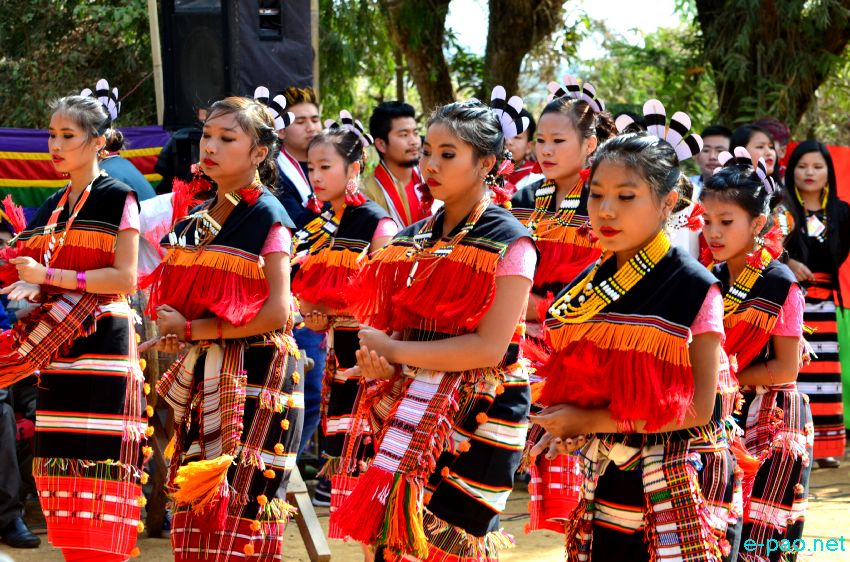
Gaan-Ngai at Maibam Kabui Khul, Nambol on January 22 2016 :: Pix - Shankar Khangembam
Gaan-Ngai is the greatest festival of the Zeliangrong
people who inhabit in the State of Manipur, Assam and Nagaland.
‘Zeliangrong’ is the combined name of three cognate kin group namely Zeme,
Liangmai and Rongmei. Puimei, another cognate group performs the same
festivals of the Zeliangrong.
Gaan-Ngai is called Hegangi among the Zeme, Gin-Ngi among
the Liangmai and Gaan-Ngai among the Rongmei and Puimei. The name,
Gaan-Ngai literally means the festival of winter season (Gaan or Ganh
means winter or dry season and Ngai means festival). It is derived from
the name of winter season like Chakan Ganh, Gan-bu or Enganh.
All the festivals of the Zeliangrong people like other
tribes throughout the world are based on the different stages of
agricultural operations; pre-operation and post harvest. The Gaan-Ngai is
a post harvest festival. When the granaries are full, the landscape is
dry, the whole village is free from all agricultural works, people turn to
celebration, festivity and worship of the God and honouring of the
dead.
This festival is also described as a new year festival as
it marks the end of the year and beginning of the new year. It is a
festival heralding the new year. Every tribal new year festival is marked
by the production of new fire either by friction of wood and bamboos or
friction of the flint. The Gaan-Ngai performs the production of fire,
Mairapmei. It is rightly described as a new year festival.
The Gaan-Ngai is a festival during which those who died
in the previous year are given ritual farewell or departure; their graves
are beautified, dances are performed in their honour, feast is given to
the community in the honour of the dead. Gaan-Ngai is thus the festival of
both the death and living.
The Gaan-Ngai was usually performed between the month of
October and December depending on the state of the progress of
agricultural operation. However, the Kabui Naga Association, the
progenitor of the present Zeliangrong Union decided in 1947 that Gaan-Ngai
be performed on the 13th day of the Meitei month of Wakching as per the Meitei
Calendar (Chandrabda) of the lunar year. Since then, due to efforts of the
community leaders, it has been performed on 13th Wakching onwards.
Gaan-Shanmei (heralding of the Gaan-Ngai):
The duration of the festival varies from place to place.
But in the beginning of the month in which the Gaan-Ngai is to perform,
the village elders will announce the coming of the festival by blowing the
horn of the buffalo or the mithun informing the community to make the
necessary arrangement for the festival. This is called Gaan-Shanmei
(Heralding of the winter season or the Gaan-Ngai festival).
Ngai-Gangmei (starting of the festival):
Gaan-ngai is essentially based on the religious belief of
the Zeliangrong people (worship of Tingkao Ragwang, the God of the
universe). The whole culture, religion and social life are interwoven in
the performance of Gaan-Ngai.
The first day of the festival is called Ngai-Gangmei
(Starting or coming of the festival). It starts with omen taking
(Danjaomei) rite at the abode of the village deity (Shong or Bambu)
outside the village gate by an elder through the offering of egg and
ginger. He will perform divination by ginger to know the future, the
prosperity or otherwise of the new year.
Sacrifice to Tingkao Ragwang:
The whole village elders, men, youth will gather at the
respective boys dormitory (Khangchu) or dormitories. The girls will gather
at the girls’ dormitory (Luchu). An animal either a pig or a mithun will
be sacrificed as offering to the Supreme God, Tingkao Ragwang. This will
be preceded by a competitive catching of the pig or the mithun. After the
sacrifice of the pig, the spleen will be examined to find out the omen for
the future. There will be community feasting at the dormitories. A feast
will be preceded by an invocation to God by Ho-Hoing.
Hoigammei (Hoi procession)
In the afternoon, there is the Hoigammei procession.
Every male, the elder, married male, youth and even child putting on the
best ceremonial dresses, holding spears, participate in the Hoigammei
procession. It starts from the boys’ dormitory, proceeds to the village
gates shouting Ho, Ho (Ho-Hoing) and then to the village jumping ground
(Danshanpung). Competition in stone throwing, long jump and wresting are
carried out in the presence of the whole community, the inauguration of
the stone throwing and long jump being performed by a village
elder.
Mairapmei (making of new fire)
The procession goes to the boys dormitory where the new
fire is produced by the wood and bamboos friction and the fire will be
distributed to every household or several team of youth visit the
individual families to produce the new fire. Every family will perform
Napkaomei ceremony (worship to God for plentiful harvest) as a
thanksgiving for the good harvest and prayer for good agricultural
production in the coming year. The evening will be spent in merry making,
drinking and eating and singing in the dormitories.
Ngaidai (The great festival)
The second day is called 'Ngai-dai' (the great
festival). It is also popularly known as 'Tamchan Ngai' (The
performance - of Tamchan dance)
The senior members of the boys dormitory and family
members of both the boys and girls who passed in the previous year will
present the Tamcha (gift in the form of food, drinks, meat,
vegetables and rice) to their respective dormitories for partaking by the
member. The parents of the dead members give the tam-cha in
remembrance of their deceased near and dear ones. There will be feasts in
the respective dormitories.
Tamchan Dance
In the evening, girls will perform a dance in the
selected families. This dance is known as 'Tamchan Laam' (Tam means
chutney of vegetables; chan means 'request'; Laam means dance, dance
requesting for Tam). Because of the performance of the Tamchan dance; the
day is also known as Tamchan Ngai.
If there is no such dance, there is usually a singing
competition between the boys and girls dormitories. Merry making
continues.
Tuna Gaan-Ngai
The third day is known as the Tuna-Gan-Ngai
(Festival of the youth). This day is important for both the death and
living and for the strength and prosperity of the village.
i) The dormitories will perform Thei-Kadi-Laam
(Dance in honour of the death) will be performed at the selected
families where death occured in the previous year. The family will prepare
the graves of the death to whom offering in the form of food and drink
will be made. The dead will be given a ritual farewell. The performance of
the dance in honour of the death is performed if the deceased happens to
be a member of the dormitory. But it is not compulsory.
ii) The dormitories perform Khangbon Kadi Lam (a
dance in honour of the elder members of the dormitories being promoted to
a higher age grade position known as Ganchang).
Rangteng pammei (Ritual of reaffirmation)
On the third day or on the eve of the Long ruimei
(Hill trekking) when there is no dancing, a ceremony known as the
Rangteng pammei is performed. This is a ceremony to strengthen and
confirm the village against the elements and forces inimical to the
village. Rangtang pammei literally means 'embracing' the village
gates.
Khunnummei (offering at the hole of the village gate)
In the afternoon, the head of the settlers clan of the
village as Nampou (owner of the village), the chief funcitonary
will go to the village gates and will dig holes in which he offers an egg
and iron pieces with the chanting of hymns. It is an affirmation that he
is the descendant of the founder of the village and prays for the
affirmation of his position and strength of the village. This has social
and administrative significance. It is the reassertion of the chiefship of
the head of the settler's clans which should be accepted by everybody in
the village.
At night, when there is complete silence in the village,
the Rangteng Pammei ceremony will be performed. During the day
time, a wooden pole will be prepared, the gaa creepers and canes will be
collected by the youth and kept in the village gates. In the night, the
wooden pole of the village gate is raised by the head or an elder of the
settler's clan which is the family of the rangteng Pammei at the
right side of the village and with appropriate hymns chanted. (It is not
to be audible to the gathering).
Two warriors dressed in ceremonial warrior dress, holding
dao and spear cut the village gate pole (Rangteng Khumei). It is followed
by the Ho-Hoing of the gathering to scare away the wild beasts and evil
elements followed by a complete silence.
The two warriors report to the elder, 'Our village is
protected and safe it will be prosperous'. The gathering at the village
gate will respond by shouting 'gaiye, gaiye, gaiye (meaning good four
times). Then the Ho-hoing and again the response of 'gaiye' four times.
From the village gate, the gathering proceeds shouting Hoi to the village
jumping ground. Then the refrain of 'gaiye, gaiye, gaiye, gaiye' will be
repeated and it is over. They return to the dormitories in a Hoi
procession. In the villages which are not established by a founder clan,
it is not performed.
On this day of the festivals, the traditional dances of
different pattern will be performed by the youths (boys & girls). On
this day, the dance, merry making, songs of the Zelian-grong are
performed. The essence of the aesthetic sense of the Zeliangrong people
and their culture are found expressed in a grand form.
Longkumei: Hill Trekking
The fourth day is called Long Kumei or Long ruimei (Hill
Trekking) performed by the boys, girls and members of the dormitories in a
nearby mountain range.
They will offer girls, sing songs (Long-Luchenlu) and
janting tam (Hetam in Zeme) made of boiled pork. Gakting Tam is an item of
boiled pork pounded with garlic, onion, chilli, ginger and salt and made
into round balls. They return to the village and perform dance in honour
of those boys and girls who have been chosen as the phak gwang or
namlengwang. The kings and queens are adorned with phak grass. The
families of the chosen boys and girls in whose honour the dance is
performed will offer money, wine, drink and other eatables.
Napchanmei
The fifth day is called Nap-chanmei, offering of
pig and fowls to God for good harvest and prosperity followed by the
feasting at the dormitories. Individual families may perform this
ceremony. A pig is sacrificied at the boys' dormitory to the God and a
fowl is also offered.
There will be feasting with the invocation of God by
Ho-Hoing, after the feast, there will be song competition between the boys
and girls and merry making. There will be Kairong Lonmei (Guarding
of the village with youth singing village guarding songs). Those who
participate are entertained by the individual families.
Rangpatmei
It is the last day. In the early morning, there will be a
ponnimmei, exchange of gifts in form of money, and necklace,
bangles among the members of the boys and girls dormitories as a mark of
farewell, marking the end of the happy Gaan-Ngai.
Rangpatmei is the offering of sacrifice to the deities of
the pantheon of Gods worshipped by the village concerned. A sacrifice
known as Ralen-loumei will be performed.
The village priest and the elders will perform this
sacrifice in which three categories of Gods are worshipped by the
Zeliangrong people with offerings of fowls, egg, ginger and water. It is
performed at the village deity's abode.
i) The eight brothers of the Ragwang who are the
members of the pantheon of Zelian-grong Gods below the Supreme God,
Tingkao Ragwang.
ii) The Gods and deities worshipped by the particular village.
iii) The Gods of different aspects of nature like the God
of the wind, fire etc.
iv) Propitiation of spirit not to disturb men.
A complete genna or neihmei is observed in
the village during the period of the sacrifice. The elder will eat the
chicken cooked at the ritual place.
Bukaomei (Calling of the Soul)
The elders will return to the village Pei (office
of the village council) and perform another ceremony known as the
Bu-kaomei (calling of the souls) to Tingkao Ragwang. A big cock
will be sacrificed after chanting the hymns invoking Tingkao Ragwang, the
Supreme God to extend protection to the people of the village from death
and danger and provide welfare to the village and its people. The cock
will be cooked and eaten by the elders and pieces of the meat will be
distributed to every household.
Thus the Gaan-Ngai comes to an end. The community prays
to Tingkao Ragwang as a Thanks giving and for future prosperity (Good
harvest), the soul of the death leaves the households and go to the land
of the death (Taroilam), the village reinvigorates its energy by
affirmation of strength and unity, rejoices in the performance of dance,
music, merry making and festivities.
Gaan-Ngai is a great festival, a unique cultural
phenomenon, a form of aesthetic expression of the Zeliangrong religion and
philosophy. It is also an institution through which the community sustains
their cultural heritage and way of life. Gaan-Ngai is the essence of the
Zeliangrong culture.
* Prof Gangmumei Kamei wrote this article for The Sangai Express
This article was first posted in January, 2003 and later re-posted with newer picture on 09th January 2017.
* Comments posted by users in this discussion thread and other parts of this site are opinions of the individuals posting them (whose user ID is displayed alongside) and not the views of e-pao.net. We strongly recommend that users exercise responsibility, sensitivity and caution over language while writing your opinions which will be seen and read by other users. Please read a complete Guideline on using comments on this website.


