TODAY -
✦

Illustrated Manuscripts from Manipur
- Pictorial Value -
- Part 6 -

By: Mutua Bahadur *

In some of the Subika Laisaba manuscripts, the human figures are drawn without the anatomical features to distinguish male from female. Like traditional Manipuri laidhi (dolls), the face of these human figures has simple lines in two colours to indicate eyebrows, nose and lips.

The eyes are not indicated separately. Dots are sometimes superimposed on the eyebrows to represent the eyes. Manipuris describe a beautiful face by comparing to the moon. This tradition finds an echo in the round faces of the human figures.

Even though distinguishing anatomical features are missing, care is taken to differentiate a king, a courtier, a monk etc. from a layman by using different types of headgear. All the pictures are related to one another. The subtleties of composition are strictly followed. It is interesting that the same number of lines is used in all the pictures.

In Subika Laisaba of 18-19th century, there is a human figure that is drawn to look like a frog (Fig. 115). But a closer examination reveals all the anatomical details of a human being. Polka dots are used to give the surface texture of a frog. Human eyes are used instead of those peculiar to frogs and the overall impression is that of a human-frog. The colours used are Indian-red, black and yellow-ochre. This is one of the strange creations of Manipuri artists of the past.

Above this drawing in another panel, there is one drawing in which the images of
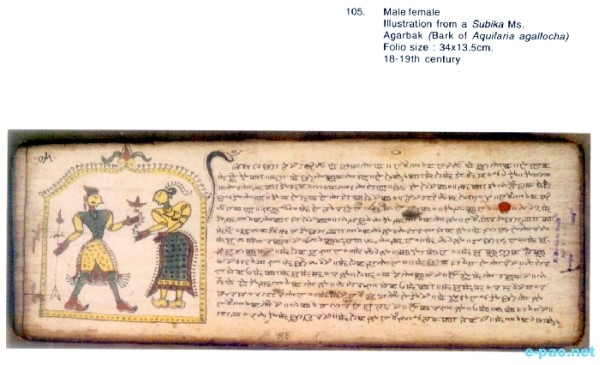

FIG 1
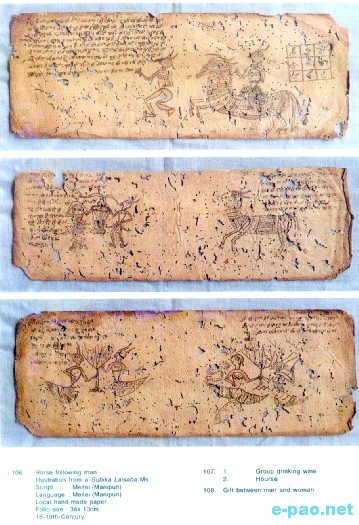


FIG 2
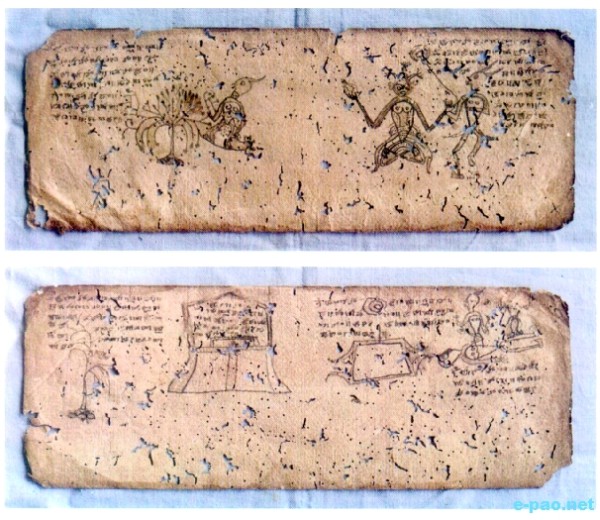


FIG 3

(109. 1. A man
Illustration from a Subika Laisaba Ms Script : Meitei (Manipuri)
Language : Meitei (Manipuri) Local hand-made paper
Folio size : 34x13cm.
18-19th Century
2. King and servant
110. 1. Tree
2. House
3. Patient and Medicine man)


a frog, a fish and a human being are all put together closely. Human characteristics are given to the hands, the head and the middle portion. The evolutionary stages of a frog, from that of an egg to that of a grown-up one, are depicted with the help of tails and hands. With a slight change in the position of the drawing at about 45° and a change in the portions of the head and the tails, the image of a fish can be deduced from the drawing. Here also the colours used are Indian-red, black and yellow-ochre. The

Fig 4 to Fig 10 - Browse it as a Photo Gallery here.

intention of the artist is clearly to depict the changes in the process of creation of a human being by the Atingkok Guru Sidaba, the Almighty God as known to the Manipuris. The Manipuris believe that everything in this world originated from Him, He protects all, and will absorb all into His body.

Fins of fishes are sometimes used in figures of pythons in the Subika manuscript. The rhythmic placing of the long body of the python gives a sinuous and artistic impression to a viewer. It is to illustrate three sets of numbers belonging to the gods, the human beings and the demons.

The numbers outside the upper body of the python belong to gods, those inside the body to human beings, and those outside the lower body to demons. Treatment with different colours also makes the distinctions clearer. Legs of birds are sometimes used in drawings of pythons.

The drawing often looks more like a python with the tail and fins of a fish and the horns of a dragon. Figures of small fishes are also inserted after the python, in line with the folk belief that shoals offish always follow the python.

Other interesting illustrations in the Subika manuscript include human figures with horns of animals, heads of animals, wings of birds, etc. The human features are presented in an abstract way, that is, on an imitative appreciation of the heads of birds and animals (Fig. 108).
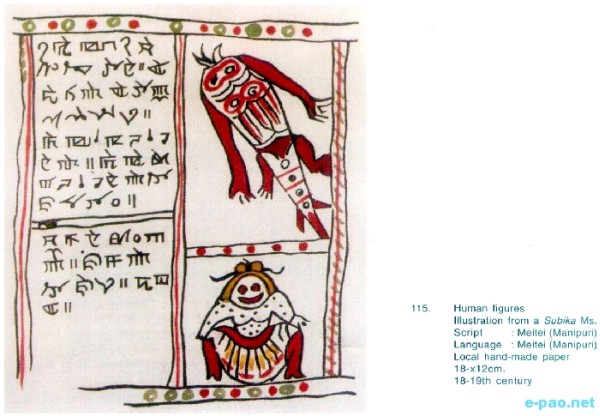

FIG 108 (8)


Most of the illustrations draw their inspiration from the indigenous cultural ethos. The traditional patterns are repeated by scribes with slight variations here and there according to their individual tastes. But the essence remains the same. Similarly, the symbols in the illustrations can be understood only in terms of Manipuri cultural symbols.

For example, the Manipuris regard the crow as messenger of death. If someone has a dream in which a crow perches on him or he merely sees one, it is taken as a bad omen. A crow in an illustration therefore hints at danger. Kairel keijao is a grand coffin used when a king or a nobleman dies and is carried over the shoulders of two persons like a palanquin. If a picture depicts a Kairel keijao it portends something evil in the near future. A crow above the Kairel keijao heightens the impending danger (Fig. 114, no. 3).

Another illustration in the Subika manuscript portrays a tiger looking at a deer. Though traditional enemies, the ample space between the two animals conveys the meaning that nothing will happen between the two. By analogical interpretation it also means a person who is envied by his enemies but no harm coming in his way (Fig. 112, no. 4).

When an illustration has platforms, the one with legs indicates movement and is the sign of unfortunate happenings in the future (Fig. 113). If the platform is depicted without legs, it conveys a positive outcome. A person sitting on a platform is indication
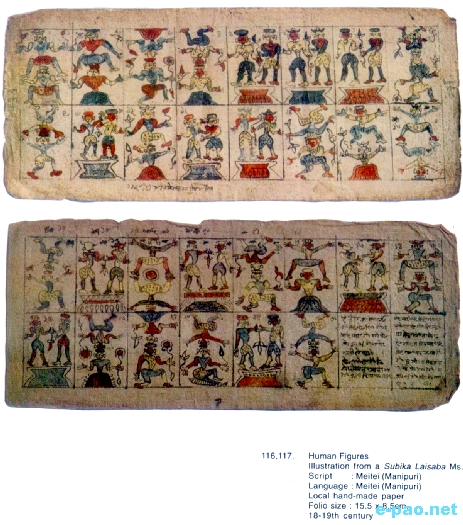

FIG 9


of promotion in life. When a cow, the traditional symbol of wealth, is shown being tied with a rope to a platform, it tells of a person who is going to amass movable properties (Fig. 111, 112, 113).

If the illustration shows two persons sitting at opposite ends of a lying figure and another one is puffing at a hookah above them, it depicts a traditional practice known as khuya lukhum phamsennaba. Here the person with the hookah is a maiba or medicine-man who has given up all hopes of recovery of a sick man, the lying figure, and the other two persons are attendants or relatives. They all are waiting for the end to come (Fig. 113, no. 10).

Large number of trees in a picture indicates profusion of wealth. Similarly, depictions of satra, chung, pe and phiral are representative symbols of a traditional
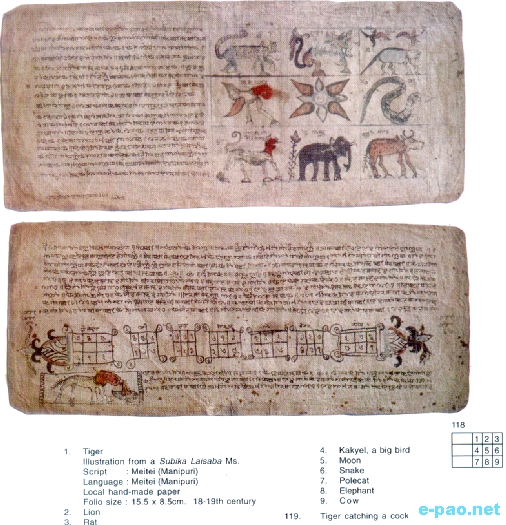

FIG 10


saying called phiral mamai chumba to describe someone's rising star (Fig. 1ll no. 4,112 no. 1,6, 113 no. 9). A twin figure without gender distinctions is symbol of happiness (Fig. 113 no. 1, Fig. 114 no. 4. A person surrounded by bodyguards stands for a king, and someone appearing to be under his influence is, of course, the king's favourite. A highly decorated lamp predicts happiness.

A figure holding daggers conveys enmity; someone shown climbing up a tree the likelihood of death from a fall. If a person is shown carrying a long pole with heavy weights suspended from both ends, it foretells suffering. Some illustrations use lines to resemble a rainbow.

The traditional thakan or canopy is also rainbow-shaped and it therefore symbolizes the best possible fortune (Fig. 113 no. 1,8). After marriage, the bride from an affluent family is sometimes brought to the residence of the groom on a decorated elephant. The king and noblemen also go on tour like this. A person who appears to be under the spell of such a picture is supposed to experience a long peaceful life.

to be continued ....


Preface :
" This work originates from seeing the scattered illustrated manuscripts, which I found in the custody of our local Pundits. Since 1973 I have been working for these manuscripts by collecting from various sources. Some of them are already published in the Book entitled the Manuscript Paintings of Manipur in 1978. Even the second reprint issue is also produced in this year. But unfortunately it could not be printed in colour due to financial constraint. All the paintings consisted in the earlier publication are coloured by freehand.

I have the opportunity to exhibit some illustrated manuscripts in the 2 day seminar organised by Manipur Folklore Society held from 26 to 27 September 1982 at G. M. Hall, Imphal. This exhibition attracts many scholars from different parts of India. Then in 1991, published another book entitled Subika Laisaba (A Manipuri illustrated Manuscript on Astrology).

The present work on illustrated Manuscripts is a bunch of paintings collected from different parts of Meitei inhabited areas like Bangladesh, Myanmar etc. It will incorporate 364 faces of Paphal and other unpublished manuscripts.

I would like to convey my thanks to the Ministry of Culture, Government of India for the financial assistance to the task of publishing it. I hope that without this support it could not have been possible to materialise the things.

I alone am responsible for any remaining errors and infelicities for they are of my own construction. I always welcome suggestions and criticisms for further development in future."


Date :31st May, 2005
Mutua Bahadur


Mutua Bahadur


* Mutua Bahadur contributes to e-pao.net regularly. This article was webcasted on February 21st 2010.


* Comments posted by users in this discussion thread and other parts of this site are opinions of the individuals posting them (whose user ID is displayed alongside) and not the views of e-pao.net. We strongly recommend that users exercise responsibility, sensitivity and caution over language while writing your opinions which will be seen and read by other users. Please read a complete Guideline on using comments on this website.


LATEST IN E-PAO.NET
  • 48-hour shutdown: Sunurok Killing #2: Gallery
  • Violence in Manipur 2023-2026 : Timeline
  • Featured Front Page Photo 2026 #5: Gallery
  • Justice for 6 Liangmai Nagas #3 : Gallery
  • The night is still young
  • Hell, thy name is Manipur
  • 7th Rongmei Freshers' Meet in Delhi
  • Workshop: Conservation of Manipuri Pony
  • 140/150 cadres missing at Sinai Camp
  • Pot Lannaba : Mera Houchongba #1: Gallery
  • The Last Picnic Season 2: Micro-Series
  • Manipur's expanding conflict & solutions
  • Mushroom Training Program at Khagempali
  • Delusional normalcy: Recurring violence
  • Toy Gun : Best Short Feature Film CNFF 2026
  • Call to exempt schools from bandhs
  • 228th Bheigyachandra @Nabadwip #2: Gallery
  • Significance of Mera Hou Chongba festival
  • When the kitchen turns loud
  • Nagaland First Five-Star Hotel
  • A harmonious family :: Poem
  • Ageing with HIV must not mean invisible
  • US Midterm Polls: What they mean for Manipur
  • Politics of the SoO pact
  • Exploring The Vanishing Self #16
  • The borders the Nagas never chose
  • Bend, Don't Break :: Poem
  • NE moved out of tropical climate zone
  • SoO-less Gong-sound for Peace
  • 'Soil Intelligence' is reshaping infrastructure
  • Naga Peace Process: Indo-Naga Talk: Timeline
  • Noise protest: Manipur Violence : Gallery
  • Nasha Mukt Bharat: A message beyond slogan
  • Bringing books back to living rooms
  • Slams Govt over Escalating Violence
  • When truth becomes the enemy :: Poem
  • The neuroscience of learning
  • 'Hiraeth' at Asian Film Fest Barcelona
  • Marching towards the next Assembly polls
  • The story behind Chahi Taret Khuntakpa
  • Biofortified sweet potatoes in Manipur
  • Probe into alleged Political-militant Nexus
  • Nimai Sarungbam - Lalit Kala Akademi Award
  • "Issue is very Delicate & Sensitive"
  • Festive fitness
  • Shilp Samagam Mela 2026
  • Noting Oct 19, 20, 21 : CoBRA at Sinai camp
  • 48-hour shutdown: Sunurok Killing #1: Gallery
  • The long road without God for 75 years
  • 30 Candidates for Employment in Japan
  • Peace cannot become a political PR exercise
  • Searching for scientific consciousness
  • Time :: Poem
  • India's journey from cotton heritage to new age
  • Tragedy scripted by geo-politics
  • Northeast Book Fair Imphal #2: Gallery
  • World Space Week 2026: The rocket revolution
  • Nomination: RIST Scientist Award 2026
  • Myanmar's return from isolation
  • Deepest Solidarity to Families
  • ABHA and Medical Transcription
  • Manipur Police arrest Three Suspect
  • Sunurok massacre: Politics of selective silence
  • Langban Tha Katchaba @Haying #2 : Gallery
  • Prof Kamal Mitra Chenoy : Obituary
  • Tale of Ahu, Alang & Apapang: Amur Falcon
  • Consumerism :: Poem
  • Condemns Khamenlok Killings
  • Humble Appeal to All Concerns
  • Envious of the Chief Minister
  • Delivering a powerful point
  • Catholic Valley Schools Sports #1: Gallery
  • When the extraordinary becomes ordinary
  • The Map We Chose :: Poem
  • Dhakeswar Potsangbam : ToI Wellness Award
  • Nigeria calls on world to turn AMR pledges
  • Understanding the pressure students face
  • Training on Mushroom at Khagempali
  • Pointing finger of accusation
  • Digital Revolution & MK Binodini Devi
  • Exploring The Vanishing Self #15
  • Letter From A Lost Crony :: Poem
  • Procedural lapses in dismissal of Dr Bimol
  • Manipur Sanaleibak (The Golden land)
  • Training on Seismic Hazard @MU
  • 2026 edition of Hnahsin Kut
  • Oncology & Neurosurgery OPD launched
  • Yaoshang Thabal Competition #5: Gallery
  • Orchids of Manipur
  • Pharmacists: A misunderstood profession
  • Vision Service Week at Ibotonsana School
  • Drone Tech Bootcamp at NIT Meghalaya
  • Athokpam Krishnakanta : World 2% Scientist
  • No Solution Without Identifying "Kuki"
  • Stands in Solidarity with Prof Bimol
  • Taking the idea of Manipur to Senapati
  • Yumjao Lairembi Haraoba #3: Gallery
  • 'Enoong Ngallamdai' :: Movie Review
  • VanDyke Release: Diplomacy or US pressure
  • Mental Health Awareness at High Court
  • 2026 NAMA Research Grant [Upd]
  • Fermented food for beauty
  • Mizoram Targets 5-7% Tourism Share
  • The hills continue to burn
  • Hearthside Story of Naothingkhong #2
  • Between Delhi Power & Valley's Protagonists
  • The Zeliangrongpui at a crossroad
  • Mushroom Cultivation Training at Konthoujam
  • Break from within :: Poem
  • White Canes to Govt Ideal Blind School
  • Concerned: Conflict - Yimkhiung & Tikhir
  • Mizoram Travel Fest 2026
  • Condolence : Kh Armstrong Charang
  • Turning Imphal into a dumping site
  • Sushila & Bichu @Airport #2: Gallery
  • When prime-time spectacle replaces priorities
  • For a new world organization for peace
  • Intl Day for Disaster Risk Reduction @MTU
  • Solidarity with Professor Angomcha Bimol
  • Intl Day for Disaster Reduction @Wangkhei
  • Condemns Barbaric Killings
  • Schools, roads, power & water supply
  • 'Meeyamgi Khollao Khongchat' #2 : Gallery
  • RIST Talk #76: Gravitational-Wave
  • Breast cancer month, October, 2026
  • Free Screening of "Ishanou"
  • Unlocking potentials of 7 horticultural crops
  • Skies and me :: Poem
  • Eramdam hanna kanbiyu
  • The hills, the SoO camps
  • Mera Chaorel Houba @ Kangla #1 : Gallery
  • China's Mayor Economy
  • My muse :: Poem
  • Condemns Killings & Beheading of Civilian
  • Who doesn't do Vote Chori ?
  • EZE Perfumes Enters Northeast
  • One to one meet with PM
  • Exploring The Vanishing Self #14
  • 61st Hunger Marchers' Day #3 : Gallery
  • Humlennganba, Saka : Eming
  • Two interviews, one empty table
  • A landscape of silence :: Poem
  • NSS Runathon for Peace 2026
  • Gender equality- central to diplomatic leaders
  • Manipuri Calendar for year 2027 : Download
  • Meiteilon not Tibeto-Burman language: Rvw
  • Visit to George Gordon's tomb at Canchipur
  • Anandkumar Naorem: World Top 2% Scientist
  • Protect the hills to protect the valley
  • Call for Papers on Manipuri Pony
  • Ashok Singhal Ji - A Karmayogi
  • Addressing the basics of life
  • 228th Bheigyachandra @Nabadwip #1: Gallery
  • Wildlife Week Celebration at Thanga
  • Evolving women's role in Manipur tourism
  • Where do we go from here ?
  • Training Programme on Mushroom
  • Festival look for Navratras
  • Condolence : Demise of Adino Phizo
  • Significant Delhi invite to 3 leaders
  • Heterogeneous Structure of Meitei Society
  • Concert @ 18th Orange Fest #1: Gallery
  • When water management was Statecraft
  • Who switched off the respect :: Poem
  • All is not yet lost for Manipur
  • Wildlife Conservation: Securing the Future
  • Exam : Post of Under Secretary (Law)
  • Understanding narco-terrorism
  • 1500 Burma Refugees Families in 1968-1973
  • 17th World Bamboo Day : Gallery
  • Land affected families: NH-202 in Ukhrul
  • Training Programme on PCB Repair
  • World Habitat Day 2026
  • AMR survivor & WHO call to protect medicines
  • Cut fuel taxes, not food
  • Creating chaos on roads of Imphal
  • Sushila & Bichu @Airport #1: Gallery
  • Manipuri Pony: Case for Animal Science Univ
  • Hemp plant for sustainable textile & Manipur
  • Flame of the lamp & our cultural sensibility
  • Without you :: Poem
  • Welcomes Lalremsiami, Lalthantluangi
  • On the growing roadside eateries
  • 36 Names: Manipur at the Asian Games
  • Abok Ki Singju to Premiere
  • A vision fragmented by corruption :: Poem
  • Gandhi Ji's 3 monkeys and Manipur
  • AI-powered X-Rays are helping find TB
  • Mizoram Reward Lalremsiami, Lalthantluangi
  • 15 years in power Vs 10 years in power
  • Exploring The Vanishing Self #13
  • US-Manipur Digital Archiving Workshop
  • 8th Cultural/ Freshers' Meet for Rongmei
  • The Same Smoke :: Poem
  • Supriya looks at HYROX World C'ships
  • AI4SEVA Hackathon @IT SEZ, Mantripukhri
  • 38th Foundation Day- NIELIT Imphal #2
  • Heikru Hidongba @Bijoy Govinda : Gallery
  • Manipur's Indigenous Natural Farming System
  • Basic human needs a struggle for Sinakeithei
  • Demise of Pame, Marinmai, Lianvela
  • When I met the pugilist Sarita
  • 38th Foundation Day of NIELIT Imphal #1
  • Mizoram's Anthurium Festival Returns
  • Poll fever seems to be catching up
  • My attempt - Meiteilon is not Tibeto-Burman
  • XXXII National Thang-Ta C'ship concluded
  • One Village One Product: A better alternative
  • When machines can answer, who will judge ?
  • Explain motive- Tronglaobi Terror Attack
  • Merger of 5 elected members of NPP
  • Namghar Unites Assam & Maharashtra
  • Trade and commerce : In a limbo
  • 130th Irawat Anniversary : Gallery
  • Lamyanba Irabot Day at Itanagar
  • Irabot's Ideals Remembered at Mumbai
  • XXXII National Junior Thang-Ta C'ship
  • Raengdai Vs NEROCA : Durand Cup : Gallery
  • October Calendar for Year 2026 : Tools
  • Lebensraum or ethnic cleansing
  • The narrative Manipur needs
  • Tour Diaries of Maxwell & Higgins #2
  • Laitonjam Rishikanta @ Asian Bodybuilding
  • Manipur Mesopotamia Force WWI : Gallery
  • Yaoshang Thabal @Khurai #2: Gallery
  • Chali-Saba - Kang Ningol Palli #1: Gallery
  • Naothingkhong & Pitanga #1: Hearthside Story
  • Meiteilon is still not a Tibeto-Burman language
  • 52nd Foundation Day of AMWJU : Gallery
  • 61st Hunger Marchers' Day #2 : Gallery
  • lEkoLdugi warisiH :: Seireng
  • Can Strong Anti-Racism Law save NE Indians
  • Culturals @Beating of Retreat #4 : Gallery
  • Justice for 6 Liangmai Nagas #2 : Gallery
  • 12th Manipur Legislative Assembly : Gallery
  • The 731, and those who may follow
  • Little Flower School, 1973 batch : Gallery
  • Bichu Kharibam: FIH Magic Skill Award
  • Tour Diaries of Maxwell & Higgins #1
  • Ningol Phida - Shumang Leela #2 : Gallery
  • Study: Social Worker on Counselling Practice
  • India-Myanmar boundary : Mistakes of 1967
  • Radio E-pao: 5 new songs updated
  • To our star Tamo Vicky, Vikram Chongtham
  • Vice President visited Manipur : Gallery
  • Langban Tha Katchaba @Haying #1 : Gallery
  • Protest by Researchers @DM Univ : Gallery
  • Meitei Esei
  • US Ambassador @ CM Mantripukhri : Gallery
  • A teacher does not leave when his classroom
  • Candle Light- Chongtham Vikram : Gallery
  • Colonial records: Hill Areas, 1891-1947
  • Joint Resolution: Abrogation of SoO
  • Manipur Can Simply Be Manipur
  • PhD Admission at Assam University
  • Census 2027 for Manipur deferred
  • Read Meitei Mayek news in romanized English
  • 24-hour Gen Strike (Sep 1) : Gallery
  • Kang Khichri Chaba #2 : Gallery
  • Relevance of NRC, 1951 for immigrants
  • 35th Manipuri Language Day, 20 August
  • The chappals we leave behind
  • Search 25 years of e-pao.net
  • Colonial Knowledge Production in NE India #23
  • 360° panoramic view of spots in Manipur
  • Final Merit List : Manipur Civil Services 2022
  • PUCL Tribunal report: A shadow of partiality #3
  • PUCL Tribunal report: A shadow of partiality #2
  • PUCL Tribunal report: A shadow of partiality #1