


Thang Ta: A journey
(Through the history of Kangleipak)
from an ancient combat art to a popular modern sport
- Part 3 -
By Dr. HanjabamCha Barun *
(B.4) The Meetei martial art – The fall:
With the advent of Hinduism, gradual disbandment & disorganization of the Lallup system & the Lalmee (soldiers) started. The King Meitingu Charairongba (1697-1709, believed to be the last king of the bloodline of Pakhangba) embraced Vaishnavism (Madhavcharya sect of Vaishnavism) around 1704, but he gave equal respect & still regarded the indigenous Meetei religion.
His son, Meitingu Pamheiba {1709-1748, an adopted son who killed his father, the king, by stabbing in the chest when he was in sleep (Meitingu Charairongba was dead tired after defeating the invading Tusuk army; he had not eaten, nor had any drink since the last two days, as a part of the three days rigorous prayer to the Lord Sanamahi Lainingthou as advised for the welfare of the king & the kingdom – unfortunately never completed due to the advancement of the invading army towards the capital, before the dawn of the last day of the prayer)} - on the contrary, was completely swayed away (by the waves of extreme/dark side of Hinduism), & even tried forceful imposition of Hinduism (he was first initiated into Vaishnavism by Gopal Das; latter he switched over to Ramanandi school of Vaishnavism).
Many temples belonging to Meetei traditional religion & deities were destroyed; & replaced by Hindu gods. He prosecuted severely the Meeteis following the traditional religion; & even did not spare those belonging to other sect of Vaishnavism. He banned poultry & piggery (around 1723), even records & books written in ancient Meetei scripts. All the Lupungs (burial grounds for Meetei Kings & his forefathers) were excavated, & the remains, burnt (on 20th March 1724) on the bank of Ningthi river (Chindwin river, then a part of Kangleipak), according to the Hindu rituals (thus starting cremation of deaths among Meeteis; the cremation site of Meetei Kings, the Manglen in Kangla, was subsequently developed by him in the year 1738).
Hinduism became deep rooted into the society, & its influence obvious in every section, resulting in extensive & sudden transformation of the socio- economic & cultural formation. Sanskritisation/Hindunization of the Meetei nomenclature {the kingdom was named as Manipur, so as to relate to the Manipur of the Mahabharata; however the name was believed, assigned officially (British India) to Kangleipak by Mr.Rendel? in 1774? when Mr. Warren Hastings was the Governor General of British India} & introduction of Hinduised gotra of the seven Salais followed.
On the 17th day of Mera (October), 1732 (as decided by a seminar, held at Kangla Hall, Imphal on 9th Oct.2008; well some consider it to be somewhere in between 1721 & 1725 A.D) at the instigation of the king's religious guru, Shanti Das Gossai (A Hindu preacher who came during the later reign of Meitingu Pamheiba from Sylhet, Bangladesh), all the ancient written documents of the kingdom, ancestral records, including the holy scriptures, called the Puya, were burnt down { Puya Meithaba: an attempt to modify & erase the ancient identity of Kangleipak; & to rewrite the theory of Hindu origin of Kangleipak; even many new Puyas ( as said by some Meetei scholar - 'Sanggai-Phamang Puyas' with wrong information??) with ideas or philosophy concerning with Hindu religion were forced to be written by the scholars, as per his order.} at Kangla Uttra (which is the ancestral coronation hall of the Meetei Kings).
Those Meeteis (the Lois & Yaithibi) {including all the Maichous (scholars like Louremba Khongang Thaba, Langol Lukhoi, Konok Thengra, Wangoo Bajee etc); & many more like Chingngu Khongnangthaba, Moirang Lalhanba etc. were even hanged to death} who resisted to the conversion to Hinduism {as one among the many techniques of conversion, said by many) - people were forced to drink 'Charnamitra' or ' Khongjum' (in Meetei language: Meeteilon, basically the water remain after washing or sinking feet- of the Hindu priests; ' who knows may be even possible, might have been forced to eat cow dung / cow urine etc ???'.} were tortured, & driven out of the main community to far villages (with them some ancient Meetei records).
All these strained the relationship between the king & the Lallup soldiers (also with the hill tribes, who along the Meetei Loi & Yaithibi were considered as the Sudras, the lowest caste in Hinduism, & uncivilized.), who often became to be viewed with suspicions. Top military commanders became Hindu immigrants. The Lallup system was deteriorating & with time, becoming more a civil organization (from its original military organization).
This collapsing of the Lallup system (& also due to the prevailing political turmoil as a result of the frequent fights for controlling power & throne among the princes of the kingdom) may be attributed for the 6 khuntakpa (devastation & abandoning of the Meetei kingdom due to Burmese army terror). Two during the reign of king, Meitingu Gourashyam or Linwai Phallou Maramba (1753-1959 AD; 1762?-1763 AD ), when the Burmese king Alaungpaya (1752 – 1760, founder of the Konbaung dynasty)'s force (of the highly militaristic Konbaung Dynasty, 1752 to 1885; by 1758, his force had reunited almost all of Burma) invaded Kangleipak in 1755 (The Burmese use fire arms against the Meetei with traditional weapons, & Khuntak Ahaanba, the first devastation followed) & 1758; three in the year 1764, 1769, 1772 during the reign of King Meitingu Ching-Thang Khomba/ Bhagyachandra (reign: 1759-1762? AD; 1763-1798 AD).
The last one, lasting for seven years, was known in the history of Kangleipak, as 'Chahi Taret Khuntakpa' from 1819 to 1825, ending the reign of King Meitingu Marjit (1813-1819). The Meetei force faced defeat in the hand of King Hsinbyushin's (1763 – 1776) force (of Konbaung dynasty, 1752-1885, Burma) {as believed assisted?? by Chitsai, uncle of Meitingu Ching-Thang Khomba, who had killed his father (Ching-Thang Khomba's) Samjai Khurai-Lakpa (the elder son of Meitingu Pamheiba) in Awa (Burma). In the subsequent years, the King, Meitingu Ching-Thang Khomba fled (along with his queen, & a few royal attendants) to Cachar/ Ahom kingdom, Assam (Kangleipak was known by the name Meklee/ Magloo/ Magalu /Moglai to them & to Cacharis). About 300,000 Kangleicha (the people of the kingdom) were believed to have been either carried away or killed around 1768? (near the city of Ava, the presence of about 100,000 Kangleicha captives were reported)
[The king fled to Cachar many times - atleast thrice? in the history, first in 1764 when the Burmese force counter attacked to his raiding of Awa (with Ibungo Sija Haricharan); 2nd in 1769 when the Burmese attacked (after he killed King Khelei Nungnang Telheiba,1764-1768); 3rd in 1772 when the Burmese counter attacked his raiding.]
(B.5) The Meetei martial art – The famous 'Maram Ta Khoushaba':
There are some interesting incidents (story) during his exile. On his way to Cachar / Ahom kingdom, the king reached 'Maram' , a village on the mountain top, where the inhabitant tribes failed to recognized him, & demanded a proof of his identity (as they had heard many stories about the divine power of the Meetei king). To this, The king did a "Ta Khoushaba" (Thang Ta spear form/ martial dance) on a hard rock, leaving his foot prints (in the spear form/pattern, about 70-80% utilization of lower extremities is needed), as he did various moves (Phanba) of the form.
Similarly, when he reached Ahom kingdom (as a result? of a letter from his crafty uncle, Chitsai, poisoning the Ahom king, Suremphaa / Rajeswar Singha (1751-1769, the 33rd King of Ahom Dynasty, 1228-1826?/1838?) that it was an imposter not the Meetei king, who was taking refuge at his court), he (without any weapons) was asked to tame & control one fierce, wild elephant at Rang Ghar {a royal sports- pavilion or stadium like, for observing sports, animal fights, social functions etc in Ahom kingdom, built in 1746 by Ahom King Sunenphaa or Pramatta Singha (1744–1751, predecessor of king Rajeswar Singha) – considered one of the oldest amphitheater in Asia, located in Sibsagar district of Assam} as a proof of his identity as a Meetei king (believed to possess divine powers). So beautifully & gallantly he did the formidable task, winning the respect & belief of Ahom people instantly. Thereafter, the Ahom king helped him regained the throne of Kangleipak.
{Two attempts were made to reinstate Bhagyachandra by the Ahom king in 1765 & in 1768. The first attempt (Ahom army) led by Haranath Senapati Phukan was unsuccessful (due to attack by Naga tribes, lack of food, heavy thickness of the forest & poisonous snake bites etc – hence called Lat kata run or war in the midst of cutting the creepers). The 2nd attempt was important for his ultimate regaining of the throne (~10,000 Ahom infantry led by Kirtichandra Borbarua + army (which included many hill tribes also) raised by Bhagyachandra, total, said to be ~80,000 infantry).
Finally, his force defeated King Wangkhei Binodram's (who was installed by the Burmese as the Kangliepak king in 1772) in 1755 at Lamangtong & Foiching. He ruled the kingdom till 1798?}
[As a devotee of lord Govind (Cheitanya's School of Vaishnavism); he is said to have been helped by the lord himself (who tamed the elephant as the Mahout). After this incident, as revealed in his dream, an idol of the Lord (some said to be four in no.) was carved form a certain Jack fruit tree growing on the slopes of Kaina hill (26 km from Imphal on Imphal-Yairipok Road), & installed at a Temple at his Langthaban (Canchipur) Palace (11th Jan ?1779). After the installing, ras-leela was played continuously for five days (at the open ground of Ras Mandal Pukhri). The dance (Kunja Ras, Maha Ras, Basanta Ras), its dresses etc, are said to have been composed by the King with the help of his daughter, princess Bimbabati or Shija Laioibi, as what he had seen in his dreams. Actually, Ras Leela dance can be concluded? as modified version of ancient Lai Haraoba Dance of Meetei]
(B.6) The Meetei martial art – The major exodus of Thang Ta warriors - The seeding out:
The year from 1819 to 1826 witnessed the dark periods of chaos & devastation in the history of Kanglaipak, painfully engraved in the hearts of each Meetei, "The 7 years devastation". The Burmese King Bagyidaw (1819 – 1837; 7th King of Konbaung Dynasty,1752-1885; grandson of the 6th king Bodawpaya,1782-1819, the 4th son of king Alaungpaya) sent a large force (~25000 soldiers and 3000 cavalry) under General Maha Bandula, the commander-in-chief (1819 -1825), when the Meetei King Meitingu Marjit (1813-1819) refused to attend the coronation ceremony & pay homage to him (the Burmese King). Meitingu Marjit was defeated (after a fierce fighting of 7 days – ~7000 Meetei vs ~30,000 Burmese soldiers), & he fled to Cachar (in Assam) - the victory earned General Maha Bandula, the title 'Ne Myo Thura Yegaung' given by the Burmese king.
Burmese troops took way about 30,001? Kangleicha war captives (around 1820?). Fearing the terror of Burmese army, many thousands more fled to neighboring kingdoms (Tekhao, Assam; Takhel, Tripura; Sylhet, Bangladesh; Awa, Burma etc; also to the hill tribes, mainly Tangkhuls & Kabuis, who latter were absorbed within them). These people, including many Thang Ta masters, took along with them the martial arts tradition of Manipur.
{During & after these seven years, the population of the Kingdom was believed to be reduced by about 30,000-50,000 to ~ 10,000 at the end; it is said that the no.of adult males in the kingdom was less than 3001in 1826; however, the total no. of Kangleicha either killed or captured during 1764-1824 was estimated to be around 2lakhs, about 9/10th of the total Meetei in the period}.
(B.7) The Rebirth:
Slowly with time, the national struggle against the Burmese rule became stronger, & the first standing army, the Manipur Levy, was created. With 500 Meetei Levy (which subsequently was increased to 2000?, with many hill Kangleicha), under the Gambhir Singh (Chinglen Nongdrenkhomba) with the help from British (Captain F.J. Grant and Lieutenant R. Boileau Pemberton were the officers) succeeded in expelling the Burmese from Cachar (Assam), & Manipur (Ningthee river/ Chindwin river was made the eastern boundary of Manipur) in the 1st Anglo-Burmese war (5th March 1824-1826), considered (by many) as the longest & most expensive war in the history of British India.
[The British {Mr.Verelst (Venositart?, the Governor of Bengal), chittagong Chief of British East India Company} had signed a treaty in 1762 with the Kingdom (Meitingu Gaurashyam/Maramba (1753-1759, 1762?-1763) that the British would give necessary assistance for protecting the Kingdom from outside invaders (Burmese, Nagas etc) {for a land (a village) given to them (British) by the Meetei King for the East India Company posting – another similar treaty was signed in 1763}.Unfortunately, The British weren't able to reach & reinforce the Meetei army during the times of devastions].
Gambhir Singh was crowned the King of Manipur with capital at Langthabal (Canchipur) (1825?-1834). About 763? Awa (Burmese), & 152? non-Manipuri were brought as war prisoners- with them their martial tradition.
(B.8) The Meetei martial art – Another seeding out:
Another emmigration of Thang Ta experts form Manipur took place, during the latter reign of Meitingu Chandrakirti (1834-1844, 1850-1886). Meitingu Gambhir Singh died on 1834 when Chandrakirti (his only son) was only 2 years old, & hence was, in accordance to the tradition, made the king of Manipur (hence he was also known by the name, 'Ningthem Pishak'), with his uncle, Nara Singh, as the caretaker & regent (so the power & control was in his hand, Nara Singh, the second cousin of Meitingu Gambhir Singh).
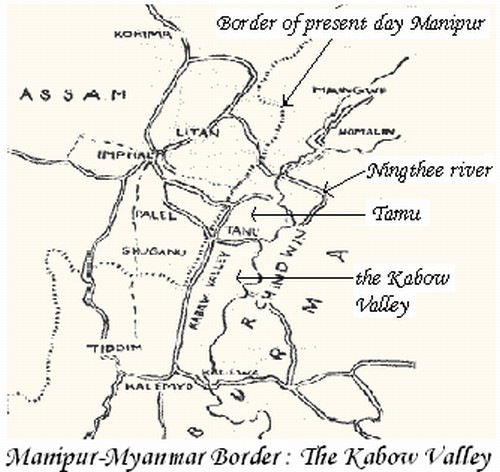
[Meitingu Gambhir Singh died ( as reported, of Cholera, who was very sad & depressed) when the British, in order to please the Burmese, gave the Kabow Valley in (~7700 sq.Km, 1/3rd area of present Manipur) to them (Burmese), after the Treaty of Yandabo (24 Feb.1826, signed by General Sir Archibald Campbell on the British side & by Governor of Legaing, Maha Min Hla Kyaw Htin from Burmese side at Yandabo, 50miles from Ava, & as per it, Manipur was recognized as an Independent kingdom after the 1st Anglo-Burmese war).
The valley had been an integral part of Kangleipak since olden days (~1475; during the reign of Meitingu Kiyamba, 1467-1508.). However, to decrease the growing resentment, the British started giving compensation (~Rs500 Sicca per month) to the Manipur King, starting from 9th Jan 1834 (the valley was transferred on this day), which was to be continued till the day of its reversion back to Manipur , as per the agreement signed by Major F.J.Grant & Capt.R.B.Pemberton at Langthabal on 25th Jan.1834. Even after independence, & merger with India, the payment of compensation was continued till 1953 when the first Prime Minister of India, Pt. Jawaharlal Nehru, without even consulting then Manipur Govt., transferred the valley permanently to Burma.]
|
The queen & mother of Chandrakirti, Maisnam Chanu Kumudini Ponglen-Khombi, was not satisfied with the arrangement (power in the hand of Nara Singh); & supported the revolt against Narasingh by Nobin, who was the grandson of Meitingu Pamheibi. Narasingh was a skilled Thang Ta expert, & a devotee of Lord Govinda (he built the original Govind temple in Kangla, Imphal in 1846, during his reign, 1844-1850). In 1844, one evening (Sandya-arati matam), taking the advantage of the vulnerable hours of evening prayer (at the Brinamchandra Temple?), Nobin attacked to kill Narasingh (who was unarmed) when he lay prostate for getting blessing (Dan-da-bot touba) from the lord.. Immediately, Narasingh reacted & retaliated, defeating Nobin (who was killed by his escort).This incident lights the undoubted effectiveness of Sharit-Sharak.
After the defeat of Nobin, Queen Kumudini with her son (said to be accompanied by Thangal General??) fled to Cachar (in Assam) in 1844. Narasingh became the king, as desired by the people (at the age of 51 years; with capital at the Kangla). Chandrakirti came from Cachar with his force (supported by rulers there) & defeated King Meitingu Devendra {the brother of King Meitingu Narasingh, who ascended the throne after his death (Meitingu Narasingh) in 1850, ruled for only 3 months}, & regained the throne of Kangleipak in 1850 (at the age of ~18 years)
The childhood incidents & hard struggles impacted deep in his mind, & in order to subdue any possible conspiracy against him (kingship), there started the killing (silent) of many Thang Ta masters, who were not in his group or directly under his control. Among the many killed was the Thang Ta master, Ojha Sanachapprando (paternal uncle - elder brother of father - of Ojha Rajkumar Sanahal, another great Thang Ta master, & also his teacher – it's said that Ojha Sanahal used to record many of the famous Thang Ta moves/steps - which he preserved for the us, the future generation - using a charcoal piece on the floor as revealed /done by Ojha Sanachapprando) who was murdered under a conspiracy.
Many surviving Thang Ta masters fled the Kingdom for neighboring countries (Kingdoms) - (present day Myanmar, Assam, Tripura etc.)- where they settled & spread the seed of Thang Ta martial art.
To be continued....
* Dr. HanjabamCha Barun (C.G. Pradesh Thang-Ta Association, Pt.J.N.M.Medical College, Raipur (C.G.)) contributes regularly to e-pao.net. The writer can be reached at dr(dot)barun(dot)hanjabam(at)gmail(dot)com
This article was webcasted on May 14th, 2010 and updated on July 9 2010 and later updated on March 15 2011.
* Comments posted by users in this discussion thread and other parts of this site are opinions of the individuals posting them (whose user ID is displayed alongside) and not the views of e-pao.net. We strongly recommend that users exercise responsibility, sensitivity and caution over language while writing your opinions which will be seen and read by other users. Please read a complete Guideline on using comments on this website.


