


Thang Ta: A journey
(Through the history of Kangleipak)
from an ancient combat art to a popular modern sport
- Part 2 -
By Dr. HanjabamCha Barun *
Section: B
(B.1) The Meetei martial art - Interaction with neighboring Kingdoms – The Chinese:
The inter-influence between the Meetei martial arts & Chinese (China- our once ancient neighbor) martial arts can be roughly understood from some of the historical events- like some of the historic battles & profile of migration between the two. The earliest Chinese interaction has already been mentioned [In Chinese, 'Meithei' means 'people of this country', meaning people of their territory, as per some learned]. Many scholars believe that Meetei travellers/traders? on horses might have reached out to China & upper Burma during the reign of Meitingu Khui Ningngonba (364-379), Pengsiba (379-394)& Naokhamba (411-428).
About the year 1250, a large number of Chinese forces invaded Kangleipak (known to Chinese as 'Hsiao Po-lo-mein'), during the reign of Meitingu Puyathaba (1247-1263), but was defeated. Many Chinese prisoners of war were assimilated into Meetei society, & settled at 'Susa Kameng' in the valley. [during these periods, in China, the practice of Ch'uan fa/Kung fu was so popular among the various civil organizations that there some group of people, called Luqi people, made their living performing martial arts all over the country.]
The words of military excellence & martial skills of Meetei Kings spread far & wide, even up to China ('Khagi' to Meeteis). In 1576, during the reign of Meetei King, Meitingu Mungyangpa (1562-1597 AD), a Chinese Chief/King (Khagi Ningthou), by the name Piyango (as known to Meeteis), sent (as per a legend / story) one fierce Chinese martial art expert or fighter, by the name, Meitana /Mayadana to challenge the Meetei king for one-on-one lethal combat (so ferocious was he that the commoners feared him as Hingchaba or a demon/monster).
The Meetei King, Meitingu Mungyangpa accepted the challenge, & fought him using his sword name 'Khoubomba' & spear 'Khangshunaha'(believed to be given by the Lord Pakhangba himself, as per a legend). The Khagi- hingchaba (Chinese monstor/demon) was ultimately defeated, killed, crushed & buried under a stone in Kangla, by the Meetei King.{some considered the stone to be at the 'Nunggoibi'?, still in Kangla today (It is the sacred place of worship of the goddess of war. Whenever a king of Kangleipak emerged victorious in battle, the sacred ritual of 'Huyein Lalu Chanba' was performed at this site)}
[In the same year (1576), Meitingu Mungyangpa got a son, who came to be known as Khagemba (from the word, 'Khagi - ngamba'; Khagi=Chinese, Ngamba =conqueror)]
It is said that when the news reached the Chinese King/Chief, he was so impressed that he, himself, came (he stayed for a short duration in Kangleipak, before returning to his kingdom) with his royal attendants to the Meetei Kingdom, & presented many precious gifts, they brought from China, including, a flower, 'Khagileihou' ('Khagi'= Chinese; 'leihou' ~ flower - a type of flower, very common in present day Manipur) to the Meetei King. Deeply impressed by the techniques & effectiveness of Thang Ta, many of his attendants stayed {& settled, as believed by many Thang Ta masters, at three places- Koutruk, Sengjam & Chirang (some sources mention the places as Khagi Hingol, west to the Kangla)} & learnt the Meetei art, Thang Ta.
His son, Ningthou (Ningthou=Meitingu=king) Hanba or Meitingu Khagemba (1597-1652), just like his father, was a great King, & also a skilled martial artist. He defeated a troop of raiding Chinese forces; probably from Yunnan province of China, in around 1631. He attacked Chinese Villages, & defeated their Chief 'Chouopha Hongdie' (known to Meeteis as Mangolsha or Manubak, a Chinese martial art expert, who was killed by Meitingu Khagemba). He too brought many Chinese war captives, & with them many skills- brick making, sericulture, & to a little extent their martial art system.
[At these periods in China, their martial arts received much development during the Ming (1368?-1644?), & Qing Dynasty (1644-1912?). Many Martial arts books were published. There was integration among various martial arts genres during the Qing period; also were the wrestling techniques introduced into general martial arts - improving & maturing them]
(B.2) The Meitei martial art - Interaction with neighboring Kingdoms – The Burmese:
Another important kingdom which had a significant impact was the Burmese (Kangleipak was known as Kathes, Cassay to them), present day Myanmar, {& to some extent, the other Southeast Asian kingdoms – Many meetei soldiers (as Burmese war captives mostly – who were part of Burmese cavalry corps etc) participated some of battles in these regions. Burmese king Alaungpaya (1752 – 1760, founder of the Konbaung dynasty, 1752 to 1885) surrounded (it's said that about 500 cassay horsemen were with him) Ayutthaya, the Siamese Capital (Thailand) in 1760, but was wounded accidently & latter died. In 1764, Burmese king Hsinbyushin (1763-1776, 2nd son of Alaungpaya & 3rd King of Konbaung Dynasty, Burma) conquered Chiang Mai (in Thailand), Vientiane (capital city of Laos); he also sacked Ayutthaya in 1767}.
One may understand this by appreciating the similarities between the Meetei Thang Ta & Burmese martial art systems- Thaing (meaning total combat), specially the weapon art of Banshay, (& the unarmed art, Bando) {& even with the Thai art-Krabi Krabong (Krabi= the sabre, a long sword with curved tip & oversized hilt; Krabong=spear/ staff, the mother art of modern Muay thai.)}.
There was constant social-cultural relationship, & trade contact between the two kingdoms, & even beyond. The similarity of the traditional Meetei male garment, Khudei, with those of Thai & Khmer is amazing. The ancient Meitei script is considered comparable? to that of Thai.
[The Khmer people of the great Khmer empire (of Cambodia, Java, Sumatra, etc) are believed to have come from west? of Burma, & India, in ancient time. They played a significant role in shaping of the ancient Burmese, Thai (& other Southeast Asian) kingdoms]
Some scholars believe that the Mon of Burma (Myanmar) came & settled in the ancient Kangleipak kingdom as early as around 2000BC?. As related to the Khmers? (The Meetei called them Khamarans, well many agree it was instead referred to the Burmese), it is said that they immigrated around 1000BC? to the kingdom. There is also historical evidence of immigration of many Shans, Tai (Pang) & Chin-Kuki groups from Upper Burma as a result of ravage of upper Burma by the Mongol ruler, Kublai Khan {reign:1260-1294; the 5th great Khan (~ruler) of the Mongol Empire, the founder of Yuan Dynasty,1271?-1368; the grandson of the great Genghis Khan (reign:1206-1227, the founder of Mongol Empire, 1206-1368, the largest contiguous land empire in the world's history – ~22% of world total land area)}.
It was the Pong king {Burma; Kangleipak was known by the name Cassay/Kassay to Shans / Tais, Kathe to Burmese etc; some scholars even doubt the Pong kings as descendants of the very early Meetei king – the first Pong king, Khool Lai (ascended throne in 80AD; a Meeteilon word- Khool = Place, Lai = lord) is considered as Tarung, the son of Pakhangba (?Nongda Lairen Pakhangba, 33-154AD, & his queen Leisuk Leisoi Yampi) who was deputed to hold administration towards the east in Pong}, Chaopha Khekhomba (to whom a Meetei princess was married), who presented a gift- a golden box? containing a stone, known as Pheiya or almighty {later claimed by an immigrant Brahmin as Hindu god Vishnu – hence mark the advent of Vaishnavism, & starting of idol (in the form of sacred stone) worshiping in Kangleipak}, a litter & a sacred spear to guard it to the Meetei king Meitingu Senbi Kiyamba (1467-1508, from word Senbi-Kiyaang Ngamba; Senbi-Kiyaang – the place, Kabo-Kiyaang in Burma; Ngamba - conqueror) as a gift to celebrate their victory after conquering (with their combined force, Meetei king was ~27years old & Ponk king ~47years) the Kiyaang Khambat {the king of Khambaat, Chao-Seng, a subordinate to the Pong king, had kidnapped the Meetei princess Sanna Langmeirangbee (accompanied by her maid servant, daughter of Haoroksu), on her way to Shan capital Mongaung, to be bride of the Pong king around 1475}.
As he rescued the princess, he is also known by the name, Leima-Phaabi, (Leima~queen/princess;Phaabi~capturer).The Meetei king got Khambaat, area on the west of Samjok (Thaungdut or Ksawnghsup), & area covered by Mingkhong & Muwai, as per the agreement with the Pong king.
[He built a brick temple for worshipping the stone at Lamangtong/Lamlangtong(~ 27 km south of Imphal) around 1475.Wel, as claimed by the immigrant Brahmin, the stone was worshiped as Hindu god Vishnu {Some sources claim the statue, probably, as Lord Buddha; as The Pong king was a Buddhist. Also Meitingu Senbi Kiyamba was not a Hindu (he practised the indigenous religion of Kangleipak- Sanaamahism.},& the place was latter called Bishnupur (land of Bishnu/Vishnu).
However, some source states the name 'Bishnupur' was given by Meitingu Pamheiba (1709-1748 AD) to carve the name 'Bishnu Goswami' in the history of Kangleipak, who had worshiped Bishnu (Vishnu)? at the place; the King also constructed a temple devoted to the God (Bishnu Temple at Lamangtong / Bishnupur.) – Bishnu Goswami was the very beloved brahmin/sadhu of the king. According to some learned, this sadhu/monk who was a wandering palm reader was even considered the biological father? of the king, Meidingu Pamheiba.
As per the source, the queen (mother of Pamheiba) of the king, Meitingu Charairongba (1697-1709 AD) - (originally she was a war captive, a Chothe by birth; though the king loved her very much) - was tricked & convinced by the sadhu who threatened her predicting that she would never get a male child from the king (hence none of her bloodline would be the future king), but he, the sadhu, could change her fortune by giving her a male child – a very common trick used by many self proclaimed so called holy men even to these days. Pamheiba (who was smuggled & nurtured since the day of his birth in a Thangal hill village) was adopted by the King (Meitingu Charairongba) at around 20 years of age]
The Toungoo Dynasty of Burma (1486–1752; King Mingyinyo, 1486–1531, founded the first dynasty at Taungoo) sent emissaries asking for Meetei princess {for marriage, to which the Meetei king Meitingu Charairongba (1697-1709) gave his daughter}
However, the relation with Burma was not always friendly, but more hostile. They were frequently faced war situations, & huge war captives (along with their tradition & martial culture) were brought into/ out of the kingdom. From the period of King Meidingu Mungyangpa (1562-1597), many Burmese (Kabo/Awas) war captives (settled at Kabo Leikai, Imphal) & were assimilated into the Meetei society. Meetei king Meitingu Khagemba (1597-1652) defeated Khamarans in 1648. The king of Samjok was defeated by Meetei king Meitingu Khunjaoba (1652-1666) in 1653 & 1659; he also defeated the Kabow valley chief in 1637.
Meitingu Pamheiba (1709-1748) (popularly known as Garibnawaz, a Persian word, meaning 'kind to poor'- given by Muslim immigrants or Gopal Singh, the Hindu name), invaded Burma after the Burmese king insulted his sister & had not treated her well (she was wife of the Burmese king). He with his skilled army under the great general, Thangjaba Chakrapani?, defeated the Burmese army on many occasions (in 1714, 1725, 1733, 1735, 1737, 1738, 1739, 1748-49 etc).
He was the terror of the upper Burma (under the king Taninganway, 1714 – 1733, the 14th king of Toungoo dynasty; & his son, King Mahadhammaraza Dipati, 1733 –1752, the 15th & last king of Toungoo dynasty of Burma). The upper Chindwin valley was under annual raids. He defeated Samjok king & collected ~1000 guns. His army killed the Burmese troops stationed to guard the Kaung Hmu Daw Pagoda{meaning ~ 'the royal merit making pagoda', a white dome-shaped Pagoda at ~10 km from Sagaing, said to be based on the model of the Maha-Ceti Pagoda of Ceylon/ Sri Lanka, was built by King Thalun,1629 – 1648, the 8th king of Toungoo dynasty of Burma in 1636, & its foundation stone is said by some scholars to have been laid by one Jibananda Thakur of Manipur), & vandalized everything on the way upto the wall of Ava in 1738, he was said to have conquered 46 divisions of Burma, of which a Burmese noble, Eu-Aujaya ('Aaumeiyajee' was the title) was made the king with capital at Yewa.
He left his sword marks at the door of the Pagoda. His army crossed the Chindwin River & captured Mayedu town on the bank of Yu River. His kingdom extended up to Mandalay? in Myanmar (frequently extended to 3-4 days journey east beyond the Chindwin river; & in the west upto the plains of Cachar). He also repulsed an army of about 20,000 to 30,000.
The Meetei soldiers, specially the cavalry on ponies with excellent skills of Thang Ta were feared & respected by all (&Meetei kings, considered to possess divine powers & abilities). One of the deadly weapons used by Meetei army cavalry was called 'Arambai', a steel arrow (commonly poisoned ) with a rope tail, hurled from the war ponies with a very high speed, accuracy, causing maximum casualties to the enemy.
(B.3) The Meetei martial art – The military strategy: 'Lallup system':
The Military excellence of the Meetei was mainly due to the 'Lallup' system (war/military organization). In Lallup, every male Kangleicha (people of Kangleipak) above 16 years & mostly up to 40 years was a member. There were seven Salai Lallup groups, belonging to the seven clans of Meetei (each controlled by their respected Maichou), all under the central command of the Meetei king.
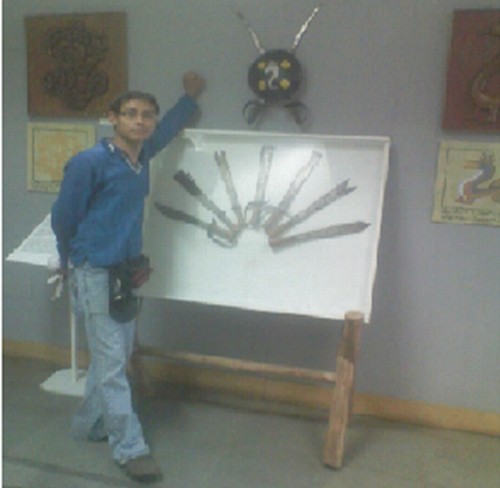
Each Salai group had their own identifying colour code, even characteristic weapons (swords- as an identification mark; & for ritualistic & religious use) of different shapes & sizes. Every member had to master the art of Thang Ta, & had to ready for action any time, when the Meetei king commanded.
|
This does not mean Thang Ta was exclusive for males. Kangleipak has witnessed many great female warriors. Three among the many, were the Queen Lingthoingambi (considered as the Joan of Arc, of Kangleipak), Queen Khayoiron Senbung Lokpi & Queen Kuranganayani. [Queen Lingthoingambi was the wife of the Meetei king Meitingu Ningthoukhomba (1432-1467 AD, conqueror of Tamu), & the mother of king Meitingu Thangwai Ningthouba or Kiyamba (1467-1508, the conqueror of Kabaw Valley). In the absence of her King, she led the Meetei soldiers in various war fronts, & also brought many spectacular victories; like the successful defense to the raid by the Tangkhul tribes from Tuisem village.
Queen Khayoiron Senbung Lokpi was her daughter-in-law, wife of King Meitingu Kiyamba & daughter of Khuman king Thingkonkhuba, & was equally brave – she defeated King of Senbi Mungkhong, Sanaahongba & even raided Panlu or Sasen. Queen Kuranganayani was the queen of King Suremphaa / Rajeswar Singha (1751-1769, the 33rd King of Ahom Dynasty, 1228-1826?/1838?), daughter of Meetei king Meitingu Jai Singh /Ching-Thang Khomba/ Bhagyachandra? (reign: 1759-1762? AD; 1763-1798 AD) who gave her hand to the Ahom king after the Ahom helped him suppressed Meitingu Kelemba?/Chitsai? (1748-1752?) – However, as per other source, Kurangganayani or Tekhao Leima Phongba Lokpi was the daughter of Meitei king Meitingu Gourshyam/Maramba? (1753-1759,1762?-1763).
It was she who played a vital role in killing {as per her plan, he was killed on the night of 1770? before the Bohag Bihu festival – It's said that she was the first to have struck him with a sword & wounded mortally} one of the rebel leaders, Raghav Moran ( he took her forcibly as his wife after dethroning the king) & helped in suppressing the first phase (1769-1770?) of Moamoria rebellion (1769-1806?) against the Ahom Dynasty. She was also the one who saved the Ahom king Lakshmi Singha/Sunyeophaa (1769-1780, who became her husband & the king after the death of his brother, Rajeswar Singha in 1769) from the Moamoria rebels - he was taken as prisoner by the rebels; & helped in restoring the kingship after suppressing the initial phase of the rebellion]
The Salai clan also had their way of learning & teaching Thang Ta (slightly different from one another). Many techniques were taught in total secrecy, for the fear of revealing to any expert onlooker; & the fear of creation of neutralizing counter attacks etc, if they became well-known & common, & hence no longer would be as effective as before. Even today, Thang Ta is taught & practised by the present masters in different ways (though the final goal is same), according to what they have learnt & experienced.
To be continued....
* Dr. HanjabamCha Barun (C.G. Pradesh Thang-Ta Association, Pt.J.N.M.Medical College, Raipur (C.G.)) contributes regularly to e-pao.net. The writer can be reached at dr(dot)barun(dot)hanjabam(at)gmail(dot)com
This article was webcasted on April 29th, 2010 and updated on July 9 2010 and again updated on March 15 2011.
* Comments posted by users in this discussion thread and other parts of this site are opinions of the individuals posting them (whose user ID is displayed alongside) and not the views of e-pao.net. We strongly recommend that users exercise responsibility, sensitivity and caution over language while writing your opinions which will be seen and read by other users. Please read a complete Guideline on using comments on this website.


