


My memories of Imphal from 1941
- Part 16 -
Dr Mohendra Irengbam *
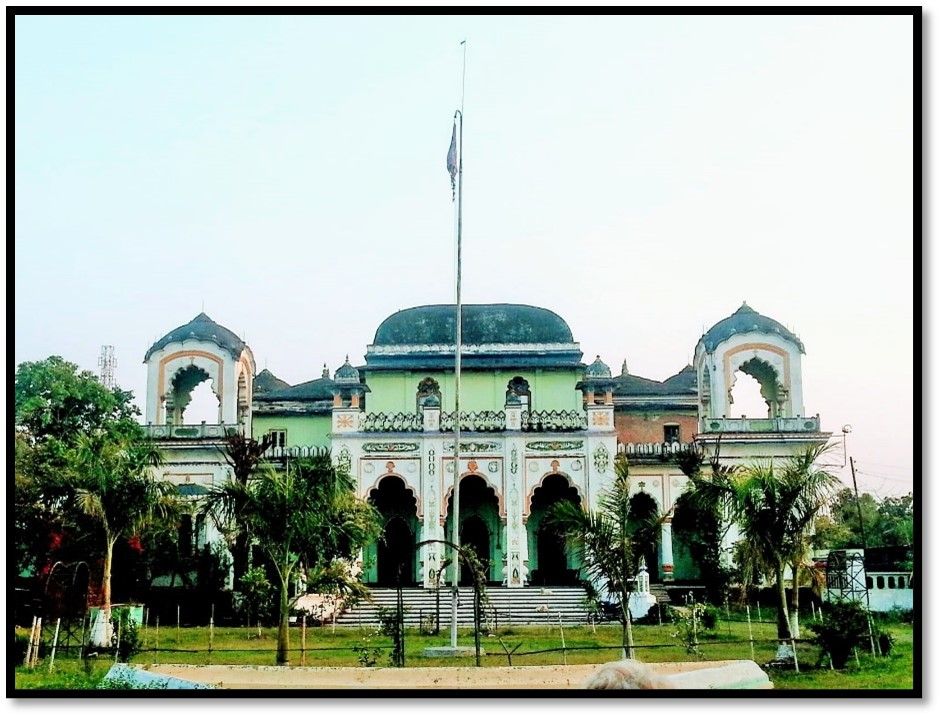
Photo of the dilapidated Palace (Konung) with tattered flag, November 24 2013.
The Palace at Wangkhei built in Rajput architectural style and completed on November 14 1910
The celebration of Lai Harouba is in extreme contrast to those of Hindu festivals, such as Jalakeli (Bengali, Jal Khel) – water sport. To Meitei devotees, entering a Hindu temple and performing a puja gives them a spiritual ecstasy, while joining a crowd of revellers of a Forest deity (Umang Lai) leaves them with only a notion of curiosity.
But, Lai Harouba is part of the ancient Meitei religion, an act of liturgical virtuosity, which drew on their traditions of 2,000- year old culture. That said, Hindu celebrations with ritual imagery of their gods, imbues them with authentic divine presence.
This Jalakeli festival arouses in me a wishful nostalgia about a halcyon Manipur, 70 years ago, not for its custom, but for my first glimpse of the Sana Konung – the Golden Palace and its splendour. I was a little boy when my sister-in-law Ibemhal took me to the palace. She went to take part in Jalakeli festival at the Govindaji mandab.
Ibemhal was a leima- a royal descendent, and as such, she was asked to take part in this Jalakeli festival. There are two main dynasties of Meitei kings: (1) Narasingh lineage [r. 1844-1850 CE] and (2) Bhagyachandra lineage (r.1762-1799 CE]. Also known as the House of Karta. Jalakeli was introduced by Raja Narasingh (1792-1850) in 1845.
Meidingu Charairongba had 4 wives and 5 sons: Pamheiba was his first son and heir to the throne. All the descendants of Charairongba are Rajkumars and Rajkumaris (Sana). All the offspring of the Rajkumaris are known as Leima.
Churachand was the son of Chaobiyaima Maikhumbi and Lalitamanjuri Devi, and was the great grandson of Maharaja Narasingh. He was born on April 15 1885. After the Anglo-Manipur War of 1891, Churachand was formally instituted as the raja of Manipur on April 29 1892, by Sir Lancelot Hare, Lt Governor of E. Bengal & Assam. He was then 8 years old. Major Maxwell, the Political Agent, chose him from the Narasingh Dynasty as the Karta dynasty revolted against the British.
On May 15 1907, Churachand was given to rule Manipur as a raja with the help of a Durbar, consisting of 6 Manipuris, and presided over by a young British ICS officer (PMSD). In 1918 he was awarded K.C.S.I, C.B.E for his contribution to WWI. He had tuberculosis as had his two daughters He went to die in Navadeep on November 6 1941 [Friday the 18th day of Hiyanggei in Manipuri calendar [Cheitharol Kumbaba, Manipur State Archives 2013 p935].
The present palace was built for Raja Churachand by the British, in time for his return from Mayo College in Ajmer and a stint at the Military Academy in Dehradun. It was completed in September 1901. It was built in Rajput architectural style as Meitei kings had similar Rajput surnames, religion and attire.
One day in 1941, my father Irengbam Gulamjat Singh was visited by a few royal ladies. They asked my father to allow Ibemhal to join the Jalakeli festival. My father, not a royalist, was not that keen, but had to acquiesce.
The Jalakeli festival was performed by two choirs (pala), every summer, on a full moon day, at the Govindaji mandab of the palace. This day coincided with the celebration of Buddha Purnima or Buddha Jayanti (birth day). Govinda (cowherd) is another name of Krishna, who has 11 names, according to the book of Gita.
These selected women sing the kirtan, seated in circles, crashing their small brass cymbals, accompanied by a couple of men beating their drums (Manipuri pung). A kirtan is Vaishnavite devotional song that is carolled with a rising tempo, extolling the life of Sri Krishna and Radha, in this case, while frolicking in the water of the Jamuna River in Brindaban. Once, the Nepali Maharani Ishwari took part as the lead singer.
The followers of Gaurya Vaishnavism (Dharma) are called Vaishnavs. This Hindu religious sect originated in the Navadeep district of Bengal in the 16th century. Goura (white) for Gouranga is another name for Chaitanya. His mother called him Gouranga because of his fair complexion. Chaitanya's' father was a Sylheti Bengali Brahmin, who migrated to Bengal.
Chaitanya was a great mystic. After his wife died from a snake-bite, he wandered all over the places associated with Krishna (Tirth Yatra). Tirtha (Sanskrit = Ford) is a crossing place between human and divine. He was regarded as an avatar of Vishnu by his followers. His prayer gatherings in Navadeep became so loud an unruly that, the Moghul governor of the area tried to ban his cult.
Before the War, we had Gouranga Lila performed at the mandab where small children 8 or so years old played Chaitanya and his wife. They had 2 ruffian brothers known as Jogai and Madhai. They got drunk one day and broke the skull of Gouranga during one of his gatherings. On another day, he got up from his bed, shaved his head, dressed in saffron and holding a stick, marched for Brindaban, while the pala sang: Brindam chole Shree Gourahari … in medieval Bengali.
His contemporary biography, Chaitanya Charitamrita, written in Bengali with Sanskrit slokas (my father had a copy) mentions that even the wild beasts were affected by his kirtans. According to it, the more the holy name (Hare Krishna, Hare Rama) is chanted the greater is the spiritual bliss (kevala ananda). It is a bit like the Islamic Insa allah (God willing).The more you say it the more bonus you get towards going to heaven (Jannat or Islamic paradise).
The nostalgia of the palace and the mandab though dwindling, still haunts my wistful memory. I have since been a few times to the palace during my school days, but it was not the same. At one time, I was friendly with a son of Bodhchandra Maharaja, born out of wedlock [name withheld] from Leishangthem Leikai.
I knew him through a common friend, the late Chongtham Achoubi from Singjamei. We used to go on picnics to the south of the valley, where the 'Maharaja's son' shot wild pigeons for curry with a 12-
bore double-barrel gun. We provided the jeep by turn. He was a better shot than I was. When Bodhchandra became king, he brought his son to live in a bungalow in the palace compound, in the south of the main building.
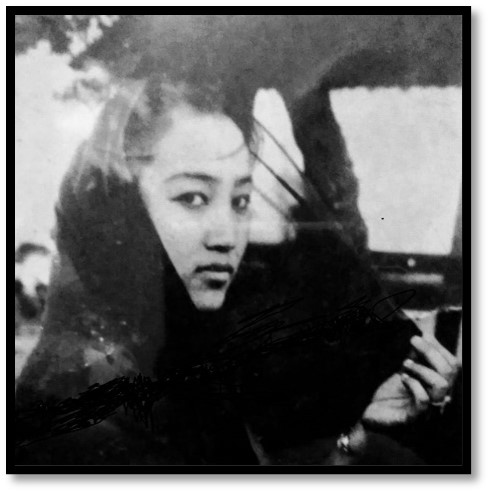
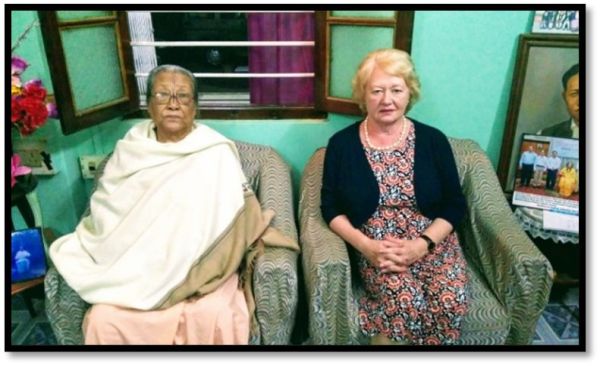
Young Rani Kherdani (6th Rani) :: Rani Kherdani and Margaret November 2019
Later on, in early 1950s, I had access to some rooms at the back of the palace where the ranis lived. thanks to my cousin Yellangbam Ibecha (Rani Kherdani) from Yellangbam Leikai, Imphal. Bodhchandra was attracted to her as she was a very attractive girl with lovely comportment. She and her first cousin Ibemhal, a very good-looking girl, who lived in the adjoining Inkhol (homestead), were my school-time contemporaries.
Many years later, in November 2010, it was a pleasure to meet the titular king Leishemba, along with my daughter Anita, her husband Martin, my son Neil and my wife Margaret at his palace. And again in November 2013. This time without my daughter and her husband. We found him to be quite congenial and intelligent, keeping the decorum and dignity of a titular monarch. We wish him well as a keeper of Manipuri culture and customs, and a unifier of hill and valley people, while functioning as an MP for Rajya Sabha.
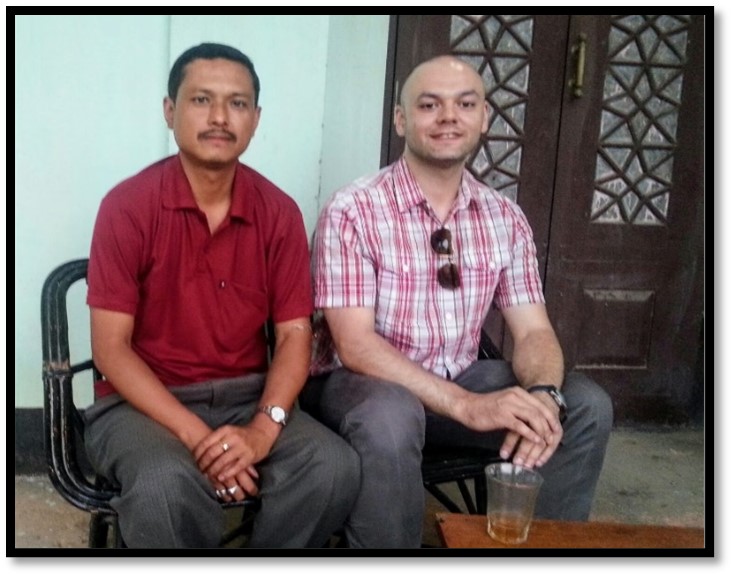
H.H. Maharaja Leishemba Sanajaoba Singh and Neil Singh Irengbam. The Palace 2013
During our second visit, we noticed visible signs of neglect of the palace by the crass ineptitude of the ruling Congress Government at that time. The palace garden was decayed. Litter and dirt were piling up everywhere, while the building needed fresh paintwork. Seeing the distressing condition of the tattered royal flag on a pole, fluttering agonisingly in the palace compound, my son Neil donated 2,000 rupees to Leishemba to buy a new flag.
Reminiscing the former glory of the palace, I can still see the carriageway from the north main gate into its low brick-walled compound. It was neatly surfaced by crushed red brick chips with a couple of small fountains with sprinkler nozzles by its sides, which brought the water to life.
The tiny open Durbar Hall was located on the west side of the estate and near the north gate. The main building was painted off-white with some coloured features. At the back of the palace building, there was a quadrangular ornamental pond and a paved space. A few steps up from it led to the main building.
The southern side of the palace compound was bounded by the Thangapat (moat) that used to have boat races. There was a road with an unmanned gate leading to a number of small bungalows on the south of the main building. The East side was walled up while in the west, the palace was limited by a footpath on the bank of the Imphal River. This footpath branched off from the main road to Nongmeibung, near Sanjenthong (bridge) and it connected with Bamon Leikai, passing by the Kabui khun and Mahabali Umang (forest).
The main gate in the north, pre, post and during WWII, was guarded by armed Manipur police, known as State Military Police (SMP), garrisoned at the Police Lines, in the present 1st Manipur Rifles cantonment. SMP was replaced by the 1st Manipur Rifles Battalion after independence and during the Chief Ministership of MK Priyobrata in 1949. Gurkhas (Gorkhalis) from Shillong were recruited.
More recently, it made my day, when my wife, son and I went to see Rani Kherdani at her residence in November 2019. She was great and still charming. We appreciated the posh sandwiches served without crusts by her adopted nephew Elangbam Priyobrata and his wife. Priyobrata is a likeable young man with an easy-going deportment. He is full of praise for his aunty and remains indebted to her for his growing up. He has earned his reputation as a lecturer in Manipuri language and literature, at the prestigious DM College of Arts in Imphal, and being elected as the General Secretary of Manipur Shahitya Parishad.
Bodhchandra Singh (1908-1955) was the first son of Churachand Maharaja and his second wife Chingakham Shyamasakhi. He had two brothers, Priyobrata and Khedasana, and a step brother known popularly as a dashing Captain Joy. He succeeded his father as king of Manipur in September 1941, when his father abdicated the throne after 50 years' reign. Bodhchandra's coronation was delayed till December 1 1941 due to WWII. He was greatly admired by the British during the War, as he stayed put in Imphal at his palace.
Bodhchandra Maharaja had an unfortunate reign, though only for 8 years as de factor ruler, from September 1941 to October 15 1949. Even then, during WWII (1942-45), his administration was taken over by the British Army. Then, after the War, he ran into difficulties because of the emergence of neo-liberal politicians in Manipur. A dustbowl of disappointment was opening up before him, especially as Sardar Vallabhbhai Patel (Iron man), the Deputy Prime Minister of India, began to integrate more than 550 Princely States in India, most of them voluntarily, and some by force.
On September 21 1949, Bodhchandra was coerced to sign an Agreement to merge Manipur with India, in Shillong. On October 15 1949, the Government of India took over the administration of Manipur and appointed a Dewan to run the government. That was the end of Bodhchandra Maharaja. His spirit was broken. He then took recourse to wooing young girls to be his escorts, to make small changes to his lifestyle and to help him get a restful sleep.
Bodhchandra was born under a bad sign. "Born under a bad sign since I began to crawl. If it wasn't for bad luck, I wouldn't have no luck at all."[William Bell]. He went for a bit of schooling to England with his younger brother Priyobrata, but did not like it and came back home. Priyobrata had also to come back. He spent some time at a school in Raipur in Madhya Pradesh, now Chhattisgarh.
He loved sports but he couldn't play anything. He started a game called 'cycle hockey' in 1946, but it fizzled out. I went once to see it played at the playing field that now belongs to All Manipur Sports Association near the Mapal Kangjeibung. It was later given gratis to the Association in 1961 by the Chief Commissioner GM Raina at that time.
Later in life, he played volley ball on Sunday evenings in winter, at the volleyball ground, located by the Cheirap-Panchai Courts and near the Maharani Bridge. Although he played only as a server, he was motivated enough to play the game, drawing big crowds.
I have a lot of empathy for Bodhchandra. He was certainly not our answered prayer. A number of storylines have emerged. Most moving is his part in ending his life.
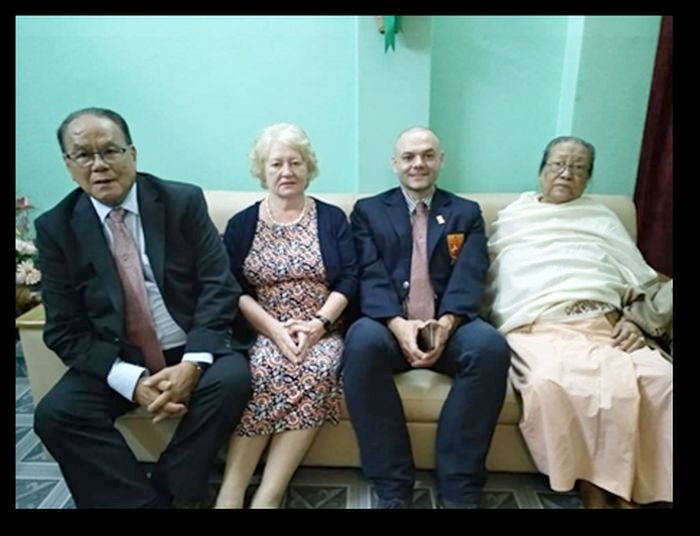
Rani Kherdani (6th Rani) at her residence with Author, Margaret, Neil Irengbam : November 2019
His first marriage was a failure. As a young Jubraj, he was married to Rampyari Devi (Tharendra Kishori), the third daughter of the Raja of Borokhemji in Ganjam district of Orissa on July 5 1929. She was divorced in 1941 without an issue, and died on March 20 1942 in Benares [Cheitharol Kumbaba, Manipuri Shahitya Parishad, Rep2015 p680].
MK Binodini, the greatest and handsomest modern royal of the postwar Manipur, eulogises Rampyari in her book, Churachand maharajgee imung. She probably had difficulty in adjusting to the Manipuri way of life. She remained introverted and had temper tantrums, often resorting to hunger strike.
Bodhchandra was married again to a Nepali princess, Ishwari Devi, eldest daughter of Prince Ramraja of Ramnagar of the then United Provinces (now Uttar Pradesh). They were married in Benares (Varanasi) on June 18 1941. She was installed as the first Queen of Manipur at the palace Durbar Hall on April 18 1942. She performed the funeral rites of her husband. She contacted the then Chief Commissioner of Manipur for permission to cremate Bodhchandra Maharaja at Kangla [Indian Government Reserve]. Later, she went to retire in Navadeep, where she died [date of death unknown]. She had no issue.
I remember how Yellangbam Ibecha became the 6th Rani Kherdani. One day I went to her house, when I found Bodhchandra Maharaja posited himself as the suitor at her Mangol (veranda) that was temporarily screened up. I also knew the 7th Thangmeiband Rani (Rani Khidir).
Rani Sangai or Kamalavati gave birth to Okendrajit, who was 5 years old when he was declared the king of Manipur after the death of Bodhchandra in 1955. The rest is current history.
Bodhchandra has forever been ostracised by some, for his part in signing away Manipur to merge with India. It is a matter of opinion and I think it unfair. To begin with, the Manipur Congress Party was campaigning for it. Little did people know that the Governor Sri Prakasa 'made an offer that Bodhchandra couldn't refuse'!
Either he signed it or else, someone else would sign it as king of Manipur. There was no mention of where he would be going, while he in his Redlands residence, was ring-fenced by a battalion of the Jat Regiment of the Indian Army.
Before we write him off as a supine and spineless king, we should ponder over the thornier question of what we would have done if we were in his shoes! Manipur would have been integrated in any case. One may recall what the ailing Sardar Patel in Bombay, simply hinted to Sri Prakasa when he went to meet him about Manipur's political issue in 1949: "Isn't there a Brigadier in Shillong?" We know what he meant.
I remember the suicidal attempts of the Razakars, the powerful private Army of the Nizam of Hyderabad, when he refused to integrate with India. And it took only 36 hours to end the 451 years of Portuguese rule of Goa. What could a handful of SMP, holding single-bullet-loading 303 rifles do? There was a battalion of Garhwali Regiment already stationed near Kangla.
Filled with remorse and self-flagellation he renounced sybaritic reality. He embarked on a self-imposed exile at the foothills of Nongmaicheeng. Having spent some time in meditation, he returned to his palace, but stayed in a thatched hut, especially constructed, outside the main palace building and on the northern side of Govindaji Temple. It had only the basic amenities. There, he breathed his last on December 9 1955 at a young age of 47. He died of heart attack.
The funeral cortege of Maharaja Bodhchandra was very poignant. The open jeep carrying his coffin to the crematorium at Kangla was followed by some artists from the Rupmahal Theatre, reciting an eloquent dirge: Chatloko Athouba, Puk phaba, Dharma chenba inningthou... [So farewell O! King, the brave, the benevolent and pious ....]
It is my sincere conviction that, future professional historians will see him in a different light, and vindicate his actions as an inevitable step in Manipur's history.
Author's website: drimsingh.com
* Dr Mohendra Irengbam wrote this article for e-pao.net
The writer can be contacted at irengbammsingh(AT)gmail(DOT)com
This article was webcasted on February 04 2021 .
* Comments posted by users in this discussion thread and other parts of this site are opinions of the individuals posting them (whose user ID is displayed alongside) and not the views of e-pao.net. We strongly recommend that users exercise responsibility, sensitivity and caution over language while writing your opinions which will be seen and read by other users. Please read a complete Guideline on using comments on this website.


