


My memories of Imphal from 1941
- Part 14 -
Dr Mohendra Irengbam *
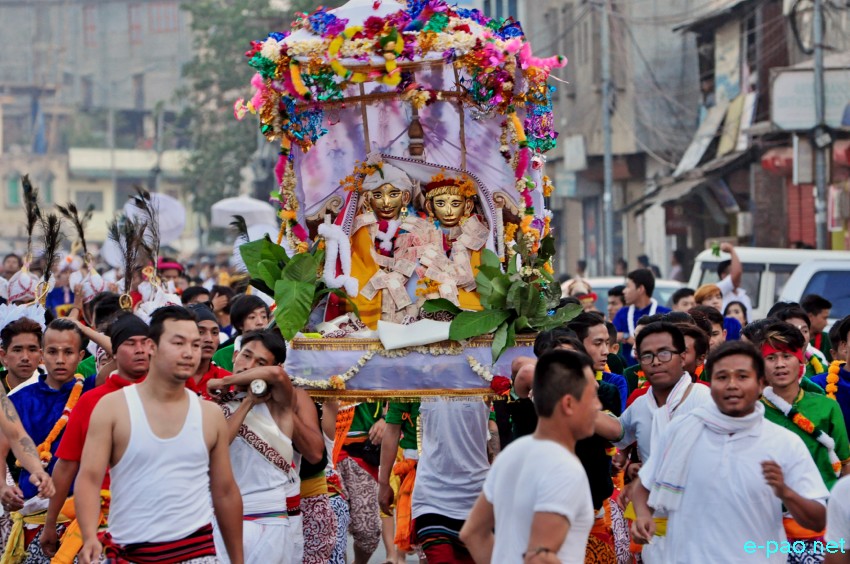
Male and female Lai (symbolic representation) at a Laipham. No English equivalent of the word 'Lai'.
'Deity' is near about.
Lai Lamthokpa at Range Lampak, Yaiskul in May 2017 :: Pix - Shanker Khangembam
I have ceased vituperating against the Lai Haraouba celebration. In my boyhood, I took it to be an absurd belief in non-existent spirits; a zeigeist of that period when when most Meiteis were unlettered.I hated being cajoled as a young person. Now, I have struck a more meaningful chord with Lai Haraouba.
I have so far gathered likewise, a scanty individual testimony from those gleeful days that has worked its way into my present memory. The force of an autographical and subjective experience of my mind and memory so as to be able to give the reader a glimpse of that era, albeit briefly, tears me between the idyllic Imphal town of those days where everybody knew everybody, and the present urban concrete jungle, where the next door neighbour has no idea of who you are.
All in all, life in the genteel town of Imphal ambled along reasonably well until April 27 1891 when the British hoisted the Union Jack at Kangla, after the decicive battle of Khongjom. The British administration did nothing to improve the economy of Manipur. No job creations, no factories. The redundant Meitei men from the king's services, were left to their own devices.
And so, Meiteis used a lot of their pent-up energy in amusements, such as dog-fight, gambling, pigeon racing and sports and games of various kinds. As a result, there was no Meitei who suffered from boredom and depression. And it was rare to see any fat Meitei man or woman among Meiteis. They enjoyed various indigenous festivals like Lai Harouba, and Hindu rituals, such as Yaoshang, Kangchingba, and Durga Puja, as pastimes, rather than devotional religious celebrations.
Among the indigenous ritualistic socio-religious recreations, Lai Harouba is the most important event. It embodies the entire pre-literate Meitei culture. Its ritual texts are very complicated and are beyond the comprehension of Joe public. There are no written texts. They are passed on by words of mouth among the professional specialists known as, maibas (male priests), maibis (female priests) and Penakhonbas (male pena players). Pena is an ancient Manipuri musical instrument, a bit like a violin in its simplest form. The celebration was always followed by some sports and games like Mukna sanaba and Thang Jagoi.
Lai Harouba is now a ritualistic pastime, rather than a deep demonstration of old Meitei faith. We humans are stubbornly attached to rituals, far more than our beliefs. In the years gone by, asking the Meiteis to abandon their popular Lai Harouba ritual, was not an effective way to convert them to Hinduism. So, the proselytisers took the easier path: 'co-opt – instead of condemn'. They were allowed to keep some part of their old religion of Sanamahism, while changing to the new religion of Hinduism.
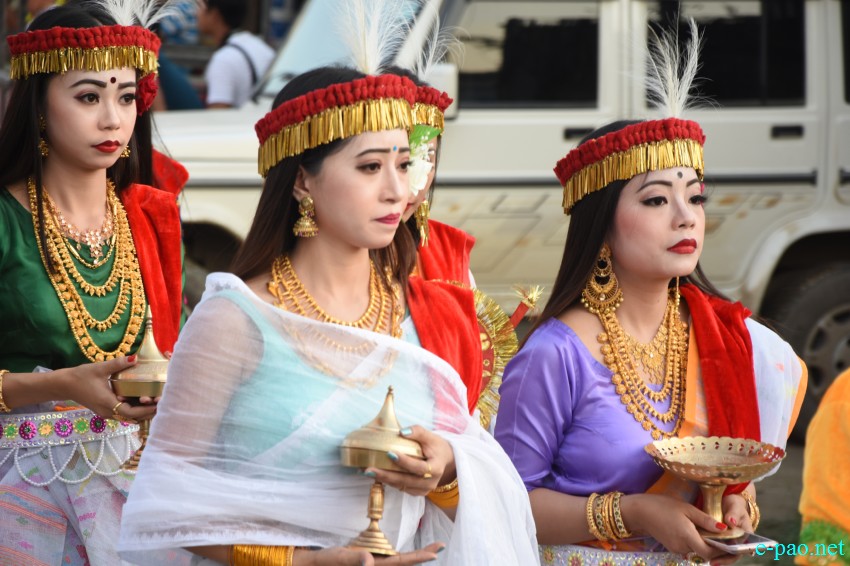
Lai Lamthokpa of Moirang Ibudhou Thangjing Lai Haraoba at Moirang in May 2019 :: Pix - Shanker Khangembam
Meiteis, who are predominantly Hindus, take part in Lai Harouba as a sort of a cultural event. Nothing spiritual. The interminable daily ritual of prayers, hymns, dances, and oracles, are unintelligible to them and imparts no divine piety on them. Still, it has now become an important ancient festival of Meiteis, an embodiment of primordial Meitei culture with their ancient concept of the cosmos.
Lai Harouba has been celebrated from the beginning of Meitei history. The festival starts in the beginning of the Meitei month of kalen (summer) ie April/May. It lasts about ten days. I grew up in the shadow of Lai Harouba as our Khoisnam Leikai lairembi (female lai) was located next door. I never paid any importance to it. I believed it to be an ancient shamanistic mumbo-jumbo ritual. Only recently, I had an epiphany very late in life that, it is a quintessential encyclopaedia of Meitei culture, with their hypotheses of the construction of human body and evolution of man, and their perception of the structure of the cosmos.
The jamboree of Lai Harouba is increasing in the last few years. It was initially motivated as a politico-religious tool by a number of Meitei militant revivalists to revert back to the indigenous shamanistic faith of Sanamahism. They regard Hinduism as a foreign religion. I am not a religious evangelist. And I believe, to the vast majority of Meiteis it is an entertainment. The function provides a meeting venue for the people living in the locality, as well as from other areas. It is a modern social platform in an urbanised Imphal city.
Lt Col John Shakeapear, the Political Agent of Manipur (1905-1914), translated Lai Harouba literally as 'Pleasing the gods'. It was short for Umang Lai Harouba and 'pleasing the forest gods' [Latin, sylvan for forest, used mostly in poetry]. These lais, or deities are interpreted as primordial ancestors of Meiteis, not in the way we think what god is. They are not personal or household gods.
They live in the woods or forests, known as laipham, such as "Ichum lairembi laipham" that is located between Feidinga and Khurukhul. The lais belong to both male and female, such as Ibudhou Thangjing and Keisampat lairembi. There are two lais, male and female at each laipham, which are often symbolised by two brass face masks, housed in a laishang (hut of the lai). The laishangs used to be thatched huts. Now, many are accommodated in small brick buildings, such as our Khoisnam lairembi at Uripok, Imphal.
The centrepiece of Lai Harouba is to invoke the male and female lais to come up from water (Lai ikouba Khayamlon) and to entertain them (Harouba) with various rituals, so as to bring good fortune to the communities to which the lais belong. At the end of the ritual celebration, they are sent back to heaven (Nongarol) by means of a boat (Hijing Hirao).
There are three main forms of Lai Harouba that differ in certain aspects of the rituals that were customary to some of the Meitei Salais (clans): (1) Kanglei Harouba with Pakhangba as the chief deity (Ningthouja Clan); (2) Moirang Lai Harouba with Thangjing as the main lai (Moirang Clan); and the Chakpa loi Haraouba (autochthones). The latter is unique in that they continued to celebrate in the ancient Meitei dialect with their sing-song accent, as I saw them during the WWII, while residing at Senjam-Chirang village.
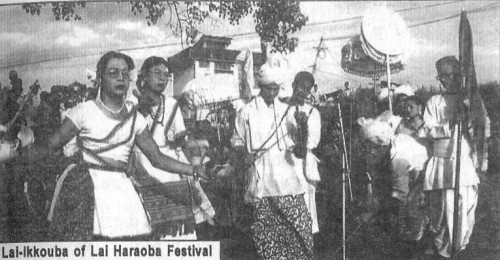
Lai Harouba dances of maibi with penakhongba in old days :: Pix - From a book by N Mangi Devi
A fascinating cultural aspect of Lai Harouba is the maibi Jagoi (maibi dances) that are classical Manipuri dances especially the khutleiba movement. They are folk dances. Meiteis children are born with Meitei Jagoi (dance) in their blood. Every child can dance it. But there are some dances that are restricted to Maibis only. The dances have patterns, such as moving in a circle, in curves (lairen laithek) representing the Lairen deity or Python Pakhangba) and so on. The pena player plays to the tune of the Maibi Jagoi. He also chants equally unintelligible lyrics.
Two aspects of Lai Harouba that had bugged me during my youth, can now be explained from my observation and inference. The first one is Maibi's role as medium and oracle. This feature is very remarkable and quite a convincing performance of the possession of the maibi with the living lai, especially as the maibi's oracles seem to relate to some individuals and/or the whole community. The spotlight is called laimang phamba (sitting before the lai).
In this act, the maibi goes into a state of trance (as all shamans do elsewhere, such as among the Alaskan and Siberian natives), with her head covered with a thin headdress and one hand ringing a hand bell (sharik khingba) to the tune of a pena, played by a pena player. She shakes violently and rambles after she gets blended with the lai (possessed).
After a while she calms down, sometimes helped physically by the pena-player. She then, sits down in a state of trance and begins the oracle, which may last about half an hour or so. The oratory and the words and phrases she uses are beautiful classical Meitei literature that no one clearly understands.
The core of these practices is altered states of consciousness (trance) during which the shaman is able to perceive and interact with the spirit world. It is possible because of human neurology and physiology. Many shamans worldwide, were in the habit of using certain native psychoactive plants to enable them to enter into the state of altered consciousness.
The oracles are directed to individuals in the village who went to ask for a blessing or for the protection of the whole community. It must be assumed that the Maibi has some prior information about these individuals or the welfare or a calamity of the community or the village and how it could be mitigated.
The words she utter are mostly garbled and ambiguous. Sometimes she will utter a particular admonition that could apply to many in that community, showing the lai's displeasure. You have to make your own interpretations. If the cap fits then you wear it. The lai speaks in the first person. Sometimes, the lai would condescend to mend matters by patronising the victim and ordering him/her in a stentorian tone – Katchouhai, to bring certain presents
This reminds me of how the Dalai Lama who is in exile in the hill station of Dharmshala in Himachal Pradesh, fled Lhasa. He was preparing to flee Tibet when Communist China invaded it. He could not do it until his Oracle said yes. One day, the Oracle said: "go, go, go". And he left Lhasa with his small entourage for India immediately. He came through Nathula Pas in the Himalaya and arrived in Tezpur on April 18 1959.
The maibis can go into a self-induced singular state of hypnosis, which is called 'trance', in which she can move and speak, but is not conscious in the normal way. The practice seems to occur among many long distance lorry drivers, who during a part of the journey, they drive in a trance. It is known as 'highway hypnosis' or 'white line fever'.
As everybody cannot be hypnotised, everybody cannot become a maibi. They have to undergo specific training under a senior maibi. A performing hypnotist (show business man) has to choose someone who can be hypnotised. Once I volunteered to be hypnotised, but I couldn't be induced however hard he and I tried to be.
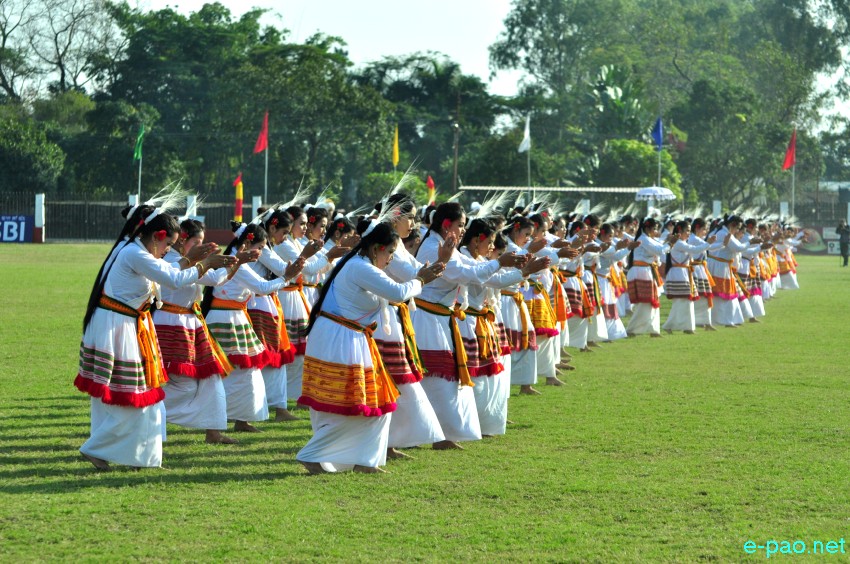
Maibi Jagoi at Opening Ceremony of 11th Manipur Polo International at Mapal Kangjeibung in November 2017 :: Pix - Shankar Khangembam
The training of a maibi is like the conditioning of girls/women who enter a cloistered Roman Catholic Convent. They have an initiation period of three years. At the end of which, those who have the right disposition would be selected to get married to Jesus Christs and take a final vow of (1) chastity, (2) celibacy and (3) obedience (to god and the Church). They get married, dressed as brides, to Jesus Christ and receive a ring to wear on the right ring finger (in most European countries a wedding ring is worn on the right hand ring finger). Then they become "sisters" or nuns.
The psyche of a married maibi can be so conditioned that she believes she is married to a lai as well as her husband, if she has one. The married maibi sleeps on the outer side of the bed that is normally the place for her husband. On a particular night, she sleeps alone, when the lai visits her and she can feel the lai entering her.
The other matter is the Naga (Tangkhul) dress that are worn by a couple during Lai Harouba (cf. Author's book, The Origins of Meiteis…(2009, p50). It has forever, been credited with passing on a seemingly limitless imagination for attributing Meitei origin from the Tangkhul Nagas and thus the Naga dress.
With the flourish of modern education in the 1960s, a few Meiteis, who read those few lines in this book, and in the book, Manipur & Naga Hills, (1971 pp82, 83) by Maj Gen Janes Johnstone, in which he quoted McCulloch, have forever been parroting.
The evidence is simply based on a flimsy account of Lt Col William McCulloch, the Political Agent of Manipur (1845-1867), who wrote in his ethnography: An Account of the Valley of Munnipore and the Hill Tribes, published in Calcutta in 1859. He however, did not say that the Meiteis adopted the Naga dress. He simply mentioned as 'the ritual clothing of a former time'.
We need to do our own research. It is just not possible that more civilised Meiteis borrowed the Tangkhul dresses, so many years ago, when Tangkhul men were conspicuous by the absence of any attire. The dresses were probably the ancient outfit of Meiteis long before they adopted the modern costume.
Another classical association with Lai Harouba is the use of Langthei leaves and langthrei buds as a holy plant. Langthrei is a balsam like Tulsi plant. What is Tusli to modern Meiteis, langthrei was to ancient Meiteis. Langthrei with its botanical name, Blumea balsamifer. It is a perennial herb about 1-3 metres tall has been used as medicine for a variety of illnesses in South-East Asia. It is rich in various medicinal compounds.
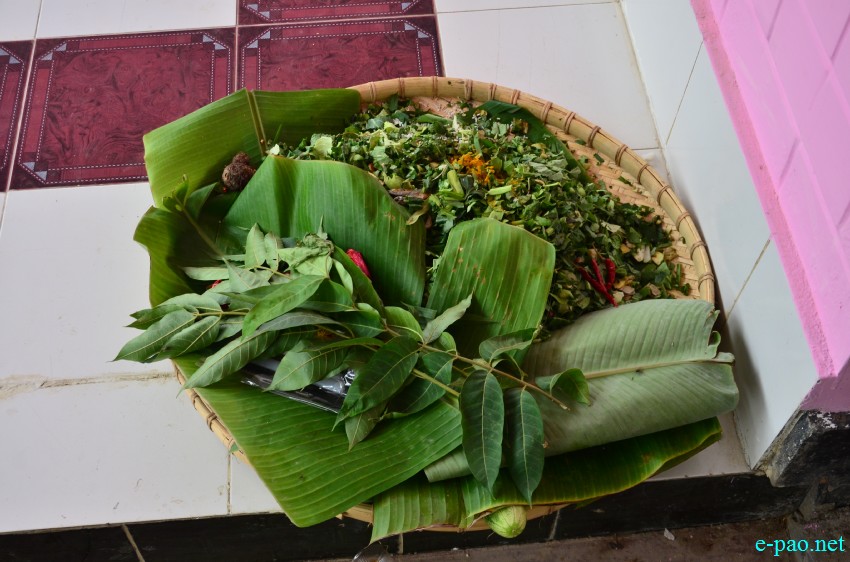
Langthrei (Blumea balsamifera) at Lai Haraoba at Ereima Ima, Kakwa Harouba in May 2015 :: Pix - Shankar Khangembam
Throughout human history, many natives were using certain plants in ritual ceremonies as they believed certain supernatural powers resided in them as a divine gift to humans. The Vedic people who were tribals, used the Tulsi plant as a goddess. Hindus worship the Tulsi plant as goddess Laxmi, the consort of Vishnu.
On the last day, or closing day, the maibis, maibas and the local community, danced and sang antiphonally ie two groups alternately sang, to represent the gathering of the universe into a 'Singularity' – a point of infinite density and gravity. This is comparable to Stephen Hawking's 'infinite point' from which the Big Bang took place, but in reverse order.
This is also the day of the lai (male) seeking a new wife (lai nupithiba). Again the maibi in personification of a male lai goes into a trance and after undergoing a few rituals with a polo stick and a ball, the priestess seemingly chooses a wife at random. She would walk around her head covered with a see- through veil and holding a polo stick, and then she would hook a girl on her shoulder from among the crowd of dancing girls, with the two-ended end of the stick.
I remember such wife-seeking performance at the Keisampat Lai Harouba festival after the War. I knew a school girl called Manmohini from that Leikai, who was participating in the festival. Because she was attractive, I used to visit the celebration every afternoon. On that particular afternoon, I had the premonition that she could be picked as the lai's wife. Though reality does not always need expectations, she was plucked from the crowd and I was chuffed. Years later, I asked her about her feelings on that day. She said she was surprised and elated. Nothing else.
There is evidence from Chitharol Khumbaba that, before hinduisation, the Meiteis who used to drink yu (alcohol) and ate sha (meat), offered yu as in Leirai yukhangba and sha as in sharen katpa. The offerings are now all vegetarian (heirukkatpa), as the lais have also become vegans and have been on the wagon. I don't know if these libations are still continued among the Phayengs – the Meitei autochthones, as they used to be, just after the war.
It is invigorating to notice that the number of practising maibis is increasing as a profession, as seen at the inauguration of the 11th International Polo festival in 2017 at the Polo ground in Imphal, where scores of them danced the primeval cosmic dance of creation. An unsullied exhibition of Meitei culture.
There will always be a Manipur.
Author's website: drimsingh.com
* Dr Mohendra Irengbam wrote this article for e-pao.net
The writer can be contacted at irengbammsingh(AT)gmail(DOT)com
This article was webcasted on January 20 2021 .
* Comments posted by users in this discussion thread and other parts of this site are opinions of the individuals posting them (whose user ID is displayed alongside) and not the views of e-pao.net. We strongly recommend that users exercise responsibility, sensitivity and caution over language while writing your opinions which will be seen and read by other users. Please read a complete Guideline on using comments on this website.


