


Reappraisal of early Meitei settlement in Manipur
Dr Mohendra Irengbam *
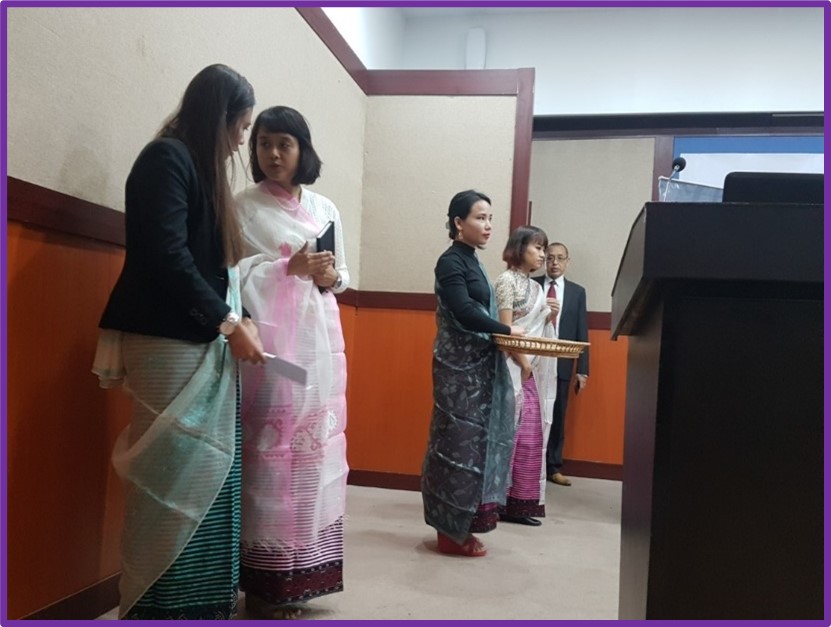
Launch of author's Book, The Origin of Meiteis of Manipur & Meiteilon is not a Tibeto-Burman language
Transliterated in Manipuri in November 2018
The hint of autumn, with days shortening and nights lengthening, has just arrived. The season reminds me of my age and good old Shakespeare with his sonnet 73, 'That time of year thou mayest behold'. The sonnet focusses on the theme of old age and the freshness of the youth. The passing of a day and dying out of fire.
In literature autumn symbolises ageing. Autumn which Americans call "Fall" is the time of falling leaves. It is the time when most people have some kind of fall in the mood. Scientifically speaking, it is due to a fall in the production of the hormone serotonin in the body, due to lack of sun-hours.
Nearly two years have gone by without a trip to Imphal, the most seductive of all places, having been deterred by the uncertainty of the Covid pandemic and quarantine. Absence makes the heart grow fonder. The separation, even though two years in the making, hit harder than I could have ever imagined.
Absence sharpens love, presence strengthens it. The appreciation of Imphal grows. I miss it and want to indulge anew when the opportunity arises. On the other hand, during the pandemic, push back on the surface-level confidence, I readily admit to a litany of learning curves with positive thinking.
The greatest challenge has been in getting to grips with the unpredictability of catching the virus because of my age. There has been no idealistic principles that could be interpreted as a judgement of how things should be done. For octogenarians like myself, the lockdown has been very tight. Tighter than a duck's butt on a choppy day. We have been run like a well-oiled machine by No. 10.
In downtime, while playing hide and seek with death, the news from Manipur that Meitei ancestors' age-old association with Koubru hill ranges, has been morphed into trailer-trash by some passive-aggressive communities in Manipur, has knocked me for six.
We know history is what someone wrote of what happened or what he thought happened at a time and place. It might be scrolls that are purely replete with platitudes. I know anticipation tempts fate. Meitei puyas written with stilted archaic Manipur is not a big help in locating Meitei origin firmly in Manipur. Not that I speak with perfectly modulated Manipuri. But they did give a chapter and verse.
If it is a percentage game we have to start somewhere, and I want to start right here in Manipur. Manipur Sana Leibak encompasses the valley and hills of Manipur, as in the oral tradition of "Chingna koina punshaba Manipur Sana Leibak". In this verse, I take it that ching (mountain ranges) are composite in Sanaleibak, in similitude to a surrounding fortress wall that is included in the geography of a fort, such as Fort William in Kolkata, Red Fort in Delhi and Chittorgarh, the old capital of Mewar in Rajasthan.
During the dark night of the soul, when my mind wanders up the dirt road, zig-zagging up the side of the mountain of Koubru in my Parikrama (pilgrim circuit), I could breathe thin and clear air, feeling warm in the sun and cold in the shadow. While the mountain foothills rippled and folded, the sky was huge and high like a sapphire on the horizon or the edge of outer space. I could see the immense tawny plain and hazy mountains afar. Nothing moving. Solitude. I was the monarch of all I surveyed.
It always fills me with conscious pleasure that Meitei primogenitors were there on Koubru Hills once upon a time, looking down at the vastness of water that filled Imphal plateau, surrounded by skeins of mountain ranges, in whose caves they took shelter after their hunting and gathering for food and warmth.
It was in the late Neolithic period (Stone Age) about 10,000-12,000 BCE (archaeological findings in Manipur), when they came down to the dry valley and settled first at Kangla in Yumphal, having done away with their foraging lifestyle. Late Stone Age settlements at Napachik in Wangoo village by the Manipur River and Nongpok Keithelmanbi in Imphal, bear evidence of Meitei settlements.
My imagination sometimes went into overdrive in picturing the joy they must have had while watching the sheen of the vast expanse of water in the valley as moonlight flooded it. And bedazzled
when they viewed it with avuncular occultation as the water gradually disappeared, unbeknownst to them, through Chingnunghut - three naturally occurring tunnels in southwest Manipur in Tengnoupal district.
I have struggled in the past, to marshal my thoughts about the origin of Meiteis before they came down from the surrounding hill ranges to the valley from different directions. Eventually, my gut instinct rejected the propositions made by a few British colonial officers, such as Capt Pemberton, who considered the Meiteis to be descendants of a Tartar colony from China. They all seemed to have an air of smugness or feigned nonchalance. Each one gloated like the cat that had swallowed the canary.
I felt it was too far-fetched that Meiteis, meaning all the clans (salais), separately had traipsed all the way from China or nearby in Southeast Asia, along a beaten earth path to Kangleipak as modern men (Homo habilis, who were the first humans who made stone tool. It was like God made beer as he wanted us to be happy.
Their views were quite in disarray as they were individual figurativeness in thought processing. There was never a coherent narrative, but the same rhyme that was recited with a mixture of insolence and good manners of politeness and scorn.
My concern has been mainly that, the postulations which were quite wide of the mark had left an unnecessary impetuous yearning about the origin of Meiteis with the uncertainty of doubt
among the Meitei intellectuals, and with a longing to unify knowledge that was left unfulfilled. My father was quite happy just being a Meitei of Meitreibak and without some kind of proof about the existence of God.
Having enough personal conviction and putting aside pedagogical dogma, I published my views in a book, The Origin of the Meiteis of Manipur & Meiteilon is not a Tibeto-Burman Language, disagreeing with their speculations, and giving my empirical reasons. It was 11 years ago and I still stand by it. Archaeological findings, later on, by the great Meitei Okram Kumar Singh confirms my suspicion that our ancestors arrived in Manipur as Homo sapiens (wise men), ancient men. Finding of similar artefacts elsewhere in Southeast Asia does not mean Meitei ancestors had migrated from those places.
Assiduous now, as I was then, in my public protestations, and as a Meitei nationalist, I take the liberty of heaving with the pannier of my thesis as submitted in my book, to reaffirm my stand in spite of some odd person who comes with a decked-load of criticism, negativity and doubt in the autochthonous origin of Meiteis in Manipur.
I generally take the attitude of never judging a book by its cover, or a sausage by its skin. I try to avoid the gloss of those pioneer British officers, who in the main, did a good job in recording our culture in the withering light of the morning of our civilisation. Due credit goes to them.
The nature of this debate of Meitei origin has gone beyond raillery and good-humoured teasing. If hilarity prevailed over prudence, they endeavoured to laugh on the other side. Their happiness or amusement has changed to sadness, annoyance and hurt for me. Out of which rose an epiphany for me, with an implication that a change is deserved. And that they might all be wrong.
My research, a longitudinal study, was observational of the same subject of Meitei origin, lasting a couple of years. I found the British interpretations were quite anodyne at first, remembering that 'history consists of a series of imaginative inventions, while professional historians focus their study to the changing time.
Over time, I realised they were patronising. It was like the answer to a preschool child's question, "Grandma, where does the baby come from"? Answer being, it was found in the gooseberry bushes. It is in the nature of things that gut feelings do not have the ambiguous and static nature of facts.
The prehistoric foreign origin of Meiteis is a British construct. We are talking about an era roughly from 1, 2 million years ago to 1,200 BCE. That encompasses Stone Age, Bronze Age and Iron Age.
In the absence of any clue, such as archaeological findings, they simply imported some place or the other, as a substitute, to show they were smarter and more capable than they really were. This is now known as the Dunning-Kruger effect. And this is what Darwin wrote in his book, The Descent of Man: "Ignorance more frequently begets confidence than does knowledge."
Had they said that Meiteis had been in Manipur all along, everybody would have toed the line without any question? History is written by victors, geography is written by rulers, which were dead easy. But the existentialist question is: if everyone is mad, is anyone mad? It is like trying to make sense of a difficult-to-answer question. An existential crisis like this can contribute to a negative outlook, especially if a person cannot find a solution to their questions of meaning.
All of which is great as far as it goes, but it incurs a debt to the truth of Meitei origin. We have become disillusioned with what we have been told, and utterly bedazzled by what we do not know now. We need to start afresh. First of all, we need to forget RB Pemberton, W McCulloch, RB Brown, EW Dunn, J Johnstone, T Hudson and J Shakespeare. A few of them repeated each other, while others had a greater flights of fancy.
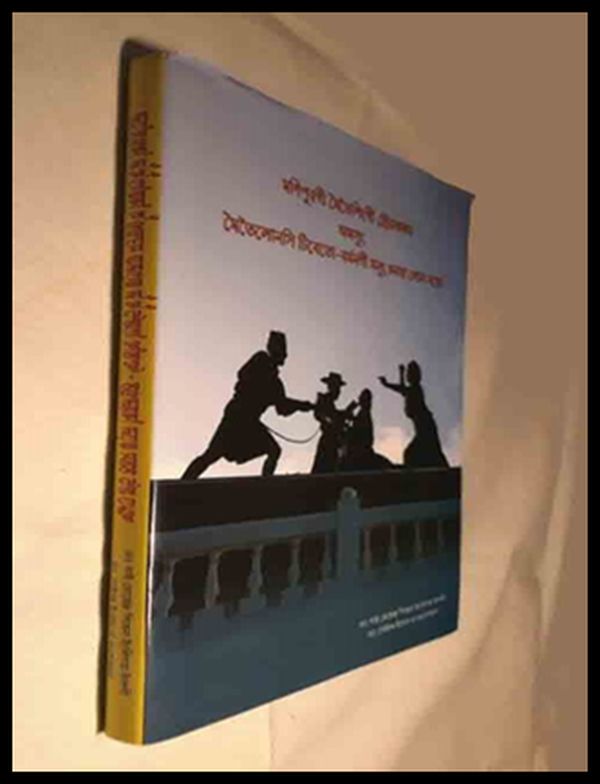
Manipuri Transliteration of Origin of Meiteis of Manipur...
Now, the question of where the Meiteis come from should be channelled into asking oneself: 'Did the Meiteis really have to come from somewhere? Is it not probable that they had been in Manipur as autochthones - the original settlers, like the Tibetans or the Chinese or the Dravidians?
My answer is yes, in the light of evidence of archaeological findings in the caves of Manipur and in the valley at Napachik near Shugnu and at Wangoo. It is more than unlikely that the Neolithic men or New Stone Age people from these two places and others, would have gone up the hills again to settle there. The obvious is they were part of the hordes that came out of the caves and settled in the mountain ranges before they came down to the valley when it dried up, and who later, settled at Kangla.
While the discussion of whether Meiteis or any other tribe in Manipur had been indigenous has become a cottage industry, it is certain that we are all immigrants, in the sense that the whole world is populated by descendants of people who emigrated from Northeast Africa 50,000 years ago (Out of Africa model). But I have always maintained that the Meitei social structure is distinctively and critically different from any other I know in Manipur or in Southeast Asia.
Talking of which, to get its poise back, I stand to be counted that Meiteis were in Kangleipak with the first human expansion from Northeast Africa (ibid. 2013, pp 20-32, 112-115 and 140-143).
Sometimes, the only way to know a stove is hot is to touch it, failing which, to go as near as you can.
This is what I have done in tracing the origin of Meiteis in that they did not migrate from anywhere in Southeast Asia. I am happy that my theory has been in agreement with the recent researched conclusion of Meitei origin by Rodney Sebastian. He with his wife, spent quite some time in Manipur, learning Manipuri language and doing research work. His thesis for his PhD was published in 2019 and can be read on the internet.
Sebastian has behind his name BA 1st class degree in Anthropology and South Asian Studies (Australia), MA in Sociology (Singapore University) and PhD thesis in Cultural Fusion in a Religious Dance Drama Building... in Manipur RasLilas (University of Florida, USA).
According to him, I quote from his thesis (pp 55 and 56): "While the origin of Meiteis cannot be conclusively determined, it is clear that "Meiteis were a distinct ethnic group." "Their cultures set apart from those of any of the groups that various theories claim they originated from, so much so that their exact origins cannot be determined." His thesis conclusion highlights my thesis statement that I made in my book, 12 years ago (ibid).
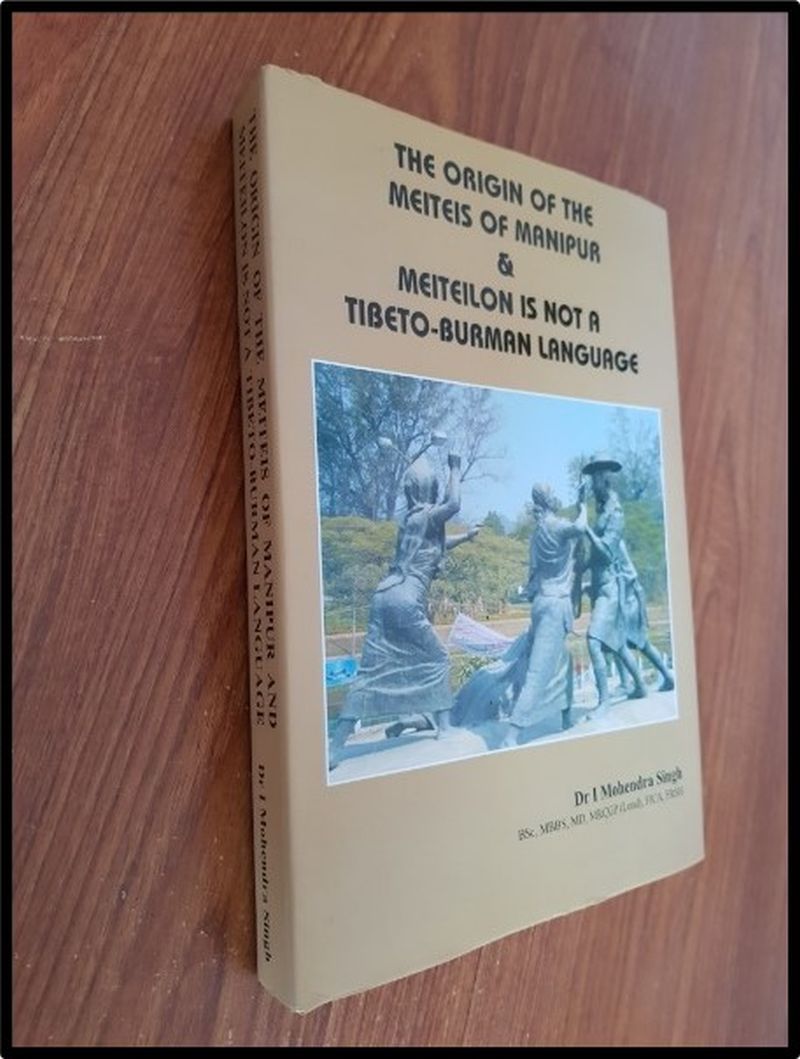
The Origin of The Meiteis of Manipur...
Interestingly, I have also recently read a book by John Parratt, The Coils of Pakhangba (Mittal Publications, New Delhi, 2017). In a patter reminiscent of RB Pemberton's dizzyingly bonkers tale of Meiteis as descendants of a Tartar colony form Northwest borders of China, Parratt implausibly traces Meitei culture back to Western China, implying that the primogenitors of Meiteis must have come from there. I quote: "(Page 4) ...the linguistic evidence clearly points to the origin of Meeteis in Western China."
While lamenting the absence of scholars in Manipur, he has freely donated his views about the missing links in prehistory and history of Meiteis. I quote, "I have attempted this task with some trepidation. It should really have been done by a Manipuri scholar, but faute de mieux [for want of better alternative].
He has also adumbrated that Sanamahi should not be what we think he is. I quote (p28): "It has been plausibly argued that Sanamahi should be connected with fire, symbolised by household hearth. "The household deity is Leimaren. Leimaren's symbol is a pot of water placed at the north wall of the house."
In light of the more recent Indo-Aryan migration debate, in which nationalist Indians are trying to prove that the theory of Aryan migration to India is a British invention (ibid pp 20, 21) I find it fortuitous to reaffirm that the moth-balled speculations of Meitei origin from somewhere in Southeast Asia, is a fabrication of ancient British ethnographers. We will have a look at it later.
Aryan (Noble ones) migration to India is currently a very hot potato because of the finding of the skeleton of a nameless woman, known only as 'Number 1411' who died in Rakhigarhi in Haryana - a settlement during the Harappan civilisation 4,500 years ago. They have analysed the gene sequence from the ear of this woman.
On my part, having stopped in being so doggedly behind the times, I feel that the zeitgeist of the time is to review the autochthonous state of Meiteis in Manipur, in light of the ongoing debate for and against the Aryan migration Theory (AMT), better known as Aryan Invasion Theory (AIT) of India. The nationalist argument is against such migration and they provide evidence to prove that.
The proponents, who refute the theory of Aryan Invasion (AIT) to India, dispute the assertion that No 14411 was a Bronze Age Aryan and they say her gene did not possess the R1a1 gene – the 'Aryan gene'. They also argue that Aryan migration or invasion was supposed to have taken place long after the woman, in 1,500 BCE, when they drove out the dark, snub-nosed Dravidians to South India.
Further in 1916, imperial evangelism disseminated the thesis that South Indians were the original Indians, who were driven south by the superior Aryans. Theosophical Society [worldwide body, first formed in New York in 1875] declared that the Aryans were founders of European civilisation.
I believe it all began following the discovery of similarities between Sanskrit and the classical languages of Europe, such as Latin, Germanic when some fervent scholars hypothesized the existence of an early "proto-Indo-European" people who spoke the language from which the other Indo-European speakers including the Sanskrit speaking Northern Indians.
We were taught in school that the Indian civilisation is the result of migration of Anatolian (Anatolia = Asia Minor, now major part of Turkey) and Iranian farmers, whose ancestors were from the pontic steppe grasslands in Eastern Europe [central Asia] between the Black Sea and Caspian Sea, and that they also brought the horses and chariots.
The antagonists to AIT, emphasise that William Jones, who is known as Father of Indology, who falsely claimed to know 32 languages and thus bungled in postulating a proto language uniting Sanskrit, Iranians, Latin, Germanic and Celtic. He set up the Asiatic Society of Bengal in Calcutta, which banned Indians, on January 15 1784.
Hindutva scholars argue against the AIT, using classical, anthropological and archaeological evidence to refute the invasion theory. They assert that the chronology of Indian languages also disapproves AIT, post the excavations in Haryana. And that a proto-Dravidian language which originated during 2,500 BCE, is considered the world's oldest discovered language.
They follow their arguments by pointing out that the genetic map of the Lady of Rakhigarhi on which the proponents of the AIT mainly base their theory, shows that the original inhabitants of Harappa could have been Dravidians with more South Indian traits than today's North Indians. On top, the paleontological evidence of Harappan Indian civilisation, which traded with central Asians around 2,500 BCE, too, contradicts AIT.
They observe that it was the British who, during the colonial era, propounded the percept that a master race, tall, fair-complexioned and with blue eyes, rode on horseback and chariots, and crossing the Indus River, conquered pastoral civilisations in Harappa and Mohenjodaro.
It has been debated for and against during the last two centuries. Now, modern generations of Indians have been asserting that there was no such thing as an Aryan Migration or Aryan invasion. They are supported by an Indo-American team of researchers, who published their findings in September 2019.
I only hope that younger Meitei generations who will in the near future, be able to research overseas where they have such facilities, to find evidence that Meiteis are not bits and pieces of some obscure bronze Age people from Southeast Asia.
I know people migrate to find new pasture for survival. I can't help wondering why any group of ancient people would traipse such a long and hazardous terrain, thousands of years ago and would want to settle in the hill ranges of such a desolate place like Manipur whose valley was filled with water!
I rest my case. Have a good day.
The Quest for the Origins of Vedic Culture: The Indo-Aryan Migration Debate.
In his book by Edwin Bryant
ABSTRACT
At first it was assumed that India was the original home of all the Indo-Europeans. Soon, however, Western scholars were contending that the Vedic culture of ancient India must have been the by-product of an invasion or migration of "Indo-Aryans" from outside the subcontinent. Over the years, Indian scholars have raised many arguments against this European reconstruction of their nation's history, yet Western scholars have generally been unaware or dismissive of these voices from India itself. Edwin Bryant offers a comprehensive examination of this ongoing debate, presenting all of the relevant philological, archaeological, linguistic, and historiographical data, and showing how they have been interpreted both to support the theory of Aryan migrations and to contest it. Bringing to the fore those hitherto marginalized voices that argue against the external origin of the Indo-Aryans, he shows how Indian scholars have questioned the very logic, assumptions, and methods upon which the theory is based and have used the same data to arrive at very different conclusions. By exposing the whole endeavour to criticism from scholars who do not share the same intellectual history as their European peers, Bryant's work newly complicates the Indo-European homeland quest. At the same time it recognizes the extent to which both sides of the debate have been driven by political, racial, religious, and nationalistic agendas.
Keywords: Aryan migration, history, India, Indian scholars, Indo-Aryan origins, Indo-Aryans, Indo-Euro which both sides of the debate have been driven by political, racial, religious, and nationalistic aghe Quest for the Origins of Vedic Culture
Bryant is the author of The Quest for the Origins of Vedic Culture (Oxford University Press, 2001).[7]
J. P. Mallory says the book:
... systematically exposes the logical weaknesses of most of the arguments that support the consensus of either side. This is not only an important work in the field of Indo-Aryan studies but a long overdue challenge for scholarly fair play.[8]
Michael Witzel writes:
A balanced description and evaluation of the two century old debate dealing with the origins of the Indo-Aryan speaking peoples of South Asia. [Bryant] presents both sides of the issue, that is the traditional western, linguistic and philological consensus of immigration from Central Asia, and the more recent Indian position that denies any immigration and that asserts an indigenous South Asian origin. He probes for loopholes on both sides....
Indo-Aryan Controversy: Evidence and Inference in Indian History
This book, edited by Edwin Bryant and Laurie Patton,[9] contains a series of articles by proponents of the "Indigenous Aryans" position and scholars of the Indo-Aryan migration theory, with some alternative interpretations. According to Edwin Bryant, most of the evidence regarding the origin of Indo-Aryans is inconclusive and he is not convinced of the Indo-Aryan migrations theory, but he is also not convinced of an "Out-of-India position", since the support for it is not significant. He notes that the discovery of Indo-Aryan language family was foundational to the investigation of the origins of the Western civilization, and the relationship between the Indo-Aryan family and the remaining Indo-European languages must be established. However, he states: "... I find most of the evidence that has been marshalled to support the theory of Indo-Aryan migrations into the subcontinent to be inconclusive upon careful scrutiny, but on the other, I have not been convinced by an Out-of-India position, since there has been very little of significance offered so far in support of it."
In a review, Sanskrit linguist Stephanie W. Jamison likened the effort of the volume to calls to "teach the controversy" by the proponents of Intelligent Design. She states that the Indo-Aryan controversy is a "manufactured one" with a non-scholarly, religio-nationalistic attack on scholarly consensus and the editors (Bryant and Patton) have unwittingly provided it a gloss of intellectual legitimacy. The editors are not linguists, she contends, and they have accepted patently weak or false linguistic arguments. So their apparently even-handed assessment lacks merit and cannot be regarded as objective scholarship.[10]
Historian Sudeshna Guha concurs, saying that Bryant does not probe into the epistemology of evidence and hence perceives the opposing viewpoints unproblematic. On the contrary, she holds that the timing and renewed vigour of the indigenist arguments during the 1990s demonstrates unscholarly opportunism. Fosse and Deshpande's contributions to the volume provide a critical analysis of the historiography and the nationalist and colonial agendas behind it. She also holds Bryant's desire to present what he calls the views of "Indian scholars" for "reconstructing the religious and cultural history of their own couendas.
Author's website: drimsingh.com
* Dr Mohendra Irengbam wrote this article for e-pao.net
The writer can be contacted at irengbammsingh(AT)gmail(DOT)com
This article was webcasted on September 11 2021 .
* Comments posted by users in this discussion thread and other parts of this site are opinions of the individuals posting them (whose user ID is displayed alongside) and not the views of e-pao.net. We strongly recommend that users exercise responsibility, sensitivity and caution over language while writing your opinions which will be seen and read by other users. Please read a complete Guideline on using comments on this website.


