


My memories of Imphal from 1941
- Part 20 -
Dr Mohendra Irengbam *
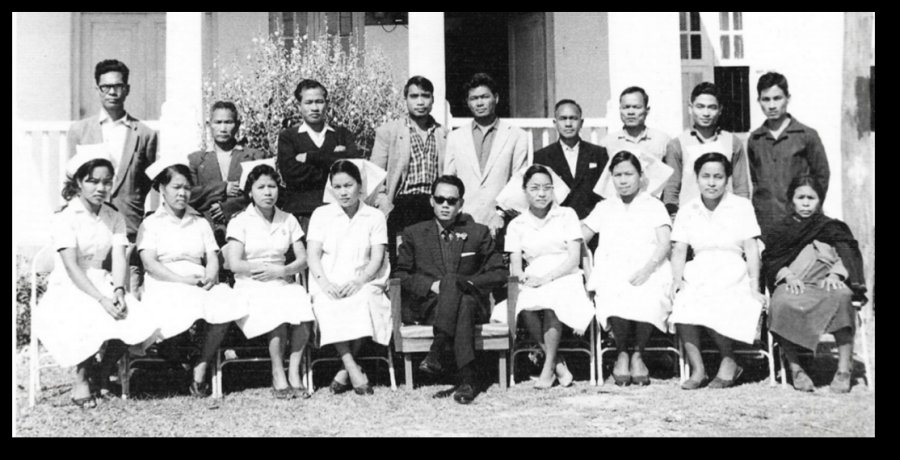
Staff of Churachand District Hospital. Author (centre). On his (R) Staff Nurse Chingnu ; On his (L) Staff Nurse Manu
This article is the last in the series and is filled with strident sentiment. The memorable photograph above, was taken in January 1966. It was also my last photograph before I left Imphal for my post-graduate study in London. As I boarded the plane at Tulihal Airport for Calcutta on February 8 1966, through one of its windows, my eyes took the horizon in the cerulean Imphal sky, where the wispy bands of white cloud were kissing the distant mountain peaks. I left a piece of my heart in Churachandpur where the people were gentle and disciplined.
While fielding WhatsApp messages from friends and relatives, accompanied by short clips of interesting videos, during this pandemic lockdown, I began to anatomise my memories of yonder years. Then came a message from Shanti Moirangthem, the eldest son of Moirangthem Gojendra of Uripok, asking me to write my memoir, which he would publish in the newspaper, and in the book form later.
I recoiled from writing a memoir as I have no pearls of wisdom to offer. But I agreed to write about the life and times of people in Imphal during my school days and the political decay in the immediate postwar period. I have written a bit about them 15 years ago, though without much political graffiti or political views. I hope this piece is not purely replete with platitude.
I am consumed with grief that Shanti did not live to see what he asked for. He was debonair, calm and collected. His retirement as IGP of Manipur Police Force, was cut short by the Covid-19 virus. He passed away on Tuesday December 8 2020.
In this article, we will run through briefly, the political order or disorder of Manipur in the postwar period from (1946-49). Those years ushered in a modern era in politics among the few educated Meiteis and tribal communities. Politics is the art and science of running a government. It is a science in that, it has to be methodical and rational.
Meiteis until the postwar period, were educationally backward, and rather naïve in politics. They had for millennia, a form of government of tribal origin, and later a monarchical feudal system. In the historical period of last 300 years, there was a 'symbiotic interdependence' between Brahmin and king. That arose from the need for royal power to be continuously resanctified by priestly (ie ritual) power, in order for the former to retain its sacred legitimacy.
The ancient Meitei concept of ningthou (king) Pakhangba as lainingthou (king of lais or deity, based on ancestral worship) became a parallel didacticism for Meitei kings as Maharaja Ishwar, constantly reinforced by Brahmins. Each Meitei king would need a personal relationship with a purohit or court priest, who would have to sanctify each action he took as a sacred leader, as in the case of mangba- sengba social rule, during the reign of Churachand Maharaja. As I recollect, a Brahmin, Phurailatpam Atombabu Sharma, was such a purohit for Maharaja Churachand, before the War.
WWII had dislocated such a link. Individual villages had local governance institutions, a kind of panchayat, and did not depend on the state for religious hegemony or to provide services for judicial arbitration. The thrust for social change in this postwar period underlined a change in the political system.
The sophistication came as a result of social mobilisation, driven by the expanse of education, cheap travel and rapid spread of knowledge brought about, by the arrival of various newspapers from Calcutta. There was a steady note of scepticism in the metaphysical belief of the effort of the soul in seeking heavenly comforts. A childlike acceptance of faith and divine providence found more placid and contemplative expression among the youth.
There was a heroic contention that the king of Manipur was not immutably ordained by God, a reflection of the revolutionary times of the postwar years. Despite the widespread and free public debate among the few lettered Meiteis, about the nature of sovereignty and an experiment in popular democracy, there was a problem of restructuring a new institution that was not indigenous but, borrowed from and enthused from outside, by shrewd men of political energy.
This indigenous movement became dominated by the Indian Congress ideology. For Manipur with such a big divide between the hills and the valley, the movement was rather fragmented. It was further weakened by inherent Meitei disunity, and weak leadership. Internal squabbles, rather than discussions amongst themselves, created political disjunctions and disruptions.
The sulphurous Meitei-style in-fighting among the various political groups in such a small country, accounted for an increasingly stale political state of affairs. The actions of political actors were determined by self-interest rather than by any altruistic ideals, though they all demanded a better protection of rights for all Manipuris.
The disconcertion, tensions and ambiguities engendered by the coming of independence, were mirrored in their confused game of politics. In the war-ruined landscape of Imphal, they all agonised over the nature of independence of Manipur, with an optimistic prospect for a political dawn with human rights and liberties for Manipuris.
Though limited, there was the emergence of new social groups of educated elite, among the newly emerging democratic public. They in essence, revolved around the internal logic of state building through the empowerment of new social actors. The defeat of the king seemed to open the way to a just restructuring of social institutions by men of goodwill. But who?
From the standpoint of political development, a critical aspect was the surfacing of many college students who were studying in Calcutta and Gauhati, where they became politically conscious, like the followers of revealed religions. When they came home during their summer holidays, they began to organise students' political forums among high school students. They formed the Manipuri Students' Congress. Studying outside Manipur, gave them advanced knowledge, experience and perspective.
Animated youngsters like me joined the party, shouting slogans during processions, such as 'chhatra congress, zindabad (long live student's congress). Bharat matagi jay (victory to mother India). We attended various meetings at the end of such processions, mostly at the Aryan Theatre Hall. There were a few eloquent speakers, such as RK Jhalajit Singh, Salam Rajdhan Singh, and Thokchom Bira Singh. Fired with the spirit of Independence, I had a poster picture of Mahatma Gandhi with Jawaharlal Nehru hung up on the wall of my room.
I was only a school boy. I did not know politics but, I knew it was for independence. Likewise, many students joined another rival party, not really knowing what sort of agenda it had. It was called Manipur students' Federation. It was the communist organisation, led by communist college students. I read Nehru's books: The Discovery of India and his autobiography. They were very exciting. I also read a thin book containing 30 letters, written by Nehru to his 10-year old daughter Indira Priyadarshani. Nehru was in Naini Jail near Allahabad, while Indira was staying in Mussoorie with her maternal aunt.
The year 1946, one year before independence, was the height of students' agitations. A considerable swathe of men in the street, was reconverted to the idea of freedom by their energy and conviction. Leftist songs like hougatlo changshillo bharat machasa, swadhinbata numit thorakle [...]. (Arise and advance all children of Bharat, the dawn of independence has broken) aroused a yearning for freedom among the mass of people in Imphal.
India ultimately got independence on August 15 1945. I heard Jawaharlal's famous speech on All India radio, one minute before the stroke of midnight on August 14 1947. He gave the speech of his life –'Tryst with destiny' to the Constituent Assembly of India, in Parliament in Delhi.
Independence physically, did not mean much to us Manipuris, in terms of our way of life, which in fact, changed for the better dung the British suzerainty. In this epoch, the Lallup kaba system with which, able bodied men of military age had to go to work for the king and/or had been conscripted to soldier in the frequent wars, had been discontinued.
I did not feel any different. It was because, we in Manipur, had never suffered from the master-servant degradation of the colonial era. There were no palpable restrictions on personal liberty and legitimate activity of lay Manipuris. We hardly saw British people except three or four of them playing polo at the Polo Ground, on Sundays and in winter. Sometimes, memsahibs and chhotasahibs (children) also came. They were not particularly related to the daily run of things for us.
There were no such humiliations, such as the segregation of natives from Europeans, at Hill stations. Almost all Hill stations in India had a Mall Road – a promenade where strolling down in the evenings was a major activity. Hill stations were developed by the British to get respite in summer months, 'away from the din and bustle, and smell of native living in the cities'.
They were developed around a central Mall Road, where restaurants, major shops, churches and theatre halls were located, as in Shimla. The Mall roads were always paved smoothly for ease of ambling. The Mall Road in Mussoorie in the Doon Valley, 34 km from Dehra Doon, was a favourite for the Nehru family. It reminded them of their home in Kashmir. Nehru died one day after he had been to the Doon Valley.
Nainital is also such a nice Hill station that I like best. I spent two years of my study there, for the B Sc degree. It had a Mall Road that extended all along the length of the lake. Between the tarmacked Mall Road and the edge of the lake and at a lower level, was a narrower road, surfaced with stone chips. The sahibs strolled on the Mall Road while the natives walked on the dirt road.
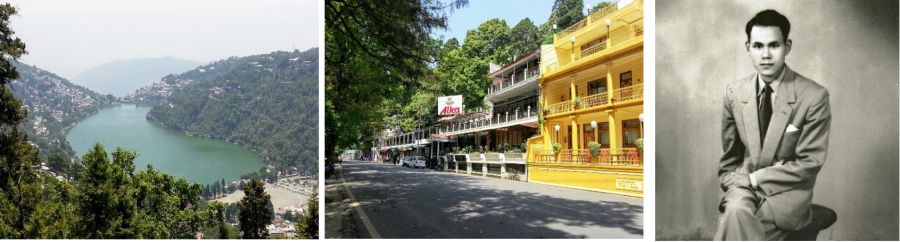
(L) Naini Tal (Naini Lake). The far end is the beginning of the town. (2016)
(M) 2/3 of the tarmac road was Mall Road. 1/3 of the road on the left was at a lower level & surfaced with chips for natives to walk
(R) Author in Nainital 1955
In Kashmir, the British owned houseboats floating in the Dal Lake, to stay in summer, as they were not allowed to own land to build anything. It began in the early 19th century. There were hundreds of them, with names like New Buckingham Palace.
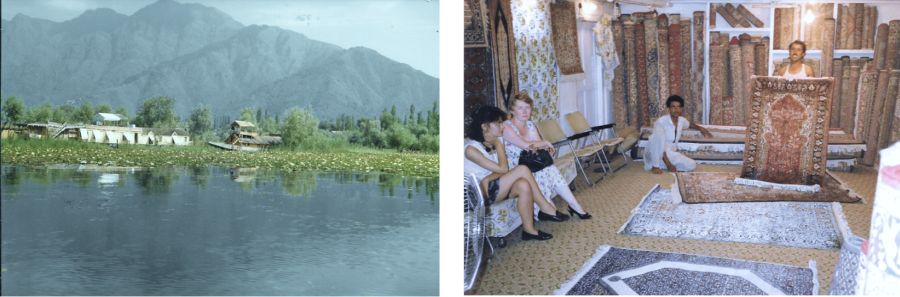
(L) Houseboats in Dal Lake, Srinagar, Kashmir 1980
(L-R) Author's daughter Anita & wife Margaret 1980 ;Inside a houseboat selling carpets in Dal Lake, Kashmir
Now, back to Imphal after going on a tangent. The manifest intentions of the leaders of college students, immediately before independence, were to arouse political consciousness among the academia and hoi polloi in Imphal. And they did. The public became politically activated with the notion of freedom from British rule. However, this new politico-cultural change created only a new kind of personality in some educated people, which was more individualistic because of higher education than a bricolage of habits and traits en masse.
The unprecedented situation demanded strong and purposeful leadership, with ambition and clear direction. But such actors with political dynamism was in short supply. This was the time when the Meitei society and other tribal societies, lived peacefully under the rule of Meitei kings. The law of living was fixed by the king. It was shaped largely by their own traditions and culture, and based on their own historical pasts. It was an ordinary law and not a legislature, and thus, could be changed at any time at the whims of the king.
Tribal Meiteis, during the time of Nongda Lairen Pakhangba, changed from a tribal society to a state. But, the tribals in the surrounding mountains, perpetuated tribal forms of social organisations with their own customary laws. Their primordial religion and kinship were strongly guarded by tribal societies, which had a huge degree of internal variance in kinship rules.
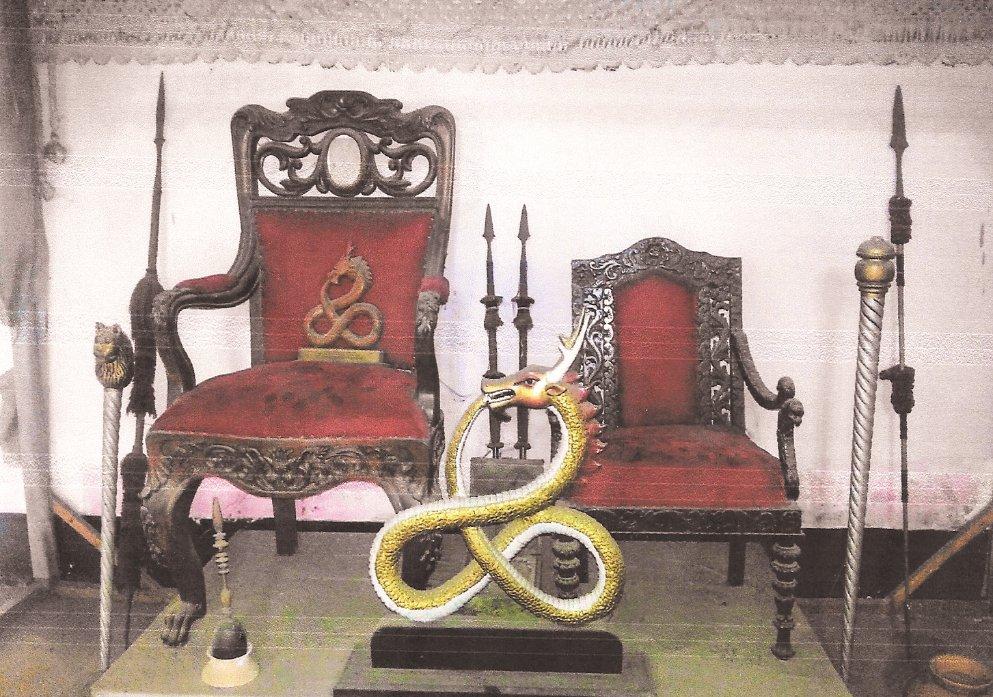
Ancient thrones of the Meitei King and Queen in the Palace with a coil of Pakhangba
The mobilisation of a new system of governance with new legislature, by new social actors, to integrate societies across the various tribal communities, including Meiteis, using outside institutional models, needed to be overlaid on indigenous ones. As it was not happening, they were not quite succeeding
Historically, in Manipur, among the Meiteis, Brahmanic social system in collusion with the ruling kings, limited political power of the populace, by controlling literacy. Brahmins were the educated people (in Sanskrit) who taught us about Hindu religion and performed puja by propitiating the sacred fire and chanting Sanskrit hymns and mantras, for birth, wedding, death and afterlife.
With benefit of hindsight, it is arguable that such a practice of keeping the mass illiterate, extended strictly, up to the end of WWII, and thus consigned a huge number of Manipuris to poverty. The Meitei society acquired a common culture under two sets of religious beliefs, one indigenised and the other imported. But it did not develop to re-evaluate politics and outreach economic developments. There was a stalemate in trying to cross a rope bridge connecting the past to the present.
The advent of WWII in Manipur, provided an exhilarating context that opened the eyes and ears of Meiteis. It was like seeing the metalled street at Khwairamband, glimmering black and silver in the downpour, following a ceaseless splatter of rain during the Monsoon. There was a kind of fascination with the nature of war, and their wartime experience created a new generation that was itching to explore the world.
Despite the optimism of Meitei intellectuals about building a progressive Manipur, the dream remained an El Dorado. However discerning it might have seemed to highbrow opinion, it was a non-starter. It was not easy to innovate a new institution by neutralising the existing political stakeholders, holding vetoes over reform. They were the monarchy and the Brahma Sabha (dormant during the war years). It was also contingent on the political ability of the echelons of the new society to rule themselves, and to be strong enough to mobilise opposition to centralised power that was looming large, just across the mountains.
That there was a rocky terrain ahead was apparent. The myth of a restored, integral, and independent Manipur on August 15 1947, seemed to encounter bad weather in Manipur's political firmament. It became increasingly wobbly. The negative force of subjective experience began to rise somewhat subversively against the intentions of Indian politicians. The assembled resistance was far from being able to stand up to the powerful inertia in Delhi.
Manipuri politicians were not simply free to remake themselves. On the other hand, they were not ready to accept the historic fact of the union with India, with a distinct distaste for Indian dominion.
The conversion of Meitei nationalism to vegetarianism in 1717, through Hinduism, was more than simply a partial rejection of Shamanism but, an approach to intellectual idealism.
The rule by a centralised alien (mayang) power in Delhi, following a coup d'etat on September 21 1949, reducing Manipur to mere 'territory', and not even a part of India, brought an end to the pride and prejudice of Manipuris, who lived in their own 'country' of Manipur (22,327 sq. km), which is bigger than Israel (21,145 sq. km). It would have been twice as big, if Nehru had not gifted away Kabaw Valley (22,210 s. km) to U Nu (father of Aung San Suu kyi) of Burma in 1953.
The practice of political science, requires highly educated politicians. Lack of higher education among the few Meitei politicians hampered their civic skills and political participation. Though many politicians elected as members of the two houses of parliament in Delhi at that time, were not educated, the core of them was highly learned and seasoned. On top, they had spent a few years of their life abroad in London.
This state of political immaturity was lampooned by a cartoon in 1962 in India's 'Shankar Weekly' (Indian satirical magazine published between 1948 and 1975). During the Chinese invasion of India in 1962, one Indian journalist asked a minister in Delhi, what he thought about it. The minister replied: 'This Chinese intention of India is very very bad'. The journalist interrupted and asked: "Sir, do you mean invasion? The minister retorted: "whether invasion or intention is just the same to me."
To enforce the parallels with the rest of India, Manipur also had its share of educational poverty in English language. In late 1940s, Editor of a Manipuri Daily, wrote what he thought was sensational weather news, quoting a national English newspaper with 'It was raining cats and dogs in Tinsukia in Assam'. He translated it in Manipuri as Assam gi Tinsukiada nong kanna tabada houdongga huiga yaore.
Independence did not mean much to a boy like me, as well as to the mass of commonsensical people in the street in Manipur. I did not feel any different. We in Manipur, had never suffered from the humiliations of master-servant degradation of the colonial era. There were no palpable restrictions on liberty and legitimate activity of lay Manipuris.
We hardly saw any British people except three or four of them playing polo at the Polo Ground on Sundays, in winter. Manipur was only under British suzerainty and that was also only for 56 years. That means, Britain allowed internal autonomy of Manipur, a de facto situation, rather than a legal de jure one.
Manipur's political consciousness was started by one person, though mainly for peasant rights, by Hijam Irabot, who was a born politician. His slogan, thangol adu maya thouna thangu hey lou-uba...
(Oh! ploughmen, sharpen the blade of your sickle...) in time for the annual session of All Indian Kishan Sabha at Mymensingh, now in Bangladesh, aroused false awakening among peasants for their rights.
Irabot was a social reformer and a Marxist politician. He stimulated certain free spirit among the urban village Meiteis and the peasantry alike. He is attributed as the Lamyanba (pathfinder) by some people. I prefer to call him a failed pathfinder as I cannot find anything that he founded. But he was a great man.
Irabot's budding political thunder began with the founding of Nikhil Hindu Manipuri Maha Sabha (NHMM) on May 30 1934. Just after the War, Laimayum Lalita Madhab Sharma became a household name leading the Congress Party in Manipur.
The history of Manipur politics at large, began to emerge at the fourth session of NHMM at Chinga Hill on December 29-30 1938. Lalita Madhab was the general secretary. The meeting brought to the educated Meiteis what it would be like to have an independent democratic government by demolishing the monarchical feudal government.
The main thrust of Manipuri politics, was only manifest in the demand of the NMM, on August 3 1946, when it petitioned Bodh Chandra Maharaja for an immediate declaration that there would be a democratic government and that he would set up a constitution-making committee, while in the meantime, an interim government would be instituted.
The brouhaha over the crisis certainly, inflicted untold damage on monarchical optics. By September 21 1946, Bodhchandra having made up his mind, wrote to the Political Agent Christopher Gimson, asking for his approval whether he could make an announcement that would lead to the formation of a responsible government. Having agreed, he declared the formation of a committee that would draft a constitution on December 12 1946. He listed who should be in the committee. Bodhchandra was supported by the pro-monarchy party of Praja Shanti.
The anti-Congress party of Manipur, Praja Sangha (Communist party in urban area), Manipur Krishak Sabha (Communist Party in rural areas), did not agree with the representation. They boycotted the process. They also appeared to want to up the ante against the pro-merger [with India] stance of Manipur Congress. They fell back on their two-pronged knee-jerk defence.
Dissention came to a head. The NMM became split one day at a general meeting at the Aryan Theatre on October 4 1946. Irabot emerged from the meeting with less credit to his name. I attended the meeting. Ousted from NMM, Irabot formed a few blatant communist organisations, and what was left of the NMM, eventually formed the Manipur State Congress, under the new president Lalita Madhab Sharma.
On March 3 1947, the Manipur State Congress set up the Manipur Constitution Making Committee (MCC). Frank Pearson, the president of Manipur State Durbar drafted a constitution for the state. On May 8 1947, the Manipur Constitution Act was passed. On July 1 1947, the old Manipur State Durbar changed its name to the Manipur State Council.
Manipur became independent from the British Raj on the stroke of midnight hour of August 14 1947. Bodhchandra Maharaja wanted to hoist a Manipuri National Flag at Kangla at that hour, but GP Stewart, the last political Agent, refused the request, as Kangla was in the British Reserve on that day and would not be handed over until the next day, August 15.
On August 15, Bodhchandra went to the Political Agent's Residence for the handover. Stewart became the first Dominion Agent. Two days later, he Left Manipur for England on August 17 1947. Two months later, he was replaced by the first Indian Dominion Agent Debeswar Sharma.
In July 1948, the first Manipur State Assembly with Maharaja Bodhchandra as the Constitutional head, was set up with elected members on adult franchise – the first of its kind in India. The representative members were from (1) General [valley] (2) Hills and (3) Muslim constituencies, in the ratio of 30:18:3. There were two additional seats for the representatives of educational and commercial interests (specialists in their fields). The total number of seats were 53.
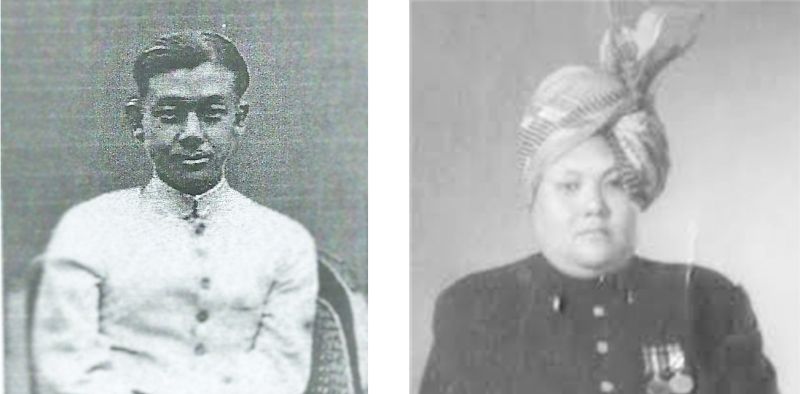
(L) MK Priyobrata Singh ; (R) HH Bodhchandra Singh Maharaja
On October 18 1948, Manipur State Assembly was inaugurated with Maharaja Bodhchandra as the constitutional head. MK Priyobrata, the outgoing Chief Minister of the Interim Council, was requested to be the Chief Minister. He obliged. TC Tiankham was elected to be the Speaker. Manipur was thus, the first state in India to have a democratic government. On October 22 1948, the name of the British era Manipur State Military Police (SMP) changed to Manipur Rifles (MR).
On September 21 1949, the Governor of Assam, Siri Prakasa coerced Bodhchandra Maharaja to sign the merger agreement at his residence – Redlands – in Shillong, while he was under house arrest. I was in Redlands a few times. It was modest, in comparison to Tripura Castle that turned into a Hotel with a posh restaurant.
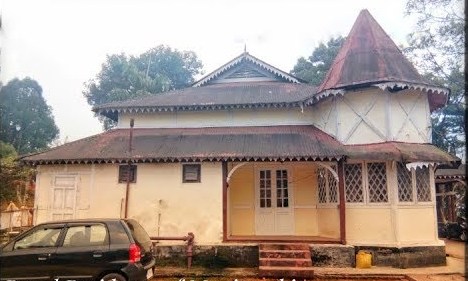
Manipur Rajbari – Redlands – in Shillong, near the picturesque Wards Lake :: Pix - IT News
In Manipur, Rawal Amar Singh, the Dewan (Dominion gent) announced the annexation October 15 1949 at an official ceremony at the Imphal polo ground at 9 am. The Manipur administration, after nearly two years of existence as a sovereign independent country, was taken over by New Delhi, by dissolving the democratically elected 1948 ministry. Manipur thus became a Chief Commissioner's province and Himmat Singh became the first Chief Commissioner.
On August 18 1950, after ten months of wrangling, Notification No. 100-p from New Delhi, notified that an Advisory Council would be set up that would consist of the Chief Commissioner and fourteen other members nominated by the central government in consultation with the Chief Commissioner. Priyobrata kept his dignity and decline to be a member.
On October 9 1950, Himmat Singh inaugurated the Advisory Council at the Secretariat Building. The Chief Commissioner was the President with the right to debate but no right to vote. The ill-fated Council came to its abrupt end when the members resigned with disagreements with the second Chief Commissioner EP Moon, the successor of Himmat Singh. The Advisory Council was dissolved in 1951 by the Union Government. Manipur became a Part C state with the provision for only two elected members.
For Maharaja Bodhchandra Singh, who always had a disdainful deadpan expression as if to avoid any imputation of self-satisfaction, it was the end of his hopes and ambitions. Deep in his heart and silently, he watched in his own life time, the beginning of the end of the Ningthouja kingdom of Manipur that was more than 2,000 years old. He died an uncanny death without the panopy of palace life.
India had its first general election in 1951-52.Congress naturally came to power and the first elected Parliament came into being in April 1952. The rest is modern history. In nearly 74 years since Indian Independence, Imphal has changed its landscape beyond recognition, from a mere district post code of Assam province to a sprawling city.
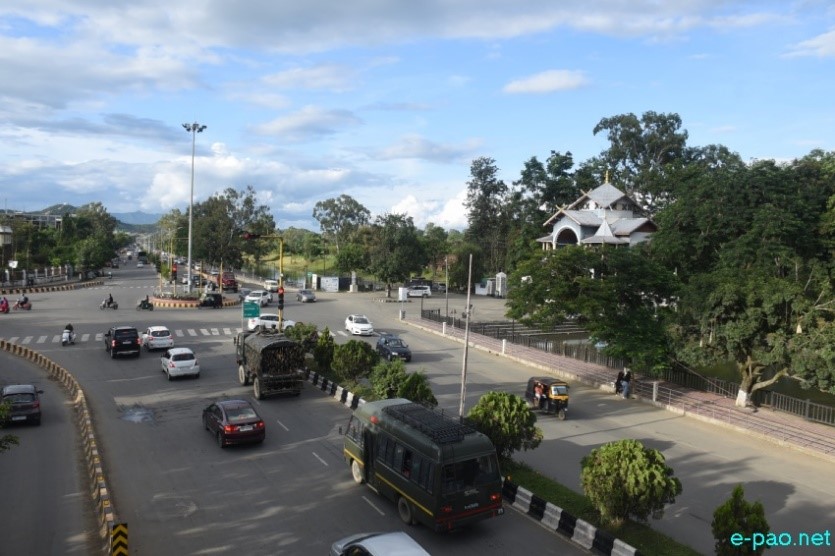
Four-Lane Ends, Imphal with cerulean sky and fluffy white clouds
In the present series, I have tried to individuate various aspects of development of the customs and traditions, food habits and dress codes, of Meitei, to draw a modicum of the period between 1941 and 1949. I have also included the process of political evolution that took place in this interim period in a nutshell.
Every effort is made to ensure the information given is correct. But authenticity is not guaranteed as they are my memories. It is not a researched history.
I have no further input. Thank you for reading.
Author's website: drimsingh.com
* Dr Mohendra Irengbam wrote this article for e-pao.net
The writer can be contacted at irengbammsingh(AT)gmail(DOT)com
This article was webcasted on March 16 2021 .
* Comments posted by users in this discussion thread and other parts of this site are opinions of the individuals posting them (whose user ID is displayed alongside) and not the views of e-pao.net. We strongly recommend that users exercise responsibility, sensitivity and caution over language while writing your opinions which will be seen and read by other users. Please read a complete Guideline on using comments on this website.


