


Meitei hunter-gatherer ancestors lived in Koubru hill ranges
- 'Ours not to reason why'
[The Charge of the Light Brigade]
Dr Mohendra Irengbam *
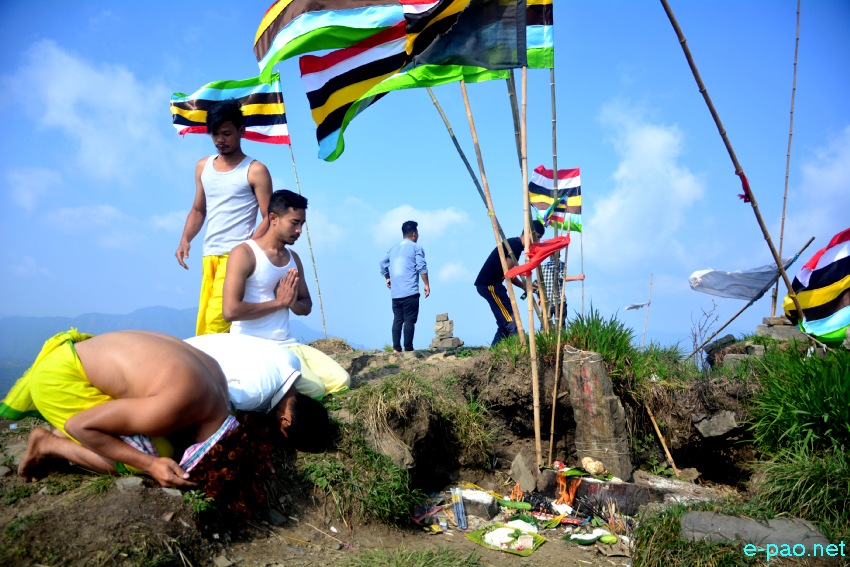
Prayers to Lainingthou Koubru Ashuppa at top of Mount Koubru in April 2021 :: Pix - Shankar Khangembam
Manipur Sana Leimayol,
Chingna koina punshaba lam,
Haona koina punngakpa lam;
Manipur sana leibakna,
Matao asumna pallame,
Maong asumna leiramme.
[Translated into English]
Manipur the golden central land,
Fortified on all sides by the hill ranges,
Guarded by the hill dwellers;
The golden land of Manipur,
Triumphed in this way,
Abounded in this fashion.
[Author's book, Point to Ponder , 2013, pp 20-25]
Cannon to left of them, cannon to right of them, cannon in front of them, volleyed and thundered, stood the 400 Meitei warriors with sabres in hands, unflinching and determined, in the bivouac of Khongjom (cf. Ibemni, Oral history. Khongjom Parva ballad). They watched and waited for the immensely powerful, well trained and well equipped British Army of 1,800. They were a handful of British, with Gurkhas and Madrasis (Madras Burma infantry regiment). They had 4 cannons (cf. T Graham, Brig-Gen, commanding Tamu Column, The 1st May 1891, Camp Manipur).
Following the occupation of Kangla in Imphal by the British at about 10 am, on April 27 1891, the British Viceroy Lord Lansdowne decided not to annexe Manipur to British India but restored it to its Princely State.
A notification, dated September 18 1891, directed that, "The Governor-General in Council has been pleased to select you, Churachand, son of Chowbi Yaima, to be the Chief of the Manipur State. You are hereby granted the title of Raja of Manipur, and a salute of eleven guns."
Manipur existed as a free country, proud and smug for 2,000 years of history until the British subjugation in 1891. It was land-locked and sandwiched between the sub-continent of India and Burma. It was cloistered like a convent by nine majestic tree lined mountain ranges with their peaks dipping in the white cloud. It was under British suzerainty only for 56 years (1891-1947 CE), and was unknown to the world until WWII. In this weird land lived seven tribes of Meiteis in the valley, and thirty six tribal communities in the hills, in harmonious coexistence.
'The Policy of Indirect Rule' that was framed for all the Princely States of India, was introduced with some changes in the valley, where the Meiteis lived. Major HP Maxwell who was the political officer during the transition, was appointed as the Political Agent, answerable to the Chief Commissioner of Assam.
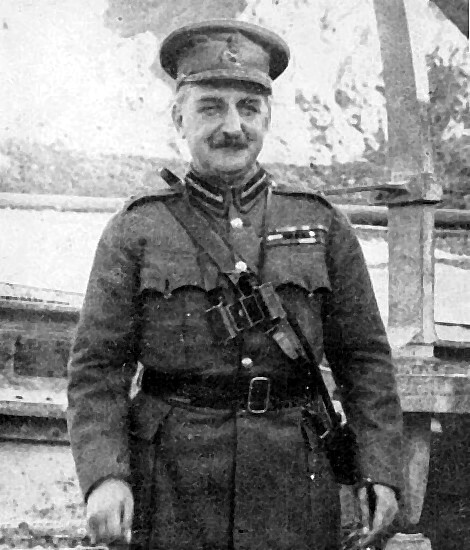
Major HP Maxwell, First Political Agent
He organised the first translation of Cheitharol Kumpapa (Kumbaba) into English through a Bengali clerk, Bamacharan
Source : Wikipedia (public domain)
During the British rule, the Hill administration was separated from the Valley. It was taken over by the Political Agent. It was said 'to protect the hill people from the oppression of the king of Manipur'.
And so, the Hill people remained segregated from taking part in the development of the modern state system. Each tribe remained fairly independent, usually headed by a chieftain. They had extra-ordinary skills of survival and conservation. They set out their own rules for the community. They had managed their livelihood for millennia from their surroundings. They remained off-limits to outsiders and protected their biodiversity from outsiders.
These various ethnic communities, including the Meiteis - a conglomeration of seven tribes, have preserved their tribalism. And like all humans, they have evolved to be social and community-based. They have kept their identities intact and become bound together, shaping their own distinguishing behaviour. They have developed their own socio-economic characteristics.
To them, their own identities matter, as in the cases of Meiteis, who used to explode often, stressing, "Ei Meitei machane haibasi khangdra"?-Don't you know I am a Meitei? So it does to a Khongjai (Kuki), Kabui (Zeliagrong), Tangkhul and other small tribes like Kom to which Mary Kom belongs. The revivalist Meitei Sanamahist are sticking for the revival of Meetei identity, rather than Meitei.
Each tribe has a common culture, such as the Maring dance, Kabui dance, Kuki dance or Tangkhul dance, and has its own traditional characteristic ways of life and dress code. Each tribe has a separate language and a commutarian basis of landholding. They communicate with each other in Manipuri language (Meitei Lon). It is similar to the 89 different tribes and dialects in Naga Hills and they communicate through a common language of Nagamese (Naga dialects mixed with Assamese language).
The tribes in Manipur have their own primal animistic religions, such as Meiteis' Sanamahi Laining, Kabuis' Haipou Tingkao and Tangkhuls' Kameo. They also have primordial social structures which have evolved over the generations. They have their own arts and crafts. They build their houses with vernacular architecture and in typical unique styles.
The use of the word 'tribe' which I am using now, has been questionable since the late 1950s. Archaeologists and ethnohistorians have been arguing with each other over its propriety. For me and for the present, I will buy the following definition. 'A tribe is a political unit, based on social or ideological solidarity, with their identity based on factors such as kinship ("clan"), ethnicity ("race"), language, dwelling place, political group, religious beliefs, oral tradition and/or cultural practice'.
In general, a tribe in Manipur is a primordial human social group with kinship structures, such as the Meitei tribe consisting of seven clans and the Naga tribe with various related communities. These tribes in Manipur, retained their standoffishness with a certain degree of economy and autonomy. As a result, they rarely mingled socially, but they were bound together by a common language of Manipuri.
Meiteis are a federation of 7 major clans, while 2 minor ones having been assimilated in the early phases of state formation. It was Nongda Lairen Pakhangba who created a state and later, a nation state of Meiteis in Meitreibak (Meitei Leibak). As Meiteis settled in the valley, which was accessible by people from outside of the surrounding mountain ranges, albeit with some hardship, they began to pick up strands of modern civilisation with complex social hierarchies and an institutional government at Kangla.
I am forever amazed at the assumption of a few clever clogs - foreign ethnologists, who, more than 100 years ago, in the absence of any history, archaeological or genealogical evidence, had propounded their humbug ideas of the origin of Meiteis as coming from somewhere near Tibet or China or from China itself such as Yunnan. They had been taking us to 'places of our origin', but when we reached there they won't let us in. They simply entertained themselves by telling tall stories and spinning edgy new yarns.
In the absence of any clue, they imported some place or the other as a substitute, to show white supremacy. Since then, many Meiteis have been parroting that Meitei tribes came from anywhere except the moon. Meitei language (Manipuri) likewise, is also suffering from the same fate. Many white linguists have identified it as Tibeto-Burman, but for over 100 years, they have been unable to find a place in the Tibeto-Burman language group (tree) to accommodate it.
It is quite baffling to me. And some people, who are smart enough to think on their feet, may ask the question: did the Meiteis really have to come from somewhere? Is it not probable that they had been in Manipur as autochthones - the original settlers, like the Tibetans or the Chinese or the Dravidians?
While the discussion of whether Meiteis or any other tribe in Manipur had been indigenous has become a cottage industry, I stand to be counted that Meiteis were there with the first human expansion from Northeast Africa (cf. Author's Book, Points to Ponder, 2013, pp 20-32, 112-115 and 140-143). Sometimes, the only way to know a stove is hot is to touch it, failing which, to go as near as you can.
In written Meitei history, Poireiton Khunthok does not mean Poireiton migration. It means Poireiton settlement. Among the bizarre allegorical interpretations, one is that they came from Khamnung (Land of the dead) to Taibangpan (land of the living).
What is historically true is that, Nongda Lairen Pakhangba (33-153 CE), a descendent of Tangja-Leela-Pakhangba who was a Lai from Koubru (Koupalu in old Manipuri), defeated Khaba Nongchenba of Khaba tribe and later, Poireiton in the battle for supremacy. Pakhangba later, married Poireiton's sister Laisna and began the Ningthouja (providers of ningthous or kings) dynasty of rulers in Manipur. It is also recorded that Poireiton's settlement (Poireiton Khunthok, 18-34 CE) preceded that of Pakhangba.
The implication now is, where did all these tribes come from? There is oral history that Meitei ancestors came down from the surrounding hills like the Koubruching, Nongmaiching, Thangching and others, when the Imphal valley that was filled with water, dried up, which they simply called Kangleipak (Dry Land) There is archaeological evidence that Manipur was raised from the bottom of the sea, filled with water. (cf. Ibid, The Raising of Kangleipak from the bottom of the sea, pp 44-47).
Based on oral history and legends, there is no dispute that the early settlement of Meitei tribes in the dry valley after they came down from the surrounding mountains, was at Kangla – a very dry area. It was about 20,000 years ago (cf. Kangla Excavation, Thangjam Nanjest et al). It is historical that after Pakhangba defeated Poireiton, his principality in 33 CE (Cheitharol Kumbaba), became known by another appellation - Poirei-Meetei Lamdam (Land of Poirei and Meetei).
Oral history tells us that Poireitons and other contemporary tribes, such as Lei-Hao and Chenglei, Khaba who settled in the Imphal plain earlier, were known as Mee. There was also another group known as Tin, contemporarily with Lai. Poireiton's people thus called them together Lai-Tin. That is the origin of the present Meitei usage of Lai-Tin (People). It is similar to the later use of the phrase mee-pong, showing association of Mee wth Pong of Burma (777 CE), from hills overlooking Kabaw valley, near Manipur border.
When Pakhangba's group (Lai people from Koubru hill ranges) came down from the hills and subdued the Poireiton and others, Mee people referred to them as Mee-Atei (other people). With word evolution Mee- Atei changed to Meetei. And when the seven salais merged to form a nation state, Meetei changed to Meitei as an eponym to cover all the salais.
There is oral history that a community of primordial ancestors of Meiteis led by Koubru and his escort Kounu, first settled on the Koubru Hill top. That must have been when they emerged from the Stone Age caves in the foothills. Koubru is still known to the Meiteis as Lai-ningthou Koubru (king of lai people). And since time out of mind, Meiteis have been climbing Cheirao Ching (Koubru hill rage) in April every year to pay obesseince to Lai ningthou Koubru.
Equally emphatic in the autochthonous oral history of the Meiteis, is Baruni Hill (Baruni Ching) or Nongmai ching (selloi Langma Ching) that is associated with the settlement of the Meitei ancestor group led by Nongpok Ningthou and his escort Panthoibi (who are now regarded as Lai tribe). That, every year in the month of March-April, Meiteis have been going up since eons ago, to the top the hill to pay homage to the long departed, must weigh heavily on the truth of this Meitei folklore.
There is now the undeniable archaeological evidence that Meitei ancestors as hunter-gatherers first, settled in various caves in the mountain caves around the Imphal valley, as well as in Imphal valley itself (Napachik) during the Stone Age (cf. Archaeology book by OK Singh, which we all know).
It is also unquestionable that, most people throughout history, have learned about their past through spoken words, long after writing had been invented. We know oral history had been used in ancient times, by Greek historians Herodotus and Thucydides. In modern times, among others, Allan Nevins of Columbia University, and his associates in 1948, have emphasised its validity.
Oral history, according to them, 'is the rehearsed accounts of the past presented by culturally sanctioned tradition-bearers; to informal conversations about "the old days" among family members, neighbours, or coworkers; to printed conversations of stories about past times and present experiences; and to recorded interviews with individuals deemed to have an important story to tell.'
I do not for a moment, imply that Koubru hill top/range belongs to Meiteis only. It belongs to all the indigenous settlers in Manipur. So is Baruni Hill (Baruni Ching). My emphasis is only that, the Meiteis were there, probably as first settlers, in view of the vast current traditions accompanied by oral history that is related to these hills.
I have gone at length to begin this article with sidewinders, so as to assert that 'Oral history' is now considered nearly as good as written history by modern researchers. And that, the authenticity of this oral history of the earliest Meitei habitation of Koubru can be inferred from the ancient Meitei invocation prayer of:
Awang Koubru Asuppa, Mighty Koubru [hill] of the North
Leima-Lai khunda Ahanba First settlement of Leima-Lai [female-male]
Nongthrei Ma-U Lingliba Full of plant life
Eerik Eepan Thariba Abundance of living beings
O! Lainingtho! O! King of Lai [people]
[Tomba Meetei]
Whilst some of our ethnic communities in Manipur are claiming to have lived in Manipur from times immemorial, which I am not disputing, I can only vouchsafe from my research, that there is archaeological evidence that Meiteis had been living in Manipur since the Stone-Age (vide supra).
Further, there is ample oral history, which points out that our ancestor hunter-gatherers came out of the caves and ventured to live in the open mountain tops, presumably in the late Neolithic (New Stone Age), between 10,000 – 20,000 years ago when the Last Glacial Maximum (when the ice sheets were at their greatest extent) ended [Cf. Author's The Origin of Meiteis, 2009, p80]. Much later, they came down to the Imphal valley where they began a sedentary life and learnt cultivation of food crops (agriculture) and domesticated wild animals like the ox for cultivation, and wolves as Meitei dogs for guarding.
All said, somewhere between prehistory and history of Meiteis, an uneasy accommodation must be made for my premise that the origin of the Meiteis is not lost and that the Meiteis are the primogenitors of Manipur, until the genetic studies clinch their autochthonous state.
Now, changing the subject from ancient oral history to modern historiography, I have come to early 1950s.
After Independence of India, all the tribes in Manipur ceased to remain isolated from the development of the modern state system. They became classified as Scheduled Tribes except Meiteis. It was because of a handful of highfaluting and ego-centric Meitei politicians who had egos as big as the Loktak Lake, and who considered themselves as Vedic Kshatriyas, would not have it. We all make mistakes. We should not be too hard on them.
It is true that Meiteis had an edge over other tribals in Manipur, in civilisational terms, especially after conversion into Hinduism in 1717. But they also remained uninitiated, and lacked worldly experience because of lack of modern education. They only began to open their eyes through experience after the arrival of Japan Lan (WWII) in 1942.
Manipur as a whole, suddenly became exposed to the war and to outsiders during WWII, though Meiteis in the valley, bore the brunt of it. Meiteis were thus, involved in World War II, in which they did not take part. They were plunged into the mayhem that came from nowhere. Life was uncertain. But Meiteis lived with the hopes tucked in their back pocket, believing that, tomorrow may not be a better day, but there will always be a better tomorrow. For Meiteis, hope was a self-filling spa.
WWII brought a hive of energy to Meitei society, accompanied by spiritual laxity among the youth and even in some of the adults. Imphal became very peaceful again. A leafy and sleepy market town consisting of many urbanised hamlets intersected by rutted and pocked lanes and bylanes, such as, Uripok, Sagolband, Yaiskul, Thangmeiband and others. Like any other town or city, it had a town centre market, Ima Keithel (Mother's market), also called Sana keithel (Royal market) in the Khwairamband Bazaar.
The townspeople in Imphal, lived happily as ever, in mendacious contentment and in the same naively optimistic and solipsistic lifestyle, they had been used to for centuries. It was partly due to illiteracy and partly to being cut off from the outside world. There was nothing more to excite their spirit of adventure, like their forefathers who had frequent warfare with neighbouring tribes and people of adjacent countries. There was nothing to learn or imitate. They became couch potatoes.
By early '50's, many students including me, and businessmen, having been outside Manipur fairly frequently, the wide world was no more a strange place. With the arrival of air travel, time and place were approaching a finite naught.
We, in a small niche of Manipur, became part of the wide world. Liberalism with political and moral philosophy, entered the sinews of the young generations of Meiteis. They were heavily (including me) in favour of racial equality. Their mindset began to share the thought that the common good was a necessity for a harmonious society with freedom of the individual. They began to foster a common identity for all the ethnic communities in Manipur, including Meitei Pangals, as Manipuris. They have ever since, been trying to create a Manipuri community consisting of all the ethnic groups in Manipur.
It was then simply, a matter of time before the disappearance of racial profiling by Meiteis as a whole, against the Hill tribals and to some extent, against the Meitei Pangals. The Meitei generation by the late 50s, had done away with the traditional racial mangba (defiled) attitude towards the indigenous tribal communities.
The change of attitude was spontaneous like a wild fire with no visible cause. This change of mindset of Meiteis into a new culture, finally laid the foundation for cementing the diversity of 37 communities in Manipur, I thought. But it did not happen. Why?
With English education that Christian missionaries brought to the tribal people in the hills, there began a surge in ethnonationalism or ethnic nationalism. It had nothing to do with religion. It was claimed by some tribal communities that Meiteis had all the flesh while the other ethnic groups were left with bones. And they have been left hung out to dry.
I do not know how much of this perception is fact or fiction? But I believe there must be some truth in it, but not the whole truth. No smoke, no fire, so is the old adage.
But, my research however, showed that the main cause was an ethnic nationalist movement of the Nagas across the state divide. Economic disparity was not the cause (Author's Book Points to Ponder, pp 147-153). Economic ground was just an excuse to ride on the passing gravy train of Nagalim.
All over the world in the post-colonial period, conflicts rooted in ethnic strife were tearing countries apart with a lot of bloodshed. Time has changed. There is no reason to start it in Manipur now. It must be understood by everybody that, to the Meiteis, Manipur's boundaries as Manipur Sana Leibak, are not negotiable. And they have been very patiently, doing spadework for peaceful coexistence.
If certain economy with the truth is what is needed in the context, I dare say that, come hell and high water, the indomitable Meitei spirit of fighting with their trait of narcissism, will rise like the Phoenix from the ashes, to defend any attempt to break up Manipur Sana Leibak.
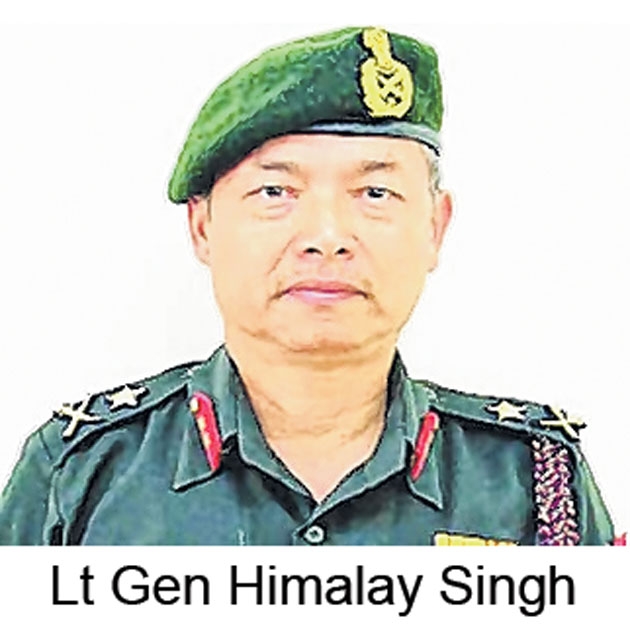
Lt Gen K Himalay Singh, PVSM, UVSM, AVSM, YSM.
Yudh Seva Medal awardee for his part in Kargil War :: Pix - TSE
Talking of which. I may be allowed to take liberty to paraphrase the Meitei spirit by citing some factual narratives. Manipur has the highest per capita number of officers in the Indian Defence Forces. I have 4 high ranking Army and Air force officers in my family itself.
There are two Lt Generals up-to-date, now retired. I know one personally, Lt Gen Konsam Himalay Singh, PVSM, UVSM, AVSM, YSM. He is highly decorated for his military skills. He was awarded Yudh Seva Medal for his successful mission to dislodge Pakistani troops from Point 5770 during the vicious Kargil war. There are a few heroes coming out of the Kargil War. Manipuri 3-Star Gen Himalay is one of them.
The Kargil War was highly treacherous, mainly because of difficult snow-capped terrain and High altitude, and mainly because unknown to Indian Military intelligence, Pakistani troops had already occupied Siachen Glacier range. Gen Himalaya was a Colonel, commanding an elite unit of 27th Rajput Infantry Battalion. He took part in the Chalunka Sector and Siachen Glaciers during the 1999 Kargil War. He was tasked to evict a Pakistani unit of 3 Northern Light Infantry that was occupying Point 5770 at an elevation of 19,000 ft. And he did.
The attack began at 0215 hrs on June 27 1999 and it was over by 1430 hrs the next day. He was commanding the assault only from 700 metre away from the objective. It was a 'silent and surprise attack' climbing up ropes that were fixed by 4 professionals under the cover of darkness on an extremely slippery and icy steep gradient. It was so steep that the Pakistani soldiers could not see his troops climbing up even during day light. (Singh, K Himalaya, Making of a General, 2021, Chapter 3).
The successful storming planned meticulously by Gen Himalaya, was described: "Perhaps the most incredible action of the Kargil War" by Maj Gen Ashok Kalyan Verma in his book Kargil: Blood in the snow, 2002, p 125. Gen Himalay's battle strategy reminds me of the Japanese tactical doctrine, which they used unbeknownst to the British Army in the South-East Asian theatre of war in WWII. It was also a bit like the action-packed movie, The Guns of Navarone, 1961, with Gregory Peck, based on the Scottish Allister MacLean's novel of the same name.
The Japanese manoeuvre was to attack the enemy where they were least expected because of difficult terrain. The tactics paid them very well in the Malaysian campaign when they navigated through dense jungles in Malaya (now Malaysia), which the British had considered impassable and had prepared few defences. By January 31 1942, they quickly routed the British troops and took 50,000 soldiers out of 60,000, mostly Indians, a few Australians and British.
They did again by attacking the British stronghold of Singapore, the major Military base in South-East Asia. Attacking from behind at the least defended part of the defence line, while powerful armour-piercing British guns to sink Japanese invading ships, were trained towards the open sea. On February 15 1942, the British surrendered to the Japanese with 80,000 troops of which 40,000 Indian soldiers joined the Indian National Army, a unit of which planted the first Indian Tiranga (Tricolour) flag at Moirang village in Manipur.
A lot of dirty water had run under the bridge of Maharani Thong. By this year of 2021, with the Covid pandemic in its last phase and with the final stage in the Indo-Naga Peace talks, my gut feeling is that the storm of ethnic nationalism in Manipur should be passing away like a whiff of malodour.
Summing up, there are no verifiable accounts of the prehistoric origin of Meiteis. In their absence, a few Colonial British officers and missionaries made a general claim of migration of Meiteis from elsewhere as substitutes. Their theories carry us to the gates of the land they name as our origin, but would not let us in. It is thus, preferable not to start travelling at all and just stay put in Manipur.
My contention of the origin of Meiteis, is based on Meitei oral history, which Meitei folklorists claim, they had first settled in Koubru Hills, and my research on the expansion of primordial human beings from the northeast of Africa (ibid supra).
Finally, I would like to give a toast:
Ladies and gentlemen,
Lend me your ears,
There'll always be a Manipur Sana Leibak.
The whole world may change,
But nothing can break Manipur,
Long live Manipur.
Author's website: drimsingh.com
* Dr Mohendra Irengbam wrote this article for e-pao.net
The writer can be contacted at irengbammsingh(AT)gmail(DOT)com
This article was webcasted on August 29 2021 .
* Comments posted by users in this discussion thread and other parts of this site are opinions of the individuals posting them (whose user ID is displayed alongside) and not the views of e-pao.net. We strongly recommend that users exercise responsibility, sensitivity and caution over language while writing your opinions which will be seen and read by other users. Please read a complete Guideline on using comments on this website.


