
TODAY -
✦


Shobha Shukla's "Justice unbound" :: Book Review

Bobby Ramakant *
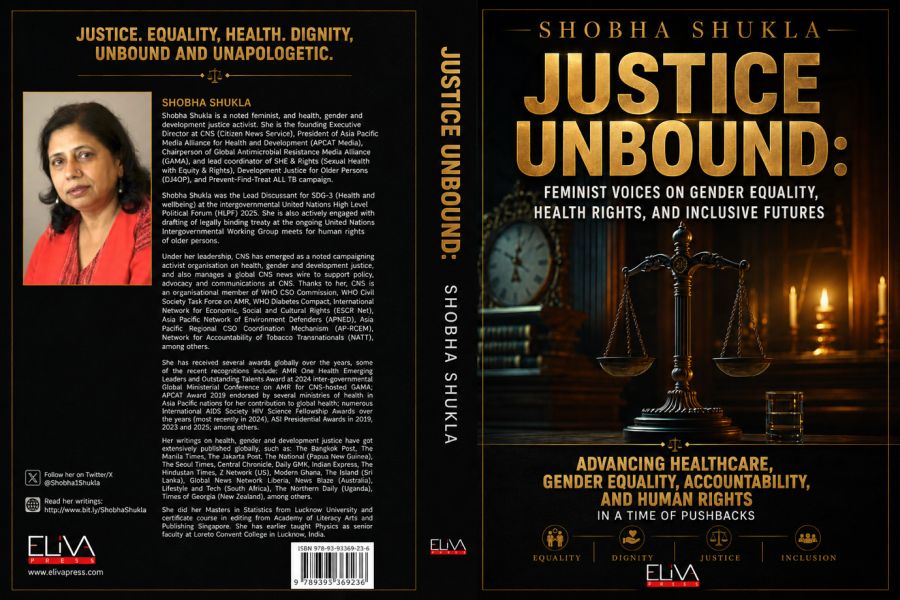
 Shobha Shukla's 'Justice unbound'
Shobha Shukla's "Justice unbound"


Justice unbound: Shobha Shukla’s urgent warning against the global rollback of gender and health rights

In a powerful intervention timed for the eve of critical global diplomacy, Eliva Press today (12th August 2026) released "Justice Unbound: Feminist Voices on Gender Equality, Health Rights, and Inclusive Futures," an exclusive compilation of 14 hard-hitting reports by veteran feminist, health and development justice advocate Shobha Shukla. Written between January and June 2026, the book documents the “nefarious pushbacks” against gender equality and the human right to health across Africa and the Asia-Pacific region. With only about 53 months remaining to meet the 2030 Sustainable Development Goals, Shukla’s work arrives as a stark warning and a call to action.

Its publication comes just weeks before world leaders gather in New York for the 81st session of the United Nations General Assembly.

The timing gives the book a significance beyond its launch. It arrives as a challenge to governments: will global leaders continue to merely make commitments on equality and health, or finally build the accountability, financing and political will required to deliver them?

A feminist record of a world pushing back

The 72-page book's 14 reports range from patriarchal resistance in Africa and the value of women's unpaid care work to menstrual justice, the rights of older persons, female genital mutilation/cutting, access to justice, antimicrobial resistance under gender lens, and the effectiveness of UN accountability mechanisms.

Across these diverse subjects runs a common argument: gender equality and the human right to health cannot be treated as optional development objectives. They are human rights, and governments have responsibilities to make those rights real.

Shukla's central concern is the widening gap between promises and lived reality. Her book notes that the world is already slipping behind on the Sustainable Development Goals, while anti-rights and anti-gender movements seek to reverse progress made for girls, women and gender-diverse communities.

That warning is particularly stark with 2030 approaching.

“Gender equality” cannot mean merely the presence of women in policy documents or conference halls. It must mean equality in law, access to healthcare, bodily autonomy, economic opportunity, political participation, safety, dignity and justice.

From Africa's pushbacks to a global warning

One of the book's opening reports examines a controversial and regressive draft African Charter on 'Family', 'Sovereignty' and 'Values,' which supposedly got support by 20 African countries at an inter-parliamentary conference in Ghana in June 2026.

The report warns that the proposed framework could undermine established rights protections by privileging narrow definitions of family, sovereignty and tradition over equality, bodily autonomy and accountability. It also raises concern about attempts to weaken commitments such as the legally binding Maputo Protocol, which protects women's rights and reproductive and health rights across Africa.

The broader warning is global: a rollback in one region can become a precedent elsewhere.

The book cites feminist and human rights voices arguing that gender equality and the right to health are not negotiable or reversible. As the doctrine of non-retrogression states, under international human rights law and constitutional jurisprudence, once a government grants, recognises, or improves healthcare and gender rights protections, it is legally barred from rolling back or reducing those established human rights standards.

Shukla's book also highlights the need for international solidarity because human dignity cannot be selectively protected according to geography, culture or political convenience. For world leaders, that should be a warning ahead of the UN General Assembly: rights once weakened are difficult to restore.

Justice must recognise the work women have always done

The book also records a striking development from India's Supreme Court, which in June 2026 substantially increased compensation in a case concerning the death of homemaker Reshma, recognising the economic value of unpaid domestic and caregiving work. The Court established that the loss of unpaid domestic care is a distinct economic loss and set ₹30,000 (approximately USD 313) per month as a minimum stand-in for a homemaker's domestic contribution when calculating compensation.

Shukla uses the judgment to expose a larger contradiction: women routinely perform essential care work while that labour remains economically and socially undervalued.

The lesson for governments is straightforward. Gender equality cannot be achieved without confronting the unequal distribution and valuation of care.

The same principle applies to health. Women and girls frequently carry the burden of caring for families and communities while encountering barriers to healthcare themselves. The book's discussion of antimicrobial resistance (AMR - which is threatening health and food security, environment and our economies) shows how gender inequality, gender-based violence, gender stereotypes and harmful social norms, stigma and unequal access to health services can influence health outcomes.

A health system that relies on women's unpaid labour while denying women equal access to care is not equitable.

The right to health must include everyone

The book repeatedly challenges governments to move beyond symbolic commitments toward inclusive, rights-based public health systems.

It calls for healthcare that is non-discriminatory and accessible to people in all their diversities, including comprehensive sexual and reproductive health and rights services and gender-affirming care. It also stresses the need to protect women and LGBTQIA+ human rights defenders facing legal and judicial harassment.

The message is particularly urgent as political debates increasingly seek to narrow the meaning of gender, sexuality and bodily autonomy.

The book also highlights a landmark January 2026 judgment by India's Supreme Court recognising menstrual health as an integral component of fundamental rights and linking it to the constitutional right to life, dignity, health and self-respect.

Such developments show what rights-based governance can achieve. But a judgment, law or treaty has little value if implementation stops on paper.

That is why the book repeatedly returns to accountability.

UN accountability cannot remain a promise

One of Justice Unbound's most direct messages is that international commitments require mechanisms capable of following governments from promise to performance.

The book highlights the Universal Periodic Review (UPR) as an important accountability mechanism through which all 193 UN Member States are periodically reviewed against human rights obligations. It argues that UPR recommendations are public and can create a pathway linking international commitments to national policies, budgets and service delivery.

That message should resonate strongly in New York next month.

The 81st UN General Assembly should not become just another summit where governments repeat familiar language about equality, inclusion and health before returning home to business as usual.

Instead, leaders should use the session to establish measurable commitments, timelines and accountability for delivering SDG 5 on gender equality and SDG 3 on health and wellbeing.

As Shukla's book puts it, governments need to be pushed to deliver on promises already made at the global level.

FGM/C shows the cost of promises without delivery

Few examples demonstrate the consequences of implementation failure more starkly than female genital mutilation/cutting (FGM/C).

The book notes that world leaders promised in 2015 to end FGM/C by 2030 under SDG target 5.3. Yet Shukla reports that the number of girls and women affected increased from about 200 million in 2016 to more than 230 million in 2024 — a 15% increase over eight years.

The book argues that FGM/C cannot be isolated from wider gender-based violence and systems controlling women's and girls' bodies. It calls for community-led solutions, stronger protection systems and accountability.

The principle is powerful: ending FGM/C is not charity; it is justice.

The same principle applies to healthcare, education, freedom from violence, bodily autonomy and equal participation in public life.

A message for the leaders of the 81st UN General Assembly

When presidents, prime ministers and ministers arrive in New York next month, Justice Unbound offers them a simple but urgent test.

* Deliver.
* Deliver on gender equality.
* Deliver on the human right to health.
* Deliver on bodily autonomy and sexual and reproductive health and rights.
* Deliver on protection from gender-based violence and harmful practices.
* Deliver on equal justice.
* Deliver on inclusive public healthcare.
* Deliver on the rights of older persons, persons with disabilities, indigenous peoples and gender-diverse communities.
* And above all, deliver on the promise to leave no one behind.

The book argues that feminist movements and human rights defenders should be recognised as rights holders, and not treated merely as petitioners asking governments for favours. Young feminist movements, in particular, need meaningful participation in decision-making and protection from reprisals.

That should become a defining principle of the 81st General Assembly.

World leaders should listen not only to governments but to the women, girls, health workers, indigenous communities, survivors, older persons, human rights defenders and gender-diverse people whose lived realities reveal whether international commitments are working.

From declarations to justice

The launch of Justice Unbound therefore comes at a critical moment.

Its title is both a description and a demand: justice must not remain bound by patriarchy, political expediency, narrow definitions of family, discriminatory laws, stigma or unequal access to power.

The book's concluding call is uncompromising. Gender equality and the right to health are fundamental human rights, yet the world remains far from achieving them despite decades of effort. Stronger accountability mechanisms are needed to ensure that governments deliver on their global commitments.

The 81st UN General Assembly now has an opportunity to turn that call into action.

The leaders meeting in September should leave New York with more than speeches. They should leave with funded plans, measurable targets, stronger accountability, protection for human rights defenders and a renewed commitment to universal human rights.

Because the question facing the world is no longer whether gender equality and the right to health are worthy aspirations. The question is whether governments will finally treat them as what they are: rights owed to every human being.

And, as Justice Unbound makes clear, rights delayed, denied or rolled back are not merely policy failures. They are failures of justice.

Justice Unbound, published by Eliva Press, is both a record of resistance and a roadmap for the action required. The question now is whether leaders at UNGA 81 will listen—and deliver.


* Bobby Ramakant – CNS (Citizen News Service) wrote this article for e-pao.net
The writer can be contacted at bobbyramakant(AT)gmail(DOT)com
This article was webcasted on August 24 2026.


* Comments posted by users in this discussion thread and other parts of this site are opinions of the individuals posting them (whose user ID is displayed alongside) and not the views of e-pao.net. We strongly recommend that users exercise responsibility, sensitivity and caution over language while writing your opinions which will be seen and read by other users. Please read a complete Guideline on using comments on this website.


LATEST IN E-PAO.NET
  • Violence in Manipur 2023-2026 : Timeline
  • First Convocation of NIELIT held
  • Detection of Breast & Cervical Cancer
  • Rising call to abrogate SoO pact
  • Rally - End proxy war in Manipur #1: Gallery
  • Exploring The Vanishing Self #17
  • Indigenous Leaders Convene in New York
  • Contribution of Wetlands towards Agriculture
  • National Unity Day 2026
  • When the sirens stop :: Poem
  • ESTIC 2026: Connecting Science with Viksit
  • Hotel Cachar Club, erstwhile Silchar Polo Club
  • Manipur's Economic Divide: Refuse to Connect
  • Yaipuba, Ningreingam, Saka : Eming
  • A century of assertion & unfulfilled settlement
  • Supports Indigenous Rally
  • Why Manipur needs counselling in every school
  • World Stroke Day 2026
  • The heart and soul of the rally
  • Yenkhong Tamba : Mera Houchongba : Gallery
  • November Calendar for Year 2026 : Tools
  • Raas Leela @Mysore Dasara : Gallery
  • Delhi Fashion Week: Award at Needle Fest
  • Mecca Pact : A reality check
  • Pre-Diwali skincare: Prepping your skin
  • ODIIN Experiences: Nightclub of Year 2026
  • Two Deputy CMs at loggerheads
  • TRAU vs Navy: 135th Durand Cup: Gallery
  • 5 Manipuris : World Top 2% Scientists
  • Reinvent Northeast Season 9 at Russia
  • Towards a better healthcare
  • Keep on loving you :: Poem
  • Parliamentary co-operation for future
  • Cultivating friends at the right places
  • 48-hour shutdown: Sunurok Killing #2: Gallery
  • Featured Front Page Photo 2026 #5: Gallery
  • Justice for 6 Liangmai Nagas #3 : Gallery
  • The night is still young
  • Hell, thy name is Manipur
  • 7th Rongmei Freshers' Meet in Delhi
  • Workshop: Conservation of Manipuri Pony
  • 140/150 cadres missing at Sinai Camp
  • Pot Lannaba : Mera Houchongba #1: Gallery
  • The Last Picnic Season 2: Micro-Series
  • Manipur's expanding conflict & solutions
  • Mushroom Training Program at Khagempali
  • Delusional normalcy: Recurring violence
  • Toy Gun : Best Short Feature Film CNFF 2026
  • Call to exempt schools from bandhs
  • 228th Bheigyachandra @Nabadwip #2: Gallery
  • Significance of Mera Hou Chongba festival
  • When the kitchen turns loud
  • Nagaland First Five-Star Hotel
  • A harmonious family :: Poem
  • Ageing with HIV must not mean invisible
  • US Midterm Polls: What they mean for Manipur
  • Politics of the SoO pact
  • Exploring The Vanishing Self #16
  • The borders the Nagas never chose
  • Bend, Don't Break :: Poem
  • NE moved out of tropical climate zone
  • SoO-less Gong-sound for Peace
  • 'Soil Intelligence' is reshaping infrastructure
  • Naga Peace Process: Indo-Naga Talk: Timeline
  • Noise protest: Manipur Violence : Gallery
  • Nasha Mukt Bharat: A message beyond slogan
  • Bringing books back to living rooms
  • Slams Govt over Escalating Violence
  • When truth becomes the enemy :: Poem
  • The neuroscience of learning
  • 'Hiraeth' at Asian Film Fest Barcelona
  • Marching towards the next Assembly polls
  • The story behind Chahi Taret Khuntakpa
  • Biofortified sweet potatoes in Manipur
  • Probe into alleged Political-militant Nexus
  • Nimai Sarungbam - Lalit Kala Akademi Award
  • "Issue is very Delicate & Sensitive"
  • Festive fitness
  • Shilp Samagam Mela 2026
  • Noting Oct 19, 20, 21 : CoBRA at Sinai camp
  • 48-hour shutdown: Sunurok Killing #1: Gallery
  • The long road without God for 75 years
  • 30 Candidates for Employment in Japan
  • Peace cannot become a political PR exercise
  • Searching for scientific consciousness
  • Time :: Poem
  • India's journey from cotton heritage to new age
  • Tragedy scripted by geo-politics
  • Northeast Book Fair Imphal #2: Gallery
  • World Space Week 2026: The rocket revolution
  • Nomination: RIST Scientist Award 2026
  • Myanmar's return from isolation
  • Deepest Solidarity to Families
  • ABHA and Medical Transcription
  • Manipur Police arrest Three Suspect
  • Sunurok massacre: Politics of selective silence
  • Langban Tha Katchaba @Haying #2 : Gallery
  • Prof Kamal Mitra Chenoy : Obituary
  • Tale of Ahu, Alang & Apapang: Amur Falcon
  • Consumerism :: Poem
  • Condemns Khamenlok Killings
  • Humble Appeal to All Concerns
  • Envious of the Chief Minister
  • Delivering a powerful point
  • Catholic Valley Schools Sports #1: Gallery
  • When the extraordinary becomes ordinary
  • The Map We Chose :: Poem
  • Dhakeswar Potsangbam : ToI Wellness Award
  • Nigeria calls on world to turn AMR pledges
  • Understanding the pressure students face
  • Training on Mushroom at Khagempali
  • Pointing finger of accusation
  • Digital Revolution & MK Binodini Devi
  • Exploring The Vanishing Self #15
  • Letter From A Lost Crony :: Poem
  • Procedural lapses in dismissal of Dr Bimol
  • Manipur Sanaleibak (The Golden land)
  • Training on Seismic Hazard @MU
  • 2026 edition of Hnahsin Kut
  • Oncology & Neurosurgery OPD launched
  • Yaoshang Thabal Competition #5: Gallery
  • Orchids of Manipur
  • Pharmacists: A misunderstood profession
  • Vision Service Week at Ibotonsana School
  • Drone Tech Bootcamp at NIT Meghalaya
  • Athokpam Krishnakanta : World 2% Scientist
  • No Solution Without Identifying "Kuki"
  • Stands in Solidarity with Prof Bimol
  • Taking the idea of Manipur to Senapati
  • Yumjao Lairembi Haraoba #3: Gallery
  • 'Enoong Ngallamdai' :: Movie Review
  • VanDyke Release: Diplomacy or US pressure
  • Mental Health Awareness at High Court
  • 2026 NAMA Research Grant [Upd]
  • Fermented food for beauty
  • Mizoram Targets 5-7% Tourism Share
  • The hills continue to burn
  • Hearthside Story of Naothingkhong #2
  • Between Delhi Power & Valley's Protagonists
  • The Zeliangrongpui at a crossroad
  • Mushroom Cultivation Training at Konthoujam
  • Break from within :: Poem
  • White Canes to Govt Ideal Blind School
  • Concerned: Conflict - Yimkhiung & Tikhir
  • Mizoram Travel Fest 2026
  • Condolence : Kh Armstrong Charang
  • Turning Imphal into a dumping site
  • Sushila & Bichu @Airport #2: Gallery
  • When prime-time spectacle replaces priorities
  • For a new world organization for peace
  • Intl Day for Disaster Risk Reduction @MTU
  • Solidarity with Professor Angomcha Bimol
  • Intl Day for Disaster Reduction @Wangkhei
  • Condemns Barbaric Killings
  • Schools, roads, power & water supply
  • 'Meeyamgi Khollao Khongchat' #2 : Gallery
  • RIST Talk #76: Gravitational-Wave
  • Breast cancer month, October, 2026
  • Free Screening of "Ishanou"
  • Unlocking potentials of 7 horticultural crops
  • Skies and me :: Poem
  • Eramdam hanna kanbiyu
  • The hills, the SoO camps
  • Mera Chaorel Houba @ Kangla #1 : Gallery
  • China's Mayor Economy
  • My muse :: Poem
  • Condemns Killings & Beheading of Civilian
  • Who doesn't do Vote Chori ?
  • EZE Perfumes Enters Northeast
  • One to one meet with PM
  • Exploring The Vanishing Self #14
  • 61st Hunger Marchers' Day #3 : Gallery
  • Two interviews, one empty table
  • A landscape of silence :: Poem
  • NSS Runathon for Peace 2026
  • Gender equality- central to diplomatic leaders
  • Manipuri Calendar for year 2027 : Download
  • Meiteilon not Tibeto-Burman language: Rvw
  • Visit to George Gordon's tomb at Canchipur
  • Anandkumar Naorem: World Top 2% Scientist
  • Protect the hills to protect the valley
  • Call for Papers on Manipuri Pony
  • Ashok Singhal Ji - A Karmayogi
  • Addressing the basics of life
  • 228th Bheigyachandra @Nabadwip #1: Gallery
  • Wildlife Week Celebration at Thanga
  • Evolving women's role in Manipur tourism
  • Where do we go from here ?
  • Training Programme on Mushroom
  • Festival look for Navratras
  • Condolence : Demise of Adino Phizo
  • Significant Delhi invite to 3 leaders
  • Heterogeneous Structure of Meitei Society
  • Concert @ 18th Orange Fest #1: Gallery
  • When water management was Statecraft
  • Who switched off the respect :: Poem
  • All is not yet lost for Manipur
  • Wildlife Conservation: Securing the Future
  • Exam : Post of Under Secretary (Law)
  • Understanding narco-terrorism
  • 1500 Burma Refugees Families in 1968-1973
  • 17th World Bamboo Day : Gallery
  • Land affected families: NH-202 in Ukhrul
  • Training Programme on PCB Repair
  • World Habitat Day 2026
  • AMR survivor & WHO call to protect medicines
  • Cut fuel taxes, not food
  • Creating chaos on roads of Imphal
  • Sushila & Bichu @Airport #1: Gallery
  • Manipuri Pony: Case for Animal Science Univ
  • Hemp plant for sustainable textile & Manipur
  • Flame of the lamp & our cultural sensibility
  • Without you :: Poem
  • Welcomes Lalremsiami, Lalthantluangi
  • On the growing roadside eateries
  • 36 Names: Manipur at the Asian Games
  • Abok Ki Singju to Premiere
  • A vision fragmented by corruption :: Poem
  • Gandhi Ji's 3 monkeys and Manipur
  • AI-powered X-Rays are helping find TB
  • Mizoram Reward Lalremsiami, Lalthantluangi
  • 15 years in power Vs 10 years in power
  • Exploring The Vanishing Self #13
  • US-Manipur Digital Archiving Workshop
  • 8th Cultural/ Freshers' Meet for Rongmei
  • The Same Smoke :: Poem
  • Supriya looks at HYROX World C'ships
  • AI4SEVA Hackathon @IT SEZ, Mantripukhri
  • 38th Foundation Day- NIELIT Imphal #2
  • Heikru Hidongba @Bijoy Govinda : Gallery
  • Manipur's Indigenous Natural Farming System
  • Basic human needs a struggle for Sinakeithei
  • Demise of Pame, Marinmai, Lianvela
  • When I met the pugilist Sarita
  • 38th Foundation Day of NIELIT Imphal #1
  • Mizoram's Anthurium Festival Returns
  • Poll fever seems to be catching up
  • My attempt - Meiteilon is not Tibeto-Burman
  • XXXII National Thang-Ta C'ship concluded
  • One Village One Product: A better alternative
  • When machines can answer, who will judge ?
  • Explain motive- Tronglaobi Terror Attack
  • Merger of 5 elected members of NPP
  • Namghar Unites Assam & Maharashtra
  • Trade and commerce : In a limbo
  • 130th Irawat Anniversary : Gallery
  • Lamyanba Irabot Day at Itanagar
  • Irabot's Ideals Remembered at Mumbai
  • XXXII National Junior Thang-Ta C'ship
  • Raengdai Vs NEROCA : Durand Cup : Gallery
  • Lebensraum or ethnic cleansing
  • The narrative Manipur needs
  • Tour Diaries of Maxwell & Higgins #2
  • Laitonjam Rishikanta @ Asian Bodybuilding
  • Manipur Mesopotamia Force WWI : Gallery
  • Yaoshang Thabal @Khurai #2: Gallery
  • Chali-Saba - Kang Ningol Palli #1: Gallery
  • Naothingkhong & Pitanga #1: Hearthside Story
  • Meiteilon is still not a Tibeto-Burman language
  • 52nd Foundation Day of AMWJU : Gallery
  • 61st Hunger Marchers' Day #2 : Gallery
  • lEkoLdugi warisiH :: Seireng
  • Can Strong Anti-Racism Law save NE Indians
  • Culturals @Beating of Retreat #4 : Gallery
  • Justice for 6 Liangmai Nagas #2 : Gallery
  • 12th Manipur Legislative Assembly : Gallery
  • The 731, and those who may follow
  • Little Flower School, 1973 batch : Gallery
  • Bichu Kharibam: FIH Magic Skill Award
  • Tour Diaries of Maxwell & Higgins #1
  • Ningol Phida - Shumang Leela #2 : Gallery
  • Study: Social Worker on Counselling Practice
  • India-Myanmar boundary : Mistakes of 1967
  • Radio E-pao: 5 new songs updated
  • To our star Tamo Vicky, Vikram Chongtham
  • Vice President visited Manipur : Gallery
  • Langban Tha Katchaba @Haying #1 : Gallery
  • Protest by Researchers @DM Univ : Gallery
  • Meitei Esei
  • US Ambassador @ CM Mantripukhri : Gallery
  • A teacher does not leave when his classroom
  • Candle Light- Chongtham Vikram : Gallery
  • Colonial records: Hill Areas, 1891-1947
  • Joint Resolution: Abrogation of SoO
  • Manipur Can Simply Be Manipur
  • PhD Admission at Assam University
  • Census 2027 for Manipur deferred
  • Read Meitei Mayek news in romanized English
  • 24-hour Gen Strike (Sep 1) : Gallery
  • Kang Khichri Chaba #2 : Gallery
  • Relevance of NRC, 1951 for immigrants
  • 35th Manipuri Language Day, 20 August
  • The chappals we leave behind
  • Search 25 years of e-pao.net
  • Colonial Knowledge Production in NE India #23
  • 360° panoramic view of spots in Manipur
  • Final Merit List : Manipur Civil Services 2022
  • PUCL Tribunal report: A shadow of partiality #3
  • PUCL Tribunal report: A shadow of partiality #2
  • PUCL Tribunal report: A shadow of partiality #1