|
Among the several memorandum submitted to the Prime
Minister, was one by the Mate Tribe Recognition Committee (dated May 22,1997),
with copies attached to the then Manipur Governor and the Chief Minister.
The memorandum focused on the sense of' gross injustice' perpetrated to
the Mate tribe by the Indian and the Manipur Governments. The background
to the memorandum dates back to those days when the British rulers in
India finally decided to leave the Country. At the close of the British
reign in Manipur in 1947, the region was left to reorganize itself, as
was the case with other former British occupied Princely States.
History has been witnessed to a chain of events that consequently saw
the amalgamation of the erstwhile sovereign territory of Manipur into
the Union of India. The Manipuri people were absorbed into the Indian
system.
In the process of State reorganization, however, a large section of the
local population - significantly ethnic minority tribal groups - were
not given formal recognition by the Government under the Constitution
of India. So, today, there are still many minority tribal communities
demanding forformal recognition.
During those years of uncertainty in 1947, as many as 22 ethnic tribal
communities in Manipur joined hands under the banner of Khulmi National
Union to address their position in the new administrative setup. The KNU
was led by Teba Kilong, then forest minister in the M.K.Priyobrata ministry,
1949). They sought formal recognition of their tribes as Scheduled Tribes
in the new setup.
In 1949 when the then State Government gave consent to grant formal recognition
to tribes in Manipur as 'Scheduled Tribes', many ethnic tribes were left
out of the Government's Scheduled Tribe list, by reasons best known to
it.
Of the original 22 ethnic tribes in the Khulmi National Union, the ones
left in the cold were the Mate, the Baite, the Manlun, the Hanghal, the
Lunkun, the Tarao, the Changsan, the Hiangum, the Lengthang and the Saum-Doungel.
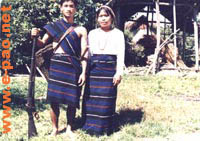
The Mate (pronounced as Ma=maa, te=tay) tribe, approximately 10,000 in
population presently and belonging to the Chin-Kuki subfamily of the Tibeto-Burman
family, was one of the original signatories of the representation submitted
to the then Dewan of Manipur in 1947 and again in 1949 (KNU Memo No. 1)
seeking recognition as Scheduled Tribe in the reorganization of State.
Unfortunately for the Mate tribe, when the final list of Scheduled Tribes
was announced by the Government, they found they didn't find a place in
the official list. The Mates were disappointed that while other smaller
tribes like the Chiru,Chothe, Purum, Ralte, Moyon, Monsang, Lamgang etc.
were given official status, they were left in the cold despite of having
a distinctive social identity and big population.
Then again in 1949 when the State Government made partial modification
to the list. vide the Constitution (Scheduled Tribes Part-C States) Order,
1956 and the Constitution (SC & ST List)(Modification) Order, 1956 the
Mate tribe was set aside for the second time. Disheartened but not undaunted,
the front-runners of the Mate tribe have not let up their relentless pursuit.
Interestingly enough, the word "Mate" is a compound of two words, namely
'mau meaning 'front' and 'te' meaning 'beaters' (the front beaters).
Memorandum after memorandum, representation after representation followed.
A breakthrough was achieved in 1986 when the then Chairman of the State
Committee on Welfare of Scheduled Caste/Scheduled Tribe, Manipur Legislative
Assembly formally recommended the Mate tribe for recognition as Scheduled
Tribe as per provision of the Constitution, subject to modifications.
Nearly a decade later, in February 1997, a response was had from the Government
of India in the form of a written communication of the then Undersecretary
(M.M.I, ah vide No.VPS-18/02/95/6806/3756, dated New Delhi February 24,
1997) in the Vice President's secretariat referring the case of the Mate
tribe to the Secretary in the Ministry of Welfare. For the Mates, the
indication was slight, of course, but it was a silver lining for it gave
fresh hopes of a positive response to the five decades of social injustice.
In April 1997, the issue of recommending more tribes in the Government's
Scheduled Tribe list was brought up in a meeting of the Hill Areas Committee,
HAC of the Manipur Legislative Assembly. In that meeting, Professor Gangmumei
Kamei, then MLA of the Federal Party of Manipur in Assembly, pointed out
the plight of the Mates as depending on others' social identity for their
sustenance. The Committee subsequently resolved to recommend the Mate
tribe for formal recognition to the Government, vide Resolution No.2 of
the HAC meeting on April 25,1997. The stress laid in emphasizing upon
the need to do justice to the Mate tribe was that the tribe has its own
distinctive history of origin, migration and settlement, genealogy and
language, socio-political and religious organizations, culture and customs;
thus qualifying the criteria for its recognition as a Scheduled Tribe
as per provisions laid in the Constitution. Prior to the partition of
Burma from India, affected in the year 1936, the Mate tribe occupied a
large tract of land bordering present-day Myanmar and North East India.
With the demarcation of the international boundary, an artificial separation
was affected by which one third of the entire Mate population remained
on the Indian side while two third remained in Myanmar. An approximate
total population of the tribe in the two countries is estimated at more
than a half lakh.
Spread out in the three districts of Chandel, Churachandpur and Senapati
in Manipur, with forty Mate chiefship villages in these regions, the tribe
has its own well-set social organizations to pull it up in par with other
major tribal communities in the State. Mate functionaries point out that
their tribe had not availed of governmental support- financial, material
- worth the name. A memorandum submitted by the Mate Tribal Union, Manipur
& Assam, to the Commissioner for Scheduled Caste/Scheduled Tribe,
Government of India in May 1970, vide No.MTU/Recognition-2/1970, dated
May 30, the MTU said they spent twenty thousand rupees out of their own
funds in providing education for their children. Whereas, they had not
obtained a single penny from the Government for the same purpose.
The system of governance today, unfortunately, indicates the Mate tribes
have a long wait before their goal is achieved. So long as the Union and
the State Governments continue to dishonor the call of the Mates for social
justice, the tribe is going to suffer economically, socially and politically.
Like the saying goes, the Mates are today relying on the benevolence of
the hands that steers the destiny of a people to obtain rightful justice
- the right to live decently. A painful truth of the system that is well
defined as the largest democratic system in the World.
|