


Agro-Tourism in North East India
Dr Dipak Nath / Dr Daya Ram *
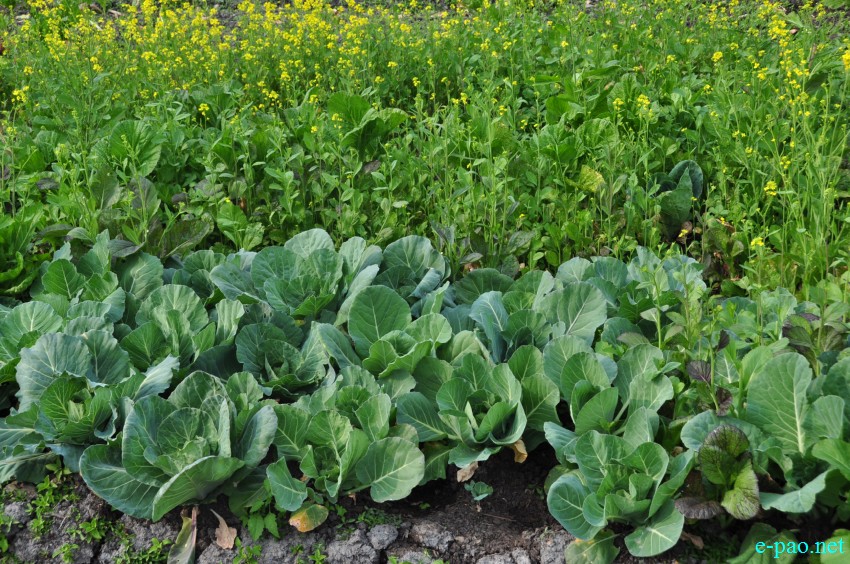
Winter vegetables grown at Thanga as seen on 10th February 2018 :: Pix - Lamdamba Oinam
Agriculture is considered to be the backbone of the Indian economy. Around 85 percent of the population is directly or indirectly dependent on agriculture and allied activities and almost 26 percent of India's GDP comes from agriculture. More than a profession or a business, agriculture is deeply rooted in Indian culture.
Farmers are now enthusiastic to try newer methods away from the typified and orthodox patterns to build relations with the consumers directly and earn extra. Hence, adding on to the agricultural income with some touristic activities is bringing in new hopes and better lives. Serious efforts are now being made in this direction and Agri-tourism is one such activity that fits the bill.
Agri-tourism with its baby steps and the talisman of research can definitely bring changes in the life of farmers and consumers shall also reap the benefits of it. It is considered as a supplement to the primary source of income and caters to a niche market due to its exclusivity. The idea has a novelty attached to it in terms of nostalgia as well as village visits for consumers.
A plethora of diversified activities amalgamated with scientific methods of cropping are paving a way for a mechanized and secure future. The plate is full with offerings like dairy practices, bird watching, wine trails, hay making and local handicrafts to woo the consumers with the simplicity of villagers hooked to it in the background.
Agri-tourism is a form of agricultural multi-functionality. It gives you the opportunity to experience the real alluring and authentic contact with the village life, taste the local veritable food and get familiar with the many farming tasks during the visit. It provides you the welcome break free from the daily busy and hectic life in the peaceful village environment.
It gives you the chance to relax and reinvigorate in the pure natural environment, surrounded by splendid settings. It gives you the chance to see the real India and have the experience on the farm stay holidays. Since agriculture is the main occupation of the people in India and other developing countries, specifically Asian economies, there is a need for these countries to think of allied income generation strategies with agriculture, one of which is agri-tourism.
It is the 'Holidays' concept of visiting a working farm or any agricultural, horticultural, or agri-business operations for the purpose of enjoyment, education, or active involvement in the activities of the farm or operation. In general, agri-tourism is the practice of attracting travellers or visitors to an area or areas used primarily for agricultural purposes. However, agri-tourism is small-scale, low-impact, and, in most cases, education-focused.
Many agri-tourism activities require only a small farm crew in order to be successful. For instance, farm tours, bed and breakfasts, tractor/bullock cart rides, horticulture farms, by-product farms, birds/animal zoos, and many other activities may be operated with little additional investment in labour. India ranks second worldwide in farm output.
Agriculture and allied sectors like forestry, logging and fishing accounted for 15.7% of the GDP in 2009-10, employed 52.1% of the total workforce, and despite a steady decline of its share in the GDP, agriculture is still the largest economic sector and a significant part of the overall socio-economic development in India.
On the other hand international comparisons reveal the average yield in India is only 30% to 50% of the highest average yield in other parts of the world, revealing a low productivity in Indian agriculture. As an important element of the service sector, tourism in India is growing with a contribution of 6.23% to the national GDP and 8.78% of the total employment in India. With this backdrop, the researchers believe that agri-tourism can contribute in a big way in optimally utilizing the agricultural land in India, generate additional income to the farmers and provide employment.
Agro-tourism is the latest concept in the Indian tourism industry, which normally occurs on farms. It is defined as an agriculturally based operation or activity that brings visitors to a farm or ranch. It basically means farm stays where tourists visit and enjoy the farming environment and sometimes also engage in farming activities.
It includes a wide variety of activities, including buying products direct from a farm stand, navigating a corn maze, picking fruits and vegetables, animal rides or staying nights on a farm. An agri-tourism farm represents the hub of a rural network, the place where agri-food products and tourism services meet consumers' demand for delocalization and triggers to motivate further direct business opportunities between tourists and other rural community actors. (Amirato & Felicetti 2014).
Agri-tourism involves agriculturally based activities and attracts tourists to experience the authentic culture of rural societies. It is a unique concept and provides opportunities to the visitors for making a closer look towards the rich culture of rural communities. It has gained popularity in western nations due to its unique and closer link with the natural environment.
Agro-tourism is a business conducted by a farmer for the enjoyment and knowledge of the people, to promote the products of the land and generate additional income from farms. It provides rural experiences to urban populations and economic alternatives to farmers. It can provide economically feasible ways to care for natural resources, natural habitats, natural scenic areas and special places.
The concept of agri-tourism is very simple, whereby the urban tourists go to the farmers home, stay like a farmer, engage in farming activities, understand the local culture, buy fresh farm produce and in turn the farmer maintains home and farm hygiene, sells his farm produce at a better price and earns a livelihood all year round.
BASIC PRINCIPLES OF AGRO-TOURISM
Agro-tourism should ensure the three basic principles:
1. Animals, birds, farms and nature are the few things which agro-tourism could offer the tourist to see. Apart from these, culture, festivals and rural games could create enough interest.
2. Participating in agricultural operations, bullock cart riding, buffalo riding, cooking and participating in rural games are some activities in which tourists can take part and enjoy
3. Rural crafts, dress materials, farm gate fresh agricultural products, processed foods are the few items which the tourist can buy as memento for remembrance.
COMPONENTS FOR AGRO-TOURISM
There are three components which contribute to the success of agri-tourism:
1. Farmer is an important component.
2. Village is the second component. Located far from the city and blessed with natural resources.
3. Rich resources in agriculture namely land, water, plants unique from place to place bringing diversity and creating curiosity.
SCOPE OF AGRO TOURISM
1. Less expensive gateway - The cost of accommodation, food, travel and recreation is very less in agri-tourism compared to any other type of tourism. Present concept tourism is limited to urban and rich class which constitutes a very small proportion of the population. However, the concept of agri- tourism takes travel and tourism to the larger population; this widens the tourist base by widening the scope of tourism due to its cost effectiveness.
2. Have strong demand for wholesome family oriented activities - Villages provide amusement opportunities to all age groups i.e. children, young, middle and old age, female, male, in total to the entire family at a cheaper cost. Rural games, traditional dresses, festivals, food and nature provide a variety of entertainment to the whole family.
3. Curiosity about the farming and farmer lifestyle - Almost all urban populations have roots in villages, so they always have had the curiosity to learn or at least see about sources of plants, plants, animals, raw materials like handicrafts, woods, rural lifestyle and their languages, culture, tradition. Agri-tourism which generally revolves around farmers, villages and agriculture has the potential to satisfy the curiosity of this segment of population.
4. Finding solace with nature friendly means - Present urban lifestyle has made life stressful and brings average life span comedown. Hence, people are in continuous search of pro-nature means to make life more peaceful. Indigenous medical knowledge of villagers must be respected. Ayurveda which is a pro-nature medical approach has its roots in villages.. Organic foods are in higher demand in urban areas and foreign countries. In totality, our health conscious urban population can look towards pro nature villages for solutions.
North-East India is a land of undulating hills and plains with luxuriant green cover and exotic flora and fauna. It comprises eight States namely Arunachal Pradesh, Assam, Manipur, Meghalaya, Mizoram, Nagaland, Tripura and Sikkim. The location of this region is strategically important as it has international borders with Bangladesh, Bhutan, China and Myanmar.
This Region is endowed with diverse tourist attractions and each State has its own distinct features. It is the treasure house of various economic and natural resources. It is blessed with rich culture and ethnic heritage. Tourism has become one of the most important sectors for generating income and employment opportunities in the North East.
Agri-tourism is a new initiative for the development of the tourism industry in the North eastern region. It can change the conventional concepts and views on tourism, and helps in bringing a new dimension in the sustainable development.
The urban population which has roots in villages or even those who have never experienced village lifestyle always has the desire to escape from hectic city life and enjoy some moments in a peaceful natural environment and learn about diverse culture and heritage from different parts.
Agri-tourism has become the new way to fulfil the desire of this segment of population. North east has hills, wetlands, rivers, river islands and also diverse culture from different tribes and communities. Therefore, it will be easier for attracting tourists to agri-tourism spots.
* Dr Dipak Nath / Dr Daya Ramt wrote this article for The Sangai Express
This article was webcasted on February 15 2022.
* Comments posted by users in this discussion thread and other parts of this site are opinions of the individuals posting them (whose user ID is displayed alongside) and not the views of e-pao.net. We strongly recommend that users exercise responsibility, sensitivity and caution over language while writing your opinions which will be seen and read by other users. Please read a complete Guideline on using comments on this website.


