


Language, identity and Meiteilon
Ningombam Bupenda Meitei *
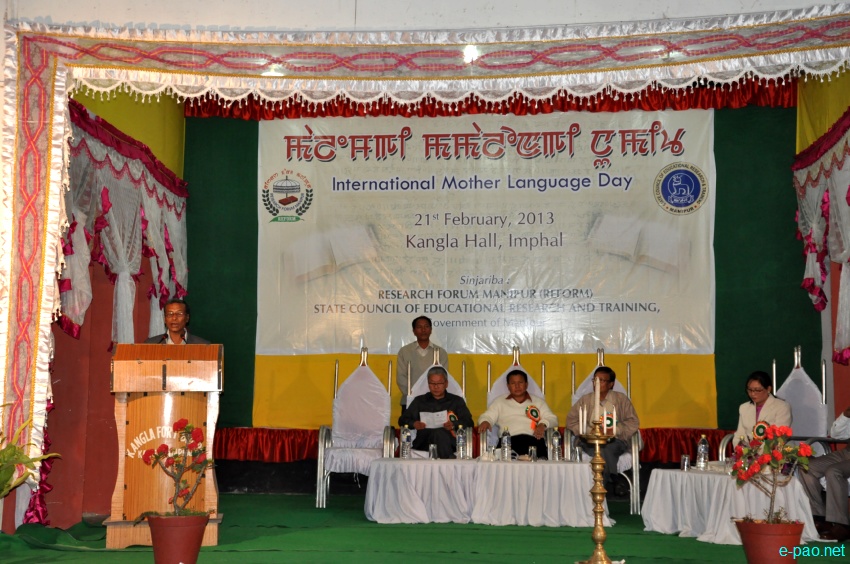
International Mother Language Day at Kangla Hall, Imphal on 21 February 2013 :: Pix - Deepak Oinam
Language and identity have played a significant role in shaping the modern nation-states. Though, in modern days, it is a result of the French Revolution and European Renaissance, the notion of identity and language if not vividly but also did exist in Athenian society. The article makes an attempt to understand the notion of language and how and who determines a language differentiating from its dialects, and also captures the notion of identity. The paper journeys through with an understanding of the language-identity relation through some fundamentals of socio-linguistic and anthro-linguistic schools of thought. It also highlights a small case study on Meiteilon , the official language of the state of Manipur.
Background
Language and identity in today's socio-political world have become so interwoven that either of the two are not only complementary but also cannot exist without the other as the notion of identity in modern world cannot be sufficed without the notion of a language which signifies one's identity. Identity revealed through language is a modern concept born out of European Renaissance and French Revolution as language becomes not only a mere medium to communicate but a pragmatically important tool to control power through nation state, lingua franca in courts and high elitist societies besides running trade and national educational policies.
Since the time of Hellenistic period when Greek is a language from linguistic coverage of the dialects of Athens, the evolution of a language either through convergence or divergence of dialects due to a change of socio-politico-cultural temporal world thereby making a possibility for modern languages like French, English, Chinese, Russian, Japanese of today to flourish as not only a standard language for communication but also as a unique identity to assert their nationality in the modern world of nation states.
The recognition of language and its nation state has become so necessary that in the present working scenario of the international political organizations of the world, the languages of a few nations which are powerful are only accepted as official languages of the organization. Hence, there is a close linkage between language and one's identity which is linked with political, social, economic, cultural equations besides an understanding resulted out of an academic research in the socio-linguistic and anthro-linguistic evolution of the language.
The notion of language
Language when discussed primarily means a language which is linguistically understood as "standard language" determined by a period of time in the time scale of evolution of languages. The definition or making or acceptance of one language as standard language is a complex activity as in doing so or even trying to make an attempt to do so , there would be many other vernaculars or dialects which are potentially strong enough or culturally and temporally matured enough to be linguistically accepted as standard language but instead are sidelined ,hence , the notion of language if discussed as the notion of standard language could only become meaningfully satisfied if the history of the growth of the language is also not discarded.
Thus, history and language cannot be made to fall apart from each other as two differently antagonistic poles. It is difficult to define what language is as today's French language could be unhesitatingly considered as a dialect of Romance by linguists who also do not normally accept the standard language of English as that which is given in OED (Oxford English Dictionary). Americans would be uncomfortable if their English is branded as American dialect, instead they would accept their language to be called as New England accent or Southern accent but never as an American dialect because Americans use dialect to refer to low class or rural speech. Which English is to be considered as standard English is not merely an empirical question but also a socio-anthro-linguistic inquiry to know whether English spoken in London central or in Ireland or in Manchester is the standard one. Whether French is the standard language and patois as its dialect, who will decide it and how will it be done?
Structurally for a language to have its dialect is different from functionally a language has its dialects, as in the case of French dialects, they are structurally regional like Greek but not functionally like it. The structural making of dialects connotes the need of understanding the growth of convergence of the dialects to form the language but the understanding of the functional significance of the language carries a temporal political and social conditions which are also not alien to cultural practices and economic based innovations of changing the language styles either in terms of its spellings or pronunciations or accent morphologically and internally also such as syntax like word order in the case of Thai language having a SVO (subject + verb + object ) order after being heavily influenced by its colonial master of English .
So, whether to accept the language spoken by the high elitist classes of a few in population from London metropolitan in the case of English or to accept a politically crafted and diplomatically tackled language like Malay instead of making Javanese to be the official language or the national language of Indonesia , requires the understanding of a language to be acceptable or not in a society or nation. Thus, there is a form of matrix which is followed for a language to grow and the matrix exists in the form and the function of the language in terms of its selection followed by codification and in turn, considered for elaboration and acceptance.
Even in the teachings of Buddha, Sanskrit was not used by him but Pali was used despite Sanskrit being an esoteric language meant for intellectuals because to communicate with the masses, he needed Pali and thus, it proves that language also needs acceptance which is the last stage of the said matrix form. Despite Hindi being the one of the official languages of India, even today in the Hon'ble Supreme Court of India, the arguments and paper works are all done in English and even politically chosen, the first Prime Minister of India Pandit Jawahar Lal Nehru gave his Midnight speech of an independent India in English, signed the oath taking of the Prime Ministership in English but used Hindi to communicate with the masses and thus, it also shows that depending upon the acceptance of language by whom, the functionality of it also differs.
The notion of language remains a complex inquiry to not only define but also assess as one's dialect in the past has become today's language and no one knows that today's language may also become tomorrow's dialect or vernacular.
The notion of identity
Identity whether to be understood as cultural identity or linguistically governed geographical regional identity creating isoglosses or political identity or macro sociological identity or religious identity or ethnic identity or economic class identity or high versus low class identity in terms of elitist class versus common masses or nation-state identity born out of French Revolution against the rule of feudalism and kingship, which also has gone against the kinship and rural village bonding of man, is a complex manifestation out of the intricate web of relationships of constraints such as political , economic, social, cultural and ideological variables conditioned by the changing time and space of the society, nation and the world.
To study such ever changing phenomenon by socio-linguists or anthro-linguists are though no sufficient to develop a holistic understanding of what an identity is but nevertheless, their attempt to de-codify the mystery of identity in today's modern world of politically rigid but economically porous nation states being backed by the facts of the human civilizations of the past, has made the study of identity and its revelation through language not only possible but also more easier.
The notion of identity makes sensible when there is a concept of sameness of the speakers of the language while dealing among themselves and a concept of difference when they encounter an outsider with a language different from theirs and hence, sameness and difference mark the vivid boundary to some extent of identity. Identity becomes an issue when determining a dialect to be a language or not and after the determination of it, one that becomes subordinate to the other becomes the dialect of the latter and hence, the latter becomes the language and the former, the dialect of the latter.
To build a nation-state also needs to have a national language not only for communication but also to govern the nation centrally by the state. The breakdown of the then Soviet Russia to smaller nations like Yugoslavia and Czechoslovakia , the struggle of Irish Republic from the United Kingdom, the conflict between Bantu and Nilotic tribes of Uganda , the partition of the British India into Pakistan and further Bangla speaking Bangladesh are the consequences of the changing temporal political identity conflicts.
The creation of two official languages of Norway in the form of Norwegian influenced by Danish language spoken in Oslo and Nynorsk or New Norwegian spoken by rural people of the western part of Norway, is an example to understand the gravity of identity through one's language. It also reflects the notion of nationhood to have its own language to differentiate its nationals from other nations' but contrary to this, Switzerland has three languages and all of them come from outside the state of Switzerland and the similar case also can be found in Belgium where it has two languages from its neighbors, thus the notion of nationhood is also not necessarily to be governed only by one's own language meant for the nation from where the language must spring out.
Despite having many colonies of the world being influenced by their former colonial masters such as English, Dutch and French , there are nations in the post colonial world after the world wars which have tried to de-educate the past education influenced by the colonial rulers and then to re-create and reeducate the masses particularly the children in schools and academia. Even, there is an attempt for an internal cleansing of language through state machinery by constitutionalising it, but the costs become the factor of decision for the state. Nations like Finland and Israel have started developing their languages seriously in 19th and 20th century respectively.
The understanding of an assertion of one's identity is very crucial as it is the source of making one's dialect a language by subduing other dialects which may be capable of replacing the proposed language, thus identity plays an important role in shaping the life of one's language.
Language � identity relation
Having been made an attempt to understand both the notion of language and identity since from Athenian days to today's modern world of nation-states, it is analytical to comprehend a possible relation between language and identity and if the relation exists, how does the relation exist and why it has to exist?
To answer the above question, it is essential to have an analytical logical argument asking a few more questions like , what has happened to the status of standard Dutch in Norway , whether Parisian
French shall be accepted as the standard French, why is that the courts from Paris to Moscow use French at some point of time in the past, how strongly English and French have made influence to underdeveloped languages of their colonies which have become developed languages according to the yardstick of colonial rulers' mindset, why despite having elitist's influenced Javanese, Malay has been recognized as the official language of Indonesia and Sanskrit being kept as a language to understand Indonesian Indic culture, and why during the reign of King Ashoka , a multi-lingualism was practised.
Understanding the questions above would mean to know some fundamentals of socio-linguistic and anthro-linguistic schools of thought out of which, some of them have been discussed here, such as the notion of power, identification, practice, ideology, performance, authorization and illegitimation.
Power is crucial to be used by the state as a machinery to constitute and legalise an authority or legitimacy for a language to flourish and grow with acceptance for which the acceptance is treated as a national obligation. Identification of a language to be the national language is significant for a nation-state to run efficiently and effectively. Practice of the language so identified by the power of the state through a constitutional mechanism, is done through national educational systems, scientific institutions, academia and other intellectual activities like literary and cultural indoctrination besides creating a sense of literacy of the language both in written and spoken. Ideology is a word which has become functional to usage since the time of Karl Marx, the notion of ideology becomes the source of inspiration for the providers of the information and knowhow of the language and ideology is often controlled by the ruling elites who form or greatly influence the political class of the nation.
Authorization of a language to be an official language may have suppressed so many other languages and other vernaculars and the process of authorization in modern nation-state is politically deeply calculated. By acknowledging the authorization of the language, there is an understanding of perceiving the remaining languages or underdeveloped languages in the eyes of the national language or vernaculars to be illegimate to be used as an official language or to make an impact to challenge the authorization of the authorized national language. Thus, there is a close intertwined relationship between language and identity. The classic example of such a relationship is endorsed by the Indian Constitution in the form of creating Indian states based on linguistic states. The relationship has shown many optimistic developments and critical conflicts which also have become politically hostile in some issues in present modern day Republic of India.
Meiteilon: a case study of language-identity relation
Meiteilon is a language with script since a historical recording of royal kings in 33 A.D. from Cheitharol Kumbaba ( Cheitharon Kumpapa , in early Meiteilon pronounciation ). The language spoken by Meiteis since history known through writings, is also a state governmental language of Manipur besides being a lingua franca of all the communities whether tribals or non-tribals such as Nepali and even outsiders (those who are not the indigenous people of Manipur) who have come to do small business and trading in Imphal such as Marwaris and Punjabi Sikhs, etc.
Meiteilon as once called but nowadays usually replaced by another word 'Manipuri' which appears to be a synonym, is again caught in a political net which is further complicated by today's evolving social conflicts in the state. The argument is, if linguistically followed in a field of academics, then 'Meiteilon' is ought to be the best possible word to symbolize in letters as the language spoken by the people and the particular people who originally have been speaking the language which is Meiteilon are Meiteis and thus, they being the original speakers who are also speaking the same language as of today shall without any doubt be given a status of coining the name of their own language and if that is accepted, then it is expected to have no problem when the language is called 'Meiteilon' instead of 'Manipuri' which is the name recognized by the Constitution of India in its 8th schedule of modern Indian languages as it stands today.
The identity of Meiteis in particular which has been diffused with the arrival of Hindu religion and the change of Meitei script to Bengali script by the royal imposition of the then King Pamheiba of Manipur who got converted into Hinduism (Chaitanya's school of Vaishnavism) in 1717 under the influence of Shantidas Adhikari also named as Shantidas Gosai through burning of ancient Meitei texts in the royal palace in 1729 , has been made to revert back to the old Meitei script in a socio-cultural revivalism even to the extent of burning books written in Bengali script by burning Manipur State Central Library, Imphal (which is next to the Raj Bhawan of Manipur) which was considered to be the source of books predominantly written in Bengali script.
Just like Hebrew being made to come back to life again anew by the Jews, Meiteis have projected their old lost script to be re-enlivened to assert the sense of identity which is the identity which has been recorded in written history for almost two thousand years and the assertion of such identity has come in an intricate relation with language namely Meiteilon. Thus, Meiteilon which is also spoken in Assam, Tripura (the language used in the then royal court of Tripura kingdom), Burma and Bangladesh besides Manipur for centuries has become an unshakable identity for the Meiteis in particular today.
The role of literary activities and cultural and religious practices in Meiteilon besides making it compulsory in curriculum in state run schools and CBSE schools except Kendriya Vidyalayas, opening its research and doctoral level studies in Indian universities and also by changing the script from Bengali to Meitei script, the Meiteis and the state of Manipur today cannot be considered to be not proud of the language called Meiteilon.
Having known the historical and social facts, it would be premature to judge the assertion of a Meitei language or Meiteilon as merely a political make-up; instead the reprojection of the language is to be viewed differently from viewing the Meitei as people. Often, it is found that more than criticizing a writing, the writer which is the personality gets criticized and hence, the desire to criticize the personality of the writer overshadows the expected criticism of the contents of the writing, such similar intention could though prejudicedly be posited but the real dilemma lies in hairsplitting the difference between criticizing a language and its speakers, as one's dislike of the speakers does not necessarily and sufficiently entail the dislike of their language used because that would encourage the building up of illogical argumentation to superficial appearance of deception based on subjective interpretation instead of analyzing what the truth given by the language per se really is.
Conclusion
The study of the language and identity relation clearly shows the intricate and complex equation which is shared between the two and to solve such a complex equation, there is a need to understand the fundamentals of the socio-linguistic and anthro-linguistic schools of thought which are governed by the conditionalities of variants like social, political, economic, cultural, etc. which are also time and space bound in the discourse of human civilization.
* Ningombam Bupenda Meitei wrote this article for Hueiyen Lanpao (English Edition)
The writer is a junior member of St. Stephen's College, Delhi currently mastering philosophy in Department of Philosophy, University of Delhi
This article was posted on March 10, 2013
* Comments posted by users in this discussion thread and other parts of this site are opinions of the individuals posting them (whose user ID is displayed alongside) and not the views of e-pao.net. We strongly recommend that users exercise responsibility, sensitivity and caution over language while writing your opinions which will be seen and read by other users. Please read a complete Guideline on using comments on this website.


