|
Born in obscurity, spotted by civilization, Polo became
a World sports by proxy. Though this majestic game had always been an
integral part of the Manipuri ethos, it was the Britishers who actually
gave it a place under the sun.
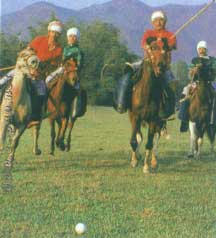 The dawn of 18th century saw historic cultural interaction between the
ever expanding British Empire and the slit eyed Mongoloid race of the
landlocked Manipur. The Surma Valley became the meeting ground of the
two cultures. After their devastating war with the Burmese, the Manipuri
princes, Chourajit, Marjit, Gambhir Singh and Nar Singh were staying at
Cachar. Incidentally, under the aggressive rule of the British Empire,
Cachar became a frontier territory of the colonial British India. There,
in the lush green plains of Cachar, the Britishers saw the Manipuri princes,
with their ever present retinues, either practising at one time the battle
exercises on horse back with swinging dart of Arambais or at other times
playing a strange game of hockey on horse back, swinging a mallet with
equal gusto. Strange was the habit of the Manipuris who never left their
little ponies either in war or in peace. In their war cry, the Britishers
saw a formidable ally in the Manipuris and signed the treaty of alliance
with Gambhir Singh and formed the famous Manipur Levy.
The dawn of 18th century saw historic cultural interaction between the
ever expanding British Empire and the slit eyed Mongoloid race of the
landlocked Manipur. The Surma Valley became the meeting ground of the
two cultures. After their devastating war with the Burmese, the Manipuri
princes, Chourajit, Marjit, Gambhir Singh and Nar Singh were staying at
Cachar. Incidentally, under the aggressive rule of the British Empire,
Cachar became a frontier territory of the colonial British India. There,
in the lush green plains of Cachar, the Britishers saw the Manipuri princes,
with their ever present retinues, either practising at one time the battle
exercises on horse back with swinging dart of Arambais or at other times
playing a strange game of hockey on horse back, swinging a mallet with
equal gusto. Strange was the habit of the Manipuris who never left their
little ponies either in war or in peace. In their war cry, the Britishers
saw a formidable ally in the Manipuris and signed the treaty of alliance
with Gambhir Singh and formed the famous Manipur Levy.
In the strange game of hockey on horse back, the Britishers equally saw
the potential of a latent sporting possibility. They saw, they learnt
and the first Polo Club of the world was born at Cachar in 1859. When
the Marques of Ripon said "it is a small State (Manipur), probably until
these events took place very little known to your Lordships, unless, indeed,
some of you may have heard of it as the birth place of the Game of Polo,"
during the house of Lords of debate on Jubraj Tikendrajit's trial on 22nd
June 1891, he paid a glowing tribute to the Manipuri pioneers of polo.
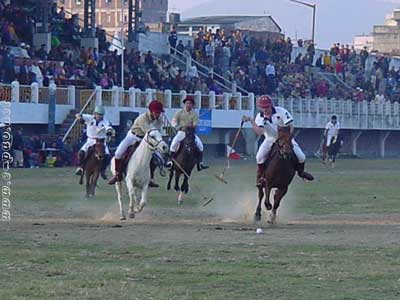 The Guinness Book of Records in its 1991 edition on page 288 writes "Polo:
Origins: Origins of Polo can be traced to origins in Manipur State c.
3100 B.C. when it was played as Sagol Kangjei". The earliest club was
the Cachar Club founded in 1859 in Assam, India. The oldest Polo Club
in the world still in existence is the Calcutta Polo Club (1862). The
game was introduced in England from India in 1869 by the 10th Hussars
at Aldershot, Hants and the earliest match was the one between the 9th
Lancers and the 10th Hussars at Hounslow Health, Greater London in July,
1871. The earliest international match between England and the USA was
in 1886. The game's governing body is the Hurligham Polo Association,
which drew up the first English rules in 1875.
The Guinness Book of Records in its 1991 edition on page 288 writes "Polo:
Origins: Origins of Polo can be traced to origins in Manipur State c.
3100 B.C. when it was played as Sagol Kangjei". The earliest club was
the Cachar Club founded in 1859 in Assam, India. The oldest Polo Club
in the world still in existence is the Calcutta Polo Club (1862). The
game was introduced in England from India in 1869 by the 10th Hussars
at Aldershot, Hants and the earliest match was the one between the 9th
Lancers and the 10th Hussars at Hounslow Health, Greater London in July,
1871. The earliest international match between England and the USA was
in 1886. The game's governing body is the Hurligham Polo Association,
which drew up the first English rules in 1875.
The antiquity of Polo in Manipur is shrouded amidst cobwebs of myths and
rituals. Ponies figure prominently in Manipur mythology and have an undeniable
presence in the social life of Manipur. In the History of Manipur, ancient
Manipuri literature gives an account of the role of ponies in the myths
of Manipur. The book 'Ougri' writes - "After completion of creating the Earth by Ashiba, his father, the Almighty God, Atiya Shidaba asked his brother Apanba to create human beings to own the Earth. Apanba who was
also known as Konglouton Louthiba, in consultation with his wife Leinung
Chakha Khongjombi started plantation of beans on Earth. Ashiba became
jealous and created Shamaton Ayangba (the first Pony) to destroy Apanba's
creation of human being and their agricultural works. Apanba then fought
with Shamaton Ayangba and his wife Leinung Chakha Khongjombi helped him
in his conquest. Later, they cut off the wings, mane and fur of Shamaton
Ayangba and tamed the pony to be used by the humans".
It is associated with the God of the Chenglei tribe, Marjing, to whom
the stick along with the ball, are still offered in worship. The traditional
Lai Haraoba Festival of Manipur has a sequence dealing with the search
of bride (Lai Nupi Thiba) on the part of Maibi (Priestess) with the Polo
Stick in hand. There are several mythological books of Manipur like 'Thangmeirol'
and 'Kangjeirol' (Art of Polo) which support the great antiquity of this
game.
Historically, according to Kangjeirol, a treaties on Manipuri Polo, king
Kangba who reigned Manipur much earlier before the birth of the Christ
introduced Sagol Kangjei, that is the "Polo" game. The book Kangjeirol
writes - "During a festival known as Ukrong Hongba, Kangba, the king of
Manipur showed a skill of dribbling a bamboo root club by his walking
stick on the ground. He asked his subjects to play this game on horse
back next the day. Accordingly, his subordinate officers along with common
men, after having lunch thrown by the king, came out in new dress to the
venue of the festival with their ponies and started playing the game as
introduced by the king. The game was witnessed by the queen, Leima Tanu
Sana sitting under a royal canopy amidst huge crowd. Deriving from the
name of the king Kangba the game was known as Sagol Kangjei. Sagol means
horse or Pony. Kangjei means Kangba's stick.
The Royal Chronicle of Manipur, Cheitharol Kumbaba, gives an account of
a Polo match between the friends of Ngonda Lairen Pakhangba who ascended
the throne of Manipur in 33 A.D. On that occasion he introduced his queen
Laisana to the royal crowd as a proof of his marital fidelity to her.
The game was played with seven players a side. The name of the players
who played on the occasion and their respective positions are as follows:
| SI. No. |
Team
facing the South |
Fielding
position |
Team
facing the North |
| 1. |
Marjing |
Pan-ngakpa (Full back) |
Thangjing |
| 2. |
Khamlangba |
Pan-ngakchang (Half back) |
Khoriphaba |
| 3. |
Irum Ningthou |
Pallak Chang (Mid-fielder) |
Wangbaren |
| 4. |
Ikop Ningthou |
Langjei (Centre) |
Yangoi Ningthou |
| 5. |
Irong Ningthou |
Pallak Chang (Mid-fielder) |
Mayokpha |
| 6. |
Nongshaba |
Pangjeng Chang (No. 2 forward) |
Oknaren |
| 7. |
Panthoiba |
Panjenba (No. l forward) |
Loyarakpa |
Records are also available that in early days Polo was
played by more than seven players in either of the side. In later years,
Lord Curzon, the then Viceroy of India who witnessed a Polo match at the
Imphal Polo ground during his visit to Manipur in 1901, in his "Viceroy's
Note-Book" wrote : "The number of players was indeterminate, the correct
number being from seven to nine a side, though there was no limit. The
game that I saw was one of the ten a side, and it was preceded and followed
by a ceremonial which undersignedly illustrated the Chinese origin of
local game and the earliest Chinese connections of the State. Before the
play began, the ten players lined up in front of me, as representative
of the King-Emperor of India, and prostrated themselves at full length
on the ground, twice striking the soil with their foreheads; the same
homage was repeated at the close of the encounter".
According to Cheitharol Kumbaba, king Khagemba of Manipur introduced Pana
Sagol Kangjei in 1606 which are played between the four Panas of higher
status and also between the two Panas of lesser status. The Panas of higher
status were Laipham, Khabam, Ahallup and Naharup. Two Panas of lesser
status were Hidakphanba and Potsangba.
Each team of the Pana (a social institution of Manipur) was given a particular
colour of uniform for games.
| Higher Status Panas: |
| 1. |
Laipham Pana |
- |
Red colour shirt |
| 2. |
Khabam Pana |
- |
Green colour shirt |
| 3. |
Ahallup Pana |
- |
White colour shirt |
| 4. |
Naharup Pana |
- |
Yellow colour shirt |
| Lesser Status Panas (Pana Khumei): |
| 1. |
Hidak Phanba |
- |
Black colour shirt |
| 2. |
Potsangba |
- |
Blue colour shirt |
No Polo game could be played between a Pana of higher
status and a Pana of lower status. When the selected player's form Laipham
Pana and Ahallup Pana made a combined team and played against the selected
combined team of Khabam Pana and Naharup Pana, the Polo match was known
as Chere-Kare.
RULES FOR MANIPURI POLO (Pana Sagol Kangjei)
Player:
(a) He or she must be a good rider.
(b) No left hander is allowed to play Polo,
Pony:
(a) No defective pony is allowed to play Polo.
(b) Pony should be healthy.
(c) Polo can be played on ponies of any height.
* Manipuri pony is a typical animal (one of the four recognised Indian breeds of the horses of the World) with a height between 11 and 13 hands high (1 hh-4 inches), short back, good shoulder and well developed hind quarters. It is a sure footed and sturdy, alert head, deep girth, high set tail and long endurance animal.
Composition of team: A Polo Team is comprised of seven players with their ponies.
Pologround: Size of the standard pologround is 160 Sana Lamjei long and 80 Sana Lamjei wide, (A Sana Lamjei is equivalent to six feet) rectangular in shape and turfed one. However this game may be played in smaller field also to suit the local condition.
Size of ball: The size of a Polo Ball is about 100 mm. in diameter and about 150 gms. in weight and it is made of well seasoned bamboo root.
Polo Stick: The mallet or the Polo stick is made of seasoned cane which is about four and half feet long, having a narrow wooden head (about eight inches long) fixed on its top at an angle of about 45 degree approximately. The portion of handle of the stick is covered by colourful cotton threads.
Players' Dress: Polo players wear Pheijom (Dhoti), may be cotton or silk, but the dhoti should be weared above the knee. The player should wear a Kokyet (Turban) on the head fixed by a chin strap known as Khadangchet and a traditional jacket with short sleeves.
No shoe is used but to protect the ankles, the players use a piece of leather or thickly folded cloth known as Khuning Khang that is bandaged by a long narrow piece of cloth around the ankles. In between the knees and ankles players use Pads or thick leather as the guard of shins and calves known as Khongyom that is also fastened by straps. Colour of the shirt or jacket and chin strap or Khadangchet should be according to their respective Pan a colour.
Saddlery: Manipuri Polo players bestride very heavy and clumsy traditional Manipuri saddles with high projecting pummel and candle. Curved flaps of mithun or buffalo skins are suspended from the saddle on both sides of the mount so as to protect the legs of the players which are already covered by legions reaching from ankle to the knee. Ponies are also well protected by the flaps of leather as well as by the big round balls of colourful soft cotton suspended from their heads and backs which look like the ornaments for the animals. A leather whip is carried by the player in his left hand. Rest of the saddlery items are almost all the same as of the common use.
Duration of Game: In traditional Manipuri Polo, there is no fixed duration of time of a match. It is according to the number of goals to be scored as fixed earlier by the rival teams before the start of the match. But, in no case the goals should be less than seven. If the number of goals fixed earlier cannot be scored in a day, the match may continue on the next day or the other. In a challenge match, if a team scores the stipulated number of goals against their counterpart the team may declare at their wish that the match is ended.
Start of the Game: The Referee or Huntre Hunba will call out the mounted players in the midfield and ask them to line up. The Huntre Hunba will throw the ball upward as high as possible in the air shouting 'Huntre' to indicate the start of the match and he has to come out quickly from the playing area. Huntre Hunba is done after every goal is scored.
Half time of the match: There is a change of sides known as Pallonba when half of the stipulated goals have been scored by any team in traditional Manipuri Polo game.
During the half time of the match there is Pot Lanba meaning presentation of sweets, fruits, other eatables and flowers by the Polo fans, women folk and villagers to the dignitaries who witness the match and the Polo players. There is great merriment.
Foul: Earlier there was no definite rules regarding foul in the traditional Manipuri Polo. For example, when the ball is thrown in the mid air by the Huntre Hunba or by linesmen, the players are at the liberty to catch the ball by hand or strike the ball by Polo stick before it reaches the ground. A mounted player is allowed to pick up the ball from the ground if he can get the ball to roll up the mallet by a flick of hand and catch the ball in hand and carry the same to the goal line before he strikes it by throwing in the air towards the goal line. There is no restriction to the player regarding his right of way so long as he is in control of the ball.
Sir Churachand Singh, the then king of Manipur in 1928 forbade 'Sagoltupnaba' or crossing the right of way and 'Hairou' or deliberate striking and hooking the opponent's stick above the height of the ponies or across the opponent's pony. These are the fouls prevailing in Manipuri Polo.
Replacement of Player: There is no restriction to replace a mounted player during the match. It is done according to the desire of the team management.
Score: In traditional Manipuri Polo, there is no goal post. A goal is scored by a team when the ball crosses the end lines of width of the field. The score of a goal is formally announced by the blow of conch or by striking a bell or gong.
Final Authority to settle dispute: If a Polo match is to be played, there should be someone whom the people respect and who could decide when there is any dispute during the match. That very respectable person should be the "Kangburel", final authority of the particular match. Usually, Pana matches are played before the Ruler so as to solve any dispute.
Polo Season: The game of Polo is interwoven with the ancient cult of Manipuris. Some ritual meanings are attached to it. There is certain period in a year when the Polo game is forbidden to play. It cannot be played in the period of 'Laicheppa' (June or July) to 'Lai Lengkhatpa' (September or October) in a year. Thus, the Manipuri Polo season starts from October and ends in the month of June of the next year which covers eight months in a Polo season.
|