
TODAY -

When river swallowed their banks

R.K. Birjit Singh *
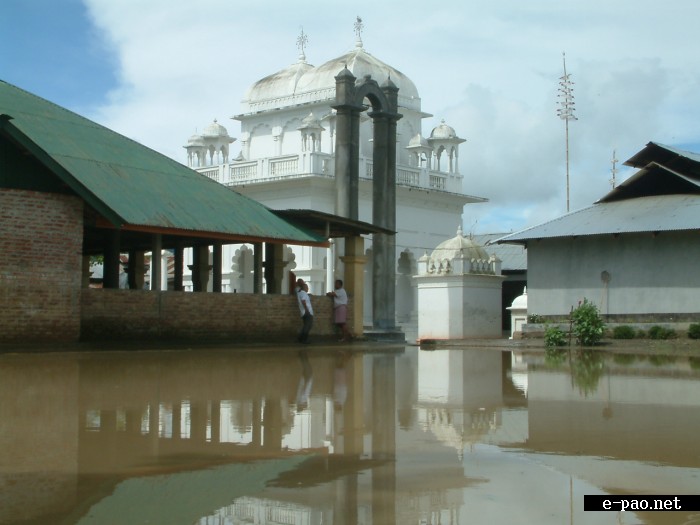
Flood And Drought in Manipur


Water hits the headlines of print and electronic media under two conditions. Number one, when there is not enough of it and secondly, when there is excess of it, what is known as flood and drought. Whenever, there is flood and it is to be followed by drought. The river flood associated with the valley areas of Manipur are due to the heavy rainfall over the catchments and the vanishing of a number of wetlands.

The frequent landslides in the hills upset the regime of the river and the rivers use to carry considerable amount of silt and have a tendency to change their course. The forest in the catchments areas of the river and streams are the most single crucial factor for controlling landslides, flood and drought condition of an area. The green vegetation of the forest protects soil erosion from the action of the rain and absorbs rainwater and releases it slowly over a period of time thereby preventing flash flood and drought.

The forest area of the state is 17,418 sq. km (FSI, 1997) which means that 78% of the land is under forest cover. But this forest cover data remains in the book whereas the green lungs of the state is vanishing at an alarming rate of 78.5 sq.km annually which is much higher than the international trend of 13 million hectares per year and another 27% of the forest i.e 4702.86 sq.km is under Jhum cultivation.

Flash floods are floods of short duration with a relatively high peak discharge. They arise from the local precipitation of extremely high intensity and mostly in the sub-montane tracts. The river washes away the flood plains when the discharge is nearer to or above the danger level. The water spills over the embankments and flood plains through breaches.

People of the valley areas of Manipur welcome a low and medium flood of short duration because the floods use to flush the garbage's of the rivers like as they have converted these streams and rivers as dumping site of their domestic waste. These small river and streams which is the life line and nerve of the people of Manipur are dried up due to the indiscriminate deforestation in the catchments areas and their carrying capacity has been reduced to a drastic level and are either converted into nala or drain.

As the carrying capacity of these rivers has been reduced during high floods the floodwater enters through breaches into the doabs, interfluve areas and fill up the low-lying areas. Sometimes flood water remains stagnant for weeks together damaging the crops and houses and invites water born-diseases.

Flood fill up the wells and community ponds with muddy water and brings a serious crisis in the drinking water situation along with the collapse of houses of mud and wood leading to human causalities and death of domestic animals.

It not only damage property and endangers the lives of humans and animals, but has other effects as well. Rapid runoff causes soil erosion as well as sediment deposition problems downstream. Spawning grounds for fish and other wildlife habitat are often destroyed. High-velocity currents increase flood damage; prolonged high floods delay traffic and interfere with drainage and economic use of lands. Bridge abutments, bank lines, sewer outfalls, and other structures within floodways are damaged, and navigation and hydroelectric power are often impaired. Financial losses due to floods are commonly crores of rupees each year.

Control of Floods:

The basic methods of flood control have been practiced since ancient times. These methods include reforestation and the construction of levees, dams, reservoirs, and floodways (artificial channels that divert floodwater).

Although dams have been used for many centuries, their primary purposes were to build up water reservoirs for irrigation and other domestic uses and to create power. Only recently have they been constructed specifically for flood control.

The Hoover Dam on the Colorado River, the reservoirs in the Miami Conservancy District, and dams of the Tennessee Valley Authority (TVA) have demonstrated the value of this method. When the tributaries on which these dams are located are at their normal level, the dams operate solely to produce power and provide water for various purposes.

During time of high water the dams operate to slow down the flow. The dams closest to the origins of the tributaries restrain the floodwaters while the dams farther down slowly release their normal reservoirs and are drained. Then the floodwaters are released to each succeeding dam and are finally emptied into the main river, the capacity of which has been increased by straightening and deepening.

Through the centuries people have created a flood problem by cutting down trees and digging up the vegetable cover of the soil, thus increasing soil erosion. Cultivation decreases the ability of the soil to retain water and increases runoff. Vast land areas along the headwaters of rivers throughout the world have been laid waste by intensive Jhum cultivation and subsequent erosion. Flood control in these areas has been directed to restoring vegetation and instituting efficient methods of soil management, such as crop rotation and contour plowing.

Another method of flood control is the construction of floodways on the lower reaches of rivers to divert floodwaters. The rivers are widened at certain points and allowed to overflow. Inundation of certain confined areas prevents the flooding of other areas. The Egyptians have used regulated flooding for thousands of years. Many areas in the Nile Valley depend for their continued fertility on periodic flooding because the soil deposited by sedimentation from floodwater is very rich.

When the people are suffering from flood, the Ministers, MLA's and concerned officers along with the district administration are very happy secretly within their mind.

Because, at least some crores of rupees is going to be released in the name of flood. In beginning they will shout rhetorically like the roaring forties and will suspend and transfer some of his subordinate officers only to siphon the amount mean for flood relief in their ever thirsty and greed pocket. The real relief of the affected people will be distributed only through AIR or DDK. This is not a new think in this trouble torn state of Manipur. After all, our netajee's and officers are expert in fishing in trouble water and is a part of our rich tradition and culture.

Sometimes, the logic of our planners and wisdom of the Government is strange and wonderful. They will be alarmed only when the flood breached the embankments of the river and engulf the mass population and their croplands. The flood cycle is known to the people of Manipur. Flash flood during the month of May and June do not cause much damage but during the post monsoon season brings severe damage to the valley area. Then, why we do not have a proper long and short term planning for flood control measures in Manipur.

Implanting bamboos to protect the banks and raising their level will not solve any problems of flood. As we make higher and higher the level of river bank, subsequently, the river bed will follow the trend.

The ancient Chinese built levees to raise the banks of the Huang Ho (Yellow River) on the supposition that the confined river would then deepen its channel to contain the maximum flow. The result, however, was a raising of the riverbed, because the sedimentary deposit of alluvial soil previously distributed over the entire flood plain during annual flooding was confined to the river bottom. In 80 years the level of the river rose as high as 21 m (70 ft) above the surrounding plain. In 1887 one of the worst floods in recorded history occurred when the Huang Ho broke through the levees, killing more than a million people.

We need a master plan home work, if we are serious enough to control flood. Let us make use of our rusted compass laying unused for decades in the department and make a joint coordinated tour and trip of IFCD, PWD, PHED, Forest and Environment and Horticulture department including DST to the catchments areas and riverheads where our brothers are leading a hard life.

By making a proper contour and survey with involvement of the people of the area let us construct co-ordinated groups of small dams and reservoirs on the headwaters of the streams that lead into the main rivers, so that water can be stored during periods of heavy runoff and released gradually during dry seasons.

The Public Health and Engineering Department will do the job for taking up water supply schemes from these dams for the surrounding villages, Electricity department to see the possibility of installing micro-hydel project to electrify the villages, Forest department to take up income generating plantation programmes like, Seri, Eri, medicinal plants and reforestation with the horticulture department. The PWD will increase the connectivity of surface transport. Forget about the flood in the valley, it will solve 60 percent of the issues and problems which tore apart the valley and hill.

Inadequate policy and regulations, combined with non-transparent and non-participatory process is at the root of many of the water and flood management problems plaguing the state. There are very limited resources in the Govt. system for quick and effective flood and other disaster response. In absence of a risk assessment, vulnerability analysis and community need assessment; flood relief and disaster mitigation activity at the district, state, block and community level becomes what the disaster managers at different level perceive.

There is no disaster management information system at any level of governance in Manipur. In the absence of such a system, the disaster management is operating on information, which is neither reliable nor authentic. There is a need for community resource mapping which can play a vital role in resource mobilization for disaster management at the community level. There is a need to evolve a state specific management policy not only for flood but for the entire natural and man made disaster to address the indigenous situations of the state.


* R.K. Birjit Singh is a frequent contributor to e-pao.net . The author is a science communicator, member of the investigating team of the ongoing "Loktak Bird Study and Research" under the Wild Life Wing, Department of Forest, Govt. of Manipur . The writer can be contacted at bsningthemcha(at)gmail(dot)com
This article was webcasted on July 20 2011 .


* Comments posted by users in this discussion thread and other parts of this site are opinions of the individuals posting them (whose user ID is displayed alongside) and not the views of e-pao.net. We strongly recommend that users exercise responsibility, sensitivity and caution over language while writing your opinions which will be seen and read by other users. Please read a complete Guideline on using comments on this website.


LATEST IN E-PAO.NET
  • Candle Light- Chongtham Vikram : Gallery
  • Violence in Manipur 2023-2026 : Timeline
  • Manipuri Pony Heritage Talk to Students
  • Souls with no sacred flame :: Poem
  • International Primate Day 2026
  • Misuse of Tapentadol: A grave danger
  • North East Creator Circuit 2026
  • Memorial Service for Nimananda Das
  • Clean chit on Sept 3, suspended on Sept 8 !
  • Presenting the reality to Delhi
  • Colonial records: Hill Areas, 1891-1947
  • Joint Resolution: Abrogation of SoO
  • NRC in Manipur : Time for 'walk the talk'
  • Elimination of Racial Discrimination
  • Manipur after conflict: Shared hope
  • Condemn Arson at Lhungjang Primary School
  • International Literacy Day 2026
  • Demands Abrogation of SoO
  • Decision to stay away from Assembly
  • Justice for 6 Liangmai Nagas #1 : Gallery
  • Manipur Can Simply Be Manipur
  • PhD Admission at Assam University
  • What delimitation could mean for Manipur
  • The puppet :: Poem
  • International Peace Poster Contest
  • Electoral Rolls of Senapati published
  • Bringing eco activity to a halt
  • Exploring The Vanishing Self #9
  • Teachers' Day Celebration : Gallery
  • Census 2027 for Manipur deferred
  • Somehow, We Continue :: Poem
  • Limping towards normalcy : Manipur Today
  • MoUs with 14 Institutions signed
  • Read Meitei Mayek news in romanized English
  • Tracing the evolution of territorial boundaries
  • Natural Farming through Rice-Water mimosa
  • Demands Justice in May 13 Massacre
  • Monsoon handcare tips for this rainy season
  • 'Dipholu' to release in theatres in Oct
  • Importance of road connectivity
  • NEROCA Vs Navy : Durand Cup : Gallery
  • Why Manipur's NRC cannot be delayed
  • A teacher by chance, a mentor by choice
  • Study & Career Pathways in South Korea
  • Is it real peace or not ? :: Poem
  • 'Bokshi' trailer spotlights Sikkim's myths
  • When the last-resort antibiotic fails
  • Expectations from the Government
  • 24-hour Gen Strike (Sep 1) : Gallery
  • JNIMS Paper IV : A roadmap for reform
  • An uncle calloused hand carried Manipur boxer
  • Natural Farming: A New Business Frontier
  • What ails the SoO arrangement
  • LGBI Airport Enhances Landing Safety
  • Taking NRC case to Delhi
  • Panthoibi Anoi Khuthek #1 : Gallery
  • Book on the History of Manipur released
  • Insights of Natural Farming in Day Today Life
  • Training on Mushroom Cultivation
  • Brutality of wars and conflicts
  • 'Govt Accountable for N Teikhang Killings'
  • 20th Charter Nite Celebrated
  • From Naga MLAs to Amit Shah
  • 48-hour General Strike by JFD #3 : Gallery
  • Wungshungmi, Kaduangaipouu : Eming
  • Culturals from Manipur at Delhi Fashion Week
  • Leaders versus politicians
  • The Mask !! :: Poem
  • Indonesian - community-led HIV responses
  • Stand to put census on hold
  • The flame of Haipou Jadonang
  • Kang Khichri Chaba #2 : Gallery
  • Manipur's Peace Begin With Refusal to Hate
  • The Highway of Hope & the Road of Blood
  • Bleeding Mother :: Poem
  • NEET-UG 2026 Pangal Students of Tripura
  • Meghalaya shines: Delhi Fashion Week 2026
  • 'Tell your folks to be human'
  • Exploring The Vanishing Self #8
  • September Calendar for Year 2026 : Tools
  • One Table, Many Tongues
  • Use of Rice Husk on Controlling Insect Pest
  • The First Bus :: Poem
  • Census deferred & NRC begins
  • Flood-Affected Communities in Upper Assam
  • Relevance of NRC, 1951 for immigrants
  • Natural Farming in Ancient Manipur
  • JNIMS Paper III : A case in point
  • National Sports Day 2026 Inaugurated
  • Condemns Killing of 5 Naga Civilians
  • 'Meetei Needs ST protection'
  • Need to go beyond issuing warnings
  • 61st Hunger Marchers' Day #1 : Gallery
  • Featured Front Page Photo 2026 #4: Gallery
  • Plain Flowerpecker sighted in Kasom Khullen
  • A mother's hope :: Poem
  • Condemns Killing of Naga Civilians
  • 1st day of Northeast India Space Workshop
  • Ticket to Hornbill 2026 Announced
  • Guns, guns everywhere in the hills
  • The King Who Caught a Bird : Konthoupa
  • JNIMS Paper II : The anatomy of a disconnect
  • GI-Tagged Natural Farming Could Turn NE
  • Condoles Passing of Huirem Ongbi Ibeni
  • Tree Plantation Drive 1.7 - Koirengei
  • NE Bands at Soundscapes of India
  • Make the JMG Report Public
  • Growing call to update NRC
  • Meira Rally 'No NRC, No Census' : Gallery
  • Day Dreaming of a Vision for a True Change
  • ChipCraft: RTL, IP Integration Course
  • Before the Census, Count the Future :: Poem
  • Khelo India Samvaad in Senapati
  • Induction Programme for Group-A & B Officers
  • Chumoukedima Councillors joined NPF
  • Questions people should raise
  • FC Reangdai Vs TRAU : Durand Cup : Gallery
  • Fast-Growing Tree Species: Link in Farming
  • Manipuri Sahitya Parishad Awards 2026
  • MTU Disaster Risk Reduction Club
  • Meeting with IDPs
  • Imphal-Guwahati Route continue on 3rd Day
  • Ambedkar Medical Aid Scheme Extended
  • 48-hour General Strike by JFD #2 : Gallery
  • Ghosts of Khadawmi: Numbers, Nationhood
  • Why Healthcare must be governed differently
  • Tree Plantation, "Loushangkhong Ningol Van"
  • Shobha Shukla "Justice unbound" : Book Rvw
  • Makeup meltdown during Monsoon
  • Science for Viksit Bharat at IBSD
  • Unresolved questions continue to hang
  • Exploring The Vanishing Self #7
  • Gen Z Rising: Pandora's Box Is Open ?
  • Northeast India Space Workshop 2026
  • Wanglembam Gobin: National Teachers Award
  • Broken heart :: Poem
  • Khemchand's bus & laity
  • Mumbai-Ghy as "Bhupen Hazarika Express"
  • Manipur Expeditionary Force, World War I
  • Waqf Amendment Act: An Analysis
  • 80th Independence Day @ Senapati : Gallery
  • Lanchenba : National record at 52nd Aquatics
  • The petition in Parliamentary democracy
  • Support for Children with Special Needs
  • Cracking down on protesters
  • 135th Patriots' Day @ Thangal Tomb : Gallery
  • India-Myanmar territorial exchange
  • The quiet alienation of living in Manipur
  • Babina wins AHPI Leadership Awards 2026
  • Brazil's favelas are reimagining HIV prevention
  • Foreign funds & responsible civil society
  • Dipholu release postponed
  • Taking the NRC demand to Delhi
  • 48-hour General Strike by JFD #1 : Gallery
  • Most neglected root causes of Manipur crisis
  • If the State moves on Agarwood now
  • The genesis of wars and conflicts :: Poem
  • Support to "No NRC, No Census"
  • The gem of transparent public procurement
  • Understanding the angst of the people
  • 35th Manipuri Language Day, 20 August
  • 'Beating of the Retreat' #2 : Gallery
  • Citizens of Manipur can reverse the downslide
  • Condolence Message : Niketu Iralu
  • Delhi Fashion Week 2026 launched
  • Community-based model transforming HIV
  • Eco-Sustainable 'Pine Home' Project
  • Assembly resolution of 2022: Update NRC
  • 77th Indian Republic Day #5 : Gallery
  • Engagement: SCGJWD Logistics & Transworld
  • 'Toy Gun' Featured in at BISFF 2026
  • India shrinking relationship with neighbours
  • A generation that undervalue experiences
  • Visit to displaced Naga families at Makhan
  • 8th Foundation Day of World Meetei Council
  • Rising call for NRC first, census later
  • 80th Independence Day @ 1st MR : Gallery
  • Durand Cup : Touching the hearts
  • 2nd "Fields of Hope" at Bengaluru
  • The torchbearers of Independent Bharat
  • Abok Ki Singju: A Student Film
  • 80th Independence Day at 1st MR Ground
  • 80th Independence Day at Senapati
  • Peace begins with us :: Poem
  • Delhi Fashion Week 2026 Auditions
  • Reliance Foundation's Scholarships open
  • Remembering the martyrs of 1891
  • NEROCA Vs TRAU: Durand Cup #2 : Gallery
  • Manipur: The best place on earth If we change
  • Why Manipur Needs Special Economic Zone
  • 7-Week Free Cancer Screening
  • Safe Release of 3 Thadou Individuals
  • Cambodia's HIV success
  • Normalcy still a far cry away
  • 135th Patriots' Day @ Hicham : Gallery
  • In Search of Peace in Manipur
  • Manipur: NRC before it will accept Census
  • India-Myanmar border dispute & land swap
  • 135th Patriots' Day at Arunachal
  • What is ABHA ?
  • How to eliminate the smell from home
  • Call to surrender all illegal arms
  • A Brief History of DM College
  • 2026 MaolKeki Memorial Scholarships
  • MU's intervention in Manipur's crisis
  • Hiroshima and Nagasaki revisited
  • Harshit Dhingaun: "Best Bollywood Host"
  • Organ Donation : The gift of life
  • LGBI Airport Advances Water Sustainability
  • Power supply : The rising need
  • Ibudhou Thangjing Haraoba #2 : Gallery
  • MKF Robert Memorial Internship Award
  • Indigenous Peoples Day @Chingmeirong
  • A bodybuilding saga from Ukhrul
  • World Elephant Day 2026
  • Endorsed Rio's letter to Home Minister
  • YAS Employee Association suspends Strike
  • Call to enlist Meiteis in ST category
  • Raengdai Vs TRAU - Durand Cup : Gallery
  • Youth Advocacy, Civil Society, & Peacebuilding
  • Panthung (The Last Spring Of Love)
  • The Price of Your Vote :: Poem
  • Wakol Laoba : A Philosophical Analysis
  • Moirang Phi: Living fabric of Manipuri Culture
  • Lifetime Achievement Award for 4 Scientists
  • 13th CM Kang Tournament : Gallery
  • N Tomchou : Gold @ Asian Weightlifting
  • 77th Indian Republic Day #4 : Gallery
  • The chappals we leave behind
  • Takhellambam Rani: National Handloom Award
  • Col M Ranjit's book: Long journey west
  • Mandengbam Jadumani @ Airport : Gallery
  • Naophangpa & the Boy Who Saved Kangla
  • Tingkuradin : Sacred text of Tingkao Ragwang
  • Raengdai Vs Navy Durand Cup : Gallery
  • Colonial Knowledge Production in NE India #24
  • Naga Peace Process: Indo-Naga Talk: Timeline
  • Search 25 years of e-pao.net
  • Remembering the Forgotten Army
  • YengjaKhige : Story on friendship released
  • Candle Light Vigil @Kangla : Gallery
  • Zomi Leaders meet CM @Imphal : Gallery
  • Honoring 3 Global Achievers from Manipur
  • NE Book Fair Imphal @Lamphel #1 : Gallery
  • Leinana Yomlibi - A Dynamic Musical Offering
  • Thailand's community-led HIV revolution
  • Mirabai Chanu won a gold medal
  • North East India Fest @ London : Gallery
  • Kang Khichri Chaba #1 : Gallery
  • Colonial Knowledge Production in NE India #23
  • 135th Durand Cup: Manipur's football empire
  • 17th Anniv of Rabina & Sanjit: Gallery
  • Kang Chingba @Kakwa, Singjamei : Gallery
  • Posts @ Life Sciences, Manipur Univ
  • A rainy day @ Ima Keithel : Gallery
  • Ahingee Laan @ JNMDA #3 : Gallery
  • Early History of Manipuri Sahitya Parishad #3
  • The Forgotten Kings : A Hearthside Story
  • Kang Chingba @Thangal Keithel : Gallery
  • Kang Chingba @Govindajee Temple : Gallery
  • 63rd Mr Manipur @ MU #5 : Gallery
  • Seasonal Fishes @Ima Keithel #3: Gallery
  • Solo Dance: Wahengbam Debina #2: Gallery
  • Yumjao Lairembi Haraoba #2 : Gallery
  • Sillam Sintha Jagoi @ATINGA : Gallery
  • 360° panoramic view of spots in Manipur
  • ANSAM Rally demanding justice : Gallery
  • 25th The Great June Uprising #2 : Gallery
  • Candle Light Vigil @ New Checkon : Gallery
  • Massacres perpetrated by Kukis during British
  • Remains of 6 Naga hostages @JNIMS: Gallery
  • Tronglaobi: 2 children laid to rest : Gallery
  • Final Merit List : Manipur Civil Services 2022
  • PUCL Tribunal report: A shadow of partiality #3
  • PUCL Tribunal report: A shadow of partiality #2
  • PUCL Tribunal report: A shadow of partiality #1