


Evolving digital film culture in Manipur: A misnomer
Meghachandra Kongbam *
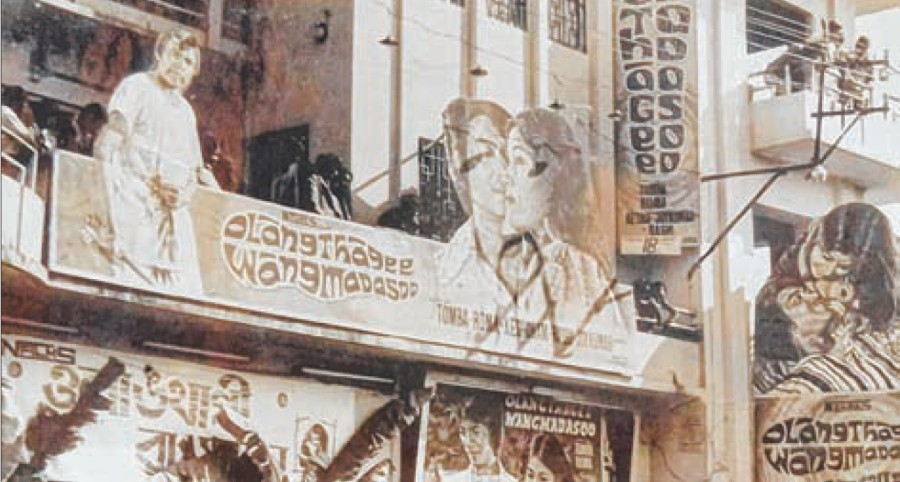
A poster for Olangthagee Wangmadasu :: Pix - TSE
In the serial number 20 of the 24 recommendations of the Government India, it is clearly stated that, "No existing theatres should be permitted to switch over to video exhibition". This practice of screening video films in the theatres, which is not done anywhere in the country, is publicised as digital film culture in Manipur. This is misnomer. Neither the theatres were equipped with digital technology nor the films shown in the theatre were certified by CBFC as Digital.
The legacy of Manipuri Cinema had its struggling past with commitment to the modern era of challenges and development. When the Indian Cinema was six decades old, the Manipuri cinema was born with Debkumar Bose's Matamgi Manipur on the 9th April 1972. To make the film, the equipments and technicians were engaged from Calcutta, Even the film director Debkumar too.
But, the collective efforts of those Manipuris involved in the film who were eminent in their fields of literature, theatre and music made the very first film, a grand success and the pride of Manipur. The first Manipuri film bagged the President's Silver Medal in the 20th National Film Awards and thus received the national recognition just when it was born.
In a decade, Manipur cinema made the Nation's pride and got international recognition when Aribam Syam Sharma's Imagi Ningthem (My Son, My Precious) bagged the Grand Prix in the competition section of the Festival of Three Continents, Nantes in France in the year 1982. Thus, Imagi Ningthem became the first and only Indian film to receive the top prize in the Nantes. The film travelled around the globe participating at many major festivals.
Aribam Syam Sharma's another Film- Ishanou (The Chosen One) produced in 1990 was the official selection in Uncertain Regard of the Cannes Film Festival 1991, and participated in many major international festivals. Thus, it proved the potentiality of Manipuri cinema in the international arena.
In a span of 25 years of Manipuri cinema upto April 1997, Manipur produced only 28 feature films. Out of 28 feature films, nine films had won the national awards; this shows that every third film produced in Manipur had won a national award.
SN Chand, Aribam Syam Sharma, G. C. Tongbra, M. Nilamani Singh, L. Banka Sharma, M. A Singh, a FTII Graduate, G. Narayan Sharma, K. Ibohal Sharma, Thoudam Doren and Sanakhya Ebotombi were the torch bearers of Manipuri Cinema.
The second generation of Manipuri cinema started in 1990. During the period, Manipuri cinema had its own technicians and equipments for pre-production and only the processing part was done outside Manipur.
A group of talented and energetic film makers including R. K. Kripa, Oken Amakcham, L.Surjakanta, Chandam Shyamacharan, Chan Heisnam, Biswamittra, Ksh Kishorekumar, M.K Jeet, Thoungamba Thouyangba, Ningombam Tomba, Jiban Heisnamba, Makhonmani Mongsaba, K Bimol Sharma, W. Ibohal, Rajen Khuman and Kh. Kuleshwar became prominent in the second generation.
The period of 1990s and the early part of 2000s was the glorious period of Manipuri cinema for its commercially viable. Manipuri audience could see at least a new Manipuri film every year and the years, 2000, 2001 and 2002 had achieved production of an average of seven films. The state Government earned more than Rupees one crore per year as revenue from the entertauinment tax from around 60 cinema halls in the State.
Thus, Manipur became the leading state, producing films in Tibeto-Burman languge in India where films are mainly made in three major language groups namely Indo-Aryan, Dravidian and Tibeto-Burman Languages.
When the advent of Cable TV and Video led to the closure of cinema halls in India in the latter parts of 1980s; the Ministry of Information & Broadcasting constituted a High Powered Committee on the problems of Film Industry on 14th February 1989 and 24 recommendations concerning to state governments were sent to every State for implementation.
The Indian film industry, being the ninth biggest industry in India, the Government of India had announced Film as Industry on the 10th March 1998. The then Union Minister Sushma Swaraj also wrote to the Chief Minister of Manipur in a letter dated the 20th March 1998 for recognition of film as industry.
The then film bodies like All Manipur Film Producers Association, Cine Artistes and Technicians Association, Manipur had demanded the implementation of the recommendations of the Government of India as well as the recognition of Film as industry in Manipur. The state government did not take up any positive action.
Meanwhile, Manipuri cinema met a major crisis in the exhibition sector in 2000. On the 12th September 2000, a militant group had imposed a blanket ban of screening Hindi films in cinema halls and video parlours against the alleged custodian death of its member in the hands of Army.
The cinema halls which were survived on Bollywood movies were closed one after another. The State Government did not take up any appropriate measures for survival of cinema halls in the state. Had there been the timely implementation of the recommendations of the Government of India, timely annoucement of film as Industry in the State and timely announcement of the State Film Policy, the crisis in Manipuri cinema would not happen.
Meanwhile, in violation of the Manipur Cinematograph Rules 1955 as well as against the recommendations of the Government of India; the state government had allowed the screening of video films certified by the Central Board of Film Certification in the cinema halls with effect from May 2002 as an interim measure for survival of cinema halls, In the serial number 20 of the 24 recommendations of the Government India, it is clearly stated that, "No existing theatres should be permitted to switch over to video exhibition".
This practice of screening video films in the theatres, which is not done anywhere in the country, is publicised as digital film culture in Manipur. This is misnomer. Neither the theatres were equipped with digital technology nor the films shown in the theatre were certified by CBFC as Digital.
Consequently, now, there is no any digital cinema hall in the State except that of state-run Manipur State Film Development Society auditorium. In the 'Theatres List' published by the Ministry of Information and Broadcasting, Manipur has been out of the list of the theatres in India. This is the fate of Manipuri film industry. Where there is no film market, what is the meaning of industry?
Despite this hurdle, filmmakers like Haobam Paban Kumar, SRFTI graduate, Maipaksana Haorongbam, Dr Bhupen Hazarika Film Institute graduate, Oinam Gautam, Ajit Yumnam and others emerged in the third generation. Haobam Paban Kumar's Loktak Lairembee (Lady of the Lake) made in 2016 became the first digital film certified by CBFC which won the national award as well as the Golden Gateway in Jio Mami Mumbai Film festival 2016. The film had its world premiere in Busan and travelled around the globe. As per CBFC, there was no production of Manipuri film in 2017.
The year 2018 witnessed three digital films and the film- Magi Matambakta directed by Dr. Makhonmani Mongsaba made its entry in Bangalore International Film festival and Third Eye Asian Film Festival, Mumbai.
The year 2019 had witnessed the production 12 digital films gaining its momemtum in the production sector. The film- Pandam Amada directed by Oinam Gautam had its world premiere in the Dhaka International Film Festival 2020 and also screened at Third Eye Asian Film Festival. Eikhoysibu Kanano directed by Ajit Yumnam participated in the Jaipur International Film Festival 2020.
In this span of five decades, Manipuri cinema bagged 38 National Film Awards- 17 in feature films, 18 in non-feature films and three in writing on cinema. Bearing the torch of the new era of Manipuri Cinema by the present generation, the film journey still goes on in the very rough weather, where there is no hope for a vibrant Manipury Film Industry.
Who is to blame?
In Manipur, the film was recognised as a medium of Mass Communication and dealt by then Publicity Department as practised in other states of the country. In the Centre, it is dealt by the Ministry of Information and Broadcasting. Unfortunately, the subject of Film was transferred from the then Publicity Department to the Art and Culture Department in Manipur as decided by a meeting of film personalties and government officials held on 13.11.1980 with the then Chief Minister R K Dorendra Singh in the chair.
The participants of the meeting were C. Doungel, Finance Commissioner; K. Kamini Singh, Additional Director of Publicity; Filmmakers- A. Syam Sharma, G.C. Tongbra, M.A. Singh, S.N. Chand, K.Ibohal Sharma and L.Banka Sharma; Film producers-G. Narayan Sharma, L. Shyamsundar Sharma and H. Gehendra Singh; Film artistes- K. Tomba Singh and Y. Roma Devi; Screenwriter- M.K. Binodini; Exhibitor- Th. Haridas Singh; Film society activists- R K Bidur Singh, Secy of Imphal Cine Club and K B Singh, Secy of Film Society of Manipur.
The Proceedings of the meeting says,"The meeting recommended that as the State Directorate of Culture has come into existance, the Directorate should be the appropriate Department to deal with the subject and the subject should be transferred to the Directorate of Culture from the Publicity Department". Thus the then Chief Minister of Manipur was misguided by the participants in the meeting to divert the film medium of Manipur into a secluded place.
Since 1980, there has been no connection of the State Department of Art and Culture with Ministry of Information and Broadcasting. Film promotion schemes introduced by the Ministry from time to time have not been implemented by the State Art and Culture Department as the connectivity has been lost. Since then, Manipur cinema has completely lost its opportunity for discussion in the biennual Information Ministers' Conference conducted by the Ministry of Information and Broadcasting.
Due to mismanagement of the State Department of Art and Culture without adequate knowledge on what the film medium is about, the Manipur Film Development Corporation Ltd could not survive effectively and was abolished. In lieu of it, Manipur State Film Development Society with limited objectives was established, which cannot connect with its counterparts in the country. The State Cabenet had approved for setting up a Film City in the State in the year 2015 but it is not yet realised.
Manipur State Film & Television Institute was inaugurated in August 2016 along with the Manipur University of Culture. While the Manipur University of Culture is running in full swing, the film institute has not started its classes till date even though the State government had appointed one Nilotpal Mazumdar as Director of the Institute since its inception. The Department recently announced the Manipur Cine Policy 2020.
In the policy, it is stated, "Lanmei, a feature film in video format was released for public show at M/S Friends Talkies in 2002. After its successful response, the film communities started producing and screening of cinemas using digital technology".
Actually, it was a video film screened in the theatre using video projector. It was not certified by the Central Board of Film Certification as digital or celuloid film with 'Valid for Theatrical Release only'. This shows that the State Department of Art and Culture does not know the difference between the FILM and VIDEO FILM which has been defined by the Ministry of Information and Broadcasting. How can the Department handle the subject of Film without knowing it?
The Policy does not reflect any monetary provisions like subsidy for film producers, which was once introduced by the then State Publicity Department to encourage the film producers in Manipur. The Policy does not encourage the exhibitors of defunt cinema halls and existing dying cinema halls. There is no provision for revival of cinema halls in the Policy.
Instead, it says," For developing domestic cine market, cinema houses equipped with state of art technology shall be constructed in suitable places in the State in Public Private Partnership model". Since there is no any attractive provision in both production and exhibition sectors in the Policy, it is certain that there will be no more film industry in Manipur. Who is to blame?
(Courtesy: The Frontier Manipur)
* Meghachandra Kongbam wrote this article which was published at The Sangai Express
Meghachandra Kongbam is a recepient of Swarna Kamal Award for Best Film Critic in National Film Awards 2015.
He is a member of International Federation of Film Critics (FIPRESCI), Indian chapter.
He is currently President of Film Society of Manipur and Advisor of Manipur Film Journalists and Critics Association.
This article was webcasted on October 11 2020.
* Comments posted by users in this discussion thread and other parts of this site are opinions of the individuals posting them (whose user ID is displayed alongside) and not the views of e-pao.net. We strongly recommend that users exercise responsibility, sensitivity and caution over language while writing your opinions which will be seen and read by other users. Please read a complete Guideline on using comments on this website.


