


Decades of Sadar Hills Demand
Thongkholal Haokip *
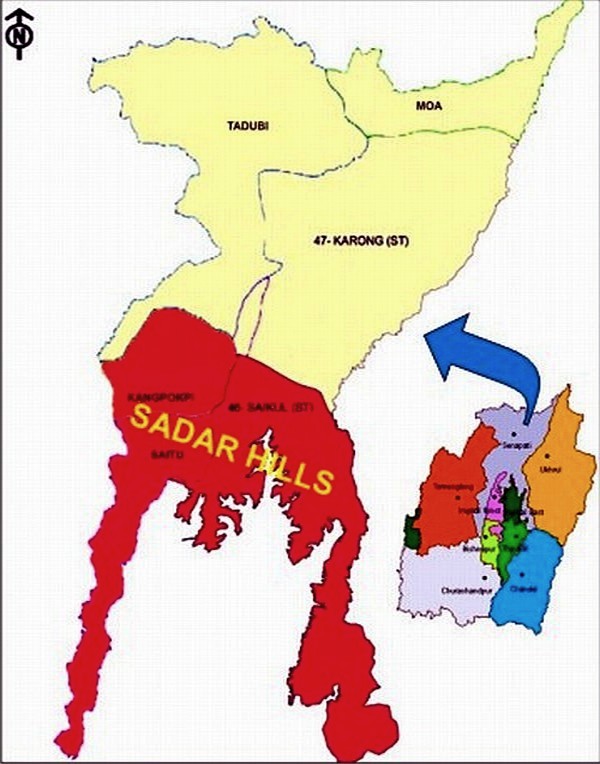
A map showing the boundary of Sadar Hills - Pix - TSE
Since the early 1970s, Manipur has been witnessing occasional strikes and bandhs demanding upgradation of the Sadar Hills area of Senapati district into a full-fledged revenue district. Despite being fully aware of the necessity of its upgradation based on administrative convenience, successive Manipur governments have been repeatedly ignoring the wishes of the people. It is high time that the state government, instead of overlooking the issue, deals promptly with ingenuity and positive outcome.
SADAR is an abbreviation of Selected Area Development Administrative Region as found in the land records of Manipur. Likewise there are a number of SADARs in many states of India particularly Uttar Pradesh which were established by the British during their colonial rule in India. Thus, Sadar Hills is the hills overlooking and encircling the Imphal valley. Sadar Hills was conceived way back in 1933 by JC Higgins, the then British Political Agent in Manipur.
History of Sadar Hills
Before the Kuki Uprising of 1917-1919, there was no administration of the hill areas of Manipur. After the Uprising the British rulers felt the necessity of administrative control and thereby divided the hills into South-East and North-East subdivisions with its headquarters at Tamenglong and Ukhrul respectively. In 1933, the British created Sadar subdivision with its headquarters at Kangpokpi for administrative convenience.
With the signing of the "Merger Agreement" with India on September 21, 1949 by the Maharajah of Manipur Bodhachandra Singh, the state becomes "Part-C State" of the Indian Union. In 1969 Manipur was divided into five districts: Central (Imphal), North (Karong), South (Churachandpur), East (Ukhrul) and West (Tamenglong). The reorganisation of districts placed Sadar Hills as a sub-division of the North District (Karong). To fulfill the aspirations of the hill people the Government of India enacted the Manipur (Hill Areas) District Council Act, 1971. Section 3 of the Act divides the hill areas into six Autonomous District Councils or Hills Districts including Sadar Hills.
Chandel, Tengnoupal and Chakpikarong continued to remain as hill sub-divisions under Central District. In the following years the four Autonomous District Councils (ADCs), Senapati, Tamenglong, Ukhrul and Churachandpur, were upgraded to a full revenue district. In 1974 three Subdivisions, Chakpikarong, Chandel, and Tengnoupal Hills, were merged and put under a separate Hill revenue district with its headquarters at Tengnoupal, which was later shifted to Chandel.
The Manipur North District came into existence on November 14, 1969 with its headquarters at Karong. Later the district headquarters was shifted to Senapati on December 13, 1976. In July 15, 1983, the district came to be known as Senapati District. Sadar Hills continues to be under the North District of Manipur awaiting to be declared as a full fledged revenue district even though it has a fully functional ADC since 1971.
Sadar Hills Movement and Manipur Governments
The demand for the creation of Sadar Hills district first came from the Kuki Chiefs' Zonal Council in its meeting held on September 3, 1970. The leaders of Kuki Chiefs' Zonal Council met the then Home Minister KC Pant in July 1971, and placed their demand for a separate district comprising of Sadar Hills. The delegates of the Kuki Chiefs' Zonal Council again held a meeting with Security Commissioner on October 6, 1971 at Kholjang village. The Nayal Commission in 1974, not only recommended for the creation of Sadar Hills district, but also suggested for the inclusion of some adjoining areas of Senapati and Ukhrul for administrative convenience and development. However, all these demands, talks and recommendations failed to produce any result.
Under the auspicious of the Kuki National Assembly the Sadar Hills District Demand Committee (SHDDC) was formed in 1974 to demand a full-fledge revenue district status for the Sadar Hills Autonomous District Council, consisting of Saikul, Kangpokpi and Saitu subdivisions. Ever since Manipur attained full fledged statehood in 1972 several state ministries made attempts to declare Sadar Hills as a full fledged revenue district. The first attempt was made by the Rishang Keishing's Congress government in 1982. The ministry put up an ordinance to the Governor to declare Sadar Hills as district and the same was dully signed by the Governor but the ordinance was withdrawn due to opposition from the then Manipur Naga Council.
The 1990s was trying times in the politics of Manipur, marked by instability of state government ministries, the Kuki-Naga ethnic conflict and attempts by various coalition governments to inaugurate Sadar Hills as a revenue district. RK Ranbir Singh's United Front ministry endeavoured to upgrade Sadar Hills to a district status in 1990-91. But the political instability and downfall of the United Front Ministry at the centre prematurely ended the life of the state government, and so were their efforts. The succeeding Congress ministry of RK Dorendro Singh also put efforts during their regime without success.
After heading the Manipur State Congress Party government in December 1997, W Nipamacha Singh's ministry gathered courage and even fixed a date in October 1997 to inaugurate Sadar Hills as a revenue district at Sapormeina. Adequate buildings were constructed and all functional departments were upgraded but the final decision was not made. In 1998 a new Assembly Constituency, Saitu, was created since all hill districts were having a minimum of three Assembly Constituencies each. To prepare Sadar Hills more for a full revenue district mini-Secretariat, Sports Complex, etc were constructed. The ADC now has all the paraphernalia of a district on ground and all offices functioning with an added prefix such as the Additional Deputy Commissioner, Additional Superintendent of Police, etc.
In the course of its untiring demand for Sadar Hills district several demonstrations, strikes and bandhs were called. Such peaceful movements were sometimes filled with gory incited by the state machinery apart from many untold miseries. In the past, two youths lost their lives. In 1981, Seikeng Haokip, who was part of a long silent procession from Sapormeina to Kangpokpi demanding Sadar Hill district, was shot dead by Manipur police in an attempt to disperse the crowd. In 2008, a grade VIII student, Lalminlien Sitlhou, was run down by a vehicle of security forces in Keithelmanbi while he was obstructing the highway in support of the demand for Sadar Hill district.
Contest for Land
Since the inception of Sadar Hills demand the Nagas oppose it based on their claims of being the first settlers or indigenous people and the Kukis as late settlers. This opposition is demonstrated by the unpublished Memorandum of Understanding between the United Naga Council (UNC) and Manipur Government to end the month long economic blockade of the UNC. It reads: "No Sadar Hills District will be created as a full-fledged Revenue District in the absence of the UNC representatives."
Most ethnic communities in Northeast India migrated to their present settlements at some historical periods, mostly after the first century AD. The Nagas claimed Tamenglong, Senapati, Chandel and Ukhrul as their ancestral land based on folktales, oral traditions and British colonial gazetteers, reports and surveys. Such myths and colonial records need to be examined scientifically for practical purposes. Neither the Nagas nor Kukis have written historical records as they don't have script of their own. In the absence of written history the claims based on such myths are more of a speculation.
Colonial records are often used to substantiate their claims. In this regard, the British records often have prejudice and biased against the Kukis since the Kukis opposed colonialism as a rebellion from 1917-1919 and also in both the World Wars. In contrary to such claims, Majumdar and Bhattasali (History of India, 1930) refer to the Kukis as the earliest people known to have lived in prehistoric India, preceding the "Dravidians". Even Cheitharol Kumpapa, the court chronicle of the kings of Manipur, and the Pooyas, the traditional records of the Meitei people, has some accounts of Kuki people and a king which dates back to 33 AD.
Thus, myths coupled with prejudiced colonial records, and even threats, were often used to oppose the Sadar Hills movement and its move to upgrade it to a revenue district.
Present Agitation
The election of new SHDDC leaders in June 2011 marked the revival for the demand of Sadar Hills district. The Sadar Hills District Demand Committee has been renamed as Sadar Hills Districthood Demand Committee to signify the readiness on the ground in terms of infrastructure and various processes needed, as the state government spelt out such requirement before and promised for the upgradation as and when done.
The committee requested the state government to declare Sadar Hills as full fledged district before July 31, failing which seven days economic blockade on the two national highways, NH-2 and NH-37, will be called and an indefinite economic blockade thereafter if there is no response from the government. On July 26, 2011, representatives of various Kuki civil bodies, Members of District Council and SHDDC staged a sit-in-protest demonstration at the office complex of the Additional Deputy Commissioner, Kangpokpi, against the 40 years denial of full fledged districthood to Sadar Hills Autonomous District Council. A memorandum addressing the Chief Minister of Manipur was submitted to the ADC Kangpokpi, by the leaders of the various bodies gathered there.
The non-response from the government forced the SHDDC leaders to impose economic blockade to the two lifeline of Manipur on August 1. On the second day the state government bullied the protest by imposing CrPC 144 in Sadar Hills area. Bandh supporters pelt stones at a truck defying the bandh and the driver lost control and run down on three girls who were beside the road. Due to the death of the innocents the SHDDC leaders declare indefinite bandh on the evening of the second day.
On the third day, procession was held at Kangpokpi carrying the dead bodies of the previous day's accident victims demanding for the upgradation. Six drivers were hurt seriously and as many as six vehicles were torched by the bandh supporters. As the bandh continues various Naga tribes and civil bodies started playing the communal card.
The UNC, the All Naga Students' Association Manipur, Senapati District Students' Association stated that they will not accept bifurcation of "Naga areas" without the wishes and consent of the Naga people. After two weeks of the imbroglio the Manipur Cabinet decided to deploy foolproof security along the two National Highways to ensure normal traffic from August 16. Meanwhile, the SHDDC representatives left for New Delhi to present their case to the Prime Minister.
The gory and destruction of property will continue unless the state government put aside its adamant attitude. And if the indefinite bandh continues, a time is near when there will be acute shortage of essential commodities in the whole state.
The Churning
The historical marginalisation of the Kukis, and the people of Sadar Hills in particular, is mainly attributed to the measures adopted by the British colonialist followed by the successive Manipur and Central governments. During the British colonial period administrative posts were set up at Tamenglong and Ukhrul to displace the original Kuki bases of Laijang and Chassad. Whereas the District Councils dominated by the Nagas were upgraded to a full-fledged revenue districts in no time when Manipur attained statehood in 1972, the Kuki dominated District Councils, Sadar Hills and Tengnoupal, were left out although the later was upgraded in 1974.
While the creation of districts such as Ukhrul and Tamenglong was not opposed by the Kukis living in those districts as it was based on administrative convenience. Putting the demand of Sadar Hills based on communal lines has eroded the whole fabric of collective Manipur life, incontestably.
The delay in granting districthood to Sadar Hills have denied the people the opportunities for all round development. In the memorandum submitted to the Chief Minister of Manipur on July 26, 2011, the SHDDC leaders estimated that an amount of Rupees 38,000 crores have been lost during the period of about 40 years due to delay in upgrading Sadar Hills to a revenue district. They lamented that such big amount of money could have been spent on socio-economic developments.
The general secretary of SHDDC, Tonghen Kipgen, stated that "we have lost our faith in the government due to their blatant lie of making promises after promises to grant Sadar Hills as a full fledged district". To the supporters of Sadar Hills movement, it seems like the Manipur government is just paying lip service and continues to delude the people of Sadar Hills with false promises and the resulting false hopes.
Concluding Remarks
The demand to upgrade Sadar Hills to a full fledged district status is one of the longstanding district demands in the whole of India, which continues to linger in the politics of Manipur for the past four decades. It is ironic to see when the other five ADCs, which had been created together with Sadar Hills in 1971 were all granted full-fledged district status decades back, while the legitimate right of the people of Sadar Hills has been continually denied. When successive governments failed in their attempts to grant full fledged district status to Sadar Hills, more districts have been created in the valley in due course of time.
Even though the demand to upgrade Sadar Hills to a district predates the idea of bifurcating Imphal district, it was taken up together and was promised to be done together. While Imphal was bifurcated on June 18, 1997 into East and West districts, Sadar Hills was left in the dark. Now when the agitation in Sadar Hills arises again, the Chief Minister stated that Sadar Hills will be discussed together with the plan to create Jiribam district and the newly emerging demands to bifurcate Ukhrul and Churachandpur into two districts each. This shows great insensitive to the feelings of the people of Sadar Hills and breeds more of a sense of anger and frustration.
The delay in granting full-fledged revenue district has not only lost precious lives and unnecessary economic hardship during the agitations. The anger and frustration of the people of Sadar Hills can cause much damage, widening the gaps between the already fragile ethnic relations, and thereby even inciting communal feeling between ethnic groups.
However, granting full fledged revenue district status to Sadar Hills will undoubtedly improve not only the trust deficit that has been existing and dividing the Hill and Valley people, but also between the Kukis and Nagas in the hills of Manipur. If their demand is not taken care, there can be scaling in their demand and agitation as mentioned by the committee leaders.
It needs to be realised that all districts in Manipur were created based on administrative convenience and developmental needs and not based on communal lines. Justice denied to the people of Sadar Hills needs to be addressed soon so that peace and goodwill exists between the ethnic communities in Manipur.
* Thongkholal Haokip wrote this article for Hueiyen Lanpao (English Edition)
This article was posted on September 06, 2011.
* Comments posted by users in this discussion thread and other parts of this site are opinions of the individuals posting them (whose user ID is displayed alongside) and not the views of e-pao.net. We strongly recommend that users exercise responsibility, sensitivity and caution over language while writing your opinions which will be seen and read by other users. Please read a complete Guideline on using comments on this website.


