
TODAY -

Ancient Manipur kingdom and Brahmanism

Maheshsana Rajkumar *
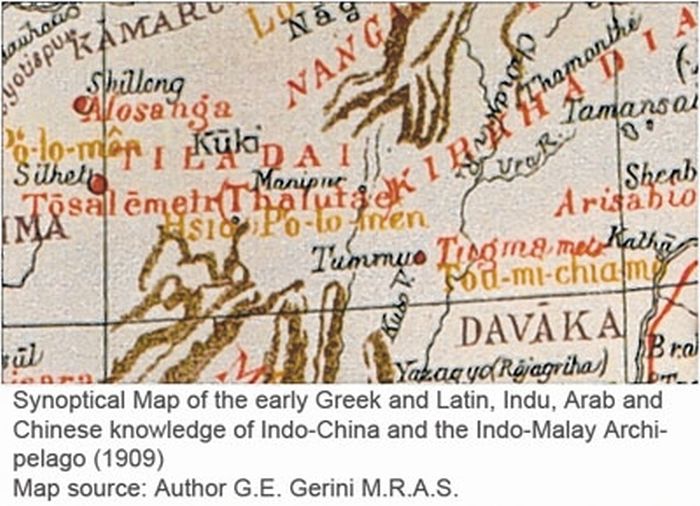
 Col. G.E. Gerini's Synoptical Map of the early Greek and Latin, Indu, Arab and Chinese


Manipur was an ancient kingdom in ancient Southeast Asia. It is worthwhile to note the book on Chinese source "The Man Shu: Book of the Southern Barbarians" translated by Gordon H. Luce and edited by G.P. Oey, 1961, gives an insight of the ancient kingdom of Manipur. The Chinese know the ancient kingdom of Manipur by name of Hsiao P'o-lo-men (Little Brahman) kingdom of the north-west.

According to Col. G.E. Gerini M.R.A.S. in his book "Researches on Ptolemy's Geography of Eastern Asia: Further India and Indo-Malay Archipelago", 1909, records that a kingdom in which the Mi-no, i.e. Man-Kathe or Manipur River, rises according to the "Man-shu" circa A.D. 860.

In this kingdom of the 'Lesser Brahmins' the "Man-shu" remarks that no beef is eaten and that future events can be predicted. The kingdom of Little Brahmans of the North-West is conterminous with P'iao (Pyu) kingdom in Burma and Mi-ch'en kingdom. The journey to the kingdom was 74 day-stages north of Yung-ch'ang.

The Nan-Chao map of the 8th & 9th Century mentioned the ancient Manipur kingdom as "Little Brahmans of the North-West" and Col. G.E. Gerini's Synoptical Map of the early Greek and Latin, Indu, Arab and Chinese knowledge of Indo-China and the Indo-Malay Archipelago showed the map of Manipur below its written "Hsiao P'o-lo-men" in ancient Chinese toponym meaning Little Brahman.

A Brahmin living then in the Magadha country was called Brahmabandhu-a degraded Brahman. Brahmabandhu also means a person who is born of a brahmana father but whose activities are not up to the standard of the brahmanas. They chose astrology as profession and intermarry with other castes.

In the words of Edward Harper Parker H.M. Consul, Kiungchow, Officiating Adviser on Chinese Affairs in Burma in his book, "Burma with Special Reference to her Relations with China", 1893, states that Chinese have records of the existence of Manipurese people under the name Kieh-Seh, this last name being imitation of the word Casse or Cathay, meaning "Manipuri-people."

The Chinese annals also mention Shan's possession of the Manipur kingdom at different times, and for several centuries. The Tai Nanchao king Ko-lo-feng built a trade route between Manipur and Nanchao in the 8th Century.

It is also recorded in the ancient Manipuri chronicle that the Manipuri king Naothingkhong who then acknowledged the suzerainty of Nanchao under Ko-lo-feng, sent a well trained party of dancers, singers and instrumental musicians to the Imperial Court of China as a goodwill mission.

It must have been a mission to T'ang Emperor Tien-Pao (Hsuan Tsung's) court. Since there was no independent Thai kingdom in Thailand in that early period the reference is apparently to Ko-lo-feng's conquest of Upper Burma and Assam including Manipur in the eight century C.E. as described in the T'ang history.

The maps highlighting Little Brahmans of north-west kingdom and Hsiao P'o-lo-men written in ancient Chinese toponym is further substantiated in the writings of R.G. Latham in his book "Descriptive Ethnology: Vol.1. Eastern and Northern Asia-Europe, 1859, records that Munipur is Brahminic in its creed; with an alphabet directly from the Devanagari of India; and Munipur, with much of its original rudeness remaining, is still in the category of equals, one for inferiors, one for superiors; even as there is in Siam, Java, and elsewhere. A difference between the language of politeness and rudeness exists everywhere. The phenomenon of a court dialect, as contrasted with the dialect of ordinary life, exhibits itself in the greatest prominence in the south-east of Asia.

Col. G.E. Gerini taking the source of Burmese Royal Chronicle "Maharajavamsa" mentioned Dhajaraja, a king of the Sakya/Maurya race, settled at Manipura, about 550 B.C., and later on conquered Tagaung (Old or Upper Pagan).

John G.R. Forlong in his book "Encyclopedia of Religions, Volume 3, 1906, records that from the time of Dhaja Raja down to the 11th century successive waves of Indian migration passed into the valley of Irawadi, bringing Sanskrit letters, legends, religions, and civilizations. According to renowned Manipuri scholar W. Yumjao Singh in his book "An Early History of Manipur", 1966, took the source of Col. G.E. Gerini, mentioned that Sanskrit or Pali languages were used in official documents and inscriptions by the Indo-Aryan adventurers.

Renowned scholar Victor B. Leiberman gives a detailed account on Manipur king Gariba Niwaza in his book "Burmese Administrative Cycles: Anarchy and Conquest, C. 1580-1760, records that "The Brahmanically sanctioned changes that Gharib Newaz introduced in political organizations, in personal devotion, in diet and dress inspired the Manipuris with a vast energy and missionary dynamism."

The religious preceptor Shanti Das was known to the Burmese by the name of Mahatharahpu. In the words of another renowned scholar Michael W. Charney, "There is, thus, little doubt that Shanti Das had major plans for the Burmese court, especially since his large entourage consisted of five hundred of his disciples, including Brahmin priests. The Hindu teacher, however, fell ill and died in Burma about a month later in 1744.

Thus if there had been any real chance of a conversion of Burma to Brahmanical Hinduism kingdom this was doused by the end of the 1750s. He also emphasized the contributions of Manipuri Brahmans who played a significant role in shaping the perspectives of and cooperating in the literary activities of Chindwin-based Buddhist scholars and lay people in a powerful literary culture which existed from mid 17th century to 19th Century known as "Chindwin Literary Culture" in Burma-Manipur Frontier.

The religious conversion of Manipuri to Ramanandi cult by Gariba Niwaza (Pamheiba) at the behest of teacher Shanti Das Goswami, brought revolution in the kingdom which paved nation building process and drew strength to counter the religious warfare of Theravada Buddhism religion of the mighty Burmese empire, the size of her kingdom larger than five southern Indian states.

Sir Athelstane Baines in his book "Encyclopedia of Indo-Aryan Research: Ethnography (Castes and Tribes)', 1912, records that on the adoption of Brahmanism by a large portion of the Mongoloid population of Manipur, the chief and his military retainers passed into the rank of Ksatriya, and to the number of about 1, 80,000, appear under that title in the last census returns.

The monarch thereupon embraced their creed and was invested with the sacred thread, and with him a large number of his people. Since then, not only have most of the Meithei become Ksatriya, but the rank has been conferred by the Chief upon a plentiful supply of recruits from the surrounding Kuki and Naga tribes. The result is that at the Census only 33 of the inhabitants of the State returned the tribal name, whilst the 33,000 Manipuri found on the record are Bengali enumerated in Kacar and its vicinity.

The Brahmanic Tainized kingdom of Manipur with military strength of 40,000 men became Asiatic power in Southeast Asia. Gariba Niwaza seized every opportunity to conquer Ava in 1740. He was backed by the Cacharese army and consolidated his control over a zone of northern Shan tributaries formerly loyal to Ava, became vassal of Manipur.

The Manipur army led by Gariba Niwaza hurriedly retreated to save her kingdom after Tripura's invasion when the Manipur army was at Ava, thus, the golden chance to conquer Burma failed. The Burmese Chronicle "Hmannan" records the last Toungoo king Maha Damma Yaza Dipati had sent letters to Qing emperor of China asking support to crush Manipuri invaders and Mons owing to the threat of his kingdom from Manipuri ruler Gariba Niwaza,.

The Manipuri nationalism faded with the advent of British rule. The proud kingdom which was forced to reckon with in Southeast Asia made by the endless sacrifices of our forefathers who safeguarded the land and protected her kingdom from external threats, encountered severe breakdown of her hard won nationalism through the ruthless, aggressive and divisive policies of the British.


* Maheshsana Rajkumar wrote this article for The Sangai Express
This article was webcasted on 06 September 2022

* Comments posted by users in this discussion thread and other parts of this site are opinions of the individuals posting them (whose user ID is displayed alongside) and not the views of e-pao.net. We strongly recommend that users exercise responsibility, sensitivity and caution over language while writing your opinions which will be seen and read by other users. Please read a complete Guideline on using comments on this website.


LATEST IN E-PAO.NET
  • Violence in Manipur 2023-2026 : Timeline
  • 3 ACs - Draft Electoral Rolls for Senapati
  • Draft Electoral Rolls for Imphal East
  • Present signature for February 30 !
  • Boy Who Dredged the Rivers: Taothingmang
  • Day 3 : Yaoshang Festivities : Gallery
  • Golden Jubilee of JNMDA (Prod Unit)
  • The failure of selective liberalism
  • Apatani's Next Top Model 2026 : Grand Finale
  • The Faithful Pen :: Poem
  • Obesity - Mother of many lifestyle disorders
  • Early History of Manipur Sahitya Parishad #1
  • Fuzzy Clearances in Mapithel Project
  • E20 Petrol in India: Controversy Behind Biofuel
  • Ratify UN Convention Against Torture
  • When Manipur University says No to Drugs
  • Teaching : The most judged profession
  • Cloud of Death: Tobacco's Global Shadow
  • Time to show there is a Govt in place
  • World Environment @Lamdeng #2 : Gallery
  • Why Kuki failed to co-exist with communities
  • Apatani Fashion Week 2026 at Hija
  • Admission Notice : Dhanamanjuri University
  • 41 yrs of healing lives & strengthening Manipur
  • Smart protected cultivation : For climate smart
  • Heatwave makeup guide
  • Call for conscientious voting
  • Ningol Phida @Shumang Leela #1 : Gallery
  • Two civil society reports on violence in Manipur
  • Influenza : A potential for another pandemic ?
  • Who Shapes Whom ? :: Poem
  • Rejects KZC's June 25 Press Conference
  • Science behind the RSS Shakha
  • Paradox of devotion, power of babas & justice
  • Impact of inter-district blockade
  • Naga Peace Process: Indo-Naga Talk: Timeline
  • Day 3 : Yaoshang Sports : Gallery
  • World Motor Cycle Day @Andro : Gallery
  • SoO & selective law application
  • New thaw of Indo-Myanmar relationship ?
  • Transparency in rehabilitation centre evaluation
  • Mother Earth :: Poem
  • Patriarchal resistance in Africa- gender equality
  • After Sharda who, is the question
  • Sillam Sintha Jagoi @ATINGA : Gallery
  • Featured Front Page Photo 2026 #3: Gallery
  • Constitutional and federal discourses
  • Guru Shishya Parampara Scheme 2026-2027
  • The Personal MBA is no less than an MBA
  • A surge of love :: Poem
  • Walking Lens - 3rd Edition
  • Selling false sense of normalcy
  • Ethnic conflicts & effects on local fisheries
  • July Calendar for Year 2026 : Tools
  • Seminar: NE Traditional Knowledge System
  • Youth, Education & the Road to Peace
  • I Will Not Be a Footnote :: Poem
  • Rejects KZC's Contradictory Statements
  • Being Indian/Manipuri citizens
  • The politics of shutdown & blockade
  • 360° panoramic view of spots in Manipur
  • Tangkhul Meiphung: The wounds of Time
  • Arambai Tenggol & the law of defence
  • SWC Khongman Mourns Demise of Founder
  • A New Skyline for Imphal
  • Legal for Inmates of Manipur Central Jail
  • Demands Abrogation of SoO
  • How Football Connects Us Across Generations
  • Homecoming @ Washington DC : Gallery
  • BSc (Horticulture) State Govt Nominee
  • The World Drug Problem
  • Senior Media Delegation Visits Karkinos
  • Why is interest on education high ?
  • Guwahati Airport Emergency Response
  • Admission without a shred of guilt
  • ANSAM Rally demanding justice : Gallery
  • Imokanta's Shumang Lila of Manipur : Review
  • Drug addiction is a disease that can be beaten
  • KZC's 25 June PR Exposes Brutality
  • Awareness Programme on Drug Abuse
  • Three-day Rise Up Summer Camp 2026
  • Tips for healthy & beautiful nails in summer
  • The yarn about return of peace
  • Workshop- 'AI in Journalism' : Gallery
  • Yaruingam, Ruichumhao, Babysana : Eming
  • Exploring The Vanishing Self - Book Launch
  • The Great Regression of Manipuri Cinema
  • A venture on culinary enterpreneurs
  • A convoy that deepened fears of proxy war
  • Offering :: Poem
  • Forgotten dialogues convened at Delhi
  • 25th The Great June Uprising #2 : Gallery
  • Day 2 : Yaoshang Mei Loukhatpa : Gallery
  • How Manipuri Cinema is Reimagining Future
  • A Dime A Dozen # 1 : Author's Warning Note
  • 3 yrs on, Manipur demand an honest reckoning
  • Financial traps you should avoid
  • NE India Infrastructure Summit 2026
  • Stand to contest coming Assembly polls
  • Manipuris (Meitei) and Bishnupriyas
  • Kamesh Salam Recognized by Business Today
  • Manipur's children are watching
  • Nungshiba Leinamna : Weaves Love & Legacy
  • The albatross of mid-June :: Poem
  • On Working Committee, NNPG's statement
  • Workshop : Application of AI in Journalism
  • Emergency shutdown politics of CoTU
  • 26th Death Anniv : Arambam Somorendra
  • Yaoshang Pechakari @ Govindaji: Gallery
  • Understanding infertility in a changing world
  • The Cry of My Six Brothers :: Poem
  • International Day of Yoga @ MU
  • International Day of Yoga @ IBSD
  • RSS is already registered
  • People returning again on wooden cots
  • ANSAM rally at Imphal : Call of indigenes
  • Candle Light Vigil @ New Checkon : Gallery
  • Youth & Politics: When Are We Addressing
  • Hostage crisis
  • B.Sc @ CMC College of Nursing, Koirengei
  • Seasons of a Lie :: Poem
  • Textile Designers @ Directorate of Handloom
  • Footpath parking at Zudio, Thangal Bazar
  • Cultural @ Beating of Retreat #2 : Gallery
  • Tree Plantation Drive @ Mekola : Gallery
  • Girls' Hostel at Heikakpokpi, Tengnoupal
  • Burden of NCD among women in Manipur
  • 35th State Thang-ta Championship 2026
  • Congratulatory Message : PhD Degree @ MU
  • Life as it floats down :: Poem
  • Advanced Botulinum Toxin Therapy
  • A three way conflict situation
  • 25th The Great June Uprising #1 : Gallery
  • The Foundational Question & Its Evasions
  • The necessity of peace in Manipur
  • AMD Academic Accelerator Program, Pune
  • Question KIM-CM Meet amid Kuki Crimes
  • Public Welfare Camp kicks off in Senapati
  • Yoga for beauty
  • Time for Imphal to assert its position
  • Manipuri and Bishnupriya Manipuri
  • June 18 : A Day of Unity, Sacrifice
  • A region on edge for 3 years on the trot
  • Cry Mother Cry :: Poem
  • Movement of half the population is in trouble
  • Building future or destroying generation ?
  • NEET Examination, 2026 : Noney District
  • June of 2001 and the reality of today
  • Protest erupted @RIMS [15 Jun] : Gallery
  • Massacres perpetrated by Kukis during British
  • Political neglect of PhD graduates
  • The fate of Ophelia :: Poem
  • RACTION 2026 - Residency & Film Challenge
  • Monetary worth of a homemaker unpaid work
  • Guwahati Airport Among World Beautiful
  • Khuiyoi Tompok & Sound of the Drum
  • 28th Meira Paibee Numit @Khurai : Gallery
  • BMSA Annual Multi-Sports Tournament 2026
  • The Real Subject of Priyakanta's 'I Am Special'
  • 3rd anniv- Khamenlok 'massacre' : Gallery
  • Manipur and settler colonialism
  • Beyond the Failure of Regional Parties
  • Healthcare for Manipuris in Bangalore
  • 'Ningol Van' Tree Plantation at Mekola
  • A battle :: Poem
  • The Cockroaches are Knocking
  • Reflecting on the reality here
  • AI : Explore 25+ yrs of Manipur archives
  • Why reform never comes : Political economy
  • Solo Dance: Wahengbam Debina #1: Gallery
  • Why the crisis demands a National strategy
  • Remains of 6 Naga hostages @JNIMS: Gallery
  • The Lost Paradise
  • Art Exhibition by G Krishnadas: Gallery
  • Moirangthem Chandra's collection of Puyas
  • What Manipur conflict reveal about oppression
  • 'No NRC Update No Census' Rally : Gallery
  • Price of a vote: How debt drives election
  • Yaoshang Mei Loukhatpa #3 : Gallery
  • Showcasing Manipur @Switzerland : Gallery
  • Criticism Without an Alternative is Not Enough
  • The Lament of a Silent Tree
  • Behavior, Psychology & Society
  • 1st Peaceful Coexistence Award 2026
  • Events- Kuki militant & Naga village volunteer
  • World Environment @Lamdeng #1 : Gallery
  • Ahingee Laan : Dance-drama #2 : Gallery
  • Abdul Hafiz graveyard at Imphal War Cemetery
  • Martyrs' Day @ Cheiraoching #3 : Gallery
  • The King Who Came from the Sky: Pakhangpa
  • Chakan Gang-Ngai 2026 : Ooba Video
  • Unfinished requiem- Linthoingambi & Hemanjit
  • How to Break Manipur w/o Breaking Any Laws
  • 17th Manipur State Film Awards (MSFA), 2025
  • Eid-Ul-Zuha @Sangaiyumpham : Gallery
  • 16th Manipur State Film Awards (MSFA), 2024
  • Lhangpat Mei @Keishamthong #2: Gallery
  • Radio E-pao: 5 new songs updated
  • Cheirao-chingkaba on Cheiraoba #2: Gallery
  • Anoi Group Art Exhibition 2026 : Download
  • Yaoshang - Cooking Competition : Gallery
  • Manipur State Award for Literature 2024
  • Manipur in India Constitutional Transition #3
  • Lamjen @ Thangjing Haraoba #1: Gallery
  • HSLC Exam 2026 : Full Result
  • HSLC Exam 2026 : Pass % : Govt Schools
  • HSLC Exam 2026 : Pass % : Aided Schools
  • HSLC Exam 2026 : Pass % : Private Schools
  • HSLC Exam 2026 : Withheld-students
  • HSLC Exam 2026 : Compartmental candidates
  • HSLC Exam 2026 : Statistical Abstract
  • HSLC Exam 2026 : Important Information
  • Indigenous Leaders Call for Global Recognition
  • Tronglaobi: 2 children laid to rest : Gallery
  • Free Online access to 'Asangba Nongjabi
  • Candlelight vigil: Killing at TM Kasom : Gallery
  • Fractured sovereignty : Proxy war
  • Final Merit List : Manipur Civil Services 2022
  • Most Heinous Murder: Derailing Normalisation
  • Killing of 2 children @ Tronglaobi : Gallery
  • Boong: India's 1st BAFTA in children's cinema
  • PUCL Tribunal report: A shadow of partiality #3
  • PUCL Tribunal report: A shadow of partiality #2
  • PUCL Tribunal report: A shadow of partiality #1