TODAY -
✦

Laiharaoba - The Most Important Festival
( Merry Making of Umanglai )

By: N Mangi Devi *

Lai-Haraoba is celebrated in honour of the sylvan deities known as Umang-Lais, meaning deities of calm and quite environment of beautiful forests. The festival represents the worship of traditional deities and ancestors of the Manipuri society. It is usually observed during the month of Kalen tha (summer season).

With the coming of warm and hot season, KALENTHA the famous and important festival of LAIHARAOBA has been celebrated at the sacred places of UMANG LAI of the Manipur valley. It is mainly observed by the Meitei society. Here it is desirable and suitable to note the importance and significance of the month of KALENTHA according to ancient Puya.

In this month, Nongda Lairen Pakhangha comes down to the peaceful and rare place, KANGLA and stays with all beings. At this time the whole earth becomes peaceful. Lainingthou, King of Gods comes down on earth and Rain God arrives and Gods and Godesses meet together.

All the people of four panas i.e. Ahallup, Nahalup, Khabam and Laipham pray to Almighty God for long life. All different kinds of flowers bloom in this month and people admire the beauty of the flowers that are distributed to the people of four Panas and offer them to God. With this idea of praying to God all the people start the observance and celebration of Laiharaoba at every locality where Umanglais are worshipped.


Four types of Lai Haraoba are prevalent in the Meitei society, namely,
  • Kanglei Haraoba,
  • Chakpa Haraoba,
  • Moirang Haraoba and
  • Kakching Haraoba.
Kanglei Haraoba is performed in many parts of the valley of Manipur excepting Moirang, Kakching and those areas where Chakpa Haraoba are practised. Moirang Haraoba is only in Moirang, Kakching Haraoba is held in Kakching and Chakpa Haraoba is celebrated at Andro, Phayeng, Sekmai, Koutruk, Khurkhul, Leimaram and Tairenpokpi.

The processes of the Laiharaoba Haraoba are :-

In every locality or village where the LAIHARABOA is observed there is a consultant group consisting of Lai Salungba, elders, Laroi Singloi, Leiloi, Choubon, Pakhanglakpa, Ningollakpa. The decision for the commencement of the festival of Lai-Haraoba has to be taken by such consultant group.

It is the responsibility of Lai Selungba and Choubon to inform Amaibi, Amaiba and Penakhongba and arrange for the beginning of the festival. Now-a-days besides the said consultant group more or less permanent local committees are formed for the festival and the local committee has constructed pucca, semi-pucca shrine and instal images of Umanglais at every locality.

Thus it makes easy and effective for the arrangement of the festival. All the items required for the festival must be prepared one day ahead by Lai Selungba and elder women of the village. In the morning of the festival day the shrine and its surroundings are cleaned with water.

In the evening all the prepared items for the festival are readily placed at the shrine. Next is the dressing and decoration of the deities, the images of which are made of either basket work or wood covered with masks made of brass. The dressing of deity is called Lai Phi Shetpa. After the dressing of both Lainingthou (male deity) and Lairemma (female deity) are ceremoniously placed on their respective thrones inside the shrine. This is known as Phamdengba.

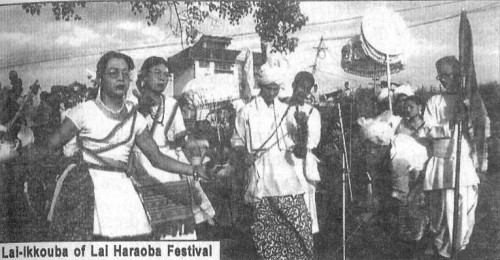
The ritual of the festival starts with the calling up of the spirit from the water (a pond or a river), this is known as Lai Ickouba, the first step of the festival.

Both men and women, boys and girls dress with proper costumes participat at Lai Ickouba led by Maibi. Two persons are selected as Laipuba to carry the deity on the two ihaiphus (earthernpitchers) which contain 'leiyum'. The Maibi (priestess) then wraps up ihaiphu containing hiri (a thread) in a higaophi (a kind of shawl) and tie them around the neck of Laipuba.

The Maibi then begins the opening dance Laihou Jagoi to the tune of Pena (a string musical instrument) alongwith the Maibas and the Pena singers, lead the procesion to the river or the pond. The Maibi performs the ritual of Konyai Hunba by chanting the Konthabol, gold and silver coins (which are symbols of earth and sky) are thrown into the water.

After this rite the Maiba or the Maibi performs the offering of Khayomlakpa. The Khayom of Lainingthou is known as Nongthak Khayom (sky or heaven) and that of Leiremma as Leikhagi Khayom (the below or the earth). This is known as Leithak-Leikha lakpa (binding of heaven and earth together). During this rite prayer is chanted when it is over both Khayoms are thrown into the water at the same time.

After offering of Khayom is over the Maibi takes the two Ickhouphus from the Laipuba holding that of Lainingthou in the right hand and that of Lairemma in the left hand. She then starts dancing known as Chuk-Pharon Jagoi to please the lords of four directions viz, the * Thangjing, the Marjing, the Wangbren and the Koubru.
* guarding deities of four direction - Thangjing at South West, Marjing at North East, Wangbren at South East, Koubru at North-West.

The Ickouphu then returned to the Laipuba, and the whole procession enters the court yard of the shrine and the Maiba and the Maibi hold the Hiri of the Ickouphus simultaneously approach the thrones of the Lais (deities). The Maiba holding the Hiri touches the navel of the Lainingthou and the Maibi that of the Lairemma.

It is believed that at this moment the spirits of the deities are infused or transmitted into the images. This is known as Thawai Happa. The Maiba performs the purification rite known as Anam-Aha Kokpa and the Pena-singers sing Karakpa song in praise of the virtues and the chivalries of the deity.

Later, the Maibi delivers the oracle (Laipao chenba) she then performs the ritual of Saroi Khangba (feeding of evil spirits or rite of appeasement) to guard off distubances and hurdles with observance of the festival. Thus comes the end of the most important and first step of Lai Haraoba Festival.

Then the second step is the daily rituals in the morning. It starts with the singing of the Pena, to awaken the deity. This ritual is known as Yaikeiba or Yakaiba. This is followed by delivery of Laipao or oracles by the Maibi. Then the meal is served.

In the afternoon a Maibi initiates the daily ritual with a dance known as Laihou Jagoi. This is followed by Lei-Langba offering of flowers by Leiroi Hanjaba. Next comes the Hoi Hoi shouting by the Maiba, then comes up Laibou dance and singing of Anoirol or Naheirol. Then dances of individual or groups. All the willing persons old or young, male and female can join the dances. The duration of the festivals varies from place to place.


The third and the most important step of Lai Haraoba is the Laibou Dance that demonstrates the birth of a child, construction of a house, plantation of cotton, weaving of clothes, land offering of the finished articles to the deity. The Laibou dance consisting of three hundred and sixty four (364) khut- thek (hand movements) known as laibou khut-thek.

It depicts the formation of human anatomy and portraying the making of each part of a human body through dance is known as Hakchang saba. Likewise the Yumsharol Khut- Thek (dance of house building) symbolically depicts the various stages of house construction starting from looking for a land, levelling of the land, laying the foundation, process of constructing of the house and then dedicating it to the deity.

It is followed by Panthoibi Jagoi - the duet dance portraying the romantic affairs between Nongpok Ningthou and Panthoibi demonstrating their first encounter, their falling into love at first sight and their subsequent love affairs.

Next comes the Pam-Yanba dance that is a recital dance portraying the cultivation of land by the people, the hand movements symbolically depict the cultivation of land, planting of cotton seeds, plucking the cotton, weaving and making of clothes and then dedicating it to the deity.

Now-a-days this Panthoibi Jagoi is replaced by Khamba-Thoibi Dance (the legendary hero-heroine of Moirang) in alsmost all Lai-Haraobas. In addition to the ritual dances other dances even of filmy dances are performed to suit the taste of modern audience and rather to enterain the different types of the people.

The next important dance is Lairel Mathek (dance depicting the never ending cosmic creation in serpentine pattern). A Maiba has to lead this dance in procession as it bears ritually technical movement of hand and foot starting from south-west encircling each of the pillars of Mandop which signfies four directions. The procession moves in such a way that it looks like the moving of a serpent that is why it is known as Lairel Mathek Chatpa (moving of like serpent sesh-nag).

Then the next is Kanglei Thokpa in which the Maibi covering her face with a veil and holding a polo-stick (like hockey made of bamboo) hooks a girl from admist the crowd with the hooked end of the stick. The girl has to come out and dance with the Maibi. This is known as Lai Nupi Thiba (search of a consort for the deity). This part of ritual has been dropped out in the present days because of certains problems like affecting of necklaces, tearing of clothes etc.

On the last day of the festival in the evening the sword dance known as Thang-Ta-Khousaba is performed by two Maibis - then Thangkhul Thokpa (appearance of Thangkhul tribes). It is a dance drama describing the meeting of Nongpok Ningthou dresses in a Thangkhul costume and Panthoibi dresses as a Thangkhul girl and their quarred over a piece of land and their final reconcilation then the last ritual of Augri Hangel dance and singing.

It is believed that the singing of "Augri" is for the welfare and prosperity of the land and people or village concerned. After it there follows the performance of the rituals such as Thawai Mi-Kouba (calling of soul /spirit), Hithi-Yenthi Yeppa and Sharit-Litpa. Then comes Lai-Nong-Gaba (retreat of the deity to heaven). After this, the ritual of Lai-Tin-Thaba (appeasement of the deity) and then follows of Saroi-Khangba (feeding of evil spirits). Herein ends the ritual of Lai-Haraoba.

A day after Lai-Nong-Gaba, there are games and sports held at the courtyard of the shrine. On this day varieties of game like Mukna (Meitei wrestling) Kangjei (Meitei hockey) Lamjel (Atheletics) Sagol Kangjei (Meitei Polo game) Thouri Ching Naba (tug of war) etc. In the atheletic game both men and women can participate but competitors are into two parties separately for male and female.

In the evening the Pena singer sings to seek forgiveness for any mistake inadvertantly committed during the days of the festival. This is known as Keining Kumba.

These processes mentioned above are more or less similiar to other three kinds of Lai Haraoba say Moirang Thangjing Haraoba, Chakpa - Andro Haraoba and Kakching Haraoba with some variations here and there. At present days the Lai-Lam-Thokpa (outing of the deities) of Chaka Haraoba is commonly seen in almost all Lai Haraoba Festivals as it becomes modern style of outing of the deities at the most crowded places like the market places. It is to suit the social change of the modern time.

(The details of the ritual parts are not elaborated in this book as it is not the purpose of this book)


* N Mangi Devi wrote this book entitled "Festival of Manipur" . This article was webcasted on February 08th 2010.


* Comments posted by users in this discussion thread and other parts of this site are opinions of the individuals posting them (whose user ID is displayed alongside) and not the views of e-pao.net. We strongly recommend that users exercise responsibility, sensitivity and caution over language while writing your opinions which will be seen and read by other users. Please read a complete Guideline on using comments on this website.


LATEST IN E-PAO.NET
  • Langban Tha Katchaba @Haying #2 : Gallery
  • Violence in Manipur 2023-2026 : Timeline
  • Prof Kamal Mitra Chenoy : Obituary
  • Tale of Ahu, Alang & Apapang: Amur Falcon
  • Consumerism :: Poem
  • Condemns Khamenlok Killings
  • Humble Appeal to All Concerns
  • Envious of the Chief Minister
  • Delivering a powerful point
  • Catholic Valley Schools Sports #1: Gallery
  • When the extraordinary becomes ordinary
  • The Map We Chose :: Poem
  • Dhakeswar Potsangbam : ToI Wellness Award
  • Nigeria calls on world to turn AMR pledges
  • Understanding the pressure students face
  • Training on Mushroom at Khagempali
  • Pointing finger of accusation
  • Digital Revolution & MK Binodini Devi
  • Exploring The Vanishing Self #15
  • Letter From A Lost Crony :: Poem
  • Procedural lapses in dismissal of Dr Bimol
  • Manipur Sanaleibak (The Golden land)
  • Training on Seismic Hazard @MU
  • 2026 edition of Hnahsin Kut
  • Oncology & Neurosurgery OPD launched
  • Yaoshang Thabal Competition #5: Gallery
  • Orchids of Manipur
  • Pharmacists: A misunderstood profession
  • Vision Service Week at Ibotonsana School
  • Drone Tech Bootcamp at NIT Meghalaya
  • Athokpam Krishnakanta : World 2% Scientist
  • No Solution Without Identifying "Kuki"
  • Stands in Solidarity with Prof Bimol
  • Taking the idea of Manipur to Senapati
  • Yumjao Lairembi Haraoba #3: Gallery
  • 'Enoong Ngallamdai' :: Movie Review
  • VanDyke Release: Diplomacy or US pressure
  • Mental Health Awareness at High Court
  • 2026 NAMA Research Grant [Upd]
  • Fermented food for beauty
  • Mizoram Targets 5-7% Tourism Share
  • The hills continue to burn
  • Hearthside Story of Naothingkhong #2
  • Between Delhi Power & Valley's Protagonists
  • The Zeliangrongpui at a crossroad
  • Mushroom Cultivation Training at Konthoujam
  • Break from within :: Poem
  • White Canes to Govt Ideal Blind School
  • Concerned: Conflict - Yimkhiung & Tikhir
  • Mizoram Travel Fest 2026
  • Condolence : Kh Armstrong Charang
  • Turning Imphal into a dumping site
  • Sushila & Bichu @Airport #2: Gallery
  • When prime-time spectacle replaces priorities
  • For a new world organization for peace
  • Intl Day for Disaster Risk Reduction @MTU
  • Solidarity with Professor Angomcha Bimol
  • Intl Day for Disaster Reduction @Wangkhei
  • Condemns Barbaric Killings
  • Schools, roads, power & water supply
  • 'Meeyamgi Khollao Khongchat' #2 : Gallery
  • RIST Talk #76: Gravitational-Wave
  • Breast cancer month, October, 2026
  • Free Screening of "Ishanou"
  • Unlocking potentials of 7 horticultural crops
  • Skies and me :: Poem
  • Eramdam hanna kanbiyu
  • The hills, the SoO camps
  • Mera Chaorel Houba @ Kangla #1 : Gallery
  • China's Mayor Economy
  • My muse :: Poem
  • Condemns Killings & Beheading of Civilian
  • Who doesn't do Vote Chori ?
  • EZE Perfumes Enters Northeast
  • One to one meet with PM
  • Exploring The Vanishing Self #14
  • 61st Hunger Marchers' Day #3 : Gallery
  • Humlennganba, Saka : Eming
  • Two interviews, one empty table
  • A landscape of silence :: Poem
  • NSS Runathon for Peace 2026
  • Gender equality- central to diplomatic leaders
  • Manipuri Calendar for year 2027 : Download
  • Meiteilon not Tibeto-Burman language: Rvw
  • Visit to George Gordon's tomb at Canchipur
  • Anandkumar Naorem: World Top 2% Scientist
  • Protect the hills to protect the valley
  • Call for Papers on Manipuri Pony
  • Ashok Singhal Ji - A Karmayogi
  • Addressing the basics of life
  • 228th Bheigyachandra @Nabadwip #1: Gallery
  • Wildlife Week Celebration at Thanga
  • Evolving women's role in Manipur tourism
  • Where do we go from here ?
  • Training Programme on Mushroom
  • Festival look for Navratras
  • Condolence : Demise of Adino Phizo
  • Significant Delhi invite to 3 leaders
  • Heterogeneous Structure of Meitei Society
  • Concert @ 18th Orange Fest #1: Gallery
  • When water management was Statecraft
  • Who switched off the respect :: Poem
  • All is not yet lost for Manipur
  • Wildlife Conservation: Securing the Future
  • Exam : Post of Under Secretary (Law)
  • Understanding narco-terrorism
  • 1500 Burma Refugees Families in 1968-1973
  • 17th World Bamboo Day : Gallery
  • Land affected families: NH-202 in Ukhrul
  • Training Programme on PCB Repair
  • World Habitat Day 2026
  • AMR survivor & WHO call to protect medicines
  • Cut fuel taxes, not food
  • Creating chaos on roads of Imphal
  • Sushila & Bichu @Airport #1: Gallery
  • Manipuri Pony: Case for Animal Science Univ
  • Hemp plant for sustainable textile & Manipur
  • Flame of the lamp & our cultural sensibility
  • Without you :: Poem
  • Welcomes Lalremsiami, Lalthantluangi
  • On the growing roadside eateries
  • Naga Peace Process: Indo-Naga Talk: Timeline
  • 36 Names: Manipur at the Asian Games
  • Abok Ki Singju to Premiere
  • A vision fragmented by corruption :: Poem
  • Gandhi Ji's 3 monkeys and Manipur
  • AI-powered X-Rays are helping find TB
  • Mizoram Reward Lalremsiami, Lalthantluangi
  • 15 years in power Vs 10 years in power
  • Exploring The Vanishing Self #13
  • US-Manipur Digital Archiving Workshop
  • 8th Cultural/ Freshers' Meet for Rongmei
  • The Same Smoke :: Poem
  • Supriya looks at HYROX World C'ships
  • AI4SEVA Hackathon @IT SEZ, Mantripukhri
  • 38th Foundation Day- NIELIT Imphal #2
  • Heikru Hidongba @Bijoy Govinda : Gallery
  • Manipur's Indigenous Natural Farming System
  • Basic human needs a struggle for Sinakeithei
  • Demise of Pame, Marinmai, Lianvela
  • When I met the pugilist Sarita
  • 38th Foundation Day of NIELIT Imphal #1
  • Mizoram's Anthurium Festival Returns
  • Poll fever seems to be catching up
  • My attempt - Meiteilon is not Tibeto-Burman
  • XXXII National Thang-Ta C'ship concluded
  • One Village One Product: A better alternative
  • When machines can answer, who will judge ?
  • Explain motive- Tronglaobi Terror Attack
  • Merger of 5 elected members of NPP
  • Namghar Unites Assam & Maharashtra
  • Trade and commerce : In a limbo
  • 130th Irawat Anniversary : Gallery
  • Lamyanba Irabot Day at Itanagar
  • Irabot's Ideals Remembered at Mumbai
  • Coffee as a sustainable alternative to poppy
  • Her Godname :: Poem
  • Polyendocrine Metabolic Ovarian Syndrome
  • Rejoinder to NPCC
  • Need to get priorities right
  • Irawat and Meetei National question
  • XXXII National Junior Thang-Ta C'ship
  • World Heart Day 2026: Don't miss a beat
  • Science in everyday life
  • Nature Education Workshop
  • Rejoinder to Dr S C Jamir
  • Daslakshan Mahaparva: Festival of 10 supreme
  • Focus back on SoO camps
  • Raengdai Vs NEROCA : Durand Cup : Gallery
  • October Calendar for Year 2026 : Tools
  • Lebensraum or ethnic cleansing
  • World Alzheimer's Day 2026
  • Sensitization Workshop on POSH
  • Mourns Passing of Aribam Shantimo
  • Lecture on 'Indigenous Knowledge Systems'
  • Rejects allegations by NPCC President
  • The narrative Manipur needs
  • Tour Diaries of Maxwell & Higgins #2
  • Laitonjam Rishikanta @ Asian Bodybuilding
  • First poster of Interlude released
  • In the womb of time :: Poem
  • Running an abnormal State
  • Khunung Eshei & Mukna competitions
  • Conference: Challenge in Sustainable Science
  • Rolling back the highway blockade
  • Exploring The Vanishing Self #12
  • Manipur Mesopotamia Force WWI : Gallery
  • PhD in Manipur : Fund it, Fix it
  • Many Voices, One State: Manipur's dilemma
  • Me and Moon: Both do the night shift : Poem
  • Putting rights: Body autonomy & sexual health
  • Green Tea for beauty
  • Yaoshang Thabal @Khurai #2: Gallery
  • AI = Arangpham Intelligence, the Frankenstein
  • World Pharmacists' Day 2026
  • Tapes of 1979 Film 'Ashroy' Discovered
  • From Pangaea to the unpredictable Earth
  • In a Crooked Room :: Poem
  • Debt recovery should be done, but within law
  • Regionalism : New political flavour
  • Chali-Saba - Kang Ningol Palli #1: Gallery
  • Book Release: Exploring The Vanishing Self
  • The Echo After Forever :: Poem
  • The paradox of Kukiland
  • Dr Wairokpam Yaiphaba : Fulbright Fellowship
  • Essay, Painting & Speech Competitions
  • Manipur : Mixture of opposites
  • Naothingkhong & Pitanga #1: Hearthside Story
  • Meiteilon is still not a Tibeto-Burman language
  • 52nd Foundation Day of AMWJU : Gallery
  • The chokehold on Manipur's potential
  • Another Langban has com :: Poem
  • Ageing needs a gendered human rights
  • Mizoram's 2026 festival season opened
  • Inspect the SoO camps
  • 61st Hunger Marchers' Day #2 : Gallery
  • lEkoLdugi warisiH :: Seireng
  • Can Strong Anti-Racism Law save NE Indians
  • Before Building a Viksit Bharat, Learning
  • Quality planting for Pineapple & Banana
  • Seminar: Career Options in Life Sciences
  • Fitclass Gym Moti Nagar Opens
  • Burning hills of Manipur
  • Culturals @Beating of Retreat #4 : Gallery
  • Justice for 6 Liangmai Nagas #2 : Gallery
  • 17th World Bamboo Day 2026
  • 12th Manipur Legislative Assembly : Gallery
  • The 731, and those who may follow
  • Exploring The Vanishing Self #11
  • Little Flower School, 1973 batch : Gallery
  • Bichu Kharibam: FIH Magic Skill Award
  • Tour Diaries of Maxwell & Higgins #1
  • Ningol Phida - Shumang Leela #2 : Gallery
  • Study: Social Worker on Counselling Practice
  • India-Myanmar boundary : Mistakes of 1967
  • Radio E-pao: 5 new songs updated
  • Chiru Maroi : Scientific Documentation
  • Academic Administration Course @MU
  • To our star Tamo Vicky, Vikram Chongtham
  • Vice President visited Manipur : Gallery
  • Langban Tha Katchaba @Haying #1 : Gallery
  • Hiring @ 4-Star Hotel in Udupi
  • Ibudhou Pakhangba Haraoba #1 : Gallery
  • Protest by Researchers @DM Univ : Gallery
  • Meitei Esei
  • US Ambassador @ CM Mantripukhri : Gallery
  • Chongtham Vikram: Delhi Cannot Explain Away
  • A teacher does not leave when his classroom
  • 'Meeyamgi Khollao Khongchat' #1 : Gallery
  • Candle Light- Chongtham Vikram : Gallery
  • Manipuri Pony Heritage Talk to Students
  • Colonial records: Hill Areas, 1891-1947
  • Joint Resolution: Abrogation of SoO
  • Elimination of Racial Discrimination
  • Justice for 6 Liangmai Nagas #1 : Gallery
  • Manipur Can Simply Be Manipur
  • PhD Admission at Assam University
  • Teachers' Day Celebration : Gallery
  • Census 2027 for Manipur deferred
  • Read Meitei Mayek news in romanized English
  • 24-hour Gen Strike (Sep 1) : Gallery
  • Panthoibi Anoi Khuthek #1 : Gallery
  • 48-hour General Strike by JFD #3 : Gallery
  • The flame of Haipou Jadonang
  • Kang Khichri Chaba #2 : Gallery
  • Relevance of NRC, 1951 for immigrants
  • Featured Front Page Photo 2026 #4: Gallery
  • The King Who Caught a Bird : Konthoupa
  • Meira Rally 'No NRC, No Census' : Gallery
  • 48-hour General Strike by JFD #2 : Gallery
  • 35th Manipuri Language Day, 20 August
  • The chappals we leave behind
  • Search 25 years of e-pao.net
  • Colonial Knowledge Production in NE India #23
  • 360° panoramic view of spots in Manipur
  • Final Merit List : Manipur Civil Services 2022
  • PUCL Tribunal report: A shadow of partiality #3
  • PUCL Tribunal report: A shadow of partiality #2
  • PUCL Tribunal report: A shadow of partiality #1