


Rongmei and Kabui are one
Ragongning Gangmei *
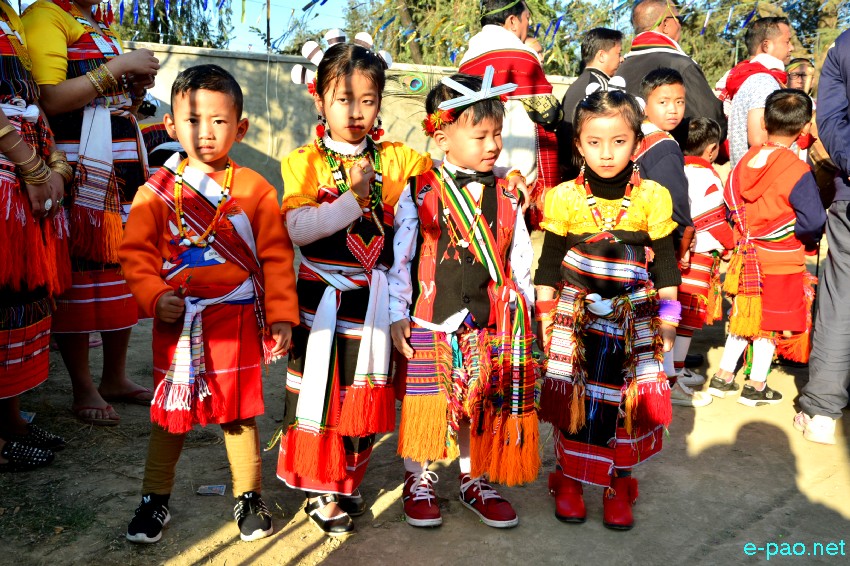
Gaan-Ngai - A ritual festival of Zeliangrongs atat Majorkhul on January 21 2019 :: Pix - Shankar Khangembam
Kabui and Rongmei are one and the same tribe. It is crystal clear and there is no confusion at all for all sensible persons. "... Kabui (minus Npui) and Rongmei are one and the same tribe. Rongmei is the original name. Kabui is the name given by the Meitei and adopted by the British Government continued by the Government of India." - Prof.Gangmumei Kamei. It should not be taken for negative.
It rather shows that Rongmei and Meitei were going together and living side by side as good neghbours since the prehistory period. It should be noted that neither 'Kabui' nor 'Rongmei' was given by God. Just we used them to call ourselves. Also it is noteworthy that Kabui/Rongmei's names of tribes are suffixed or finaled by 'mei' like Marammei, Maringmei, Thadoumei, Tangkhulmei, Chirumei, etc. Kabui is not finaled by 'mei'. So Kabui was given by the neighbours and Prof.Gangmumei Kamei is right.
We all know it very well. During the expansion of Maharaja administration and the British rule to the hill areas of Manipur, the Maharaja himself or his men and the Britishers gave a new Meitei name to each and every village they affiliated. They called Kambiron for Puiluanh, Nungba for Luangba, Khongjaron for Chiuluanh, No-ne for Luangmai, and so on. Also, they had given new designations to the village administrative headmen and replaced the traditional names by Khun Laakpa, Khun Puba, Lup Laakpa, Meitei Lambu, Chengloi, etc.
The native names of the village headmen are Namvpouc, Raenghpamhmei, Khangchupouc, Luchupouc, Gaanvchangc, Baanhzaa, etc. and they were the village administrative headmen before the coming of the Maharaja system of administration in the Rongmei villages.
Likewise, in Imphal Valley Kabui/Rongmei people have two names - one native name and one Meitei's name. We called the youngest Kamkhuguang and he has another Meitei name Tomba. Likewise Lanchunglu has a neighbour's name Inaakkhunbi, Kamchungpou is called Yaima and Howreylung Ibohal. Rather it is very good that we have a neighbour's name and is an advantage for both the neighbours.
Likewise, we have two names of our tribe - Rongmei and Kabui. Rongmei is native name and Kabui is Meitei's name. Kabui was popularly used/called by the Maharaja administration and adopted by the then Britishers and was continued by the Government of India.
Why Npui and Rongmei were clubbed together in Kabui?
Both Npui (Inpui) and Rongmei are claiming the ancestry of Makhel-Makuiluangdi-Koubru. So, the ancestry of Npui and Rongmei are one and the same. Facial look, body built of the Npuis and Rongmeis are similar and the same. Folk-songs and dances and cotumes are seen common to the outsiders inspite of many variations here and there to the insiders. Many of the Npuis who came down to Imphal Valley can speak Rongmei language. So they lived together with Rongmei at many villages and they communicated each other in Rongmei language.
So to the Meitei nobilities they were seen as the same people. Also, during that time neither Npui nor Rongmei made complaint to the Maharaja administration. So the Maharaja might have accepted the Npui and Rongmei as one and the same tribe.
Why modification of Kabui to Rongmei was done?
First, the Manipur administration had wrongly clubbed together two tribes in Kabui. Npui (now Inpui) and Rongmei were clubbed together in Kabui by the Maharaja administration since the early period of Manipur. Npui and Rongmei are two distinct tribes with two distinct languages. Since many years back, the Inpui have separate tribe's union, separate literature society, separate churches association, separate students body and separate women organisation. Likewise, Rongmei has its own separate tribe council, separate literature society, separate churches association and separate women, youth and students organisations.
Second, and more seriously, it was not possible to introduce Kabui language in education system because there are two distinct languages within Kabui viz Npui language and Rongmei language.
Third, the nomenclature 'Kabui' is derogatory in the native languages. Also it has no meaning in Meiteilol, the main neibouring language. In Liangmai 'Kabui' is a mithun, in Npui it is a 'bamboo rodent' and in Rongmei it is an obscene word (male private part).
Fourth, today all over the world people prefer the original native names having native meanings and values, may be, names of places, cities, countries, tribes, people.
Together with all these, modification of tribe's name from Kabui to Inpui and Rongmei was done taking a long journey of decades together.
The new GoI's practice of retainment of old nomenclatures:
Only in 2012 the nomenclature Kabui was modified as Rongmei (and Inpui) by the Constitution (Scheduled Tribes) Order (Amendment) Act, 2011 ( No.2 of 2012). However, according to the Government of India's new practice of modification or correction of a tribe's name, the old name shall be temporarily retained till all the people concerned have accepted the new name and is proved by the return of the next Census(es).
So all the old names Galong of Galo (Arunachal Pradesh), Koirao of Thangal, Kacha Naga of Liangmai, Zeme and Kabui of Inpui and Rongmei (Manipur) are temporarily retained in the Constitution amendment order. The problems of Galo, Liangmai, Thangal, Zeme had been solved once for all by this Constitution amendment because there is no claimant for the old nomeclatures Galong, Koirao, Kacha Naga. But a new social controversy has cropped up among the Rongmei community. Majority of the community has accepted the native name 'Rongmei'. However, some section of people want to retain the old name 'Kabui'. So the wind of eminent split of the tribe into two is blowing in the air.
Etymology of Kabui:
It seems the origin of the name Kabui came from Npui. In Meitei sound system there is no prenasal sound. So, the Meitei nobilities could not spell or pronounce 'Npui' and they spelled it as Kapui or Kabui. There is one Npui village called Luanzaeng in Tamenglong District, now Noney (Luangmai) District. The village is called Kabui Khullen by the Maharaja administration and till today.
Once upon a time, a man named Npui Sarangba, a great maiba (medicineman) came and settled at Rongmei village called Chamangluangc or Ningthi at the foothill of Thangjing Ching. As a great maiba he could have easy accesses to the Meitei nobilities of Moirang principality. He made friendship with them, particulrly, Purem and his contemporaries. By them, Npui Sarangba was called Kabui Salang Maiba.
In place of Npui they called it Kabui as they could not spell Npui (a prenasal word). Among the Rongmeis he was called Ramhngampouc. So the familiarity of the name of Kabui Salang Maiba went freely among the Meiteis. So they called the community of Kabui Salang Maiba as 'Kabui'. Therefore, it seems, the origin of Kabui comes from 'Npui'.
Now, Npui community is called Inpui meaning 'Big Home or Big Family' modified from the Kabui (the combined nomenclature of two linguistic groups of Npui and Rongmei.)
Renaming or modification of nomenclatures:
Peoples all over the world prefer to have native names for their people, community, states, capitals, places, etc. So changing of nomenclatures from old names to new ones are taking places everywhere every day. Burma was renamed Myanmar and Peking was renamed Beijing. Calcutta was renamed Kolkata and so on. These changes are made to give native names with native meanings or values.
In Arunachal Pradesh a tribe's name Galong was modified as Galo, in Manipur Koirao was modified as Thangal, Kacha Nga as Liangmai, Zeme and Kabui as Inpui and Rongmei. These changes are made from the meaningless names given by the neighbours or strangers or foreigners with or without meaning or value. These are more happening today all over the world because of the people's increasing awareness of the native culture and values.
So, the modification from Kacha Naga to Liangmai and Zeme and from Kabui to Inpui and Rongmei were done for good. The changes are done to rectify from derogatory names or misnormers to the correct native names. It is considered so far so good.
Also, there is nothing wrong to have two names of a tribe. For example, Sema and Sumi are one and the same tribe. Meetei, Meitei, Kangleimi(subject to correction) are one and the same community. Muslim and Pangal in Manipur are one and the same community. Kabui is Rongmei, Rongmei is Kabui. They are one and the same tribe. What is the benefit of splitting into two tribes?
Eventuality:
Here the conscience and wisdom of the tribesmen are matter most. In eventuality, let us presume that Rongmei is splitting in two - Kabui and Rongmei. What benefit is visible for us? Neither Kabuis nor Rongmeis are benefitted. It is just to fulfil the vested interests. It is just to quench the thirst of the emotions. Only committing a historical blunder to be regretted for centuries to come. Splitting a community is not in the interest of the people of the community concerned.
It works only in the vested interests. Usually something is suspected to be moving behind the eminent split. Is there any agencies working behind it? Is there any spies working for it? Is it engineered by some shortsighted and small-minded people? Or is it the handiwork of the devils? The people of the community concerned should kneel down and seek the will of God and they should search their own minds before Him. The should think and rethink over it not only twice but ten times, hundred times. Such decision should not be left to be taken by the emotion of the young and immatured people.
The decision should be taken by conscience and wisdom of the people - the leaders, intellectuals, scholars and senior tribesmen.
Presumables Aftermath
After eventual split of the tribe, Rongmei and Kabui, each shall become smaller tribes. The origins of all the Kabuis/Rongmeis of Imphal Valley are from the districts of Tamenglong, Noney (Luangmai), Kangpokpi (Gamphazol areas) and Churachandpur (Henglep areas).
Their dear and near relatives are still in these districts. When the tribe eventually splits into two, they have to split with them also. When they are being split into two, the Kabuis and the Rongmeis may remain as good sister tribes, else become rivals developing jealousy and enmity between them, like South Korea and North Korea or Pakistan and Bangladesh.
It is presumable that social crises may crop up claiming and counter claiming Haipou Jadonang, Rani Gaidinliu, etc. They may claim and counter claim over All India Radio Programme, ISTV Programme, language education, etc. The authorities concerned may refuse to give programme to both of them for they are speaking the same language.
They may file legal suits and counter legal suits in the law courts against each other. Endless court cases may ensue. There are possibilities of many unseen issues, crises, claims and objections against each other entailing endless bitterness, rivalry and enmity beyond our imagination today.
Therefore, naturally it shall be the appeal from everyone of Kabui or Rongmei community to patch up differences, if any, between them. Because the common people are innocent and ignorant about the merits and demerits of the impending split as is looming large over them.
Also, it is high time that the senior tribesmen, community leaders, intellects and scholars, particularly, the Rongmei Naga Council, Manipur (RNCM) and the Kabui Karu Phom (KKP) to come closer and sit together and speak out their minds before each and other so that best decision is taken to save the community from eminent split once for all.
Kabui and Rongmei are one. No one should engineer to split it.
* Ragongning Gangmei wrote this article for The Sangai Express
The writer is president of Ruangmei Literature Society .
This article was webcasted on January 24, 2019.
* Comments posted by users in this discussion thread and other parts of this site are opinions of the individuals posting them (whose user ID is displayed alongside) and not the views of e-pao.net. We strongly recommend that users exercise responsibility, sensitivity and caution over language while writing your opinions which will be seen and read by other users. Please read a complete Guideline on using comments on this website.


