


Manipur : Final population of data of Census 2011 :: Download
- Released by Census Operations, Manipur Director Y Thamkishore -
- on June 05 2013 -
*
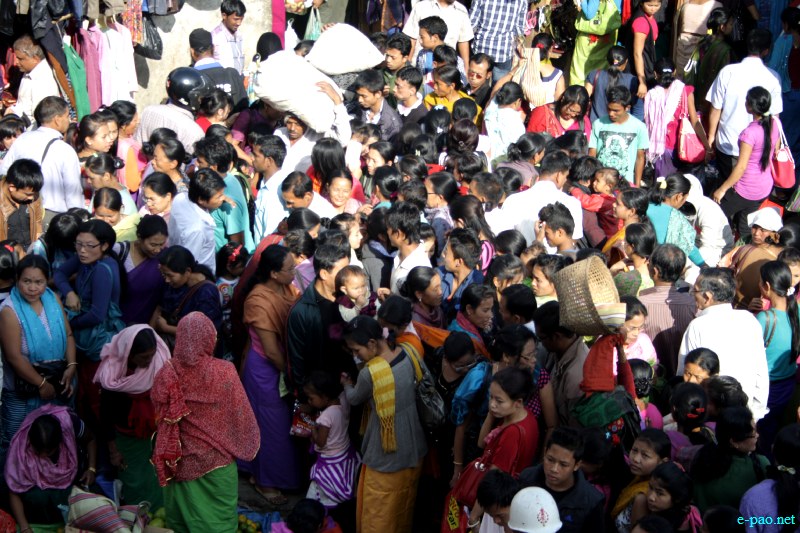
Crowd at Ema Keithel, Imphal on the eve of Ningol Chakkouba Shopping in November 2012 :: Pix - Bunti Phurailatpam
Download the entire report in PDF format (8.6 MB) here
Browse the full tables as a Photo Gallery here
Executive Summary
1. Administrative Units: In Manipur, Census 2011 covered 9 districts, 38 Sub- districts, 51 towns (Statutory towns 28, Census town 23) and 2582 villages. In Census 2001, the corresponding figures were 9 District, 38 Sub -Districts, 33 Towns (28 Statutory towns, 5 Census towns) and 2391 villages. There, is no specific increase in both Districts, Sub- districts and Statutory towns but there is an increase of 18 Census towns and 191 villages in Census 2011 as compared to Census 2001.
2. Population: As per Census 2011, the total population of Manipur at 0.00 hours of 1 st March 2011 is 2,570,390 .Of this, the rural population is 1,736,236 and the urban population 834,154. In absolute numbers, out of the total increase of 403,602 added in the last decade, the contribution of rural is 145,416 and urban area is 258,186.
3. Growth Rate: The growth rate of population in Manipur in the last decade is 18.6 % (Rural 9.1 %; Urban 44.8%). Chandel has recorded the highest decadal growth rate in rural population (23.2%) and Imphal East (69.2%) the highest decadal growth rate in urban population during 2001 -2011.
4. Density of Population (persons per sq.km): Population density in Census 2011 works out to be 115 showing an increase of 18 points from 2001. Imphal West (998 per Sq. Km.) turns out to be the most densely inhabited followed by Thoubal (821 per Sq. Km.), in all districts in 2011 Census. Likewise among the major districts Imphal West occupies the first position with a density of 856 per Sq. Km. and Thoubal occupied second with a density of 708 per Sq. Km. during 2001. The minimum population density works out in Tamenglong district (25 per Sq. Km during 2001 and 32 per Sq. Km. during 2011) for both Censuses.
5. Proportion of Population: In percentage terms, the rural population constitutes 67.5 % and Urban population 32.5 % of the total population. There has been an increase of 5.9 % in the proportion of urban population in the last decade. Senapati (96.1 %) has the largest proportion of rural population, while Imphal West (62.3%) has the highest proportion of urban population.
6. Sex Ratio (Number of females per 1,000 males): The Sex Ran: in the state which was 978 in 2001 has increased by 14 points to 992 in 2011. In rural areas as sex ratio has increased from 967 to 976. The corresponding increase in urban areas has been of 17 points from 1,009 to 1,026. Imphal West has recorded the highest sex ratio in respect of total population (1031), Rural population (1013) and Urban population (1042). The lowest sex ratio in rural areas has been recorded in Chandel District (932). The corresponding value in urban areas has been returned in Chandel District (943). Chandel District shows fall in the sex ratio by 51 points in rural and 21 points in urban.
7. Child Population (0-6 years): As per Census 2011, the child population in the age group of 0-6 years stands at 338254 . Of this, 236843 were returned in rural areas and 101411 in urban areas. Compared to Census 2001, the Child population has increased by 29669 in the State. There has been an increase of 3168 in rural areas and 26501 in urban areas. In terms of proportion of child population to the total population, there has been decline of 1.1 percentage points in rural areas and 0.8 percentage points in urban areas. The growth rate of Child population works out to 9.6% in the last decade. There has been an increase of 1.4% in rural areas and 35.4 % in urban areas.
8. Child Sex Ratio(0-6 years) (Girls per thousand Boys): Census 2011 marks a considerable fall in child sex ratio(0-6 years) from 957 to 936 (21 points) during 2001 -2011. In rural areas, the fall has been to the tune of 25 points (956 to 931) and in urban areas, the decline has been to an extent of 12 points (961 to 949) over the last decade. Tamenglong and Chandel districts (911 each) have recorded the lowest child sex ratio in rural areas whereas Churachandpur district (948) recorded the highest child sex ratio in rural areas. Bishnupur district (929) has recorded the lowest child sex ratio and Chandel district (985) the highest child sex ratio in urban areas.
9. Scheduled Caste Population:
The total Scheduled Caste population returned in Census 2011 is 97042. Of this 47563 are in rural areas and 49479 in urban areas.
a.In terms of proportion, the Scheduled Caste population constitutes 3.8 % of the total population. The proportion during the last Census was 2.8 %. There has thus been an increase of 1 % during the last decade. The highest proportion of Scheduled Castes has been recorded in Thoubal district (9.6%) and lowest in Tamenglong district.
b. The Scheduled Castes population in absolute numbers has increased by 37005. This con stitutes a decadal growth of 61.6 per cent.
c. The highest number of Scheduled Castes has been recorded in Thoubal district (40593) and the lowest in Tamenglong district (22).
d. In terms of gender composition, there are 48714 males Scheduled Castes (Rural -24126 and Urban-24588 ). Female Scheduled Castes numbered 48328 (Rural -23437 and Urban-24891).
10. Scheduled Tribe Population:
The total Scheduled Tribe population returned in Census 2011 is 902740. Of this, 791126 are in rural areas and 111614 in urban areas.
a. In terms of proportion, the Scheduled Tribe population constitutes 35.1 % of the total population. The proportion during the last Census was 34.2%. There has thus been an increase of 0.9 % during the last decade. The highest proportion of Scheduled tribes has been recorded in Tamenglong district (95.7%) and the lowest in Thoubal district(0.4 %).
b. The Scheduled Tribes population in absolute numbers has increased by 161599. This constitutes a decadal growth of 21.8 per cent.
c. The highest number of Scheduled Tribes has been recorded in Churachandpur district (254787) and the lowest in Thoubal district (1808).
d. In terms of gender composition, there are 450887 male Scheduled Tribes (Rural-396464 and Urban-54423). Female Scheduled Tribes numbered 451853(Rural-394662 and Urban-57191).
11. Literates(Age 7 years and above):
a. The number of literates in Manipur is 1768181 in Census 2011. Of this, 1142564 literates are in rural areas and 625617 literates in urban areas. Out of an increase of 457647 literates during the decade 2001 -2011, rural areas accounted for 229282 and urban ar eas 228365. The highest number of rural literates has been recorded in Imphal East district (183881). Imphal West (253235) has recorded the highest number of literates in urban areas.
b. Male literates numbered 960015 (86.1% of the total literates). The highest number of male literates in rural areas are returned in Imphal West district (89.5%), while the lowest are returned in Tamenglong district (73.8 %). In urban areas, the lowest number of female literates are returned in Chandel district (62.9 %) and the highest number in Ukhrul district (86%)
12. Effective Literacy Rate (Number of Literate persons aged 7 and above X 100 ) Population aged 7 and above
a. The Effective literacy Rate in 85.4 %).There has been an increase of 8.7 percentage points in the effective literacy
rate (8.9 percentage points in rural areas and 6.1 percentage points in urban areas) during the last decade.
b. Male Litercy: The male Literacy Rate works out to 86.1 percent (Rural-83.4 percent; Urban-91.7 percent). The highest male literacy rate in rural areas is returned in Imphal West (89.5 percent), while the lowest is returned in Tamenglong (73.8 percent). In Urban areas, the lowest male literacy rate is returned in Chandel district (79.5 percent) and the highest in Imphal West district (93.9 percent).
c. Female Literacy: The Female Literay Rate works out to 72.4 percent (Rural 68.9 per cent; Urban 79.3 percent). The highest female literacy rate in rural areas is returned in Churachandpur district (78.0Percent), while the lowest is returned in Thoubal district (60.0 percent). In urban areas, the lowest female literacy rate is returned in Chandel district (62.9 percent) and the highest in Ukhrul (86.0 percent).
d. The female literacy rate has increased significantly by 11.9 percentage points in the last decade (Rural 11.9 percentage points and Urban 9.3 percentage points). On the other hand, male literacy rate increased only by 5.8 points (Rural 6.1. percnetage points and Urban 3.0 percentage points). It is significant to note that the gap in literacy rate among males and females has reduced from 19.8 in 2001 tol3.7 in 2011 (Rural from 20.3 in 2001 to 14.5 in2011 and Urban from 18.7 in 2001 to 12.4 in 2011).
13. Workers
a. As per Census 2011, the total number of workers (who have worked for at least one day during the reference years) in Manipur, is 1159053 Of this 665463 workers are males and 493590 are females. Out of the increase of 1.6 % workers during the decade 2001 -2011, male workers have accounted for 3.5% and female workers-0.4%.
b. The workers have registered a growth of 1.5 per cent, which is singificantly lower than the overall population growth rate of 18.6 per cent during the decade. The male workers has grown by 3.5 per cent and female workers has-declined by 0.4 per cent.
c. 813604 workers are in the rural areas and 345449 are in the urban areas. The female workers in the rural and urban areas are 353464 and 140126 respectively.
14. Work Participation Rates
a. The Work Participation Rate (WPR) for the state works out to 45.1 per cent. This is marginally higher than the corresponding WPR of 43.6 per cent in Census 2001. The WPR for males has increased to 51.6 per cent in 2011 in comparison to 48.1 per cent in Census 2001. The Female WPR has reduced marginally to 38.6 per cent in 2011 from 39.0 per cent in 2001.
b. Chandel District (52.9 per cent) ranks first in WPR for total workers as well as male workers (57.1 per cent). The lowest WPR have been reported from Imphal West (41.2 per cent). The lowest female WPR has been reported from Imphal West (32.3 per cent). The highest male WPR has been reported in Chandel (57. lper cent) and lowest in Ukhrul (49.1 per cent).
15. Main and Marginal Workers
a. In Census 2011, out of 1159053 total workers, 855012 are main workers and the re maining 304041 are marginal workers. The percentage of main workers among the total workers, in Census 2011, is 73.8 per cent against 69.8 per cent in Census 2001.
b. The percentage of main workers among the male workers is 83.3 per cent and female workers 60.9 per cent. The percentage of male main workers has increased from 81.6 per cent to 83.3 per cent in Census 2011. On the other hand, the percentage of female main workers has increases from 54.8 per cent to 60.9 per cent in Census 2011.
Tamenglong has reported highest percentage of main workers (79.2 per cent) as per Census 2011 and minimum of 68.3 per cent in Thoubal.
c. For the first time in Census 2011, the marginal workers, i.e. workers who worked for less than six months in the reference year, have been sub- divided into two categories, namely, those working for less than 3 months and those who worked for 3 months or more but less than six months. Amongst the 304041 marginal workers, around 2,39,890 worked for 3 to 6 months whereas only 64151 worked for less than 3 months, amounting to 78.9 per cent and 21.1 per cent respectively. Percentage share of persons working for 3 to 6 months is slightly higher in urban areas (79.8 per cent) than in rural areas (78.5 per cent), whereas for persons working for less than 3 months, it is higher in rural areas (21.5 per cent) than its counterpart in urban areas (20.2 per cent). Tamenglong has reported highest percent of marginal workers 84.7 per cent in the 3 to 6 months category and Chandel reported the lowest 70.5 percent. For persons working for less than 3 months, it is obvious that these districts hold the reverse positions.
16. Categories of economic activities of the workers
a. The broad categories of economic activities, also known as a four-fold classification of the workers, are Cultivators (CL), Agricultural Labourer (AL), working in Household Industries (HHI) and Other Workers (OW). The cultivators and agricultural labourers braodly show the workers engaged in the agricultural sector, except those engaged in plantation activities, which, over the Censuses, have been considered as part of'other workers'.
b. In Census 2011, out of 11,59,053 total workers, 457891 are cultivators and another 111061 are agricultural labourers. Thus, nearly 49.1 per cent of the workers are engaged in agricultural activities compared to 52.2 percent in Census 2001 . About one - in -two males and two of every three females are engaged in agricultural activities either as a cultivator or an agricultural labourer. Of the remaining workers, 89,495 are in household industries and 5,00,606 are other workers.
c. During the decade 2001 - 2011. the Census results show an increase of about 78.186 in cultivators and decrease of about 2569 in agricultural labourers. The household industries have shown a decrease of 7425 and other workers have increased by 1,45,6.48.
d. The increase in the number of cultivators, during the decade 2001 -2011, was more pro nounced among the male workers. In Census 2011, the number of male cultivators increased to 2,70,899 from 2,14,282 in Census 2001. Among the female, the number of cultivators has increased to 1,86,992 in Census 2011 from 1,65,423 in Census 2001.
e. Among the Districts Thoubal has reported the highest numbers of cultivators (77,331) and agricultural labourers (33106). lmphal East has the highest number of household industry workers (21,826). On the other hand, Imphal West has the highest number of other workers (1,43,492).
Notes:
1. The figures for India and Manipur, exclude the population of Mao Maram, Paomata and Purul sub divisions 'of Senapati district of Manipur for Census 2001 and 2011 due to administrative reasons.
2. For working out density of India and the State of Jammu & Kashmir, the entire area and population of those portions of Jammu & Kashmir which are under illegal occupation of Pakistan and China have not been taken into account.
3. For Census 2011, the population of "Others" has been clubbed with the "Males"
4. In working out 'decadal variation' and 'percentage decadal variation' for 1941-1951 & 1951-1961 of IndiaandNagaland State, thepopulationofTuensangDistrictfor 1951 (7,025) & the population of Tuensang (83,50 l)&Mon(50,774) districts for 1961 Census have not been taken into account as the area was censused for the first time in 1951 and the same are not comparable.
5. The 1981 Census could not be held owing to disturbed conditions prevailing in Assam. Hence the population figures for 1981 of Assam have been worked out by 'Interpolation'.
6. The 1991 Census was not held in Jammu & Kashmir. Hence the population figures for 1991 of Jammu & Kashmir have been worked out by 'Interpolation'.
7. The distribution of population of Pondicherry (Puducherry) by sex for 1901 (246,354), and 1931 (25 8,628) and 1941 (285,011) is not available. The figures of lndia for these years are, therefore, exclusive of these population figures so far as distribution by sex is concerned.
8. Arunachal Pradesh was Censused for the first time in 1961.
9. In 1951, Tuensang was Censused for the first time for 129.5 sq. kms. of areas only. In 1961 censused areas of Tuensang District of Nagaland was increased to 5356.1 sq. kms.
10. Due to non availability of Census data the figures for the decades, from 1901 to 1951 have been estimated for the districts of Kohima,Phek,Wokha,Zunheboto,and Mokokchung of Nagaland. Estimation however could not be done for Tuensang and Mon as they were not fully censused prior to 1961.
11. As the sex break-up for the districts. Sheopur, Morena, Bhind, Gwalior, Datia, Shivpuri, Guna, Ratlam,Ujjain, Shajapur,Dewas, Jhabua, Dhar, Indore, West Nimar(khargone), Barwani, Rajgarh, Bhopal, Sehore and Raisen is not available for the year 1901, figures for males and females have been estimated for the year 1901 for Madhya Pradessh.
12. One village Ramtapur (code No. 217 and 101 in 1951 and 1961 respectively) of Jukkal circle of Degulur taluka which was transferred under the state Reorganisation Act, 1956 from Maharastra to Andhra Pradesh, still continues in Nanded district of Maharashtra. The population of this village has, however, been adjusted in Nizamabad district for the 1901-1951.
13. The names of Uttaranchal, Orissa and Pondicherry have changed to Uttarakhand, Odisha and Puducherry respectively after Census 2001.
14. Abbreviations used: EAG- Empowered Action Group; NSC- No scheduled Castes; NST- No scheduled Tribes.
Note of Caution: The figures in this report being the data highlights, only the important footnotes have been given above. The detailed footnotes would be given when the "Primary Census Abstract" is released.
Download the entire report in PDF format (8.6 MB) here
Browse the full tables as a Photo Gallery here
* This Booklet is courtesy of Census Operations, Manipur, Director Y Thamkishore who released this booklet on June 5 2013
This was posted on June 10, 2013.
* Comments posted by users in this discussion thread and other parts of this site are opinions of the individuals posting them (whose user ID is displayed alongside) and not the views of e-pao.net. We strongly recommend that users exercise responsibility, sensitivity and caution over language while writing your opinions which will be seen and read by other users. Please read a complete Guideline on using comments on this website.


